The launch of the Goalkeepers 2017 report by the Bill and Melinda Gates Foundation marked a pivotal moment in the international community’s effort to monitor and accelerate progress toward the United Nations Sustainable Development Goals (SDGs). Designed to be a living document that tracks the progress of the most ambitious global health and development targets, the report serves as both a diagnostic tool and a roadmap for policymakers, NGOs, and private stakeholders. By synthesizing vast amounts of data into actionable insights, the Goalkeepers initiative aims to identify where the world is succeeding in its fight against extreme poverty and disease, and where urgent interventions are required. One of the most critical metrics highlighted in the inaugural report is the maternal mortality ratio, a figure that serves as a profound indicator of a nation’s overall healthcare infrastructure and social stability.
The Goalkeepers 2017 report was not merely a collection of statistics; it was a call to action rooted in the philosophy that data-driven storytelling can catalyze political will. The foundation’s leadership, Bill and Melinda Gates, underscored the gravity of maternal health by stating that maternal mortality is one of the most efficient ways to devastate a community. When a mother dies due to complications from pregnancy or childbirth, the ripple effects are felt across generations, impacting the survival rates of her children, the economic stability of the household, and the educational outcomes of surviving siblings. The report emphasizes that while significant progress has been made since the 1990s, the path to achieving the 2030 SDG targets remains steep and requires a concentrated effort on "best practices" and "promising solutions."
A Chronology of Global Health Commitments
To understand the context of the 2017 report, it is necessary to look back at the timeline of global health initiatives that preceded it. In 2000, the United Nations established the Millennium Development Goals (MDGs), a set of eight targets to be achieved by 2015. MDG 5 specifically aimed to reduce the maternal mortality ratio by three-quarters. While the world did not fully meet this target, the period between 1990 and 2015 saw a nearly 44% decline in maternal deaths globally. This era proved that targeted investment in health systems—such as increasing the number of skilled birth attendants and improving access to emergency obstetric care—could yield measurable results.
As the MDGs transitioned into the Sustainable Development Goals in 2015, the target for maternal mortality was refined. SDG Target 3.1 aims to reduce the global maternal mortality ratio to less than 70 per 100,000 live births by 2030. The Goalkeepers 2017 report was released two years into this new fifteen-year cycle, serving as an early assessment of whether the world was on track. The chronology of these efforts demonstrates a shift from general awareness to a sophisticated, data-centric approach where success is measured by "lives saved" rather than just "dollars spent."
Case Study: The Ethiopian Transformation
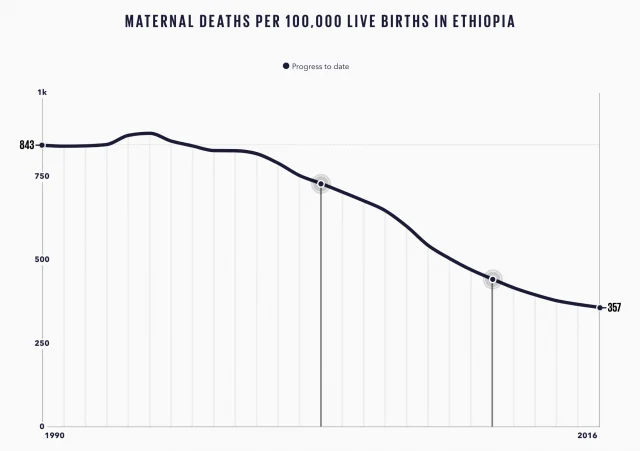
A centerpiece of the Goalkeepers 2017 report is the case study of Ethiopia, a nation that has become a model for maternal health reform in Sub-Saharan Africa. In 1990, Ethiopia faced a staggering maternal mortality ratio of 843 deaths per 100,000 live births. By 2015, that number had plummeted to 357. While still high by global standards, the rate of decline represents an extraordinary achievement for a country with significant geographical and economic challenges.
The "Ethiopian Model" involved a multi-pronged strategy that prioritized rural health coverage. The government launched the Health Extension Program, training and deploying over 38,000 female health extension workers to rural villages. These workers provided essential prenatal care, educated families on the importance of facility-based deliveries, and facilitated referrals to higher-level health centers. Furthermore, Ethiopia invested heavily in infrastructure, increasing the number of health centers from fewer than 700 in 2005 to over 3,500 by 2015. The Goalkeepers report highlights Ethiopia as a prime example of how "identifying promising solutions" and "spreading best practices" can fundamentally alter the trajectory of a nation’s health outcomes.
Supporting Data: The Global Landscape of Maternal Mortality
While the Goalkeepers report provides a narrative of hope, broader datasets from UNICEF and the World Health Organization (WHO) provide the necessary context to understand the scale of the remaining challenge. According to UNICEF data, approximately 302,530 women died globally in 2015 from causes related to pregnancy and childbirth. This equates to roughly 830 women dying every single day. The global maternal mortality ratio in 2015 stood at 168.7 deaths per 100,000 live births, illustrating a deep divide between high-income and low-income regions.
Independent analysis of the UNICEF maternal mortality dataset reveals significant regional disparities. In high-income countries, the risk of maternal death is often as low as 1 in 3,300, whereas in some Sub-Saharan African countries, the lifetime risk can be as high as 1 in 36. The data suggests that the vast majority of these deaths—nearly 99%—occur in developing countries, and most are preventable. The primary causes of maternal death include severe bleeding (postpartum hemorrhage), infections, high blood pressure during pregnancy (pre-eclampsia and eclampsia), and complications from delivery. The UNICEF data underscores that the "spotless information design" used in the Goalkeepers report is essential for translating these grim statistics into a format that can influence global policy.
The Role of Information Design and Data Visualization
The Goalkeepers 2017 report was widely praised for its innovative use of data visualization. By utilizing a mix of text, high-resolution imagery, video testimonials, and interactive charts, the Bill and Melinda Gates Foundation ensured that the data was not just accessible but engaging. For data professionals and public health analysts, the report demonstrated the power of using the "right medium for each piece of information."
In the digital age, the ability to visualize trends is crucial for accountability. For instance, horizontal bar charts and longitudinal line graphs allow observers to see at a glance which countries are "beating the trend" and which are falling behind. Tools like Google Data Studio have become instrumental in this process, allowing researchers to import public datasets—such as those from the UNICEF data portal—and create custom reports that provide localized context. This democratization of data allows for a more granular understanding of health crises, moving beyond global averages to identify specific districts or provinces where maternal mortality remains stubbornly high.
Official Responses and International Reactions
The release of Goalkeepers 2017 prompted a wave of responses from international bodies and national governments. The United Nations praised the report for its alignment with the 2030 Agenda, noting that the foundation’s focus on "stories behind the data" helped humanize the SDGs. Health ministers from several developing nations expressed a commitment to adopting the "best practices" identified in the report, particularly those regarding the training of community health workers and the improvement of data collection at the local level.
However, some critics and global health experts cautioned that while the data showed progress, the "last mile" of reducing maternal mortality would be the hardest. They argued that addressing clinical causes of death is insufficient without also addressing the social determinants of health, such as female literacy, child marriage, and lack of access to family planning. The Gates Foundation acknowledged these complexities, stating that their goal was to provide the diagnostic tools necessary to tackle these multifaceted problems.
Broader Impact and Future Implications
The implications of the Goalkeepers 2017 report extend far beyond the specific metrics of maternal mortality. It established a new standard for how philanthropic organizations interact with global data. By committing to an annual report through 2030, the Gates Foundation has created a mechanism for long-term accountability. This ensures that the global community remains focused on the SDGs even as political priorities shift in individual nations.
Furthermore, the focus on maternal health serves as a catalyst for broader health system strengthening. A healthcare system capable of preventing maternal death is, by definition, a system that has functional blood banks, trained surgical staff, reliable transportation for emergencies, and robust prenatal screening. Therefore, investments made in the name of reducing maternal mortality have a "force multiplier" effect, improving health outcomes for the entire population.
As the world moves toward the 2030 deadline, the lessons from the Goalkeepers 2017 report remain highly relevant. The fight against maternal mortality is not just a medical challenge; it is a test of the world’s ability to use data to protect its most vulnerable citizens. The integration of trustworthy datasets from organizations like UNICEF with the storytelling and advocacy power of the Gates Foundation represents a potent combination in the ongoing effort to make the world a better, safer place for mothers and their children. The success of countries like Ethiopia provides a blueprint, but the data reminds us that the work is far from over. Constant monitoring, transparent reporting, and an unwavering commitment to evidence-based interventions will be the deciding factors in whether the global community meets its promise to mothers worldwide.


 Dwi Wanna