The Bill & Melinda Gates Foundation launched the inaugural Goalkeepers report in 2017, marking a significant milestone in the international community’s effort to track and accelerate progress toward the United Nations Sustainable Development Goals (SDGs). This comprehensive report, titled “Goalkeepers: The Stories Behind the Data,” was designed to serve as a diagnostic tool for global health and poverty, identifying both the most urgent challenges and the most promising solutions currently being implemented across the globe. By synthesizing vast datasets from organizations such as UNICEF and the World Health Organization (WHO), the foundation aimed to provide a transparent, data-driven narrative of human progress, specifically focusing on the elimination of extreme poverty and the improvement of health outcomes in developing nations.
Central to the 2017 report was the critical issue of maternal mortality, a metric that many experts consider the ultimate litmus test for the functionality of a country’s healthcare system. The Gates Foundation, alongside international partners, emphasized that maternal health is not merely a medical concern but a foundational pillar of community stability. As Bill and Melinda Gates noted within the report, the loss of a mother is a devastating event that places surviving children in immediate peril and destabilizes the economic and social fabric of the family unit. The report utilized a blend of rigorous data visualization and qualitative storytelling to highlight how specific interventions have yielded measurable success, particularly in regions that have historically struggled with high mortality rates.
The Global Landscape of Maternal Mortality
To understand the context of the Goalkeepers 2017 report, one must look at the statistical baseline established by UNICEF and the Maternal Mortality Estimation Inter-Agency Group (MMEIG). In 2015, the global maternal mortality ratio (MMR) was estimated at 168.7 deaths per 100,000 live births. While this number represented a staggering 302,530 maternal deaths annually, it also reflected significant progress. Between 1990 and 2015, the global maternal mortality ratio declined by approximately 44%. This reduction was a primary objective of the Millennium Development Goals (MDGs), which preceded the SDGs.
The transition from the MDGs to the SDGs in 2015 brought about a more ambitious target: Sustainable Development Goal 3.1 aims to reduce the global maternal mortality ratio to less than 70 per 100,000 live births by the year 2030. Achieving this requires a deep dive into the regional disparities that define the current landscape. According to UNICEF data, roughly 99% of all maternal deaths occur in developing countries, with Sub-Saharan Africa and Southern Asia accounting for the vast majority. In these regions, the risk of maternal death is exacerbated by a lack of skilled birth attendants, inadequate emergency obstetric care, and limited access to reproductive health services.
Case Study: Ethiopia’s Strategic Success
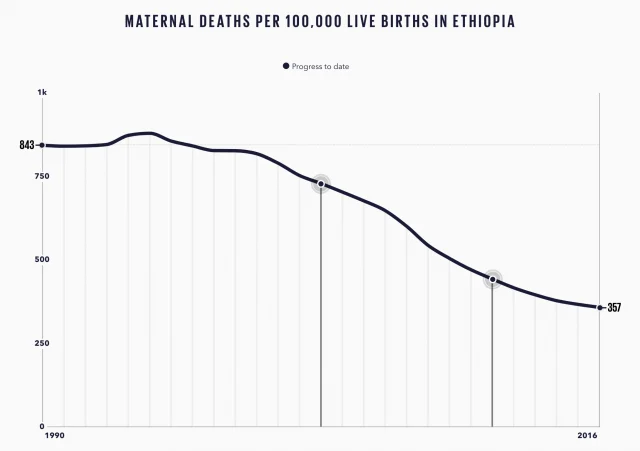
The Goalkeepers 2017 report highlighted Ethiopia as a primary example of how targeted government intervention and international cooperation can yield rapid improvements in maternal health. Ethiopia’s progress is often cited by global health experts as a blueprint for other low-income nations. In 1990, Ethiopia had one of the highest maternal mortality ratios in the world, with approximately 843 deaths per 100,000 live births. By 2015, that number had plummeted to 357—a reduction of more than 50%.
The “Ethiopian Miracle” in healthcare was not the result of a single intervention but rather a comprehensive restructuring of the country’s primary healthcare delivery system. Central to this success was the Health Extension Program (HEP), launched by the Ethiopian government in 2003. This program involved the training and deployment of over 38,000 female health extension workers who were stationed in rural villages. These workers provided essential services, including prenatal care, immunization, and education on the importance of facility-based deliveries. By bringing healthcare directly to the community level, Ethiopia managed to bridge the gap between rural populations and the formal medical system, significantly reducing the delays that often lead to maternal death.
The Role of Data Visualization in Global Advocacy
One of the defining features of the Goalkeepers initiative is its emphasis on information design. The 2017 report was lauded by communications professionals and data scientists alike for its “spotless” presentation of complex information. By utilizing interactive charts, videos, and animations, the report transformed dry statistical datasets into engaging narratives that could be easily understood by policymakers and the general public.
This approach to data storytelling is crucial for maintaining political will and securing funding for global health initiatives. When data is presented in an accessible format, it allows for better “diagnosis” of problems. For instance, by visualizing the specific years and regions where mortality rates plateaued, researchers can investigate the external factors—such as civil unrest, economic downturns, or disease outbreaks like Ebola—that may have hindered progress. Conversely, visualizing sharp declines in mortality helps identify “best practices” that can be exported to other countries facing similar challenges.
UNICEF Data and the Importance of Transparency
The Goalkeepers report relies heavily on the transparency and accuracy of data provided by UNICEF’s data portal. UNICEF maintains extensive records on maternal health, including the proportion of births attended by skilled health personnel and the prevalence of adolescent birth rates. These datasets are essential for creating independent analyses and “shadow reports” that hold governments accountable to their international commitments.
An analysis of the UNICEF maternal mortality dataset reveals that while global trends are moving in the right direction, the pace of change varies significantly by country. While Ethiopia has seen a dramatic decline, other nations have struggled with stagnation. The data shows that the horizontal bar of mortality rates remains stubbornly high in conflict-affected states, where healthcare infrastructure has been decimated. This underscores the reality that maternal health is inextricably linked to peace and security.
Socio-Economic Implications of Maternal Survival
The impact of reducing maternal mortality extends far beyond the immediate health of the woman. Economists have long argued that maternal health is a driver of economic development. When a mother survives and remains healthy, she is more likely to participate in the labor force and invest in the education and health of her children. The “intergenerational cycle of poverty” is often broken at the moment of a successful, safe childbirth.
In contrast, the economic cost of maternal mortality is immense. Studies have shown that the death of a mother can lead to a significant decrease in the household’s productivity and a higher likelihood that her children will drop out of school. By framing maternal mortality as an economic and developmental crisis, the Goalkeepers report and the Gates Foundation have successfully elevated the issue from a niche medical concern to a central priority for global leaders and finance ministers.
Challenges Toward the 2030 Agenda
As the world moves closer to the 2030 deadline for the Sustainable Development Goals, several challenges remain. The “last mile” of reducing maternal mortality is often the most difficult, as it involves reaching the most marginalized and remote populations. Furthermore, the global health community must address the quality of care, not just the quantity of health facility visits. Data indicates that in some regions, even when women give birth in clinics, the lack of clean water, electricity, and trained surgical staff results in preventable deaths.
The Goalkeepers 2017 report served as a clarion call for continued investment in data systems. Without accurate, real-time data, it is impossible to know which interventions are working and which are failing. The report emphasized that while the trends are positive, progress is not inevitable. It requires sustained funding, political leadership, and a commitment to using data as a guide for action.
Conclusion: A Data-Driven Path Forward
The Goalkeepers 2017 report, through its use of UNICEF data and its focus on success stories like Ethiopia, provided a roadmap for the future of global health advocacy. It demonstrated that while the challenge of maternal mortality is daunting, it is not insurmountable. By diagnosing problems with precision and spreading best practices with urgency, the international community can continue to drive down mortality rates.
The legacy of the 2017 report lies in its ability to bridge the gap between complex data and human emotion. It reminded the world that behind every statistic is a human story—a mother whose survival is vital to her family and a child whose future depends on the strength of a healthcare system. As global health organizations continue to refine their strategies, the principles of transparency, data-driven decision-making, and community-based care remains the most effective tools in the fight to make maternal mortality a thing of the past. Through continued vigilance and the intelligent application of data, the goal of reducing global maternal deaths to a minimum is within reach, promising a more stable and prosperous world for the next generation.