


Shoppers arriving at online retail sites through artificial intelligence (AI) referrals are demonstrating significantly higher engagement and spending power, according to a comprehensive analysis of transactional data by Adobe Analytics. This trend, which has persisted for eleven consecutive months, indicates a fundamental shift in consumer behavior and the growing influence of AI in e-commerce. The data highlights that AI-driven traffic not only converts at a substantially higher rate but also generates more revenue per visit, signaling a critical opportunity for retailers to harness AI’s potential to enhance customer journeys and boost sales.
Adobe’s findings reveal that shoppers guided by AI referrals generate an impressive 53% more revenue per visit compared to their counterparts who do not interact with AI-driven recommendations or pathways. Furthermore, retail website visits originating from AI sources exhibit a conversion rate that is 60% higher than non-AI traffic. This sustained outperformance underscores the effectiveness of AI in personalizing the shopping experience, leading consumers more directly to products they are likely to purchase. This consistent trend, observed for over a year, suggests that AI is no longer a nascent technology but a mature and impactful driver of online commerce success.
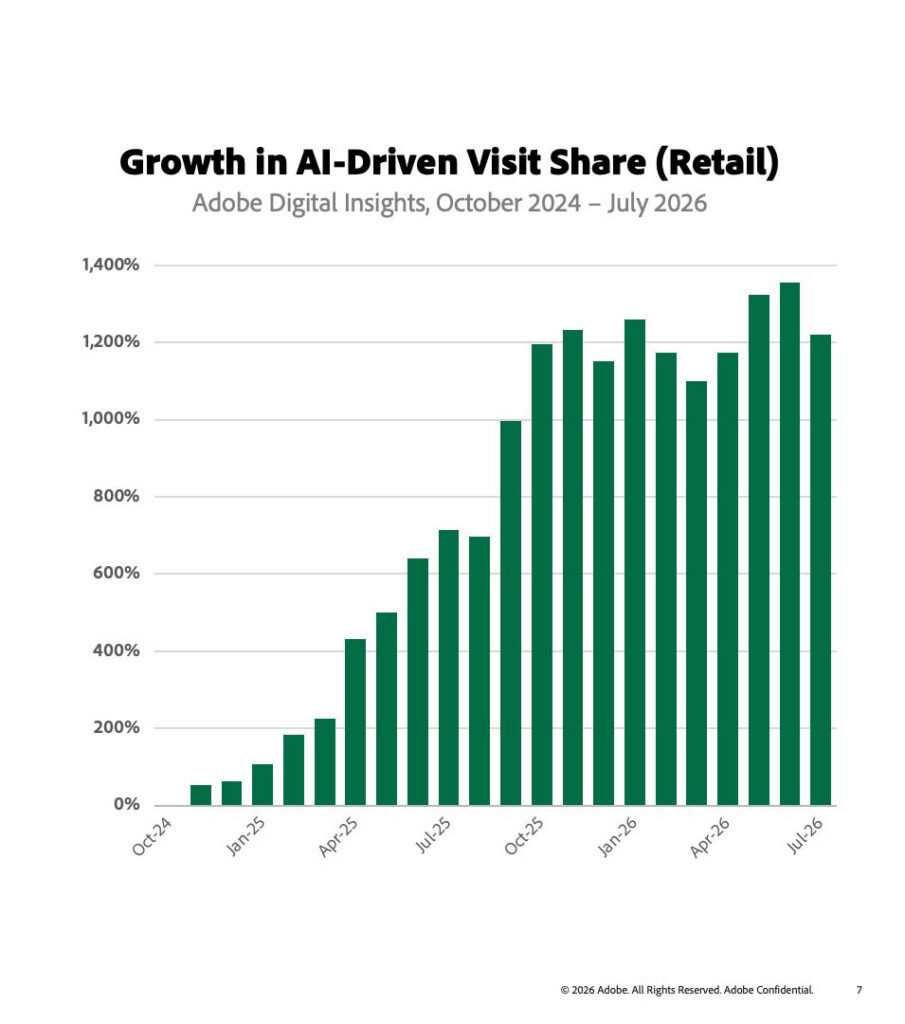
The surge in AI’s influence is further illustrated by the dramatic increase in AI-referral traffic to U.S. retail sites. In July 2026, this traffic saw a substantial year-over-year increase of 62%. The growth trajectory becomes even more pronounced when considering the period following the widespread adoption of generative AI platforms like OpenAI’s ChatGPT in October 2024. Since that pivotal point, AI-referral traffic has skyrocketed by an astonishing 1,219%, demonstrating the rapid integration of AI into consumer search and discovery habits.
The Evolving Landscape of AI in E-commerce
The widespread adoption of AI in e-commerce is not merely about driving traffic; it’s about optimizing the entire customer journey. AI’s ability to process vast amounts of data allows for hyper-personalization, from product recommendations and curated search results to dynamic pricing and tailored marketing messages. As AI tools become more sophisticated, they can anticipate consumer needs and preferences with remarkable accuracy, thereby reducing friction in the path to purchase.
The initial impact of generative AI tools, such as ChatGPT, can be traced back to late 2024. These tools empowered consumers with new ways to interact with information, including seeking product advice and comparisons. This led to a significant uptick in users directing their queries through AI-powered search engines and conversational interfaces, which in turn, started directing traffic to online retailers. Retailers who were quick to adapt and ensure their product information was accessible and understandable by these AI models began to see the benefits in terms of increased engagement and conversions.
The current data from Adobe Analytics, spanning July 2026, provides concrete evidence of this evolving dynamic. The 62% year-over-year increase in AI-referral traffic to U.S. retail sites suggests that more consumers are actively using AI to discover and purchase products. This growth is not a fleeting trend but a sustained shift, indicating that AI has become an integral part of the modern online shopping experience.

Assessing Retailers’ AI Readiness: A Crucial Diagnostic
Recognizing the critical importance of AI integration, Adobe has developed an "AI Content Visibility Checker." This diagnostic tool is designed to analyze web pages and identify how effectively large language models (LLMs), the engines behind many AI applications, can read and interpret brand content. The implications of this are profound: if an LLM cannot easily access and understand essential information such as product amenities, pricing, or availability, retailers risk leaving potential revenue on the table.
Adobe’s insights are grounded in an extensive dataset encompassing over 1 trillion visits to U.S. retail sites, representing direct online transactions. This robust sample includes data from more than 200 of the Top 2000 largest online retailers that utilized Adobe for web analytics in 2025, collectively accounting for over $836 billion in e-commerce sales. This broad scope lends significant credibility to the findings and underscores the widespread impact of AI on the retail sector.
To further contextualize this landscape, Digital Commerce 360 has also introduced its "AI Rankings," tied to its Top 1000 Database. These rankings are designed to measure the preparedness of leading online retailers for the rise of AI-driven shopping and agentic product discovery, providing another layer of insight into the industry’s adaptation to this transformative technology.
Deep Dive into AI-Referral Traffic Performance
The enhanced engagement metrics from AI-referred shoppers are particularly noteworthy. Consumers arriving at U.S. retail sites via AI platforms demonstrate 14% more engagement than other visitor segments. This heightened engagement translates into a longer on-site presence, with AI-referred shoppers spending 59% more time on the site and exhibiting a 33% lower bounce rate. This suggests that AI is not only directing shoppers to the right sites but is also helping them navigate those sites more effectively, leading to a more immersive and productive shopping experience.
Furthermore, the data reveals a significant uplift in purchase intent among AI-referred consumers. They are 28% more likely to add items to their cart compared to shoppers arriving through other channels. This metric is a strong indicator of AI’s efficacy in identifying and guiding consumers toward products that meet their needs and desires, effectively bridging the gap between browsing and buying.
Adobe’s analysis posits that these performance improvements stem from AI’s ability to "reduc[e] time required for shoppers to locate desired products or find relevant deals." By streamlining the discovery process and offering personalized suggestions, AI tools empower consumers to make faster, more informed purchasing decisions. However, Adobe also cautions that "many U.S. retailers, however, continue to have AI visibility gaps," suggesting that not all businesses are fully capitalizing on these advancements.
The Criticality of AI Content Visibility
The concept of "AI visibility" refers to how well a website’s content is structured and presented to be understood by AI models, particularly LLMs. In April 2026, Adobe’s analysis indicated that approximately 25% of content on retailers’ homepages was not optimized for LLMs. This means that crucial information was effectively hidden from AI crawlers, hindering their ability to accurately represent products and services.
By July 2026, Adobe expanded its analysis to a broader set of U.S. retail sites. While the exact increase in the number of sites analyzed was not specified, the overall LLM visibility across this expanded cohort saw a reduction to 61%, meaning that a significant 39% of these homepages remained unreadable by machines. This indicates that despite growing awareness, a substantial portion of the retail industry is still struggling to make its digital content AI-friendly.
Adobe’s categorization of retailers based on AI visibility provided further granular insights:
- Apparel, Electronics, and Cosmetics Retailers: These sectors demonstrated strong performance, with Adobe attributing their success to "consistent and structured product content." The presence of news stories and corporate blog posts also played a role in enhancing AI visibility. This suggests that retailers in these categories have been proactive in creating machine-readable content, likely due to the highly visual and information-rich nature of their products.
- Other Categories: For the remaining retail categories, the data points to a clear need for improvement. Adobe emphasized the necessity for teams to "update their digital properties and ensure content can be easily parsed by machines." This highlights a potential disconnect between the content creation strategies of some retailers and the evolving requirements of AI-driven discovery.
Adobe’s overarching conclusion is that while U.S. travel and retail brands have established a foundational level of AI visibility, "critical adjustments are still needed." As consumer adoption of AI tools continues its rapid acceleration, retailers must prioritize optimizing their entire digital ecosystem. This includes not only product pages but also marketing materials, customer service content, and any other digital assets that influence the consumer journey. Failure to do so risks diminishing visibility and relevance in an increasingly AI-centric marketplace.
Broader Implications and Future Outlook
The findings from Adobe Analytics underscore a fundamental transformation in how consumers discover and interact with brands online. AI is no longer just a tool for businesses; it has become a powerful intermediary for consumers. Retailers that embrace this reality and invest in making their digital content AI-ready are poised to gain a significant competitive advantage.
The implications extend beyond immediate sales figures. Enhanced AI visibility can lead to improved search engine rankings, more accurate product indexing by AI aggregators, and ultimately, a more seamless and satisfying customer experience. This can foster brand loyalty and drive long-term growth. Conversely, retailers that lag behind risk becoming invisible to a growing segment of consumers who rely on AI for their purchasing decisions.
The continued evolution of AI, particularly in areas like agentic shopping, where AI agents can autonomously make purchases on behalf of consumers, will further amplify the importance of AI visibility and structured data. Retailers must prepare for a future where their digital storefronts are not just viewed by humans but are actively navigated and understood by intelligent machines. This requires a strategic shift in content creation, data management, and technological adoption.
The ongoing data collection and analysis by organizations like Adobe and Digital Commerce 360 are crucial for guiding the retail industry through this period of rapid change. By providing actionable insights and benchmarks, these reports empower retailers to make informed decisions and adapt their strategies to thrive in the AI-driven era of e-commerce. The message is clear: AI is not just a trend; it’s the future of retail, and readiness is paramount.








