
 rifanmuazin
The global ecommerce landscape is currently undergoing a fundamental shift as businesses move away from traditional, manual conversion rate optimization (CRO) toward automated, artificial intelligence-driven systems. For years, digital retailers have funneled billions of dollars into top-of-funnel activities, including programmatic advertising, high-end product photography, and expensive influencer partnerships, only to face a persistent and costly bottleneck: the "experience gap." This gap, characterized by high cart abandonment rates and low click-through rates on calls-to-action (CTAs), often stems not from the quality of the product itself, but from friction points within the user journey. Historically, identifying these points required significant capital, involving weeks of analysis by specialized UX consultants and the production of static reports that were often outdated by the time they were implemented. The emergence of AI ecommerce optimization is now disrupting this cycle, offering a scalable, data-focused alternative that promises to maximize revenue without the traditional reliance on guesswork.
The Shift from Manual CRO to AI-Driven Intelligence
To understand the impact of AI in this sector, one must look at the limitations of traditional user experience (UX) audits. In the conventional model, an ecommerce brand would hire an external agency to conduct a deep-dive analysis of their storefront. This process typically lasted between four to six weeks and culminated in a massive document—often exceeding 60 pages—filled with generic best practices and a daunting list of recommendations. Because these audits were static, they captured only a single moment in time and rarely integrated real-time behavioral data. Furthermore, the high cost of these services meant that only enterprise-level companies could afford high-quality optimization, leaving small and medium-sized businesses to rely on trial-and-error A/B testing.
AI ecommerce optimization resolves these issues by replacing static analysis with dynamic, automated intelligence. Unlike classic CRO, which requires manual hypothesis building and slow A/B testing cycles, AI systems can simultaneously analyze behavioral signals, UX patterns, content performance, and page structure. These tools are capable of flagging micro-frictions that a human reviewer might overlook, such as subtle layout shifts that cause "click rage" or phrasing in a checkout flow that triggers psychological hesitation. By processing vast datasets in minutes, AI provides a tighter, more intelligent loop between data collection and actionable strategy.
The Economic Imperative for Optimization
The rise of AI-driven tools comes at a critical juncture for the ecommerce industry. According to market data, customer acquisition costs (CAC) have surged by over 60% in the last five years, driven by increased competition on social media platforms and the deprecation of third-party cookies. As it becomes more expensive to drive traffic to a site, the value of every individual visitor increases. In this high-stakes environment, a 1% increase in conversion rate can represent the difference between a profitable quarter and a net loss.
Industry experts suggest that optimization is no longer a discretionary luxury but a survival mechanism. AI tools offer four primary advantages that traditional methods cannot match:
- Speed of Execution: AI can scan an entire ecommerce ecosystem in a fraction of the time it takes a human consultant.
- Objectivity: Machine learning models are free from the subjective biases of internal stakeholders, focusing strictly on data points like scroll depth, click maps, and form abandonment.
- Scalability: Whether a site has 50 product pages or 50,000, AI can audit the entire catalog without a proportional increase in cost.
- Continuous Improvement: Rather than a one-off audit, AI provides ongoing insights that adapt as traffic patterns shift and new consumer behaviors emerge.
Technical Analysis of Content and Context
Modern AI optimization goes far beyond simple spell-checking or keyword density. It evaluates content through the lens of conversion psychology. This includes a deep analysis of product descriptions to ensure they address specific consumer pain points and highlight benefits in a scannable format. It also extends to the technical aspects of UI/UX, such as the visibility of CTAs above the fold and the contrast ratios of buttons.
For instance, an AI audit might reveal that a generic "Add to Cart" button is underperforming compared to more urgent or personalized labels like "Get Yours Today." In the checkout phase, AI can identify "form friction"—the specific fields where users hesitate or abandon the process. By analyzing the context of error messages and the clarity of field titles, AI helps retailers remove the final barriers to payment.

Expert Perspectives and Case Studies
The practical application of these technologies is already yielding significant results. Anwar, a noted practitioner in the field, observes that traditional CRO relied on "manual depth," which required senior-level expertise that was difficult to scale. "AI-CRO, when done right, enables scalable depth, providing mid-level strategists with senior-level reach," Anwar stated. He emphasizes that the role of the human marketer is shifting from technical execution to "decision mindset," where the focus is on building AI workflows that support strategic goals.
Similarly, Garret Cunningham has highlighted the predictive power of AI in experimentation. By using AI predictors trained on years of historical experimentation data and psychological principles, teams can now estimate the likelihood of a test’s success before it is even launched. Cunningham noted a specific instance where data shifted a team’s focus from merely making a search bar more visible to motivating users to use the search function in the first place. This data-backed pivot helped double their testing "win rate" from 20% to over 40%. This shift from "assumptions to strategy" is the hallmark of the AI-integrated approach.
Democratizing Access: The VWO AI Initiative
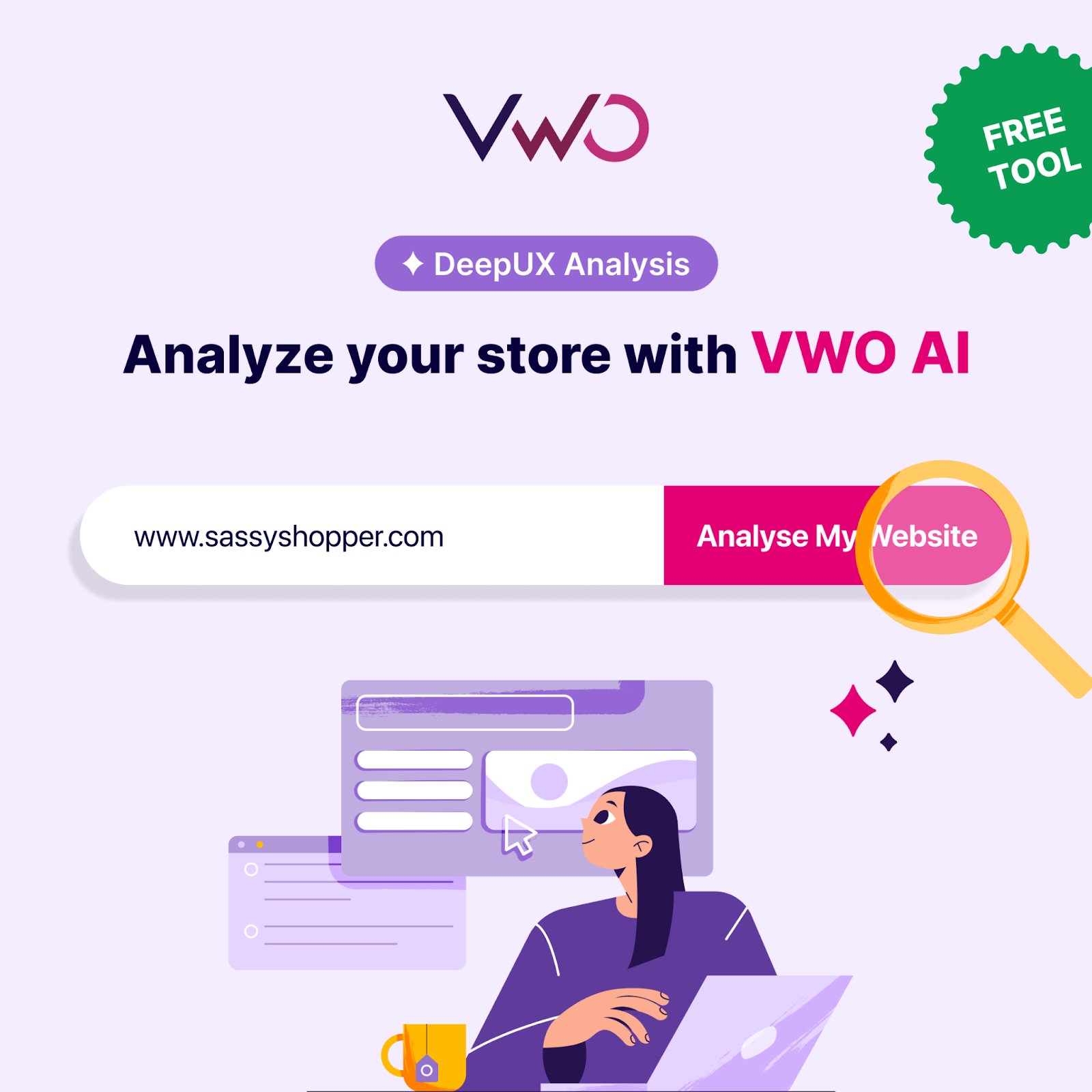
Recognizing the barriers to entry for many ecommerce teams, VWO has introduced a free AI-powered UX audit tool designed to make enterprise-level intelligence accessible to any business. The tool operates on a simplified three-step process:
- URL Submission: Users provide the address of their ecommerce site without the need for complex code installation or onboarding.
- Automated Analysis: The VWO AI engine—the same technology powering some of the world’s largest experimentation platforms—scans the site for UX gaps, content issues, and conversion friction.
- Interactive Reporting: Results are delivered via email in a two-column format that explicitly pairs identified problems with actionable recommendations.
This initiative reflects a broader trend in the software-as-a-service (SaaS) industry to provide "value-first" tools that demonstrate the power of AI before requiring a financial commitment. It is particularly targeted at teams that lack dedicated CRO experts, stores experiencing high traffic but low conversions, and businesses looking to justify their optimization budgets with hard data.
Chronology of AI Integration in Retail
The path to current AI ecommerce optimization has evolved through several distinct phases:
- Phase 1 (2010–2015): The era of manual A/B testing. Tools like Google Website Optimizer allowed for basic testing, but hypotheses were largely driven by "gut feeling" and best-practice blogs.
- Phase 2 (2016–2020): The introduction of heatmaps and session recordings. While providing more data, these tools still required hours of human labor to interpret.
- Phase 3 (2021–Present): The Generative and Predictive AI era. Tools now not only show what is happening but explain why and suggest how to fix it, using large language models (LLMs) and computer vision.
Broader Impact and Future Implications
The implications of AI-driven optimization extend beyond individual store revenue. As these tools become more prevalent, they are likely to raise the baseline for the "standard" ecommerce experience. Consumers will become accustomed to highly intuitive, frictionless journeys, making it even harder for unoptimized sites to compete.
Furthermore, the integration of AI in UX auditing is a precursor to "Hyper-Personalization," where the layout and content of a store change in real-time based on the specific behavior and preferences of the individual visitor. While we are currently in the phase of fixing existing friction, the next frontier will be the automated creation of unique, optimized experiences for every user.
Conclusion
AI has moved decisively past the "hype" phase to become a practical, essential tool for modern ecommerce. By replacing slow, expensive, and subjective manual audits with fast, data-driven AI analysis, businesses can finally align their digital storefronts with the high expectations of today’s consumers. Whether managing a niche Shopify boutique or a massive enterprise catalog, the directive remains the same: move away from guesswork and toward a structured, AI-supported strategy. The transition from manual CRO to AI-driven intelligence is not merely a technical upgrade; it is a fundamental reimagining of how digital commerce operates in an increasingly competitive global market.








