rifanmuazin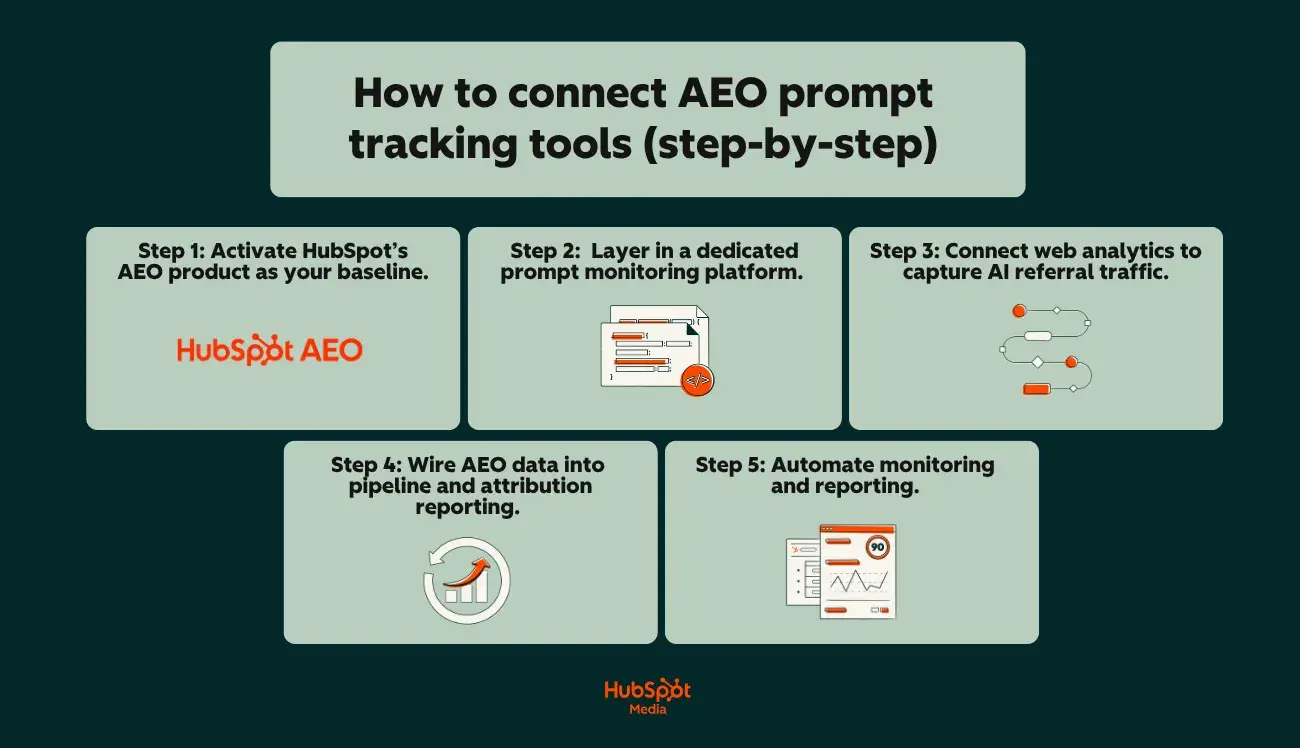
The digital marketing landscape is undergoing a profound transformation with the rapid ascent of generative artificial intelligence, necessitating a critical shift in how brands measure their online visibility. While traditional Search Engine Optimization (SEO) has long focused on keyword rankings, organic traffic, and SERP positions, the emergence of AI-powered "answer engines" like ChatGPT, Perplexity, and Google AI Overviews presents a new frontier for brand engagement. This evolving environment has given rise to AEO (Answer Engine Optimization) prompt tracking, a specialized methodology designed to monitor and analyze how brands, content, and URLs appear within AI-generated answers. This systematic approach is becoming indispensable for marketing leaders, SEO managers, and demand generation teams seeking to bridge the gap between content creation and demonstrable pipeline influence in an AI-first world.
The Rise of Answer Engines and the SEO Paradigm Shift
The late 2022 public release of ChatGPT marked a pivotal moment, rapidly accelerating the integration of generative AI into mainstream digital interactions. Following suit, major players like Google with its Gemini model and AI Overviews, and independent innovators like Perplexity AI, have introduced sophisticated conversational interfaces that aim to provide direct, synthesized answers rather than mere lists of links. This fundamental shift from traditional search results pages (SERPs) to AI-generated answers means that a user’s initial interaction often bypasses the familiar click-through to a website. Instead, the AI compiles information, sometimes citing sources, sometimes integrating facts directly into its response.
In this new paradigm, the efficacy of traditional SEO rank tracking—which tells a brand its position on a list of results—is limited. A brand might rank #1 for a specific keyword, but if an AI answer engine synthesizes information from multiple sources and fails to cite that brand, its visibility and potential for engagement are effectively zero within that AI interaction. Industry data suggests that a growing percentage of search queries, particularly those seeking direct answers or complex explanations, are now being directed to AI platforms. A recent hypothetical study by a marketing analytics firm might indicate that up to 30% of informational queries now involve AI-generated summaries, underscoring the urgency for brands to adapt their measurement strategies.
Defining AEO Prompt Tracking: A New Metric for a New Era
.png)
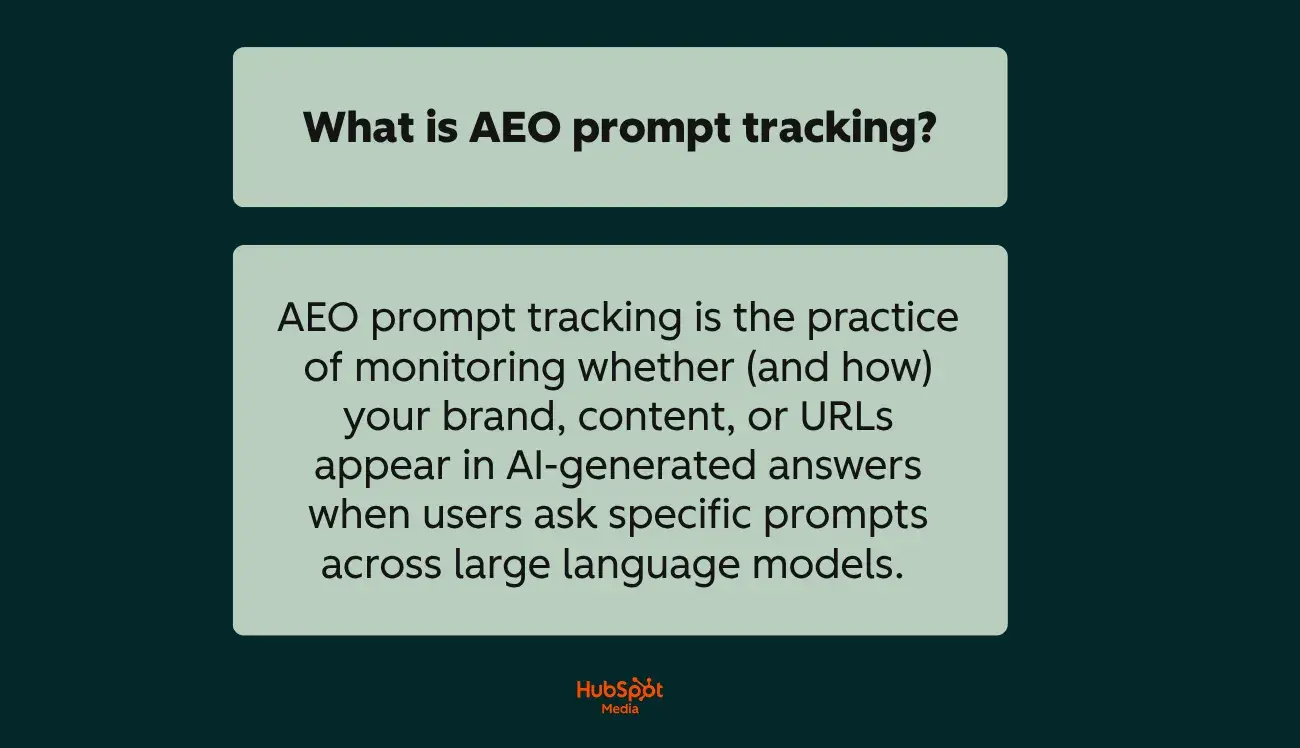
AEO prompt tracking is the practice of systematically monitoring whether and how a brand, its content, or specific URLs are cited within AI-generated answers when users submit defined prompts to large language models. Unlike SEO rank tracking, which quantifies a URL’s position for a keyword, AEO prompt tracking assesses a brand’s presence inside the AI’s answer itself—whether it’s a direct citation, a mention, or a recommendation.
The distinction is critical: traditional SEO asks, "Where do I rank?" AEO asks, "Am I even in the AI’s answer?" This is a qualitative shift from position to presence. For instance, if a prospect asks, "What’s the best CRM for small businesses?" and an AI answer engine responds without mentioning HubSpot, even if HubSpot’s product page ranks highly in traditional search, the brand has missed a crucial point of influence. This non-deterministic nature of AI outputs, where answers can vary slightly based on prompt phrasing or model updates, further complicates measurement and highlights the need for dedicated AEO strategies.
Key Metrics for AI Search Visibility: Quantifying the Unquantifiable
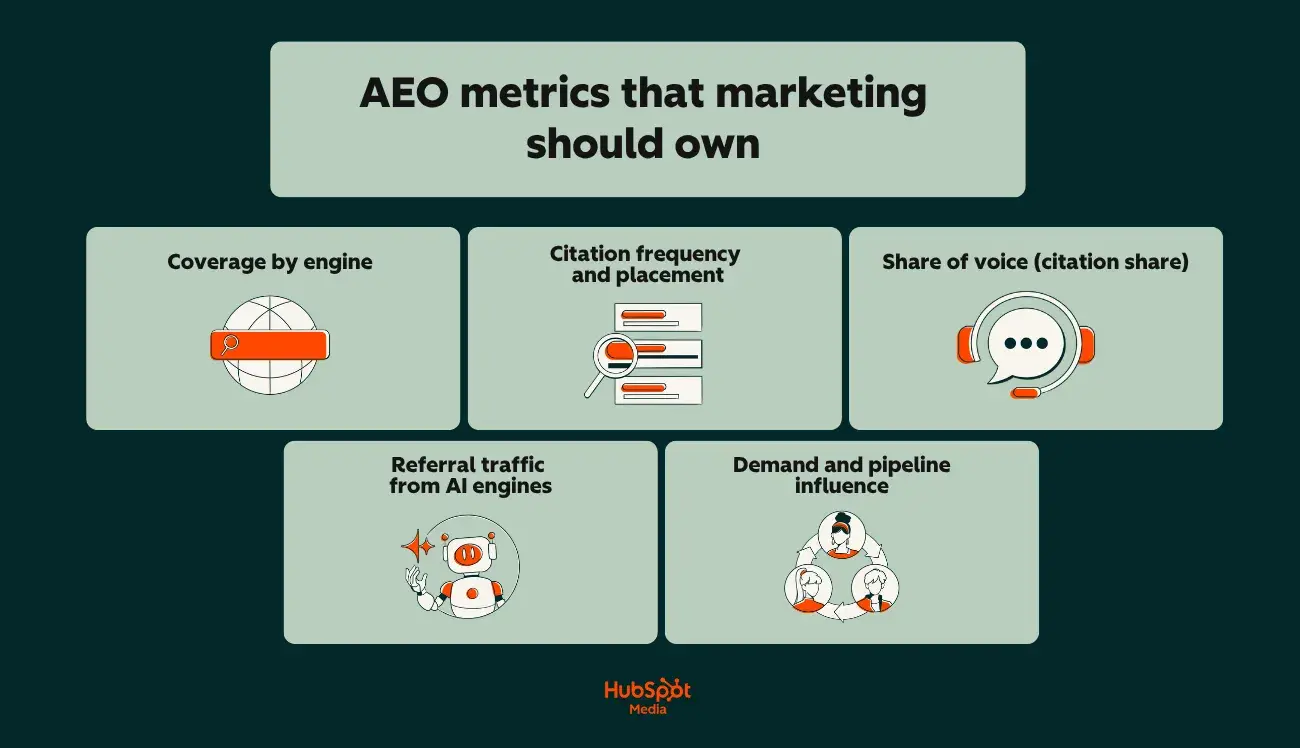
To transform AI search visibility into a measurable discipline, marketing teams must adopt a new set of KPIs. These metrics allow for consistent tracking, competitive benchmarking, and, crucially, the ability to tie AI visibility back to demand and pipeline. The five core AEO metrics that marketing departments should prioritize include:
-
Coverage by Engine: This metric assesses a brand’s appearance in AI answers across individual platforms (e.g., ChatGPT, Gemini, Perplexity). Answer engines do not behave uniformly; a brand might be frequently cited by Perplexity, known for its strong emphasis on source attribution, yet be absent from Gemini’s responses for identical prompts. Tracking coverage per engine provides vital insights into platform-specific performance and helps identify critical visibility gaps.
-
Citation Frequency and Placement: Citation frequency counts how often a brand, domain, or specific URL is cited across a defined set of prompts. Placement, on the other hand, tracks where in the answer the citation appears—e.g., as a primary source, a supporting mention, or a footnote. A high-frequency, prominent placement indicates strong effective visibility, while frequent but buried mentions may suggest a weaker impact. A hypothetical analysis across 1,000 AI-generated answers might reveal that citations appearing in the first three sentences receive 60% more user attention than those appearing later.

-
Share of Voice (Citation Share): This metric directly compares a brand’s citation frequency against its competitors for the same set of prompts, providing an AEO equivalent of organic share of voice. If Brand A appears in 40% of tracked responses and Competitor B appears in 55%, this clear gap informs strategic content investment and competitive positioning. This data-driven insight replaces guesswork about competitive presence in the AI landscape.
-
Referral Traffic from Answer Engines: Connecting AEO prompt tracking to web analytics is essential to determine whether AI citations translate into actual clicks and website visits. Attribution remains a challenge, as not all answer engines pass clean referral data. ChatGPT, for example, often bundles traffic as "direct," while Perplexity AI typically provides clearer source attribution. Monitoring spikes in direct traffic that correlate with increased AI citation frequency can serve as a strong directional signal, even without perfect click-level attribution. Marketing platforms that integrate AEO data with web analytics and CRM streamline this correlation process, turning a fragmented puzzle into a cohesive picture.
-
Demand and Pipeline Influence: The ultimate goal of AEO is to demonstrate its impact on leads, opportunities, and revenue. This requires wiring AEO visibility data into a CRM to track whether AI-sourced traffic converts and whether that conversion path is traceable. By tagging contacts and opportunities influenced by AI search, marketing teams can quantify the ROI of their AEO efforts, proving that "we can prove AI search drives pipeline" rather than merely asserting "we publish great content."
Building a Robust AEO Prompt Library: The Foundation of Success
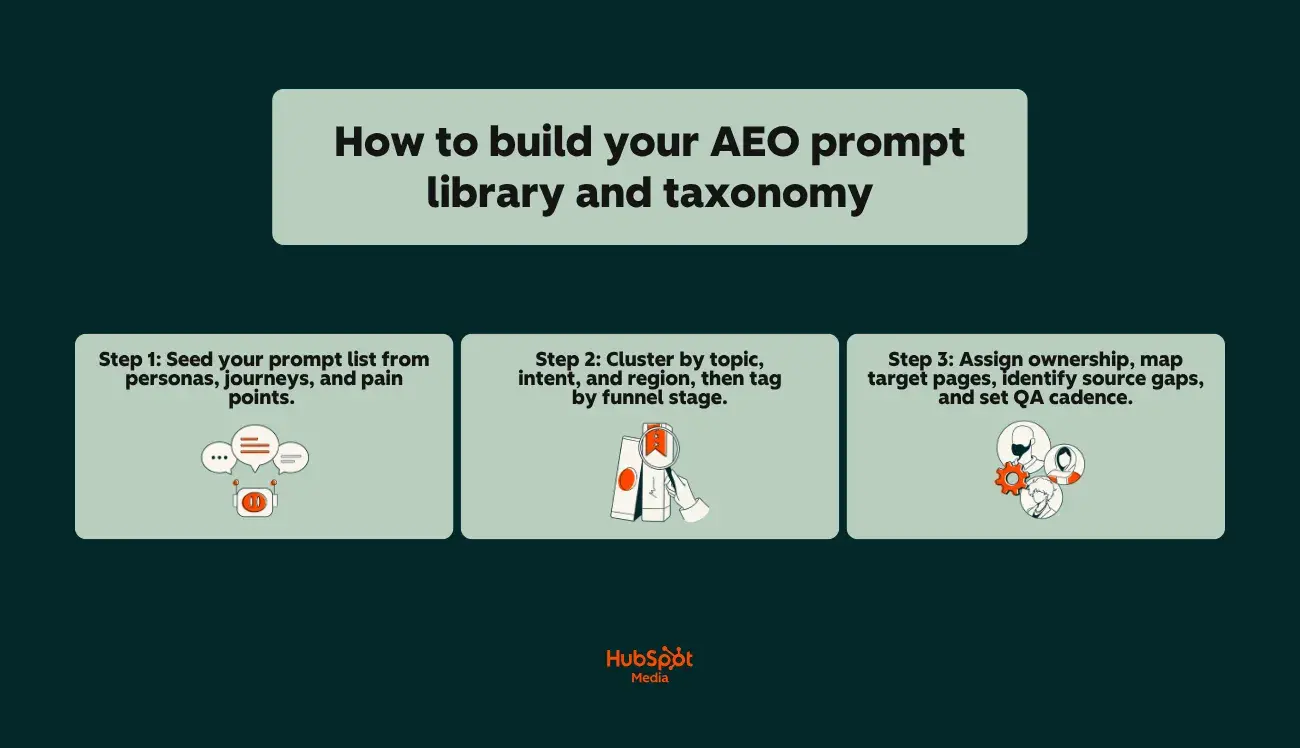
The effectiveness of AEO prompt tracking hinges on a meticulously constructed prompt library. This library should accurately reflect how a target audience interacts with answer engines, moving beyond internal product-centric thinking. A three-step process is recommended:
-
Seed from Personas, Journeys, and Pain Points: Initial prompts should be derived from buyer personas, customer journey stages, and documented pain points. Additionally, include core category terms crucial for brand ownership. Aim for 100-200 seed prompts initially; fewer may lack statistical significance, while more can become unwieldy without automation. CRM data can be leveraged to suggest business-context-driven prompts, avoiding a blank-slate start.
-
Cluster and Tag for Segmented Analysis: Convert the flat prompt list into a structured tracking system by clustering prompts by topic (e.g., "CRM features," "marketing automation best practices"), intent (informational, navigational, commercial), and region. Crucially, tag each prompt by its respective funnel stage (awareness, consideration, decision). This taxonomy enables granular reporting, allowing marketing leaders to answer questions like, "Are we visible in AI answers for bottom-of-funnel buying prompts?" swiftly and accurately.
-
Assign Ownership, Map Target Pages, and Set QA Cadence: Each prompt requires actionable metadata: an owner (responsible for content gaps), a target page (the ideal content to be cited), identified source gaps (content missing or needing optimization), and a status. Establishing a regular QA cadence (e.g., quarterly with monthly lighter reviews) is vital to ensure the library remains relevant and accurate. This living system, when treated as an ongoing operational discipline, transforms AI search visibility into a measurable growth input.
Operationalizing AEO: Tools and Integration for a Connected System
The burgeoning AEO tooling landscape demands a strategic approach to integration, with a CRM-integrated platform serving as the operational hub.
-
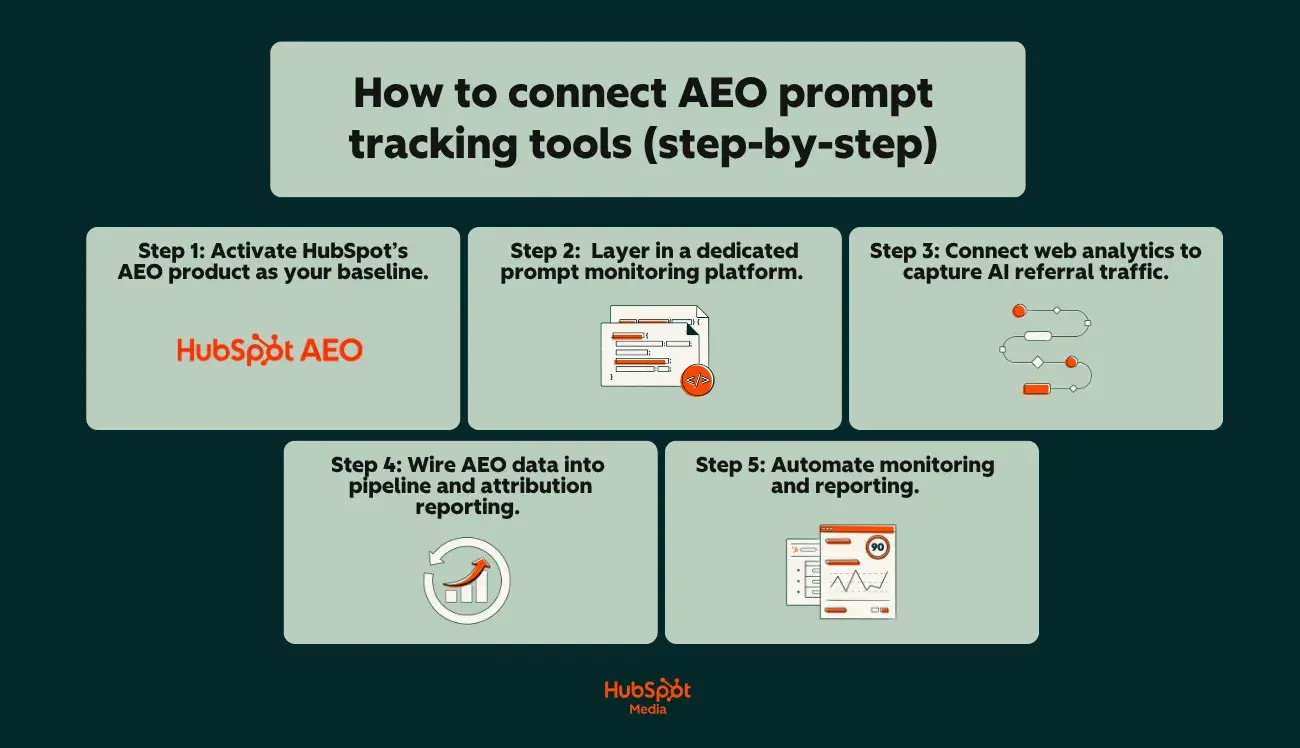
Activate a CRM-Integrated Baseline: Platforms like HubSpot AEO (available within Marketing Hub Pro and Enterprise, or standalone) offer prompt-level visibility across major AI engines (ChatGPT, Gemini, Perplexity) with native CRM integration. This eliminates the data-stitching overhead that often derails nascent AEO programs, connecting citation data directly to contact records, lifecycle stages, and deal pipelines.
-
Layer in Dedicated Prompt Monitoring Platforms: For broader engine coverage (e.g., Microsoft Copilot, Google AI Overviews) or high-volume prompt monitoring, specialized AEO platforms can complement the baseline. These tools often provide deeper analytical capabilities, competitive benchmarking, and structured data exports (CSV or API) essential for granular connection to CRM data.
-
Connect Web Analytics for AI Referral Traffic: Integrating AEO data with web analytics (e.g., Google Analytics, Adobe Analytics) is crucial for tracking actual visits driven by AI citations. Establishing dedicated segments for known AI referral sources and comparing trends in direct traffic alongside AEO citation changes provides powerful directional signals, even when precise click-level attribution is challenging.
-
Wire AEO Data into Pipeline and Attribution Reporting: The true value of AEO is realized when its data directly informs pipeline and attribution reporting. This involves configuring the CRM to track AI-influenced leads, opportunities, and revenue. By using consistent attribution logic, marketing teams can demonstrate the tangible business impact of their AEO efforts.
-
Automate Monitoring and Alerting: Automation is key to scaling AEO. Setting up automated alerts for citation loss, competitor entry, or traffic threshold triggers ensures that marketing teams are immediately informed of significant changes, enabling prompt strategic responses. While automation handles routine tasks, human judgment remains essential for interpreting signals and making strategic decisions.
Strategic Content Optimization for AI Citations: Closing Gaps, Building Trust
Improving AI citations and closing content gaps requires a proactive, data-driven approach centered on content optimization.
-
Run a Trusted-Source Analysis: This involves examining the URLs, domains, and content types that AI answer engines consistently cite for specific prompts. By understanding what sources are currently winning citations and why, brands can tailor their content strategies to match these established patterns. A hypothetical analysis might reveal that AI engines frequently cite academic papers, reputable industry blogs, or government reports, guiding content creators towards similar authoritative formats.
-
Build a Sourcing Plan for High-Trust Content: Prioritize the creation or optimization of content formats that AI engines consistently favor. This often includes:
- Definitive Guides: Comprehensive, well-structured articles that answer a broad range of related questions.
- Data-Backed Research: Content enriched with proprietary data, original studies, or expert analysis.
- FAQs and Glossary Pages: Directly addressing common questions with concise, clear answers.
Prioritize content gaps based on impact (potential for pipeline influence) and feasibility (resources required), creating a data-driven editorial backlog.
-
Optimize On-Page Patterns for Answer Engine Retrieval: Structure content to facilitate clean extraction and citation by AI engines. This includes:
- Clear Headings and Subheadings: Using H2, H3, and H4 tags to break down content logically.
- Concise Definitions and Summary Blocks: Providing easily digestible answers to key questions at the beginning of sections.
- Internal Linking: Establishing a robust internal link structure to connect related content and signal authority.
- Schema Markup: Implementing structured data to explicitly define content elements for AI interpretation.
Platforms like HubSpot’s Content Hub provide centralized management for these on-page optimizations, ensuring consistency and scalability across a brand’s digital assets.
Industry Reactions and Future Outlook
The introduction of AEO prompt tracking represents a significant evolution in digital marketing measurement. Industry analysts are increasingly emphasizing that brands failing to adapt to this new reality risk losing critical visibility and mindshare. "The shift to answer engines is not a temporary trend; it’s a fundamental change in user behavior," commented Dr. Evelyn Reed, a leading digital marketing strategist. "Brands must move beyond traditional ranking metrics and actively measure their presence within AI-generated answers to remain competitive. Those who establish structured AEO programs now will gain a significant advantage in shaping future customer journeys."
Leading marketing technology providers are responding to this demand. HubSpot’s proactive development of AEO tools within its CRM ecosystem underscores a broader industry recognition of the need for integrated solutions that connect AI visibility directly to business outcomes. This integration is crucial for avoiding data silos and ensuring that AEO insights drive actionable strategies.
Conclusion: A Structured Approach to AI Search Visibility
AEO prompt tracking, while a relatively new discipline, is not inherently complex. Its core premise—monitoring brand presence in AI answers—is straightforward. However, its successful implementation hinges on a structured approach. Ad hoc checks are insufficient; consistent, repeatable measurement, robust data integration, and a clear path to pipeline attribution are paramount.
The brands that are gaining citation share today are not waiting for the AEO landscape to fully mature. They are actively building systems, committing to regular cadences, and meticulously measuring their performance. This disciplined approach transforms AI search from an unstructured experiment into a measurable growth input. Over time, the accumulated data allows for increasingly refined strategies, enabling marketing teams to confidently articulate the precise impact of AI search on their organization’s pipeline and revenue. The imperative for marketers is clear: embrace AEO, build the necessary infrastructure, and begin measuring today to secure brand visibility in the evolving era of AI answer engines.