
 rifanmuazin
The efficacy of a simple sign-up form, devoid of any compelling offer, typically yields a conversion rate of approximately 2%. However, the strategic integration of a well-crafted lead magnet dramatically transforms this landscape, propelling conversion rates to an average of 6.5%. This represents a staggering 325% increase in subscriber acquisition, shifting the paradigm from gradual list expansion to robust, continuous growth with every new visitor. This significant lift underscores the critical role lead magnets play in contemporary digital marketing, serving as the bridge between casual website browsing and active engagement.
Many small businesses erroneously equate lead magnet creation with the arduous task of authoring an ebook. In reality, a lead magnet encompasses any valuable asset that entices a visitor to exchange their email address. This can range from a tangible discount or a practical checklist to a customizable template, a personalized quiz result, or even a free trial of a service. The format itself is less crucial than its relevance and resonance with the target audience. The most effective lead magnet is precisely tailored to meet the specific needs and preferences of a business’s unique clientele, offering something they genuinely desire and can immediately utilize.
The more pressing strategic question for businesses is not whether to employ a lead magnet, but rather to discern which format will best align with their business model and captivate their intended audience. This inquiry forms the cornerstone of a successful email list-building strategy, demanding a nuanced understanding of consumer behavior and value proposition.
The Strategic Imperative of Lead Magnets in a Competitive Digital Landscape
In an era saturated with digital content and marketing messages, capturing audience attention and securing permission for ongoing communication is paramount. Lead magnets emerged as a sophisticated response to the declining effectiveness of generic "subscribe to our newsletter" prompts. The fundamental shift lies in providing immediate, tangible value in exchange for personal information, thereby establishing a trust-based relationship from the outset. Industry analysis consistently demonstrates that email marketing, when powered by robust list building, offers one of the highest returns on investment (ROI) in digital marketing. Without an effective lead magnet strategy, businesses risk leaving substantial growth opportunities untapped, operating at a significant disadvantage in an increasingly competitive online environment.

Defining Effectiveness: The "Immediate Miracle" Principle
An effective lead magnet distinguishes itself by delivering value almost instantaneously upon subscriber sign-up. The goal is not deferred gratification but immediate utility, ensuring the subscriber can leverage the offered asset within minutes, not days or weeks. This principle was eloquently articulated by author and long-time AWeber customer Alexandra Franzen, who describes the objective of every email interaction as "delivering a little miracle to their inbox."
This framing provides a vital litmus test for evaluating any potential lead magnet. Can a new subscriber genuinely use this offer within the next 30 minutes? Does it address a specific problem or need they are actively trying to solve? Affirmative answers signal a lead magnet worthy of investment. Conversely, if the offer demands a significant time commitment or cannot be immediately acted upon, its format warrants reconsideration. The psychological impact of immediate value fosters goodwill, reinforces the subscriber’s decision, and significantly increases the likelihood of future email engagement.
The various lead magnet formats can be broadly grouped by their type and, within each category, are often prioritized by their speed of utility, ensuring the most immediate-impact options are considered first.
Categorizing Lead Magnet Formats for Optimal Engagement
Deals and Direct Offers: Immediate Value for Purchase Intent
These lead magnets are designed for rapid conversion, particularly effective for businesses where pricing plays a significant role in the customer’s decision-making process. They require no reading or downloading, delivering value directly and instantly.
Discounts and Coupons
Applicability: Ecommerce businesses, brick-and-mortar retailers, restaurants, and service providers with standardized pricing menus.
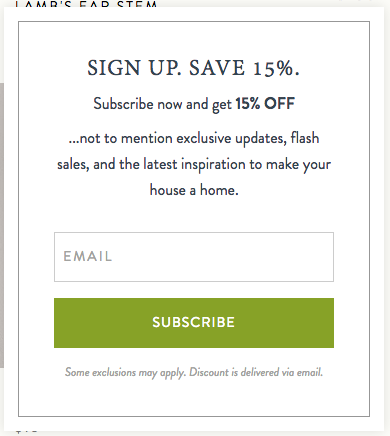
A discount serves as a powerful lead magnet, offering concrete, measurable value that can be utilized immediately. A common incentive, such as "Get 15% off your first order when you join our list," directly links subscription to an immediate financial benefit. Subscribers gain a tangible saving, while businesses acquire an email address attached to clear purchase intent. This immediate gratification minimizes the gap between subscribing and receiving the benefit, fostering high conversion rates. For instance, a local coffee shop offering a free drink on the next visit or a clothing retailer providing 20% off a first purchase capitalizes on the moment of highest intent, when a customer is already considering a transaction.
Giveaways and Contests
Applicability: Retail, ecommerce, consumer brands, and local businesses aiming for rapid audience expansion.
Giveaways offer a prize in exchange for an email address, often incentivizing bonus entries for social sharing. While capable of rapid list growth, the quality of leads can vary. Strategic design dictates that the prize must exclusively appeal to the ideal customer, rather than attracting anyone merely seeking a free item. The organic reach extended through sharing mechanics makes well-promoted giveaways, especially on social media, potent tools for significant list expansion within short timeframes. Examples include a fitness studio offering a free month of classes or a home goods brand giving away a product bundle, ensuring that all entrants are qualified leads genuinely interested in the business’s offerings.
Free Trials and Demos
Applicability: SaaS (Software as a Service) companies, subscription-based products, and service businesses with clearly defined scopes of work.
Here, the product or service itself acts as the lead magnet. Subscribers engage directly with the offering, rather than downloading content. For software and subscription models, a trial subscriber is statistically far more likely to convert into a paying customer compared to a cold lead acquired through an ebook. The low barrier to entry and high trust signal inherent in a free trial underscore a business’s confidence in its offering. A project management tool providing a 14-day free trial or a marketing consultant offering a complimentary 30-minute strategy call exemplify how this approach captures highly interested prospects.
High-Value, Ready-to-Use Resources: Empowering Immediate Action
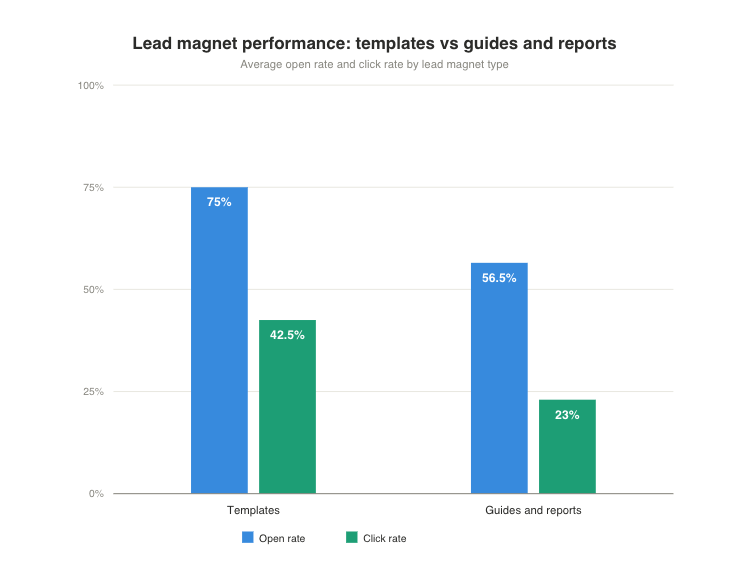
These formats provide assets that subscribers can put into practice immediately, consistently outperforming purely knowledge-based formats in terms of welcome email engagement. AWeber’s extensive data, drawn from over 42,000 welcome email sends, reveals that template-based lead magnets achieve an average 75% open rate and 42.5% click rate. This stands in stark contrast to guides and reports, which average 56.5% opens and 23% clicks, highlighting the preference for actionable tools over passive information.
Templates
Applicability: Any business catering to subscribers with specific tasks requiring completion, such as writing, planning, organizing, designing, or presenting.
When a subscriber downloads a template, their intent is immediate application, not future learning. The welcome email acts as a direct fulfillment mechanism. AWeber’s email marketing planning template, for example, boasts a 76% open rate and 47% click rate across over 3,000 sends, while their 45-email templates offer achieved 74% opens and 38% clicks from over 28,700 sends. A template that saves a user 20 minutes on a task they were already undertaking holds more perceived value than a voluminous guide on the same subject. Examples include a social media manager offering caption templates or a financial coach providing a budget spreadsheet.
Checklists and Cheat Sheets
Applicability: Nearly every small business category, including coaches, consultants, service providers, retailers, health and wellness practitioners, and home services.
A concise, one-page checklist can be created in a few hours and used in minutes, starkly contrasting with an ebook that may take days to write and hours to read. The most effective checklists function as decision-support tools, with each item being actionable and designed to eliminate decisions the subscriber would otherwise have to make independently. They demonstrate expertise without demanding a significant time investment from the subscriber, signaling an understanding of their challenges. Examples include "10 things to check before launching a website" or "The questions to ask when hiring a photographer."
Workbooks and Worksheets
Applicability: Coaches, educators, consultants, health and wellness businesses, and anyone guiding subscribers through a structured process or decision.
Workbooks expand on checklists by incorporating prompts, transforming a list of actions into a structured space for engagement. Subscribers actively fill them in, engaging with the provided framework rather than passively consuming information. A well-designed 8-to-10-page PDF guiding a planning exercise can be developed in a single day and offers the structured thinking typically associated with paid coaching or consulting sessions. A business coach’s 90-day goal-setting workbook or a nutritionist’s meal planning workbook are prime examples.
Resource Lists and Toolkits
Applicability: Coaches, consultants, educators, service providers, and bloggers – essentially any business serving audiences seeking recommendations for tools, resources, or services.
A curated resource list saves subscribers the laborious research they would otherwise conduct. The value lies in expert curation, not exhaustive comprehensiveness. A concise, opinionated list of essential tools, with brief explanations for each inclusion, is far more valuable than an unwieldy compilation. Specificity is key; "The seven tools I use to run my one-person consulting business" resonates more powerfully than a generic list of "marketing tools." Examples include "The apps every bakery owner should know" or "My go-to vendors for event planning."
Interactive and Educational Formats: Building Deeper Relationships
These formats typically require a longer time commitment from the subscriber but foster a more profound relationship. The increased time investment often translates into greater trust by the completion of the engagement sequence.
Quizzes and Assessments
Applicability: Coaches, consultants, educators, health and wellness businesses, and service providers where the optimal solution depends on the subscriber’s unique circumstances.
Quizzes convert exceptionally well due to their promise of personalization. Instead of a generic offering, they provide tailored insights based on specific answers. Furthermore, assessment results yield valuable segmentation data, allowing businesses to understand subscriber needs from the moment they join the list. Conversion rates for quiz lead magnets typically range between 20% and 40%, directly correlating with the perceived personalization of the experience. A financial coach’s "What’s your money personality?" quiz or a personal trainer’s "What’s your fitness starting point?" are effective examples.
Challenges
Applicability: Fitness, wellness, productivity, creative, education, and any business focused on facilitating behavioral change.
A challenge involves a multi-day commitment, such as a "5-day writing challenge" or a "7-day meal prep challenge." Subscribers opt-in with the understanding that they are entering a structured, time-bound experience. Challenges inherently filter for highly motivated individuals, and participants often share their progress publicly, generating organic reach and social proof simultaneously. A yoga instructor’s "7-day morning movement challenge" is a strong illustration of this format.

Mini-Courses Delivered by Email
Applicability: Educators, coaches, consultants, and anyone teaching a specific skill or methodology.
A five-day email course functions as both a lead magnet and a nurture sequence. Each email delivers a single lesson, setting clear engagement expectations from the outset. Subscribers who complete such a course have spent five days engaging with the business’s perspective, building trust and increasing their likelihood of taking the next step. This format transforms passive subscribers into active learners, with each lesson providing a compelling reason to open the subsequent email. Examples include a business coach’s "5 days to your first paying client" or a graphic designer’s "Learn Canva in 5 emails."
In-Depth Content: Catering to Research and Evaluation
These formats are most effective when subscribers are in a research phase, actively evaluating options, accumulating knowledge, or preparing for a significant decision.
Guides, Reports, and Ebooks
Applicability: Businesses targeting subscribers in research mode, such as those involved in high-consideration purchases, B2B audiences, or industries where extensive context is required before a decision.
While guides and reports are common lead magnet formats, they are often not the fastest-converting. AWeber’s data for a small business email marketing report showed a 54% open rate and 21% click rate, while a landing page guide yielded 59% opens and 25% clicks. This suggests that subscribers often download guides with the intent to "learn something eventually," leading to a lower sense of urgency and a higher "I’ll get to this later" impulse. A guide’s effectiveness hinges on its ability to provide unique data or frameworks that are not readily available elsewhere, emphasizing specificity over generic information. Examples include a recruiting firm’s "The 2026 Salary Guide for Tech Roles" or an accountant’s "The Small Business Tax Prep Checklist."
Operationalizing Lead Magnet Delivery: A Standardized Framework
Regardless of the chosen format, the delivery mechanism for a lead magnet typically follows a consistent, automated setup involving a landing page, a sign-up form, and an automated welcome email. Platforms like AWeber allow businesses to construct these components without requiring coding expertise.
- Landing Page Construction: This dedicated page serves as the digital storefront where visitors exchange their email for the promised offer. It must be singularly focused, featuring one clear offer, one sign-up form, and one primary call to action to minimize distraction and maximize conversion.
- Sign-Up Form Creation: The form should be minimalist, ideally requesting only an email address unless there is a compelling, conversion-justifying reason to ask for more information. Each additional field incrementally reduces conversion rates. Crucially, new subscribers should be tagged based on the specific form they used, providing immediate insight into the lead magnet that attracted them.
- Tag Application for Segmentation: The tags applied at sign-up are instrumental in routing subscribers into appropriate follow-up sequences. A subscriber who downloads a beginner’s checklist, for instance, requires different follow-up content than one who opts for an advanced course. Marketing automation workflows, often visualized in platforms, allow for the creation of these tailored paths without complex technical configurations.
- Welcome Email Automation Setup: The moment a subscriber signs up, an automated welcome email is triggered, delivering the promised offer. For PDFs, a direct link to the file is provided. Discount codes are embedded within the email body. For challenges or mini-courses, this initial email serves as "Day One" of the experience. This setup typically takes less than 20 minutes and operates autonomously thereafter, ensuring immediate fulfillment and a professional first impression.
Key Attributes of High-Converting Lead Magnets
While conversion rates for lead magnets can fluctuate widely, from 5% to 35% or even higher, this variance is rarely arbitrary. The most successful lead magnets consistently exhibit four core characteristics:
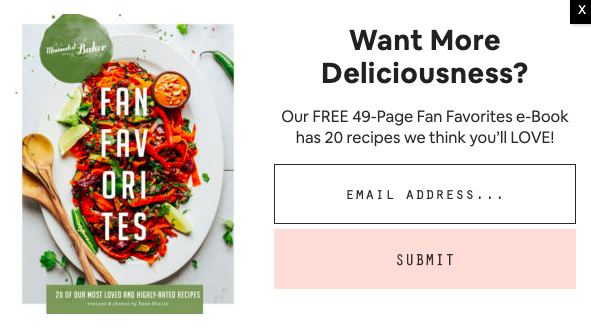
- Solves One Specific Problem: Generic offers like "10 Marketing Tips" lack the precision of a lead magnet such as "5-Minute Email Template That Books Discovery Calls." Specificity is the psychological trigger that makes a prospect think, "This is exactly what I need right now."
- Demonstrates Your Unique Process: The most compelling lead magnets offer a glimpse into a business’s distinctive methodology. A template built around a proprietary framework or a checklist reflecting a unique approach is harder to replicate and more difficult for prospects to ignore, providing a tangible taste of working with the business.
- Requires Minimal Time Investment: The faster a subscriber can derive value, the higher the likelihood of them opening the welcome email, utilizing the offer, and developing trust in subsequent communications. For most audiences and stages of the buyer’s journey, a one-page checklist will outperform a 20-page guide due to its immediate usability.
- Matches Your Paid Offering’s Value Level: The lead magnet should align with the perceived value of the paid services or products. A $5,000 consulting package necessitates a more substantial lead magnet than a $29 online course. This alignment prevents a disconnect that could breed doubt rather than build trust, ensuring the lead magnet signals the appropriate relationship level.
Strategic Selection: Choosing the Right Lead Magnet for Sustained Growth
The ultimate goal in selecting a lead magnet is not merely to maximize raw sign-up volume, but to attract the subscriber most likely to convert into a paying customer. This requires a deliberate, audience-centric approach:
- Target a Specific Problem: A lead magnet that attempts to appeal to everyone inevitably appeals to no one. Instead of broad topics like "Email marketing for small businesses," focus on precise solutions such as "A checklist for writing your first welcome email."
- Align Format with Subscriber Intent: The chosen format must match what the subscriber is actively trying to accomplish. Someone preparing a product launch needs a checklist or template; someone evaluating a coaching service needs an assessment; a new visitor seeking savings needs a discount code. The format is a direct consequence of the prospect’s immediate intent.
- Prioritize Immediate Use Over Eventual Learning: The closer a lead magnet is to something a subscriber can use within 30 minutes, the higher the welcome email click rate will be. Templates, checklists, workbooks, and discount codes satisfy an immediate need, whereas guides and courses demand a time investment that many subscribers lack.
- Utilize Lead Magnets for Segmentation: Always tag subscribers based on the specific offer they chose. This tagging provides invaluable data, revealing their initial intent and allowing for highly personalized follow-up content that resonates deeply, moving beyond generic broadcasts.
Expert Insights and Broader Implications for Digital Marketing
Industry experts consistently emphasize the strategic importance of lead magnets. For service businesses, practical tools like checklists or assessments are often recommended. As one marketing strategist noted, "A ’10 questions to ask before hiring a [type of provider]’ positions you as an expert while pre-qualifying leads. Someone downloading that is actively in the market for your service, unlike someone passively reading an ebook." For ecommerce, immediate value through discounts or first-purchase offers reigns supreme. "The value is concrete, instantaneous, and directly encourages a purchase, which is the ultimate goal for an online retailer," explained an e-commerce consultant.
While the temptation might be to deploy multiple lead magnets, starting with one well-matched offer yields cleaner data and simpler delivery. Only after validating the conversion effectiveness and subscriber behavior of the initial offer should additional, segment-specific offers be introduced. The distinction between a "lead magnet" and an "opt-in incentive" is largely semantic; both refer to the exchange of value for an email address. The critical factors remain the format and quality of the offer.
The implications of a well-executed lead magnet strategy extend far beyond simple list growth. It significantly impacts customer acquisition cost (CAC) by attracting more qualified leads, thereby reducing the marketing spend required to convert them. It enhances customer lifetime value (CLV) by initiating relationships built on value and trust. Furthermore, it refines brand perception, positioning the business as a helpful resource rather than just a seller. In the evolving digital landscape, where attention is a scarce commodity, a strategically chosen and effectively delivered lead magnet is not just a marketing tactic; it is a fundamental pillar of sustainable online business growth. By understanding and applying these principles, businesses can transform their email list-building efforts from a passive chore into a powerful engine for engagement and revenue generation.









