rifanmuazin
The digital landscape has undergone a profound transformation since the early days of the internet. What began as a rudimentary system for indexing web pages based on keyword density has blossomed into a sophisticated artificial intelligence-driven engine capable of understanding nuances of human language, intent, and, crucially, the inherent quality and trustworthiness of information. For content creators and digital marketers, this evolution represents a seismic shift, demanding a fundamental re-evaluation of strategies that may still be rooted in outdated keyword-centric paradigms.
The Seismic Shift: From Keywords to Quality and Intent
In its nascent stages, Google’s primary directive was straightforward: match a user’s search query to identical or highly similar keywords found within web documents. The more times a keyword appeared, the higher the perceived relevance, often leading to a primitive form of "keyword research and optimization" where volume and repetition were king. This era inadvertently fostered tactics like keyword stuffing, cloaking, and other manipulative practices, prioritizing algorithmic appeasement over genuine user value.
However, as the internet expanded exponentially, the sheer volume of information, coupled with a growing demand for accurate and authoritative answers, necessitated a more intelligent approach. Google’s mission to "organize the world’s information and make it universally accessible and useful" could not be achieved by simple keyword matching alone. Users sought answers, not just documents containing specific words. This imperative spurred Google to invest heavily in natural language processing (NLP), machine learning, and artificial intelligence, shifting its focus from what words were on a page to what the page truly meant, who created it, and how trustworthy it was.
The Genesis and Evolution of E-E-A-T
The journey towards understanding content quality has been a long and iterative process for Google. Key algorithmic updates throughout the 2010s, such as Panda (2011), which targeted low-quality content, and Hummingbird (2013), which focused on understanding the meaning behind queries, laid the groundwork. RankBrain (2015), an AI-based system, further enhanced Google’s ability to interpret ambiguous queries and deliver more relevant results.
Yet, a quantifiable framework for "quality" remained elusive. The challenge was defining a concept that inherently varies based on individual user needs and the sensitivity of the information. This led to the formalization of the E-A-T concept (Expertise, Authoritativeness, Trustworthiness) within Google’s Search Quality Raters’ Guidelines. These extensive documents, first released publicly in 2013, serve as a manual for thousands of human quality raters worldwide. These raters evaluate actual search results against Google’s standards, providing crucial feedback that helps train and refine the underlying algorithms.
The initial E-A-T framework was a significant step, emphasizing the credentials and credibility of content and its creators. However, in December 2022, Google updated these guidelines, adding a fourth "E" for "Experience," transforming E-A-T into E-E-A-T. This addition underscored the growing importance of first-hand knowledge and practical application, particularly for topics where lived experience offers unique and valuable insights. This evolution signifies Google’s continuous refinement in mimicking human discernment of reliable information.
Decoding E-E-A-T: Experience, Expertise, Authoritativeness, and Trustworthiness
To truly excel in today’s search landscape, content creators must internalize the principles of E-E-A-T, understanding each component’s role in establishing credibility for both the content itself and its originators.
-
Experience: This refers to the creator’s direct, first-hand knowledge or life experience regarding the topic. For instance, a review of a hiking trail written by someone who has personally traversed it demonstrates experience. A DIY guide written by a seasoned craftsman or a personal finance article detailing budgeting tips from someone who successfully managed debt exemplifies this "lived experience." Google now explicitly values this practical insight, particularly where it adds unique value beyond theoretical knowledge.
-
Expertise: This denotes specialized knowledge or skill in a particular field. This can be demonstrated through formal qualifications (e.g., a medical doctor writing about health), professional roles (e.g., a certified financial advisor offering investment tips), or extensive demonstrable knowledge acquired over time. A content creator doesn’t always need a formal degree, but they must exhibit a deep understanding and accuracy in their chosen subject matter.
-
Authoritativeness: This reflects the recognition of a person or website as a trusted source of information on a particular topic. It’s about reputation within a given industry or community. Authority is often built through mentions, citations, and endorsements from other respected experts or organizations. For a website, it might involve being linked to by reputable publications or being a go-to resource in its niche.
-
Trustworthiness: This is arguably the most foundational element, encompassing the honesty, accuracy, safety, and reliability of both the website and its content. A trustworthy website is transparent about its purpose, provides accurate information, protects user data (e.g., via HTTPS), and is free from deceptive practices. For content, trustworthiness means providing verifiable facts, citing credible sources, and presenting a balanced perspective where appropriate. This is paramount for building and maintaining user confidence.
It is crucial to note that E-E-A-T is not a universal constant. A website or creator might possess high E-E-A-T for one topic (e.g., a chef for culinary advice) but low E-E-A-T for another (e.g., the same chef providing medical diagnoses). Google’s algorithms, informed by human raters, evaluate E-E-A-T within the context of the specific content and search query.
The Criticality of E-E-A-T in YMYL Sectors
The importance of E-E-A-T is amplified for "Your Money or Your Life" (YMYL) topics. These are subjects where inaccurate, misleading, or low-quality information could directly impact a person’s health, financial stability, safety, or well-being. Google applies a significantly higher E-E-A-T standard to YMYL content to protect users from potential harm.
Examples of YMYL topics include:
- Medical and Health Information: Advice on treatments, diagnoses, medications, or disease prevention. Content here demands expertise from qualified doctors, scientists, or official health organizations.
- Financial and Legal Advice: Information concerning investments, taxes, loans, legal rights, or wills. This requires input from certified accountants, lawyers, or regulatory bodies.
- Safety and Public Policy: Content related to voting, legislation, public safety, or critical infrastructure. Official government sources or recognized public institutions are paramount.
- News and Current Events: Reporting on significant local, national, or international events, especially those with public interest implications. Accuracy, factual reporting, and experienced journalism are essential.
- Product Reviews (especially high-value or critical items): When reviewing products that impact a user’s finances or safety, first-hand experience and a transparent methodology for evaluation are vital.
- Topics related to children: Any advice or information pertaining to children’s health, education, or safety must come from exceptionally reliable and authoritative sources.
For YMYL content, the absence of clear E-E-A-T signals can lead to severe ranking penalties, as Google prioritizes user safety above all else. Conversely, for lighter topics, such as hobby blogs or entertainment news, the E-E-A-T bar might be lower, allowing for more diverse voices and less formal credentials, provided the content is still helpful and engaging. Even in these cases, however, foundational trustworthiness remains important.
Strategic Pillars for Elevating Your Content’s E-E-A-T
To thrive in this E-E-A-T-driven ecosystem, content strategies must pivot from optimizing for search engines to genuinely serving user needs. This involves a multi-faceted approach:
-
Deep Dive into Content Research and Benchmarking:
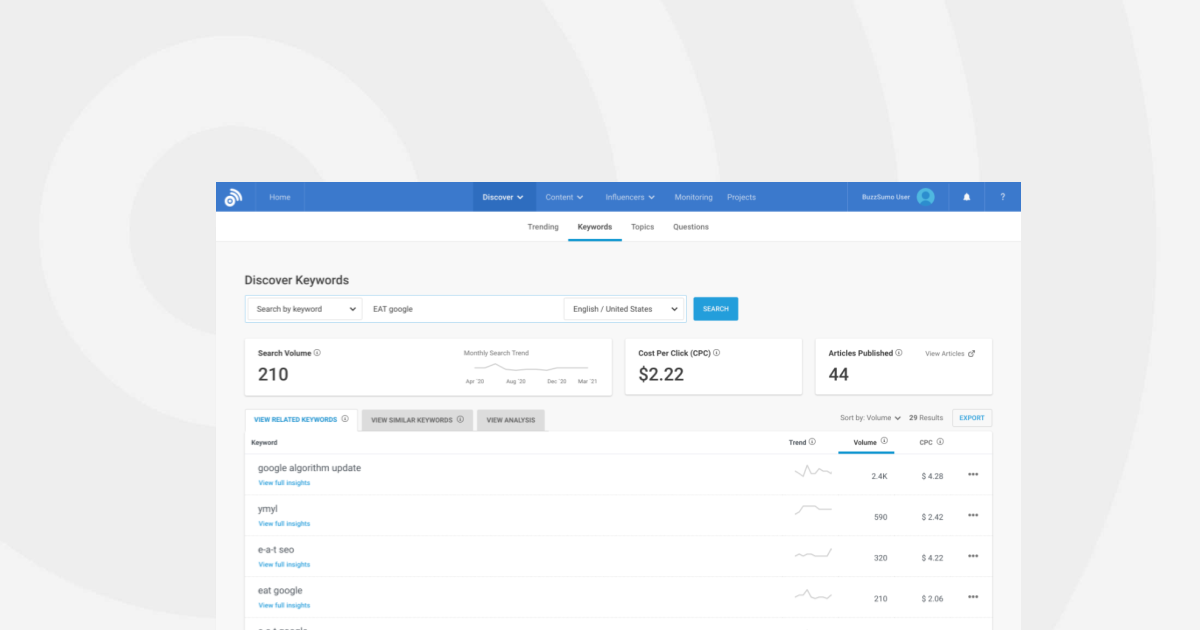
The first step in creating high-E-E-A-T content is to understand what truly resonates with your audience and what competitors are doing effectively. Tools like BuzzSumo’s Content Analyzer allow content strategists to identify widely shared, engaged-with, and linked-to articles within a given niche. By analyzing successful headlines, content structures, and promotional strategies, publishers can glean insights into user preferences and topical coverage. Observing "evergreen" content – articles that maintain high engagement over time – reveals topics with sustained interest and inherent quality. Furthermore, competitive analysis using keyword tools to identify top-ranking content in the SERPs provides a direct benchmark for the depth, format, and authority expected by Google for specific queries. This analytical approach moves beyond guesswork, grounding content creation in data-driven understanding of what "quality" looks like in practice. -
Cultivating Niche Authority and Personal Branding:
Google’s quality raters are explicitly instructed to investigate the author and website behind content to assess their credibility. Building a strong personal and brand authority is no longer optional. This involves actively positioning individuals and organizations as thought leaders in their respective fields. Tactics include:- Public Relations and Media Engagement: Seeking opportunities for interviews, podcasts, guest contributions, and features in reputable industry publications. Tools like BuzzSumo’s Content Analyzer, with its advanced filters, can help identify platforms that regularly feature expert voices.
- Author and Organization Schema Markup: Implementing structured data (Schema.org) to explicitly inform search engines about the author’s credentials, the organization’s background, and their affiliations. This helps Google connect authors and brands across the web, consolidating their digital footprint and signaling authority.
- Consistent Online Presence: Maintaining professional profiles on relevant social media platforms, industry forums, and personal websites. Ensuring consistent messaging and showcasing relevant experience, expertise, and accolades in all bios and bylines reinforces authority. Platforms like Beacons.ai can help centralize these diverse channels.
- Monitoring Industry Leaders: Tracking the content and activities of established authorities in your niche can provide valuable learning opportunities and identify potential collaboration avenues.
-
Embracing a Topic-Centric Content Architecture:
With Google’s emphasis on understanding topics and entities rather than isolated keywords, content strategies must shift towards a "topic cluster" model. This involves identifying broad "pillar content" topics that comprehensively cover a subject, supported by numerous interconnected "cluster content" articles that delve into specific sub-topics.- Pillar Content: A foundational, extensive piece of content (e.g., "The Ultimate Guide to Social Media Marketing").
- Cluster Content: More specific articles that explore facets of the pillar topic (e.g., "Best Practices for Instagram Engagement," "LinkedIn Marketing Strategies for B2B").
- Internal Linking: Robust internal linking between cluster content and the pillar page signals semantic relationships to Google, demonstrating comprehensive coverage and depth of knowledge.
Tools like BuzzSumo’s Topics Explorer can help identify thousands of popular associated topics around a core keyword, guiding the development of a coherent and comprehensive content strategy that aligns with user intent and Google’s topical understanding. This model not only improves SEO but also enhances the user experience by providing a logical pathway through related information.
-
Optimizing Content Depth for User Satisfaction:
Google states it seeks a "satisfying amount" of content, which is highly contextual. The optimal content length is not arbitrary but depends entirely on the searcher’s intent and the topic’s complexity. A quick answer might require a concise paragraph, while a comprehensive guide demands thousands of words.- Intent Matching: For informational queries, users might expect detailed explanations, examples, and step-by-step guides. For transactional queries, brevity and clear calls to action might be more appropriate.
- Data-Driven Length Analysis: Utilizing tools like BuzzSumo’s Content Analysis report, which charts average engagement by content length, can provide insights into what resonates for specific topics. For instance, an analysis of "Social Media Marketing" might reveal that articles between 3,000 and 10,000 words garner the highest engagement, suggesting that users in this niche value in-depth, thorough guides. Conversely, a search for a simple definition might show that shorter articles perform best. This approach ensures content is neither unnecessarily verbose nor insufficiently detailed.
-
Forging Strategic Relationships for Enhanced Visibility:
While traditional link building remains valuable, Google’s advanced understanding of entities means that "relationships" extend beyond mere hyperlinks. Building genuine connections with credible authors, journalists, and publications is paramount. Google’s 10,000+ quality raters, and by extension its algorithms, observe who mentions your brand, who cites your experts, and who you are associated with.- Media Outreach: Using tools like BuzzSumo’s Journalist Database to identify influential journalists and authors in your niche. Understanding their writing interests and past work allows for targeted pitches and genuine collaboration opportunities.
- "Mates First, Links Later": Fostering authentic relationships with industry influencers can lead to organic mentions, citations, and collaborations that signal authority. Even if no direct link is exchanged, Google can semantically understand when your brand is regularly referenced alongside other respected entities, thereby boosting your perceived E-E-A-T.
- Co-citation and Co-occurrence: When authoritative sites mention your brand or experts without necessarily linking, it still contributes to Google’s understanding of your entity’s relevance and authority within its ecosystem.
-
Prioritizing Verifiable and Diverse Sourcing:
Citing sources is fundamental to demonstrating trustworthiness and factual accuracy, especially for YMYL topics. Content that provides a variety of credible references indicates thorough research and an unbiased approach.- Official Sources First: Prioritize official government reports (e.g., using
SITE:GOVin Google searches), academic studies, reputable scientific journals, and recognized industry bodies. - Diverse Sources: Incorporate a mix of primary and secondary sources, avoiding over-reliance on a single perspective.
- Transparency: Clearly attribute all data, statistics, and expert opinions to their original sources.
- Regular Updates: For time-sensitive topics, ensure that sources and data are current and regularly updated. This demonstrates a commitment to accuracy and relevance.
- Official Sources First: Prioritize official government reports (e.g., using
The Future of Content: Beyond Algorithms, Towards User Value
Google’s continuous advancements in AI and machine learning mean that its algorithms are increasingly adept at evaluating content with human-like discernment. This intelligence demands that content creators shift their mindset entirely: from "how do I rank for this keyword?" to "how do I provide the most helpful, accurate, and trustworthy information to my audience?"
The days of gaming the system with superficial SEO tactics are firmly in the past. The future of content strategy lies in genuine value creation, establishing undeniable authority, and fostering trust with both users and search engines. By meticulously focusing on Experience, Expertise, Authoritativeness, and Trustworthiness, publishers can build a sustainable digital presence that not only ranks well but also genuinely serves its audience, solidifying long-term brand credibility and loyalty. This strategic pivot ensures that content is not just found, but also respected and relied upon.