rifanmuazin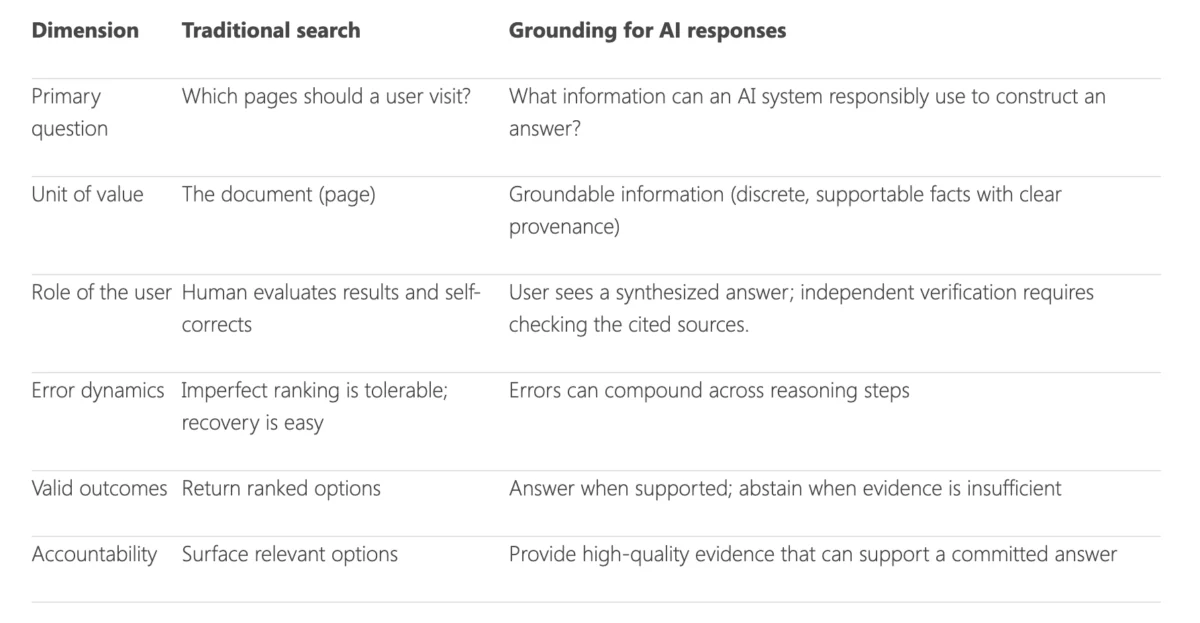
In a pivotal announcement signaling a significant shift in the landscape of digital information processing, Microsoft Bing has formally articulated the fundamental distinctions between traditional search indexing and the emerging paradigm of "grounding indexing" for artificial intelligence (AI) responses. This delineation, detailed in a recent blog post authored by Krishna Madhavan, Knut Risvik, and Meenaz Merchant from Microsoft, asserts that while both functions rely on a common foundational infrastructure, their ultimate objectives and measurement criteria are profoundly different. The core message underscores that indexing for grounded AI answers is not merely an incremental update to search but a profound evolution, committing the AI system to a definitive, trustworthy answer rather than merely pointing users to potential sources.
This strategic clarification comes at a time when the integration of generative AI into search engines is rapidly redefining how users interact with online information. Microsoft, having been at the forefront of this integration with its Copilot (formerly Bing Chat) offering, powered by OpenAI’s GPT models, has consistently emphasized the importance of "grounding" AI responses in factual, verifiable web content to combat issues like hallucination and misinformation. The company’s stance marks a notable contrast, or at least a more explicit differentiation, compared to the messaging from competitors like Google regarding similar AI-driven search initiatives, which have often focused on AI Overviews or Search Generative Experience (SGE) as extensions of traditional search.
The Evolving Purpose of the Index: From Navigation to Affirmation
The central thesis put forth by the Microsoft Bing team is that "search indexing was built to help humans decide what to read. Grounding indexing is being built to help AI systems decide what to say." This distinction is not merely semantic; it necessitates entirely different infrastructural optimizations, even if they originate from the same underlying data collection mechanisms. Traditional search engines, since their inception, have been designed to serve as sophisticated directories, mapping queries to relevant web pages. Their success metrics revolve around user satisfaction with the provided links, the diversity of results, and the speed of retrieval. The user retains the agency to interpret, compare, and synthesize information from multiple sources.
In contrast, grounding indexing assumes a more active, authoritative role. It aims to furnish AI systems with the robust, verifiable evidence required to construct accurate, contextually appropriate, and trustworthy responses. This implies a higher bar for factual accuracy, source credibility, and the ability to extract precise data points rather than entire documents. The infrastructure, therefore, must be optimized not just for relevance in the classical sense, but for the "strength of evidence" a piece of information provides.
Microsoft provided illustrative examples to clarify this dichotomy. For instance, a traditional search query like "How tall is the Eiffel Tower?" would yield various pages discussing the Eiffel Tower, its history, dimensions, and perhaps even tourist information. The user would then sift through these pages to find the exact height. A grounding index, however, would aim to provide the AI system with the specific, verified fact (e.g., "330 meters including antenna") and the authoritative source from which that fact is derived, enabling the AI to directly answer the query with confidence.
Redefining Index Quality in the AI Era
The introduction of grounding indexing fundamentally reshapes the metrics by which "index quality" is assessed. In the realm of traditional search, quality often correlates with factors such as:

- Coverage: How much of the web is indexed?
- Freshness: How quickly new content is discovered and added?
- Relevance: How well do indexed pages match user queries?
- Diversity: Offering a range of perspectives or types of content.
- Page Quality: Factors like E-E-A-T (Experience, Expertise, Authoritativeness, Trustworthiness) of the source.
For grounding indexing, while these traditional metrics remain important foundational elements, an additional, more stringent layer of evaluation is applied. The focus shifts to:
- Facticity: Is the information objectively true and verifiable?
- Granularity: Can specific data points or statements be extracted rather than just broad topics?
- Attribution: Can the source of the specific piece of evidence be clearly identified and linked?
- Consistency: Does the information align with other authoritative sources?
- Safety/Harmfulness: Does the information pose any risk if presented by an AI?
This evolution means that a page considered high-quality for traditional search (e.g., a well-written opinion piece or a comprehensive blog post) might not be ideal as "grounding evidence" for an AI if it lacks precise, verifiable facts or clear attribution. Conversely, a highly factual, perhaps dry, data repository might be invaluable for grounding, even if it wouldn’t typically rank high for a broad search query.
The Foundational Overlap and New Optimization Layers
Crucially, Microsoft emphasizes that grounding does not supersede or replace traditional search. Instead, it builds upon the same foundational infrastructure. This means the vast network of crawlers that traverse the web, the sophisticated algorithms that identify quality signals, and the deep understanding of web semantics and content structures developed over decades of search engine evolution remain indispensable. The difference lies in the "new optimization layer" added on top for grounding.
This new layer involves advanced natural language processing (NLP) techniques, knowledge graph integration, and sophisticated fact-checking mechanisms. It requires the index to not just store documents, but to parse them into discrete, verifiable assertions that an AI can confidently utilize. This involves identifying entities, relationships, attributes, and temporal contexts within text, and cross-referencing these against known facts and other indexed information.
Historical Context and the Rise of Generative AI
The imperative for grounding indexing has been amplified by the rapid ascent of generative AI technologies. Prior to late 2022, AI in search was primarily about improving relevance and understanding user intent. With the public release of models like ChatGPT, the potential for AI to directly generate human-like text responses became evident. Microsoft quickly integrated this capability into Bing in early 2023, positioning itself as an innovator in "AI-powered search."
However, the early days of generative AI also brought to light its significant limitations, most notably the phenomenon of "hallucinations"—where AI models confidently present false information as fact. This underscored the critical need for AI systems to be "grounded" in verifiable, external knowledge. Without such grounding, AI responses, however fluent, risk eroding user trust and spreading misinformation. This context provides the backdrop for Microsoft’s current explicit articulation of grounding indexing as a distinct and vital component of its AI strategy. The timeline saw Bing’s AI integration, followed by Google’s response with Bard (now Gemini) and SGE, both grappling with similar challenges of accuracy and reliability in AI-generated answers.
Statements from Microsoft Leadership

The significance of this announcement is further underscored by reactions from key figures within Microsoft. Krishna Madhavan, one of the co-authors, elaborated on LinkedIn, stating, "In our new blog post published today, we examine the transformation that occurs when the index evolves from merely assisting users in finding pages to aiding AI systems in providing answers. Co-authored with Knut Risvik and Meenaz Merchant, we discuss how the unit of value transitions from documents to evidence, and why this shift is crucial for establishing AI that people can genuinely trust." This statement concisely captures the essence of the transition: from documents as the primary unit of value to individual pieces of verifiable evidence.
Jordi Ribas, Corporate Vice President of Search and AI at Microsoft, echoed this sentiment on X (formerly Twitter), highlighting the broader implications: "In the era of the agentic web, the role of the web index needs to evolve to support very different needs across agents and humans." Ribas’s comment points to a future where AI "agents" will increasingly navigate and synthesize information, requiring an index tailored to their distinct operational needs, separate from how humans browse. This suggests a future where AI systems might interact with the web directly, leveraging this new indexing paradigm to perform complex tasks and generate informed actions.
Implications for Web Publishers and SEO Professionals
This evolution has profound implications for web publishers, content creators, and search engine optimization (SEO) professionals. The traditional SEO focus on keywords, backlinks, and user engagement for ranking purposes will need to adapt to the new reality of grounding.
- Shift to Evidence-Based Content: Content that provides clear, verifiable facts, data, and expert opinions, with proper citations and structured data, will likely gain prominence in the grounding index. Publishers may need to think less about "what people want to read" and more about "what facts an AI needs to know."
- Granularity and Structure: Content that is easily parsable into discrete facts, perhaps through the use of schema markup, structured data, and clear headings, will be more amenable to grounding. Long, discursive paragraphs without clear factual statements might be less useful for AI grounding, even if they are engaging for human readers.
- Authoritativeness and Trust: The emphasis on "strength of evidence" means that content from highly authoritative and trustworthy sources will be paramount. Building a reputation for accuracy, expertise, and transparency will become even more critical.
- The "Zero-Click" Dilemma: As AI provides direct answers, the traditional click-through from search results to websites might diminish for certain types of queries. Publishers will need to re-evaluate their monetization strategies and consider how to derive value when their content is primarily consumed by AI for grounding, rather than directly by users clicking through. This could lead to a greater emphasis on brand building, direct traffic, and niche authority.
- New Optimization Strategies: SEO will likely evolve to include "AI grounding optimization" (AIGO), focusing on making content easily digestible, verifiable, and attributable for AI systems. This might involve new technical SEO practices, content formatting guidelines, and perhaps even direct API integrations for content syndication to AI models.
Broader Impact and Future Outlook
The explicit distinction between search and grounding indexing by Microsoft Bing is more than a technical detail; it is a philosophical statement about the future of information access. It acknowledges that the era of AI necessitates a fundamental re-evaluation of how knowledge is organized, retrieved, and presented.
- Enhanced Trust in AI: By prioritizing "strength of evidence," Microsoft aims to build AI systems that users can genuinely trust. This is a crucial step in ensuring the responsible development and deployment of generative AI.
- Computational Demands: Maintaining two distinct yet interconnected indexes, each optimized for different objectives, will undoubtedly require immense computational resources. The scale of web data, combined with the need for granular fact extraction and verification, presents a significant engineering challenge.
- Ethical Considerations: The power of AI to synthesize and present information directly raises ethical questions about bias, fairness, and the potential for misuse. Grounding indexing, with its emphasis on verifiable evidence, is a mechanism to mitigate some of these risks, but ongoing vigilance will be necessary.
- The "Agentic Web": As alluded to by Jordi Ribas, the concept of an "agentic web" where AI systems act autonomously on behalf of users suggests a future where the primary consumers of indexed information might not always be humans. This could fundamentally alter web design, content creation, and the very economics of the internet.
In conclusion, Microsoft Bing’s detailed explanation of search indexing versus grounding indexing signifies a profound evolution in how search engines are adapting to the age of artificial intelligence. It underscores a strategic commitment to building AI systems that are not only intelligent but also trustworthy, by ensuring their responses are firmly rooted in verifiable evidence. This architectural shift, while complex, is essential for navigating the opportunities and challenges presented by generative AI, ultimately shaping how humanity accesses and interacts with knowledge in the digital age. The implications ripple across the entire digital ecosystem, from search engine developers to web publishers, and ultimately, to every internet user.