rifanmuazin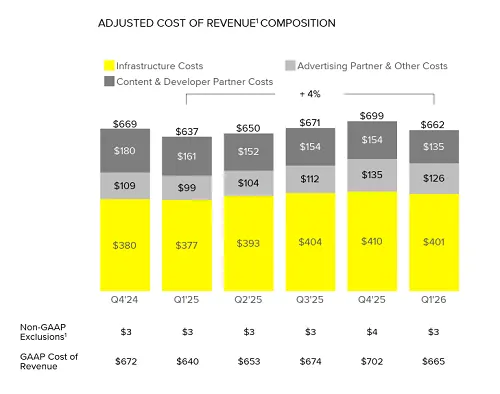
Snap Inc., the parent company behind the popular social media platform Snapchat, has released its First Quarter 2026 earnings report, revealing a nuanced financial and user landscape. While the company posted an increase in its global daily active users (DAU) and a steady performance in its advertising business, the report underscored persistent challenges in its most lucrative markets and highlighted significant regulatory headwinds threatening its core demographic. This "crucible moment," as described by CEO Evan Spiegel, reflects the critical juncture Snap finds itself in, striving to innovate and expand amidst intense competition and evolving societal expectations for social media platforms.
Q1 2026 Financial Overview: Revenue Growth Versus Profitability Concerns
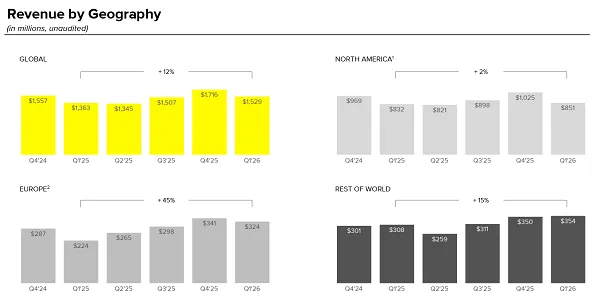
For the first quarter of 2026, Snap Inc. reported a total revenue of $1.53 billion, marking a 12% year-over-year increase. This growth was largely attributed to the robust performance of its diversified advertising offerings. Sponsored Snaps, a key format allowing advertisers to create interactive, branded content within the Snapchat ecosystem, demonstrated strong engagement and conversion rates. Complementing this, Dynamic Product Ads, which enable businesses to automatically showcase relevant products to users based on their interests and behaviors, saw impressive growth exceeding 30% year-over-year. This particular ad format resonated especially well with Small and Medium Business (SMB) customers, indicating Snap’s success in broadening its advertiser base beyond large corporations.
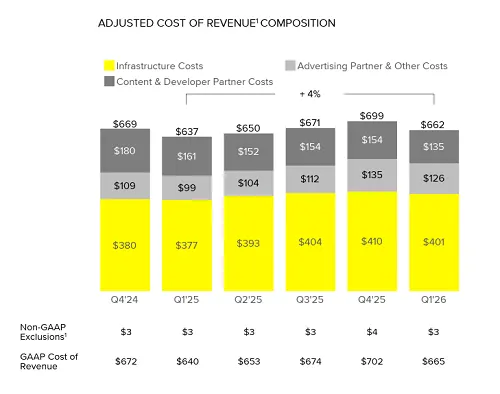
Despite the positive revenue trajectory, profitability remains a critical concern for Snap. The earnings report illustrated that operating costs continue to be substantial, putting pressure on the company’s bottom line. While Snap has undertaken significant measures to optimize its cost structure, including a widely reported workforce reduction of approximately 16% of its full-time staff in late 2025, these efforts are yet to fully translate into consistent profitability. Analysts frequently point to the high expenditure on cloud infrastructure, research and development for new technologies like augmented reality (AR), and marketing as primary drivers of these elevated costs. The delicate balance between investing in future growth and achieving financial self-sufficiency continues to define Snap’s operational strategy. The company’s Adjusted EBITDA, while showing signs of improvement in efficiency, still reflects the ongoing challenge of scaling profitably, particularly as user acquisition shifts towards lower-ARPU regions.
User Growth: Global Expansion Masks Regional Contractions
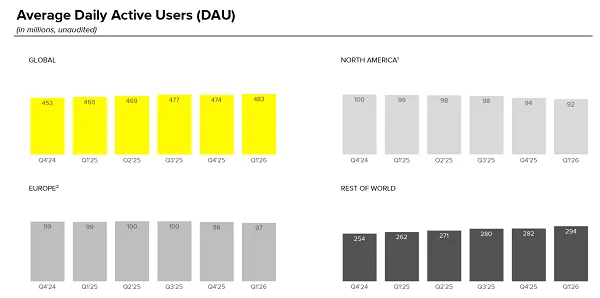
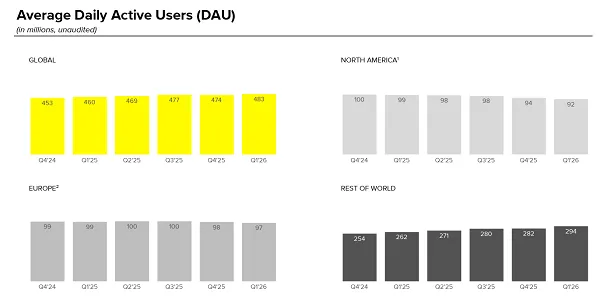
Snapchat’s global daily active user (DAU) count reached 483 million in Q1 2026, adding 9 million users since the previous quarter. This figure represents a notable rebound from Q4 2025, when the platform experienced a quarter-over-quarter loss of 3 million users. Furthermore, monthly active usage (MAU) also saw an uptick, rising to 956 million from 946 million in Q4 2025, indicating a broader reach even if daily engagement varies.
However, a deeper dive into the user metrics reveals a stark regional disparity. The topline global growth figure obscures significant declines in Snap’s most financially vital markets. In North America, which historically generates the vast majority of Snapchat’s revenue per user, DAU decreased by another 2 million, settling at 92 million. This marks a concerning trend of sustained user attrition in a region characterized by high advertising spend and mature digital economies. Similarly, the European market experienced a decline of 1 million users compared to the previous quarter, signaling similar saturation and competitive pressures.
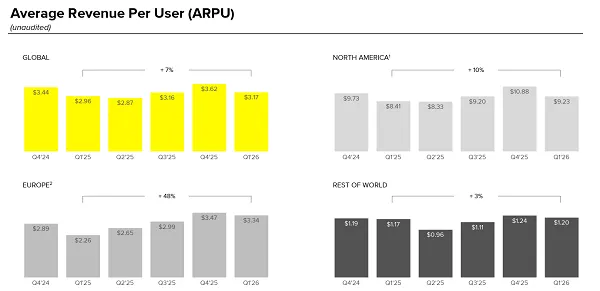
Conversely, all of Snap’s user growth in Q1 2026 originated from the "Rest of World" category. This segment, encompassing burgeoning markets in Asia, Africa, and Latin America, represents significant potential for expansion but currently yields considerably lower average revenue per user (ARPU). For instance, while North America might boast an ARPU upwards of $7-$8, emerging markets often hover below $1, reflecting lower advertising rates, nascent digital ad ecosystems, and differing consumer spending habits. This creates a strategic dilemma for Snap: while expanding its global footprint, it simultaneously faces the challenge of effectively monetizing these new user bases to offset the revenue impact of shrinking audiences in its traditional high-value markets. The company’s ability to develop region-specific monetization strategies and grow its ad infrastructure in these developing areas will be paramount to translating user growth into sustainable financial performance.
Regulatory Pressures: The Looming Threat of Age Restrictions
One of the most significant and potentially disruptive challenges facing Snapchat is the escalating global movement towards increased age restrictions on social media use. Governments and regulatory bodies worldwide are increasingly scrutinizing the impact of social media on youth mental health and development, leading to calls for stricter age verification and outright bans for minors under certain ages.
Australia has been at the forefront of this trend, implementing bans for users under the age of 16. In February, Snapchat reported that this Australian ban had forced the company to lock or disable approximately 415,000 teen accounts within the nation. Given Australia’s population of around 27 million, this figure represents a substantial segment of its youth demographic. The implications of such bans expanding to larger, key markets are profound.
Several major European nations are actively considering similar legislation. Germany, with a population of 84 million, the United Kingdom (69 million), and Spain (49 million) are all engaged in discussions or legislative processes to implement teen social media bans. To illustrate the potential impact, if we conservatively extrapolate the Australian experience (where roughly 1.5% of the total population saw their accounts affected), a ban in Germany could lead to an estimated loss of over 1.2 million users for Snapchat. In the UK, this could mean around 1 million fewer users, and in Spain, approximately 700,000. These are substantial figures that could cumulatively result in several million user losses across Snap’s key European markets, further exacerbating the existing user decline in the region.
Snapchat is particularly vulnerable to these regulations due to its strong appeal among younger audiences. Historically, the platform has been a dominant force among teenagers and young adults, making any policy that restricts access for this demographic a direct threat to its core user base. The company faces a difficult balancing act: complying with evolving regulations while attempting to retain its youthful appeal and prevent significant user exodus. The long-term effects of these bans could not only reduce user numbers but also diminish the platform’s overall market share among the next generation of social media users, impacting future growth pipelines.
The Competitive Landscape and Demographic Shift
Snapchat operates in an intensely competitive digital landscape, battling tech giants and nimble startups for user attention and advertising dollars. Its primary rival for youth engagement remains TikTok, which has revolutionized short-form video and consistently innovated its content formats. Snapchat’s "Spotlight" feature, designed to compete with TikTok’s viral video feed, has seen some traction but has largely been perceived as an imitative effort rather than a groundbreaking innovation.
Meta platforms, including Instagram and Facebook, also pose a significant threat. Instagram’s Reels directly compete with Snapchat’s video content, while its Stories format was famously inspired by Snapchat’s original innovation. Meta’s broader ecosystem, with its extensive user base and sophisticated advertising tools, provides a formidable challenge, particularly as users age out of Snapchat’s core demographic. YouTube Shorts further fragments the short-form video market, vying for the same attention span.
A perennial challenge for Snapchat has been its struggle to retain users as they transition into older demographics. While many users flock to Snapchat in their teenage years, engagement often wanes as they mature and gravitate towards platforms with broader social circles or more diverse content offerings. This demographic churn means Snapchat is constantly reliant on acquiring new, younger users, a pipeline that is now threatened by age restrictions. This inherent limitation on its market capitalization, tied to a younger and more transient user base, makes long-term sustained growth more complex compared to platforms with broader age appeal like Facebook or YouTube.
Innovation and Future Bets: A High-Stakes Gamble
Snap’s growth strategy, as outlined in its investor presentations, centers on three pillars: growing and engaging its community, accelerating and diversifying revenue, and investing in the future. While the company is making strides in diversifying its ad revenue and achieving global user growth (albeit in lower-monetization regions), its investment in future technologies, particularly augmented reality (AR), represents a high-stakes gamble.
The company is still aiming to launch its next iteration of AR Spectacles this year, building on previous, commercially unsuccessful versions. However, early indications suggest that this new device may face significant hurdles. Described as "chunky and heavy," the form factor could be a major deterrent for consumer adoption. Furthermore, the competitive landscape for AR wearables is intensifying. Meta, a formidable rival with deep pockets and extensive R&D capabilities, has ambitious plans to release its own advanced AR glasses around 2027. Meta’s Project Aria, for instance, has been sharing technical details of its research, pointing towards a sleek, powerful device. This suggests that Snap’s offering, even if it brings advanced AR functionality, might be outpaced in terms of design, user experience, and ecosystem integration by Meta’s subsequent entry. Consumer demand for dedicated AR wearables remains largely unproven, and the high cost of developing and marketing such devices places considerable strain on Snap’s resources, especially given its ongoing profitability challenges.
Beyond hardware, Snap is also exploring new software-based monetization avenues. The introduction of "ads in user DMs" and "sponsored AI chatbots" are examples of its aggressive push to expand advertising placements. While these innovations could unlock new revenue streams by allowing advertisers to reach Snapchat’s influential audience in more personal contexts, they also carry the risk of user backlash. An influx of intrusive ads could disrupt the "connective experience" that users value, potentially leading to decreased engagement or even user exodus, as seen with similar monetization attempts on other platforms. Balancing revenue generation with user experience is a perennial challenge for social media companies, and Snap’s ventures into these highly personal spaces will be closely watched.
Snapchat+ subscription revenue, while growing, remains a secondary revenue stream. While it offers premium features and an ad-free experience for some, its financial contribution is unlikely to ever rival the scale of ad intake, reinforcing the platform’s core dependency on advertising.
A Crucible Moment: Navigating Uncertainty
Evan Spiegel’s characterization of this period as a "crucible moment" aptly encapsulates the profound challenges and strategic decisions facing Snap Inc. The company’s ability to compete with established tech giants like Meta and Google, while simultaneously fending off agile startups, requires continuous innovation and shrewd execution.
The path forward for Snap is multifaceted and fraught with uncertainty. It needs to find effective ways to maximize business opportunities and significantly increase revenue per user in the emerging markets where it is currently experiencing growth. Simultaneously, it must address the persistent user decline in North America and Europe, either by innovating to re-engage older demographics or by accepting a more niche position. The escalating regulatory landscape regarding youth usage demands proactive engagement and potentially significant adjustments to its product and user acquisition strategies.
The success of its long-term bets, particularly in augmented reality, is far from guaranteed and will require substantial investment without immediate returns. The delicate balance between aggressive monetization and preserving the user experience will determine if new ad formats become a sustainable revenue driver or a source of user discontent.
In essence, Snap’s future hinges on its capacity to transcend its image as primarily a "youth app" and to cultivate a more diverse, engaged, and monetizable global audience. As the digital landscape continues to evolve at a rapid pace, all eyes will be on Snap to see if it can successfully navigate this complex period and emerge stronger, or if the pressures of competition and regulation will constrain its long-term potential.