rifanmuazin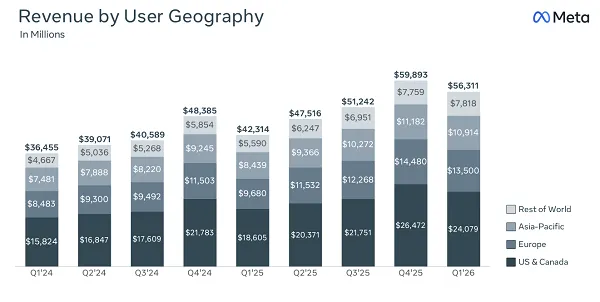
Meta Platforms Inc. has released its first-quarter 2026 performance update, presenting a complex financial narrative marked by an unprecedented dip in daily active users across its family of applications, yet simultaneously demonstrating robust revenue growth driven by aggressive monetization strategies. The report underscores Meta’s unwavering commitment to an AI-centric future, a strategic pivot that entails substantial investments and consequential operational adjustments. This period’s results offer critical insights into the company’s navigation of geopolitical challenges, evolving regulatory landscapes, and its ambitious pursuit of next-generation artificial intelligence capabilities.
A Noteworthy Dip in User Engagement
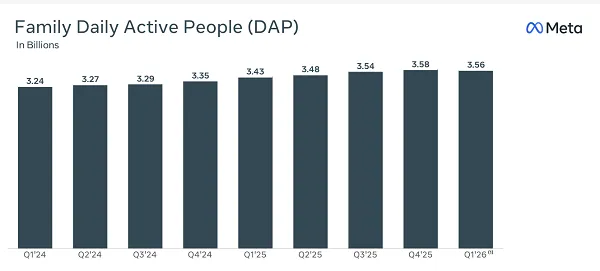
For the first time in its history, Meta reported a decline in its daily active user (DAU) count, registering 3.56 billion users across its suite of applications for Q1 2026. This represents a marginal, yet symbolically significant, decrease from the 3.58 billion DAU reported in the preceding quarter, Q4 2025. While seemingly slight in absolute terms, this contraction marks a critical inflection point for a company that has historically showcased consistent user expansion, even in mature markets. The decline signals potential saturation in some regions, combined with specific external pressures that are impacting user accessibility and engagement. The company’s family of apps, encompassing Facebook, Instagram, WhatsApp, and Messenger, traditionally serves as the bedrock of its advertising revenue, making any dip in user numbers a point of heightened scrutiny for investors and market analysts.
The significance of this user contraction is further amplified by Meta’s recent efforts to diversify and expand its user base through new platforms such as Threads and its dedicated Meta AI app. Despite these initiatives, designed to capture new audiences and re-engage existing ones, the overall user count experienced a downturn, prompting questions about the effectiveness of these new offerings in offsetting external headwinds.
Geopolitical Headwinds and Regulatory Shifts Impacting User Base
Meta attributed the decline in user numbers to a confluence of external factors, primarily internet disruptions in Iran, a governmental restriction on access to WhatsApp in Russia, and new teen social media restrictions implemented in Australia. Each of these situations reflects broader global trends impacting large technology companies.
In Iran, long-standing government policies of internet censorship and periodic disruptions to quell civil unrest or control information flows have consistently posed challenges for global communication platforms. These disruptions often manifest as throttling of international bandwidth, blocking of specific services, or complete internet blackouts, directly impacting the ability of millions of users to access Meta’s apps. Such actions are a testament to the complex interplay between technology, governance, and human rights, where state control over digital infrastructure can directly impede user access to global platforms.
Meanwhile, Russia’s escalating digital sovereignty efforts have led to a systematic crackdown on foreign social media and messaging applications. The ban on WhatsApp, alongside other platforms like Facebook and Instagram (which were already restricted), is part of a broader strategic move by the Russian government to compel its citizens towards state-owned or domestically controlled messaging and social media tools. This policy, driven by national security concerns and a desire for greater control over information dissemination, has effectively severed a significant portion of Meta’s potential user base in a large, populous market. The blocking of WhatsApp in Russia, a country where it previously held significant market penetration, underscores the growing fragmentation of the global internet and the challenges for tech companies operating across diverse geopolitical landscapes. This restriction directly translates into a loss of active users who are either unable or unwilling to circumvent the ban.
Furthermore, Meta cited new teen social media restrictions in Australia as another contributing factor. Globally, there is an increasing regulatory focus on youth safety and mental well-being on social media platforms. Australia, among other nations, has been at the forefront of implementing stricter age verification processes, content moderation rules, and usage limits for minors. While these measures are often lauded for protecting younger users, they can inadvertently create barriers to entry or reduce engagement for a demographic that is crucial for platform growth and future user acquisition. These restrictions can lead to a slight, but measurable, decline in active users as some younger individuals may find it harder to access or maintain accounts under the new rules. The cumulative effect of these distinct, geographically specific challenges painted a picture of a company grappling with external forces beyond its immediate control.
Robust Revenue Growth Amidst Strategic Shifts
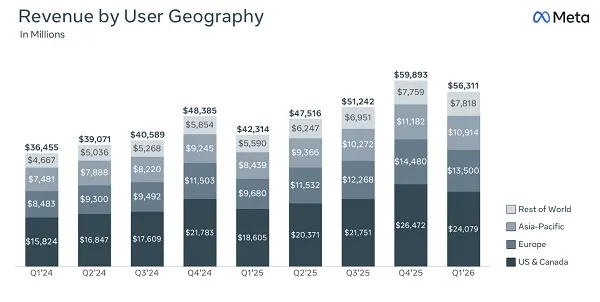
Despite the unprecedented user dip, Meta’s financial performance painted a picture of significant strength on the revenue front. The company reported $56.31 billion in revenue for the first quarter, marking an impressive 33% increase year-over-year. This substantial growth indicates that Meta has successfully decoupled its revenue generation from its immediate user acquisition trajectory, at least in the short term. The ability to achieve such robust financial expansion in the face of user stagnation highlights the effectiveness of its sophisticated monetization strategies and the continued demand for its advertising inventory.
Monetization Strategies and Ad Load Optimization
The primary drivers behind this strong revenue performance were an increase in ad impressions delivered across Meta’s applications and a rise in the average price per ad. Ad impressions increased by a significant 19% year-over-year, while the average price per ad saw a 12% year-over-year increase. This dual growth in both quantity and cost per ad suggests a multi-pronged approach to revenue optimization.
The increase in ad impressions indicates that Meta is likely integrating more advertisements into its users’ feeds, stories, and other content streams across Facebook, Instagram, and potentially other surfaces. This "ad load" optimization is a common strategy for mature platforms seeking to maximize revenue from their existing user base. While effective for revenue, an excessive increase in ad load can sometimes risk user experience, potentially leading to fatigue or even disengagement, a factor Meta continually balances.
Concurrently, the 12% increase in average ad price reflects strong demand from advertisers and potentially improved targeting capabilities, allowing Meta to command higher prices for its ad placements. The digital advertising market, despite broader economic fluctuations, continues to demonstrate resilience, with businesses allocating significant budgets to reach Meta’s vast and highly segmented audience. This pricing power is also indicative of Meta’s continued innovation in ad formats, measurement tools, and performance optimization, which provides a compelling value proposition for advertisers. The combination of more ads and higher-priced ads underscores Meta’s determination to extract maximum value from its platforms to fund its ambitious long-term projects.
The High Cost of an AI-Driven Future
Meta’s impressive revenue growth is set against a backdrop of escalating operational costs, largely fueled by its aggressive investments in artificial intelligence. Total costs and expenses for Q1 2026 amounted to $33.44 billion, representing a substantial 35% increase year-over-year. This surge in expenditure is directly tied to CEO Mark Zuckerberg’s vision for Meta as a leader in AI, a commitment that he has articulated will require "hundreds of billions" in capital expenditures over the coming years. Earlier reports indicated Meta’s commitment of up to $600 billion into AI infrastructure spending, a figure that dwarfs many national R&D budgets.
These investments span a wide array of AI initiatives, including the development of powerful large language models (LLMs) like Llama, advanced generative AI tools for content creation and advertising, AI assistants integrated across its platforms, and the necessary compute infrastructure—data centers, specialized chips, and high-bandwidth networks—to support these endeavors. The race to build foundational AI models and integrate them into consumer products is incredibly capital-intensive, requiring immense computing power and a global talent pool of highly specialized engineers and researchers. The substantial increase in costs reflects the company’s aggressive pace in acquiring these resources, from securing vast quantities of NVIDIA GPUs to expanding its global data center footprint and hiring top AI talent. This heavy investment is deemed essential for Meta to maintain its competitive edge against rivals like Google, Microsoft, and OpenAI, who are also pouring billions into AI research and deployment.
Reality Labs: A Glimmer of Fiscal Improvement
Amidst the broader surge in expenses, Meta reported a slight reduction in losses within its Reality Labs division, the segment responsible for its metaverse vision and hardware initiatives such as the Quest VR headsets and Ray-Ban Meta smart glasses. This division has historically been a significant drain on Meta’s financials, incurring billions in losses quarter after quarter as it builds out nascent technologies. The modest improvement in Q1 2026 suggests that recent strategic adjustments, including significant staff cuts announced within Reality Labs, may be starting to yield some fiscal discipline. Earlier reports indicated a 10% reduction in staff within this division, part of a wider series of layoffs aimed at rationalizing operations and focusing resources on the most promising areas. While still operating at a loss, any reduction is a positive signal that Meta is attempting to manage the financial burn rate of its long-term metaverse bets, even as its primary focus shifts more acutely towards AI. The long-term vision for Reality Labs, particularly its integration with AI-powered experiences, remains a critical component of Meta’s future, but its immediate financial performance is being closely scrutinized.
Strategic Headcount Rebalancing
Despite the widely publicized staff reductions across various departments, Meta’s overall headcount saw a 1% increase year-over-year. This seemingly paradoxical outcome highlights a strategic rebalancing of its workforce. The company has been aggressively shedding roles in areas deemed less critical or redundant, while simultaneously making significant new hires in specialized AI-related fields. This includes recruiting top-tier machine learning engineers, data scientists, AI researchers, and infrastructure specialists. The overall headcount increase, therefore, reflects a strategic pivot in talent acquisition, emphasizing the critical importance of AI expertise to Meta’s future product development and competitive standing. This re-allocation of human capital underscores the company’s long-term commitment to AI as its core technological frontier.
Analyst Perspectives and Company Outlook
Industry analysts have offered mixed reactions to Meta’s Q1 2026 report. While the substantial revenue growth and improved monetization metrics are generally viewed positively, the unprecedented decline in daily active users has raised concerns about long-term user acquisition trends and market saturation. Many analysts acknowledge the external factors contributing to the user dip but emphasize the need for Meta to demonstrate sustainable user growth in subsequent quarters.
Inferred statements from Meta executives would likely emphasize the company’s strategic long-term vision. CEO Mark Zuckerberg might state, "Our first-quarter results reflect our strategic commitment to building the future of AI, which we believe will unlock unprecedented opportunities for connection and economic growth. While navigating a complex global landscape that impacts user numbers in specific regions, our robust revenue performance demonstrates the underlying strength of our platforms and the effectiveness of our monetization efforts. The investments we are making today in AI infrastructure and talent are foundational to delivering innovative experiences and maintaining our leadership position for decades to come."
A CFO might add, "We are managing our capital allocation with discipline, focusing on strategic expenditures that drive future growth. The efficiency measures taken across the company, including in Reality Labs, are enabling us to fund our aggressive AI roadmap while delivering strong financial returns. Our ability to increase both ad impressions and average ad prices highlights the continued value we provide to advertisers and our capacity to monetize our massive global reach."
Market analysts, such as those from major investment banks, might comment, "Meta’s Q1 2026 results present a classic growth-versus-investment dilemma. The user decline, while attributable to specific geopolitical events, is a red flag that warrants close monitoring. However, the company’s exceptional revenue growth, driven by effective ad monetization, provides the necessary capital for its ambitious AI pivot. The market will be closely watching for clear signs of ROI from these massive AI investments and how they translate into renewed user engagement and innovative product offerings in the coming quarters. The reduced losses in Reality Labs are a welcome sign of improved operational efficiency in a division that has historically been a significant drag on earnings."
Broader Implications and Future Trajectory
Meta’s Q1 2026 report paints a vivid picture of a technology giant in transition. The company is actively reshaping its core business model, moving from a primary focus on user growth at all costs to a more refined strategy that balances aggressive monetization with massive, long-term investments in AI. The 3.56 billion daily active users, while slightly down, still represent an unparalleled global reach, connecting nearly a quarter of the world’s population every single day. This vast ecosystem continues to offer immense opportunities for revenue generation and the deployment of new AI-powered features.
However, the numbers also serve as a stark reminder that Meta operates in an increasingly complex and fragmented global digital landscape. Geopolitical tensions, regulatory pressures, and evolving user preferences will continue to shape its trajectory. The success of Meta’s colossal AI bets is paramount. These investments are not merely incremental upgrades; they are fundamental shifts aimed at redefining how users interact with its platforms, how content is created and consumed, and how businesses connect with customers. The ability to translate these AI advancements into compelling user experiences and new revenue streams will be the ultimate determinant of Meta’s long-term success.
The company’s strategic rebalancing of its workforce, emphasizing AI talent, and its efforts to manage the financial burden of Reality Labs, suggest a disciplined approach to navigating this complex period. While the short-term challenge of user stagnation demands attention, Meta’s Q1 2026 performance ultimately reflects a company with immense financial power and a clear, albeit costly, vision for its AI-driven future. The coming quarters will be critical in demonstrating whether these strategic pivots can yield sustained growth, innovation, and a renewed sense of purpose in the ever-evolving digital realm.