
 rifanmuazin
On January 24, 2026, a significant disruption impacted teams utilizing Salesforce Marketing Cloud (SFMC) for email campaigns, leading to widespread deliverability issues, broken links, and damaged sender reputations. The incident, stemming from a security vulnerability patch and subsequent incompatibility with Microsoft’s email infrastructure, highlighted the intricate and often fragile nature of the global email ecosystem. This event caused considerable alarm among marketers and technical teams, particularly given its immediate follow-up to a separate major Microsoft outage.
Background to the Disruption: A Security Patch and Unforeseen Consequences
The genesis of this widespread problem can be traced back to Salesforce’s proactive measure to address a potential security vulnerability within its Marketing Cloud platform. In an effort to fortify its email infrastructure against potential threats, Salesforce implemented a critical update by migrating to a new, more secure method of authenticated encryption. This move, while essential for enhancing the platform’s security posture, inadvertently introduced a significant compatibility challenge.
The new encryption solution, deployed on January 21, 2026, was not backward-compatible with the encryption method previously used. The immediate consequence was that all email links generated before this date – meaning links embedded in emails sent prior to January 21 – effectively expired and ceased to function. This created a silent, ticking time bomb within recipients’ inboxes, as countless active campaigns suddenly contained dead links. Salesforce promptly issued a security notification, providing technical details and guidance to affected users.
However, the problem was further exacerbated by an unforeseen interaction with Microsoft’s email systems. The newly generated links by SFMC, a direct result of the updated encryption, were substantially longer than their predecessors, often more than double the original character count. This increased length proved problematic for legacy rules within Microsoft’s mail infrastructure, particularly for services like Hotmail, Outlook, and Microsoft 365. When email messages exceeded certain character limits, these legacy systems automatically inserted line breaks. Crucially, these unintended line breaks corrupted Domain Keys Identified Mail (DKIM) signatures, a vital email authentication standard designed to detect email spoofing. A broken DKIM signature signals to recipient mail servers that an email might be fraudulent or tampered with, leading to severe deliverability penalties.
A Chronology of Compounding Issues
The sequence of events underscores the cascading nature of digital disruptions:

- Pre-January 21, 2026: Salesforce Marketing Cloud operates with its previous encryption method. Emails are sent, containing links that rely on this method.
- January 21, 2026: Salesforce implements a new, more robust authenticated encryption method to address a security vulnerability. This update renders all previously generated links (those sent before this date) non-functional due to incompatibility.
- January 22-23, 2026: Microsoft experiences a significant, unrelated outage affecting its email services. This incident independently causes a surge in soft bounce activity for emails directed to Hotmail, Outlook, and Microsoft 365 users, creating a pre-existing state of email instability.
- January 24, 2026: SFMC users begin experiencing "major disruptions." The combination of expired links from the SFMC security patch and the DKIM signature breakage due to longer links interacting with Microsoft’s legacy systems leads to widespread deliverability failures.
- Immediate Aftermath: Senders and subscribers face a barrage of issues: non-functional unsubscribe links, dramatically increased bounce rates, widespread authentication failures, and a significant erosion of sender reputation.
This timeline reveals a perfect storm of technical challenges, where an essential security upgrade from one major vendor (Salesforce) collided with the architectural nuances and a separate outage of another critical vendor (Microsoft), resulting in widespread disruption for mutual users.
Profound Impact on Senders, Subscribers, and Compliance
The ramifications of this incident were felt immediately and severely across the entire email marketing spectrum. For senders, the impact was multi-faceted and damaging:
- Broken Click-Throughs and User Experience: All click-through traffic from emails sent before January 21 was directed to generic error pages. This meant promotional offers, transactional confirmations, password reset links, and critical customer communications simply did not work. This led to immense frustration for subscribers and a significant loss of potential revenue and engagement for businesses.
- Severe Compliance Issues: Perhaps most critically, unsubscribe links embedded in older emails also ceased to function. This created serious compliance violations under regulations such as GDPR (General Data Protection Regulation) and CAN-SPAM Act, which mandate easily accessible and functional unsubscribe mechanisms. Businesses found themselves in a precarious legal position, unable to honor opt-out requests, which could lead to hefty fines and further damage to brand trust.
- Massive Increase in Bounce Rates and Authentication Failures: The breakage of DKIM signatures, particularly for emails destined for Microsoft inboxes, resulted in a massive surge in hard bounces. Email servers, unable to verify the sender’s authenticity, rejected these messages outright. This, combined with the soft bounces from the earlier Microsoft outage, painted a picture of unreliability for sending domains.
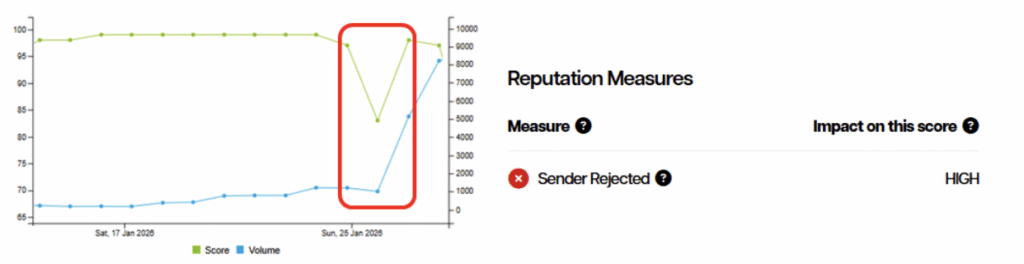
- Damaged Sender Reputation: Data from Validity, a leading email deliverability and sender reputation firm, indicated a severe degradation of sender reputations. Their metrics, such as Sender Score, showed sharp declines for affected email programs. Recipients, encountering broken links and unauthenticated messages, frequently marked these emails as spam, further exacerbating the reputation hit. The perception of fraud increased significantly, as users were wary of unexpected link behavior.
- Plummeting Inbox Placement Rates: The combined effect of authentication failures, high bounce rates, and increased spam complaints led to a dramatic drop in inbox placement rates. Validity’s data illustrated this stark reality, showing that overall deliverability dropped by approximately 25%. For many SFMC senders, particularly those heavily reliant on Microsoft inboxes, placement rates plummeted to near zero percent in the immediate aftermath of the incident. This meant that even newly sent, correctly formatted emails struggled to reach the inbox, trapped in a cycle of reputational damage. The provided charts from Validity vividly depict this decline, showing a steep drop in a large email program’s Sender Score and a significant downturn in Microsoft Global Inbox Placement Rates throughout January 2026.
The timing of this SFMC-related incident, immediately following a major Microsoft outage, created a compounding effect. Marketers were already grappling with elevated soft bounce rates from the Microsoft outage when the SFMC issue struck, turning a challenging situation into a full-blown crisis for many.
Statements and Industry Reactions
Salesforce, as the platform provider, promptly acknowledged the issue and released a security notification detailing the vulnerability and the steps taken to mitigate it. While specific public statements beyond the security alert were limited, the industry’s reaction was one of concern and a renewed focus on vendor reliability and robust contingency planning. Deliverability experts and consultants quickly began to disseminate information and provide guidance to their clients.
Microsoft, for its part, would likely have focused on addressing its own outage issues and would have been aware of the impact of its legacy systems on DKIM authentication. While no direct statement from Microsoft linking their systems to the SFMC issue was widely publicized, the technical details point to an architectural challenge within their infrastructure that collided with SFMC’s updated link structure.
The incident underscored the critical importance of interoperability and thorough testing in a multi-vendor environment. Even the most well-intentioned security updates can have unintended ripple effects across complex digital landscapes.
Safeguarding Email Programs in a Volatile Landscape
Events like the SFMC disruption serve as a potent reminder of the fragility of email deliverability and the absolute necessity of vigilant monitoring and proactive management. To safeguard email programs and rebuild trust, especially after such an incident, Validity and other industry experts recommend several key steps:
- Continuous Sender Reputation Monitoring: Regularly tracking sender reputation metrics through tools like Sender Score is paramount. These tools provide real-time insights into how mailbox providers perceive a sender’s email activity, allowing for early detection of issues.
- In-depth Bounce Profile Analysis: When performance dips are observed, senders must dive deep into their bounce profiles using tools like Bounce Lookups. Understanding the specific reasons for bounces (e.g., authentication failures, content issues, recipient errors) is crucial for targeted remediation.
- DKIM Pass/Fail Rate Oversight: Close monitoring of DKIM pass/fail rates is essential. A sudden increase in DKIM failures is a clear indicator of authentication problems that can severely impact deliverability, as seen in this SFMC incident.
- Strategic Re-engagement: For impacted senders, a cautious and strategic approach to re-engagement is vital. This may involve segmenting subscribers, gradually re-introducing sending volumes, and prioritizing highly engaged segments to rebuild a positive sending history.
- Email List Hygiene: Regularly cleaning email lists to remove inactive or invalid addresses helps improve deliverability and reduce bounce rates, contributing to a healthier sender reputation.
- Transparent Communication: If an incident affects subscribers, transparent communication about the issue and the steps being taken to resolve it can help rebuild trust.
- Collaboration with ESPs and Deliverability Experts: Working closely with Email Service Providers (like Salesforce) and independent deliverability consultants can provide invaluable insights and support during recovery phases.
- Ensure All New Links are Functional: Immediately after such an event, it’s critical to verify that all links in newly sent emails are correctly generated and functional across various email clients and devices.
- Internal Education and Best Practices: Educating internal teams on email best practices, security protocols, and the potential vulnerabilities of email infrastructure can help prevent future incidents or facilitate quicker responses.
Keeping Consumer Trust at the Forefront in 2026 and Beyond
As the digital landscape continues to evolve, consumer trust has unequivocally become the bedrock of any successful sender-subscriber relationship. The incident with Salesforce Marketing Cloud starkly illustrates how quickly this trust can be eroded when fundamental aspects of email functionality—like working links and reliable delivery—are compromised. In an era where email fraud and sophisticated phishing attempts are rampant, recipients are more vigilant than ever, often equating broken links or authentication failures with malicious intent.
Moving forward into 2026, the challenge for email marketers is not merely to react to present crises but to anticipate future ones. This involves a deep understanding of evolving mailbox provider requirements, including new authentication standards and reputation algorithms. The increasing integration of Artificial Intelligence (AI) is also reshaping inbox access, potentially introducing new filtering mechanisms and personalization capabilities that will define success in email marketing. New signals and regulations, such as those related to data privacy and consent, will continue to emerge, demanding agility and proactive compliance from all stakeholders.
The insights shared at industry events, such as the upcoming Litmus Live session "Where is email marketing headed in 2026?" featuring experts like Danielle Gallant and Al Iverson, become invaluable resources for senders navigating this complex environment. These discussions aim to equip marketers with the knowledge to protect consumer trust, cultivate stronger subscriber relationships, and ultimately maximize long-term revenue in an increasingly intricate and dynamic email ecosystem. The Salesforce Marketing Cloud disruption serves as a stark, recent example of why such foresight and continuous adaptation are not just advantageous, but absolutely essential for survival and success in the modern digital age.









