
 rifanmuazin
Imagine the painstaking effort behind crafting a perfect email campaign: compelling copy, engaging visuals, and a meticulously planned call to action. You hit ‘send,’ filled with anticipation, only to be met with a deluge of bounce notifications and plummeting engagement rates. This scenario is a stark reality for countless marketing professionals navigating the ever-expanding digital landscape. As contact databases swell, the inherent challenge of maintaining data hygiene intensifies, silently eroding campaign effectiveness and damaging brand reputation. Email list validation automation emerges not merely as a convenience but as a strategic imperative, offering a proactive defense against this scaling problem. By transitioning from reactive, periodic list cleanups to an always-on validation mechanism, businesses can safeguard their deliverability, optimize their marketing spend, and fortify their bottom line.
This comprehensive analysis delves into the critical role of automated email verification, uncovers the insidious costs associated with neglected data, and outlines a practical, step-by-step framework for implementing a strategy that ensures email lists remain pristine, responsive, and invaluable assets. The digital marketing ecosystem, increasingly reliant on precision and personalization, demands an unwavering commitment to data quality, making automation an indispensable tool for sustained growth and competitive advantage.
The Evolution and Imperative of Email List Validation Automation
Email marketing continues its reign as one of the most potent digital communication channels. Projections from industry analysts, such as MarkNtel Advisors, indicate a robust compound annual growth rate (CAGR) of 15.92% between 2024 and 2030 for the email marketing market, underscoring its enduring efficacy. This growth is intrinsically linked to technological advancements, with automation serving as a primary catalyst. However, the sheer volume of emails exchanged daily – estimated to be in the hundreds of billions globally – creates fertile ground for data decay. Users change jobs, abandon old accounts, make typographical errors during sign-ups, or even intentionally provide invalid addresses, leading to a constant influx of ‘bad’ data.
Email list validation automation leverages sophisticated technology to automatically verify email addresses within a database. Unlike traditional one-time list scrubbing, which offers temporary relief, automation integrates seamlessly into ongoing data workflows. It acts as a continuous, automated security checkpoint for a company’s Customer Relationship Management (CRM) system and other marketing platforms. By automatically flagging invalid, risky, or dormant email addresses before messages are sent, it ensures that only legitimate, engaged contacts remain on the active list. This constant vigilance mirrors airport security protocols, where every passenger and piece of luggage is screened. Similarly, automated validation scrutinizes every email address, whether newly acquired or long-standing, preventing problematic entries from polluting the system and, crucially, protecting the sender’s reputation 24/7.
The rise of stringent data privacy regulations like GDPR in Europe and CCPA in California further amplifies the need for meticulous data hygiene. Sending unsolicited or undeliverable emails, even inadvertently, can lead to compliance issues, fines, and a damaged public image. Automated validation helps businesses adhere to these regulations by ensuring consent is valid and communication is directed only to genuinely interested parties, minimizing legal and reputational risks.
The Hidden Economic Drain of Neglected Data
A neglected or "dirty" email list is far more than a minor inconvenience; it represents a significant economic drain and a strategic liability that can silently undermine marketing performance and overall business health. The costs are multifaceted, ranging from direct financial losses to intangible damage to brand equity.
Firstly, there are direct financial costs. Email service providers (ESPs) often charge based on the number of contacts in a list or the volume of emails sent. Maintaining invalid addresses means paying for services that deliver no value, effectively wasting budget. Furthermore, campaign budgets allocated to acquiring leads or running advertisements are diminished when a significant portion of those acquired contacts are unusable. For instance, if 15-20% of a newly acquired list is invalid, a substantial percentage of the acquisition cost is immediately lost.
Secondly, eroded sender reputation is perhaps the most insidious cost. Internet Service Providers (ISPs) like Gmail, Outlook, and Yahoo meticulously monitor sender behavior. High bounce rates, spam complaints, and hits on spam traps (email addresses specifically designed to identify spammers) are red flags. When an ISP detects these negative signals, it lowers the sender’s reputation score, leading to increased email blockages and messages being routed directly to spam folders. A recent study by Validity, a leader in email deliverability, highlighted that sender reputation is the single biggest factor determining inbox placement. Once damaged, rebuilding sender reputation is a long and arduous process, costing businesses valuable time, resources, and missed opportunities.
Thirdly, skewed analytics and impaired decision-making plague businesses operating with dirty data. Imagine a marketing team trying to analyze campaign performance or segment an audience based on engagement metrics, only to find that 25% of their data is inaccurate. This leads to false conclusions about campaign effectiveness, misallocation of resources, and potentially abandoning strategies that were, in fact, successful but appeared to fail due to poor data quality. Without reliable data, personalization efforts – a cornerstone of modern marketing – become ineffective, leading to generic messaging that fails to resonate with recipients.
Finally, operational inefficiencies and opportunity costs weigh heavily on teams. Manual data cleaning processes are labor-intensive, diverting valuable marketing and sales operations specialists from strategic, high-impact tasks to tedious data hygiene. This not only increases operational costs but also slows down campaign deployment and sales cycles. Moreover, the inability to trust CRM data impacts sales teams, leading to wasted time pursuing invalid leads, inaccurate forecasting, and ultimately, missed revenue targets.

Strategic Imperatives: Why Automation is Non-Negotiable
Implementing an automated email verification strategy fundamentally shifts a business’s posture from defensive to offensive. This proactive approach generates compounding value that extends far beyond merely maintaining a clean list, delivering a powerful and sustained impact across several critical business functions.
Safeguarding Sender Reputation and Deliverability
Your sender reputation is the bedrock of your email marketing success. It dictates whether your carefully crafted messages land in the primary inbox or languish in the spam folder, unseen and unacted upon. ISPs actively monitor a range of metrics, including bounce rates, spam trap hits, engagement levels (opens, clicks), and complaint rates. Automated validation systematically removes invalid, risky, and dormant addresses, drastically reducing negative signals. By consistently demonstrating responsible sending practices, businesses build trust with ISPs, which in turn significantly improves inbox placement rates. This is not merely about avoiding the spam folder; it’s about ensuring your legitimate communications reach their intended audience, fostering consistent engagement and driving desired outcomes. The long-term implication is a more resilient and effective email program, less susceptible to sudden deliverability crises.
Optimizing Campaign ROI and Performance Metrics
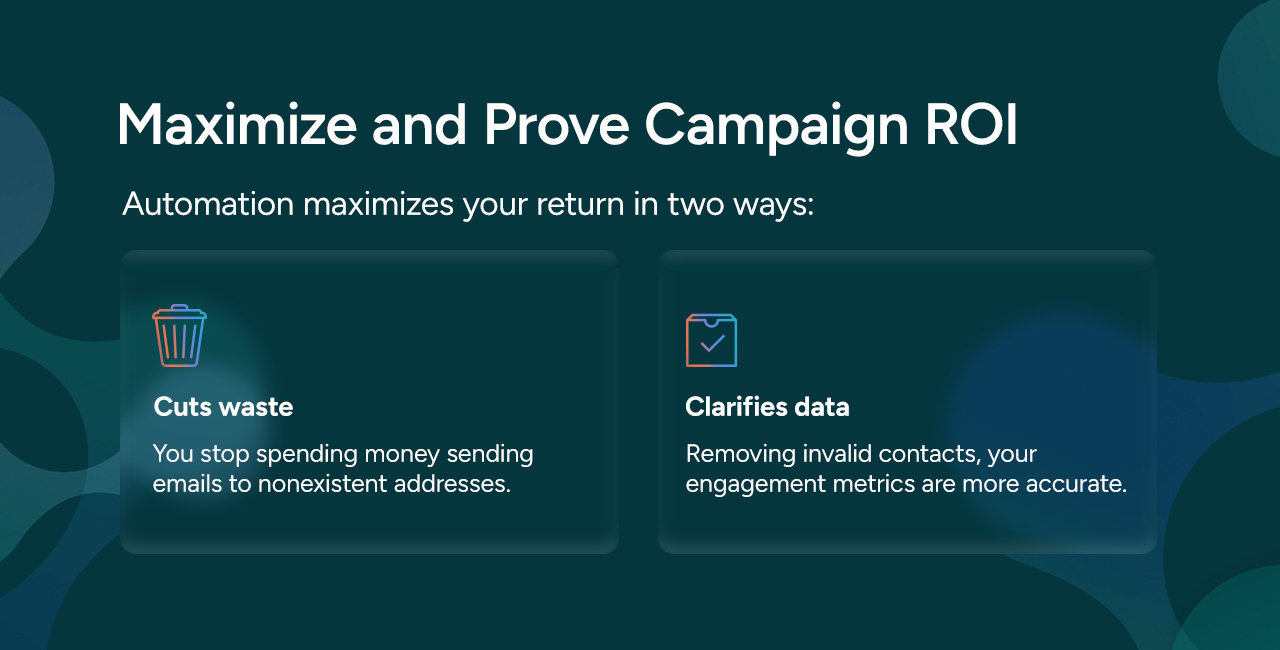
Email marketing consistently boasts an exceptional return on investment (ROI), with figures often cited around $36 for every dollar spent. However, this impressive ROI is only achievable if emails successfully reach the inbox and engage their recipients. Automation maximizes this return in two pivotal ways. First, by eliminating invalid addresses, it ensures that every email sent has the potential to be delivered and acted upon, thereby optimizing email service provider costs by only sending to valid contacts. Second, cleaner lists lead to higher open rates, click-through rates, and conversion rates, as messages are delivered to genuinely interested and reachable individuals. Accurate data also allows for precise A/B testing and performance tracking, enabling marketers to make data-driven decisions that continuously refine and improve campaign effectiveness, ultimately proving and maximizing ROI with undeniable metrics.
Elevating Personalization and Data-Driven Strategies
Effective marketing, especially in today’s hyper-personalized digital environment, is predicated on reliable data. Consider a re-engagement campaign targeting customers who haven’t made a purchase in six months. If 20% of that segment consists of invalid or outdated addresses, the campaign’s true performance will be distorted. Marketers might mistakenly conclude the strategy was ineffective, abandoning a potentially lucrative approach. An automated email verification service ensures that the foundational data underpinning segments and personalized campaigns is robust and accurate. This allows for truly informed decision-making, enabling hyper-segmentation, dynamic content delivery, and highly targeted messaging that resonates deeply with individual recipients, fostering stronger customer relationships and driving higher conversion rates. The implications extend to customer journey mapping, where accurate data ensures relevant messages are delivered at critical touchpoints.
Streamlining Operations and Boosting Team Productivity
The time of marketing and sales operations teams is a valuable, finite resource. Manual processes involving exporting, cleaning, and re-uploading large CSV files are not only time-consuming but also prone to human error, which can further jeopardize data integrity. An automated verification process liberates operations specialists from these tedious, repetitive tasks, allowing them to redirect their expertise towards high-impact strategic initiatives such as advanced analytics, campaign optimization, or developing new growth strategies. For organizations leveraging CRM platforms like Salesforce, this translates into a significant game-changer. Teams can operate with unwavering trust in the reliability of their CRM data, leading to more accurate lead routing, precise reporting, dependable forecasting, and overall enhanced operational efficiency across both marketing and sales departments. This efficiency gain contributes directly to a healthier sales pipeline and faster revenue generation.
Fortifying Data Integrity at the Point of Entry
Real-time automation acts as an indispensable first line of defense, a vigilant security guard for your entire database. By integrating a verification API (Application Programming Interface) at every data capture point – from newsletter sign-up forms and lead magnet downloads to demo request forms and e-commerce checkout processes – businesses can drastically reduce the influx of bad data. This immediate validation helps prevent common issues such as typos, fake addresses, and bot-driven sign-ups that often rely on invalid or disposable email addresses to inflate lists or engage in fraudulent activities. Securing your email list at the point of entry ensures that your database starts clean and stays clean, preventing future deliverability issues, protecting against malicious actors, and maintaining a high-quality data foundation for all business interactions. This proactive approach is critical for long-term data health and compliance.
A Phased Approach to Implementing Email List Validation Automation
Building a robust and effective email verification strategy requires a structured, methodical approach. Following a clear four-step framework can ensure a seamless transition and maximize the benefits of automation.
Step 1: Comprehensive Data Audit and Goal Definition
Before embarking on any automation initiative, a thorough assessment of current list management practices is paramount. This begins with a detailed health check of your existing email list. Marketers should analyze segments with historically high bounce rates, low engagement metrics (opens, clicks), or high unsubscribe rates, as these often indicate underlying data quality issues. Tools for audience segmentation and analytics can help identify these problematic areas.
Concurrently, it is crucial to define clear, measurable goals for the automation strategy. What does success look like for your organization? Is it a specific reduction in bounce rates (e.g., from 5% to under 1%), a measurable improvement in open rates across particular segments, or the complete cleanup of a legacy database acquired years ago? Perhaps the goal is to reduce ESP costs by a certain percentage or improve the accuracy of sales forecasting. Establishing these quantifiable baselines and objectives is vital for measuring the return on investment (ROI) and demonstrating the tangible impact of the automation solution later on. This initial audit provides a roadmap for implementation and sets the stage for success.
Step 2: Selecting a Robust Verification Partner
The choice of an email verification service provider is a critical decision that dictates the efficacy and reliability of your entire strategy. When evaluating vendors, accuracy and security must be the foremost priorities. A seemingly inexpensive tool that frequently generates "false positives" (flagging valid emails as invalid) can lead to lost revenue by preventing communication with legitimate, engaged subscribers. Conversely, a tool that misses invalid emails allows bad data to persist, undermining all other efforts.
Therefore, businesses should seek a secure, scalable solution that offers industry-leading accuracy and speed, supported by transparent reporting and robust data security protocols (e.g., SOC 2 compliance, ISO 27001 certification). Key features to look for include:
- Real-time API: For instant verification at point of entry.
- Batch processing: For cleaning existing large lists.
- Comprehensive checks: Syntax validation, domain existence, mailbox existence, spam trap detection, disposable email detection, role-based email identification.
- Integration capabilities: Seamless connectivity with major CRMs, ESPs, and marketing automation platforms.
- Reporting and analytics: Detailed insights into list health and verification results.
- Customer support: Reliable assistance during implementation and ongoing use.
Reputable providers, such as Validity with its BriteVerify solution, offer these capabilities as part of a broader ecosystem designed to optimize every stage of the email program, ensuring not just verification but overall deliverability success.
Step 3: Integrate with Your Marketing and Sales Stack
True automation unlocks its full potential when the verification tool is seamlessly integrated with existing marketing and sales systems. This dual approach addresses both historical data and ongoing data acquisition.
For existing data, the verification tool should be connected directly to your CRM (e.g., Salesforce) and marketing automation platforms (e.g., HubSpot, Marketo). Schedule periodic bulk verifications to proactively identify and address data decay that occurs naturally over time. This ensures that even dormant contacts are regularly checked for validity before any re-engagement campaigns are launched.
For new data, the implementation of a real-time API on all web forms – including newsletter sign-ups, lead magnet forms, contact pages, and e-commerce checkouts – is crucial. This verifies email addresses instantly as users type them, allowing for immediate feedback and correction of typos before the data enters your system. This "preventative medicine" approach drastically reduces the inflow of bad data, ensuring that your database grows with clean, high-quality contacts from day one.
Step 4: Monitor and Refine
Implementation is not the endpoint; it’s the beginning of a continuous improvement cycle. Regularly reviewing verification reports and analytics is essential to gauge the effectiveness of the strategy and identify emerging trends. Are you observing an unexpected increase in invalid emails originating from a particular lead source or marketing campaign? Is a specific web form disproportionately attracting bot traffic or disposable email addresses?
These insights are invaluable for refining your acquisition strategy. For instance, if a particular ad campaign is generating a high percentage of invalid emails, it might indicate a targeting issue or a need to adjust the lead capture mechanism. If bot traffic is prevalent, stronger CAPTCHA or reCAPTCHA integrations might be necessary. Use these data-driven observations to further tighten your list capture rules, optimize lead generation efforts, and continuously enhance the overall health and quality of your email database. This iterative refinement ensures that your email list validation automation strategy remains dynamic, responsive, and maximally effective in an ever-evolving digital landscape.
Industry Leadership and the Future Outlook
The imperative for robust email list validation automation is universally acknowledged by industry leaders and marketing strategists alike. Organizations such as Validity, a trusted global leader in data quality and ethical marketing, exemplify the commitment to providing solutions that support tens of thousands of organizations worldwide. Their flagship verification solution, BriteVerify, processes millions of email addresses daily with industry-leading accuracy and speed. What sets such solutions apart is their integration into a wider ecosystem designed to optimize every stage of an email program, extending beyond mere verification to encompass overall deliverability and sender reputation management.
With seamless integrations for major platforms like Salesforce, these solutions make it effortless for businesses to implement the sophisticated automation strategies discussed herein. As the digital marketing landscape continues to evolve, characterized by increasing data volumes, stricter privacy regulations, and more sophisticated spam filters, the role of automated email validation will only grow in importance. It is no longer a luxury but a fundamental component of a successful, compliant, and profitable digital marketing strategy.
Conclusion: The Indispensable Role of Automated Email List Validation
In an era where every marketing dollar counts and brand reputation is paramount, email list validation automation stands as a necessity, not an option. It is the proactive shield that protects revenue streams, safeguards sender reputation, and ensures the efficacy of every email marketing endeavor. By automating the critical function of data hygiene, businesses can prevent bad data from ever entering their systems, ensuring that their marketing efforts are precisely targeted at real, engaged individuals.
The consequences of neglecting email list hygiene are dire: wasted resources, damaged sender reputation, skewed analytics, and missed revenue opportunities. Conversely, embracing automated validation unlocks a cascade of benefits: superior deliverability, optimized campaign ROI, enhanced personalization, radical operational efficiency, and fortified data integrity. For any organization serious about maximizing its digital marketing potential and sustaining long-term growth, the question is no longer whether to clean their email list, but how to automate that process for continuous, reliable data quality. The time to stop bad data from hurting your email ROI is now.









