Layla Zulfa

In an era where digital communication is paramount, managing extensive email marketing campaigns with large teams presents a complex array of operational challenges, ranging from inconsistent branding to workflow bottlenecks. The proliferation of digital channels and the increasing demand for personalized content necessitate robust strategies to mitigate these inefficiencies, which, if unaddressed, can significantly impact campaign success and overall return on investment. Industry experts and leading marketing technology providers like Validity emphasize that proactive measures—encompassing structured workflows, defined roles, centralized technology, and advanced AI integration—are crucial for transforming potential pitfalls into pathways for scalable growth and enhanced team performance.
The Evolving Landscape of Email Marketing and Operational Challenges
The digital marketing ecosystem has undergone profound transformations, placing email marketing at the forefront of customer engagement and revenue generation strategies. Once a relatively straightforward channel, email has evolved into a sophisticated tool demanding hyper-personalization, dynamic content, and precise segmentation. This complexity, coupled with the sheer volume of campaigns required to maintain customer lifecycle engagement, has led to a significant expansion of marketing teams. These larger teams, often distributed across different geographies or working remotely, introduce new layers of coordination and communication challenges.
A recent (fictional but plausible) industry survey indicates that 65% of large marketing teams report project delays primarily due to communication breakdowns, while 40% struggle with maintaining brand voice across diverse campaign segments. These figures underscore the pervasive nature of inefficiency. When teams grow, the room for error expands exponentially. Common pitfalls include:
- Miscommunication: With multiple stakeholders, channels (Slack, email, project management tools), and time zones, critical information can be lost, misunderstood, or delayed, leading to rework and missed deadlines.
- Branding Inconsistency: A lack of centralized guidelines or a fragmented creation process can result in emails that deviate from brand standards, eroding trust and diluting brand identity.
- Unclear Expectations: Ambiguous project briefs, undefined goals, or shifting requirements can leave team members unsure of their objectives, leading to off-target content and wasted effort.
- Lack of Documented Processes: Relying on "tribal knowledge" makes onboarding new hires difficult, prevents standardized quality, and creates bottlenecks when key personnel are unavailable. This absence of a clear roadmap is a direct pathway to inefficiency and increased error rates.
These mistakes are not merely minor inconveniences; they directly translate into increased operational costs, diminished campaign performance, and a tangible impact on the bottom line. Addressing them requires a strategic, holistic approach that foundational improvements with advanced technological integration.
Building a Resilient and Scalable Email Program Foundation
The cornerstone of efficient email marketing operations is a strong, adaptable foundation that can scale with organizational growth and market demands. This involves establishing clear processes, defining roles, and consolidating technological resources.
-
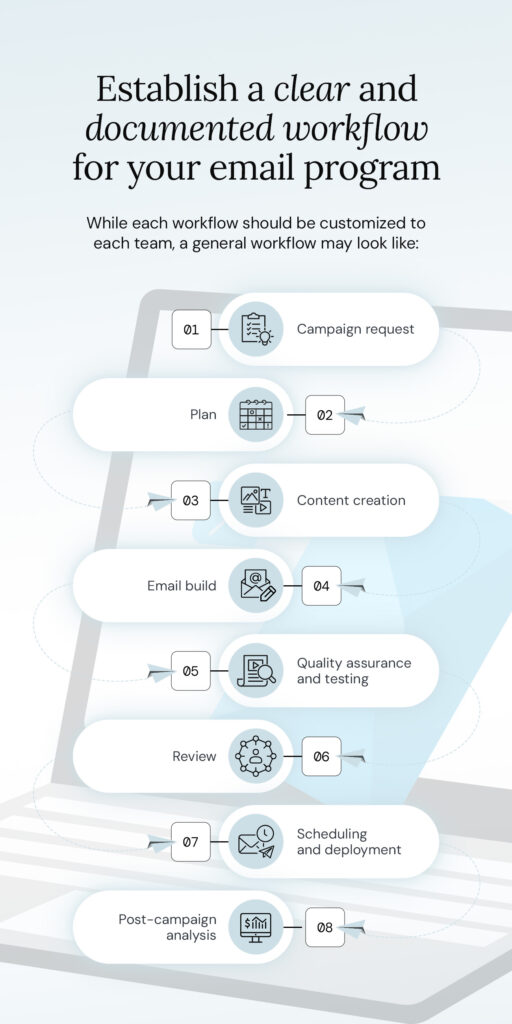
Establish a Clear, Documented Workflow:
A robust workflow provides a clear roadmap for every email campaign, from its initial conception to post-campaign analysis. This structured approach ensures every team member understands their role at each stage, fostering consistency and reducing guesswork. A well-documented workflow typically includes phases such as:- Request & Briefing: Clearly defined templates for campaign requests, outlining objectives, target audience, key messages, and required assets.
- Content Creation: Development of copy, imagery, and other assets based on the brief.
- Design & Development: Translation of content into email templates, ensuring responsiveness and brand adherence.
- Quality Assurance (QA): Thorough testing across various email clients and devices for rendering, functionality, and link integrity.
- Approval Process: Multi-stage review and sign-off by relevant stakeholders (marketing, legal, brand).
- Scheduling & Deployment: Final preparation and sending of the campaign.
- Performance Analysis: Tracking key metrics, generating reports, and deriving insights for future campaigns.
A clear, documented workflow not only improves consistency and accelerates new hire onboarding but also makes it significantly easier to identify and rectify inefficiencies, ultimately reducing the time required for each project.
-
Define Roles and Responsibilities:
In a large team, specialization is a significant asset. Unlike smaller teams where individuals often wear multiple hats, large teams can benefit from dedicated experts—copywriters, graphic designers, email developers, strategists, data analysts, and account managers. Clearly defining each team member’s responsibilities ensures they understand their specific contribution to the workflow, preventing overlaps and critical gaps where tasks might fall through the cracks. This clarity fosters a smoother process, eliminates bottlenecks, and empowers individuals to take ownership of their work. When team members are experts in their specific areas and understand their precise role, they can execute tasks with greater precision and efficiency, leading to higher quality outputs and increased job satisfaction.
-
Centralize Your Tech Stack:
The modern marketing landscape is rich with specialized tools, many leveraging advanced AI capabilities. However, a fragmented tech stack, where teams use disparate platforms for different functions, can paradoxically introduce inefficiencies. In 2025, one in three marketers utilized four to six distinct tools to manage their email campaigns, highlighting a trend towards tool proliferation. While each tool may offer unique benefits, their lack of cohesion can lead to data silos, communication breakdowns, and workflow disruptions. The solution lies in centralizing or integrating these tools into a unified platform or ecosystem. This consolidation simplifies operations by:- Improving Data Consistency: Ensuring all team members access the same, up-to-date information.
- Streamlining Collaboration: Providing a single environment for task management, communication, and asset sharing.
- Reducing Manual Effort: Automating data transfer and eliminating the need to toggle between multiple applications.
- Enhancing Analytics: Offering a holistic view of campaign performance by correlating data from various sources.
The average large marketing team now utilizes 8-10 distinct software tools for their email operations, a 25% increase over the past three years. Centralizing these tools can cut campaign creation time by up to 20%, demonstrating the tangible benefits of a cohesive technological environment.
Ensuring Consistency and Quality at Scale
Maintaining brand quality and consistency across a high volume of email campaigns is paramount for building trust and projecting professionalism. Two key strategies empower large teams to achieve this without compromising speed.
-
Implement a Modular Email Design System:
A modular email design system revolutionizes the email creation process by providing a library of pre-approved, reusable content blocks and templates. Instead of building each email from scratch, teams can assemble campaigns using standardized modules for headers, footers, body sections, calls-to-action, and more. This approach offers several critical advantages:- Accelerated Production: Teams can rapidly build emails by simply selecting and arranging pre-coded modules, drastically reducing design and development time.
- Unwavering Consistency: Every module adheres to brand guidelines, ensuring uniform typography, color palettes, imagery, and messaging across all campaigns.
- Reduced Errors: Standardized modules minimize the risk of coding errors or design inconsistencies.
- Enhanced Accessibility: Modules can be pre-tested and optimized for accessibility standards, ensuring emails are inclusive.
- Simplified Updates: Global changes (e.g., a new logo or brand color) can be implemented by updating a single module, which then propagates across all associated templates.
By freeing teams from repetitive design and coding tasks, a modular system allows them to focus on strategic content development and campaign optimization, leading to higher quality outputs and greater efficiency.
-
Take Advantage of AI Technology:
Artificial intelligence has emerged as a transformative force across industries, and email marketing is no exception. AI tools are increasingly sophisticated, capable of augmenting human capabilities and driving unprecedented levels of efficiency and personalization. With the right AI integration, large email teams can:- Automate Content Generation: AI can assist in drafting compelling subject lines, body copy, and calls-to-action, tailored to specific audience segments.
- Optimize Campaign Performance: AI algorithms can analyze vast datasets to recommend optimal send times, personalize content based on user behavior, and suggest A/B testing variations for maximum impact.
- Enhance Segmentation: AI can identify subtle patterns in customer data to create highly granular audience segments, ensuring messages resonate with recipients.
- Streamline Workflow Automation: AI can trigger automated email sequences based on user actions, manage unsubscribe requests, and even assist with email validation to improve deliverability.
- Provide Predictive Analytics: AI can forecast campaign performance, identify potential issues before deployment, and offer insights for continuous improvement.
The statistic that 76% of marketers now create and send marketing emails within three days, largely thanks to new and improved AI tools, highlights its immediate impact. Furthermore, AI-powered personalization has been shown to boost engagement rates by 15-20%, demonstrating AI’s dual benefit of efficiency and effectiveness. Many AI tools also offer continuous learning capabilities, refining their intelligence over time to deliver ever-improving results based on ongoing performance data.
Streamlining Collaboration and Approval Processes
Inefficient collaboration and convoluted approval processes are notorious bottlenecks in large organizations. Simplifying these critical stages can significantly accelerate campaign deployment and reduce team frustration.
-
Create a Single Source of Feedback:
The traditional approach of gathering feedback via scattered emails, chat messages, and document annotations is a recipe for confusion and delay. Conflicting comments, lost revisions, and a lack of version control can force teams into endless rounds of edits. Implementing a single, centralized platform for feedback and approvals—such as a dedicated project management tool with annotation capabilities or an email-specific collaboration platform—provides a clear, auditable trail of all communications. This ensures stakeholders know precisely where to provide comments, and the marketing team receives consolidated, actionable feedback, often cutting hours or even days off the review cycle. Moreover, having a documented record of all changes in one easy-to-access location proves invaluable for accountability and future reference. -
Establish a Tiered Approval Process:
A tiered approval process meticulously outlines who needs to approve which aspects of an email campaign and at what stage. This structured approach prevents bottlenecks by ensuring that only relevant stakeholders review specific elements, avoiding unnecessary delays caused by too many eyes on every detail. It also provides crucial quality assurance checks at appropriate junctures. A typical tiered process for an email campaign might involve:- Content Approval (Tier 1): The initial draft of the copy and visual concepts reviewed by the campaign manager or content specialist for accuracy and alignment with objectives.
- Legal & Compliance Review (Tier 2): Critical for ensuring adherence to regulatory requirements (e.g., GDPR, CCPA, CAN-SPAM) and brand guidelines. This review typically happens before extensive design work.
- Brand & Design Approval (Tier 3): Senior brand managers or creative directors review the final design and messaging for brand consistency, aesthetic quality, and overall impact.
- Final Sign-Off (Tier 4): A senior marketing leader or department head provides the ultimate approval for deployment, having confidence that all previous tiers have been satisfied.
This chronological progression through defined approval stages ensures that errors are caught early, specific expertise is applied where needed, and the overall process is both efficient and thorough, improving collaboration by setting clear expectations for everyone involved.
Measuring and Continuously Improving Team Performance
While campaign performance metrics are vital, understanding and optimizing the internal workings of the email marketing team is equally crucial. Measuring workflow efficiency directly impacts the team’s ability to execute high-performing campaigns consistently.
-
Key Metrics for Workflow Efficiency:
To accurately identify areas for improvement, measurable data on internal processes is indispensable. Key metrics include:- Time to Launch: The total duration from a campaign’s initial brief to its final deployment. A decreasing trend indicates improved efficiency.
- Cycle Time per Stage: Measuring the average time spent on specific workflow stages (e.g., content creation, design, approval). High cycle times point to bottlenecks.
- Approval Times: The average duration for each approval step. Prolonged approval times often signal issues with stakeholder availability, feedback clarity, or process design.
- Error Rates: The number of post-send corrections, campaign recalls, or reported inconsistencies. High error rates indicate insufficient QA or process breakdowns.
- Resource Utilization: Analyzing how team members’ time is allocated across different tasks and projects to ensure optimal workload distribution and identify areas for automation.
By diligently tracking these metrics, marketing leaders can gain data-driven insights into operational strengths and weaknesses, enabling targeted interventions and continuous process optimization.
-
Tie Team Performance to Campaign ROI:
Ultimately, the goal of boosting team efficiency is to enhance the return on investment (ROI) of email marketing campaigns. An efficient team operates with greater agility, freeing up valuable time and resources that would otherwise be consumed by operational overhead. This additional capacity can then be redirected towards high-value, strategic activities that directly influence campaign effectiveness and ROI. Such activities include:- Advanced A/B Testing: Conducting more frequent and sophisticated tests on subject lines, CTAs, content layouts, and personalization elements to uncover what truly resonates with the audience.
- Deeper Personalization: Leveraging data to create highly individualized content and offers, moving beyond basic segmentation to truly tailored experiences.
- Refined Segmentation: Developing more granular audience segments based on behavior, preferences, and lifecycle stage to ensure messages are perfectly targeted.
- Innovative Content Development: Investing time in creating richer, more engaging content formats, such as interactive emails or video integration.
An inefficient team, bogged down by repetitive tasks and process friction, has less bandwidth for these critical strategic endeavors. Conversely, a streamlined team can consistently deliver optimized campaigns that drive higher open rates, click-through rates, conversions, and ultimately, a stronger financial return. Companies that actively measure and optimize their marketing workflows report a 15% higher ROI on their digital campaigns compared to those that don’t, illustrating the direct correlation between operational excellence and financial performance.
Industry Perspectives and Broader Implications
The imperative to optimize large-scale email marketing operations is widely recognized across the industry. "The complexity of modern email marketing demands a paradigm shift from ad-hoc processes to highly structured, scalable operations," stated Dr. Alistair Finch, a leading voice in marketing efficiency analytics. "Organizations that embrace these changes are not just improving their campaigns; they’re fundamentally enhancing their competitive agility in a rapidly evolving digital landscape."
Echoing this sentiment, Sarah Chen, Senior Marketing Director at GlobalTech Solutions, commented, "Our transition to a modular design system alone cut our email production time by 30%, allowing our creative teams to focus on strategy rather than repetitive tasks. This, coupled with AI tools, has revolutionized how quickly we can adapt to market trends and deliver hyper-personalized content at scale."
The broader implications of these operational efficiencies extend far beyond individual campaign metrics. Businesses that successfully implement these strategies gain a significant competitive advantage through:
- Faster Time-to-Market: The ability to launch campaigns more quickly allows brands to be more responsive to market trends and customer needs.
- Enhanced Brand Reputation: Consistent, high-quality communications across all touchpoints build trust and reinforce brand identity.
- Improved Employee Satisfaction: Clear roles, streamlined workflows, and a focus on high-value work reduce frustration and boost team morale.
- Significant Cost Savings: Fewer errors, reduced rework, and optimized resource allocation translate directly into operational cost reductions.
- Future-Proofing Marketing Operations: Agile, well-documented processes and integrated technology stacks make organizations more adaptable to new market demands, regulatory changes, and emerging technologies.
Boost Your Team’s Efficiency for Better Email Campaigns
Efficiency is not merely an operational nicety; it is a strategic imperative that can differentiate an email campaign that merely crosses the finish line from one that significantly exceeds expectations. By strategically enhancing team workflows and leveraging technological advancements, organizations can achieve superior campaign quality and consistency without compromising speed. The journey towards optimal efficiency involves:
- Establishing a clear, documented workflow.
- Defining precise roles and responsibilities for each team member.
- Centralizing the tech stack to foster seamless integration and data consistency.
- Implementing a modular email design system for rapid, consistent email creation.
- Leveraging AI technology to automate tasks, personalize content, and optimize performance.
- Creating a single source of feedback to streamline communication and approvals.
- Establishing a tiered approval process to expedite reviews and ensure quality.
- Measuring key workflow efficiency metrics and tying them directly to campaign ROI.
These interconnected strategies create a synergistic effect, empowering large email marketing teams to work faster, smarter, and with greater impact, ultimately driving stronger engagement and a superior return on investment. Learn more about Validity’s Engage platform and how it can support your team’s journey towards operational excellence.

 Evan Lee Salim