Evan Lee Salim
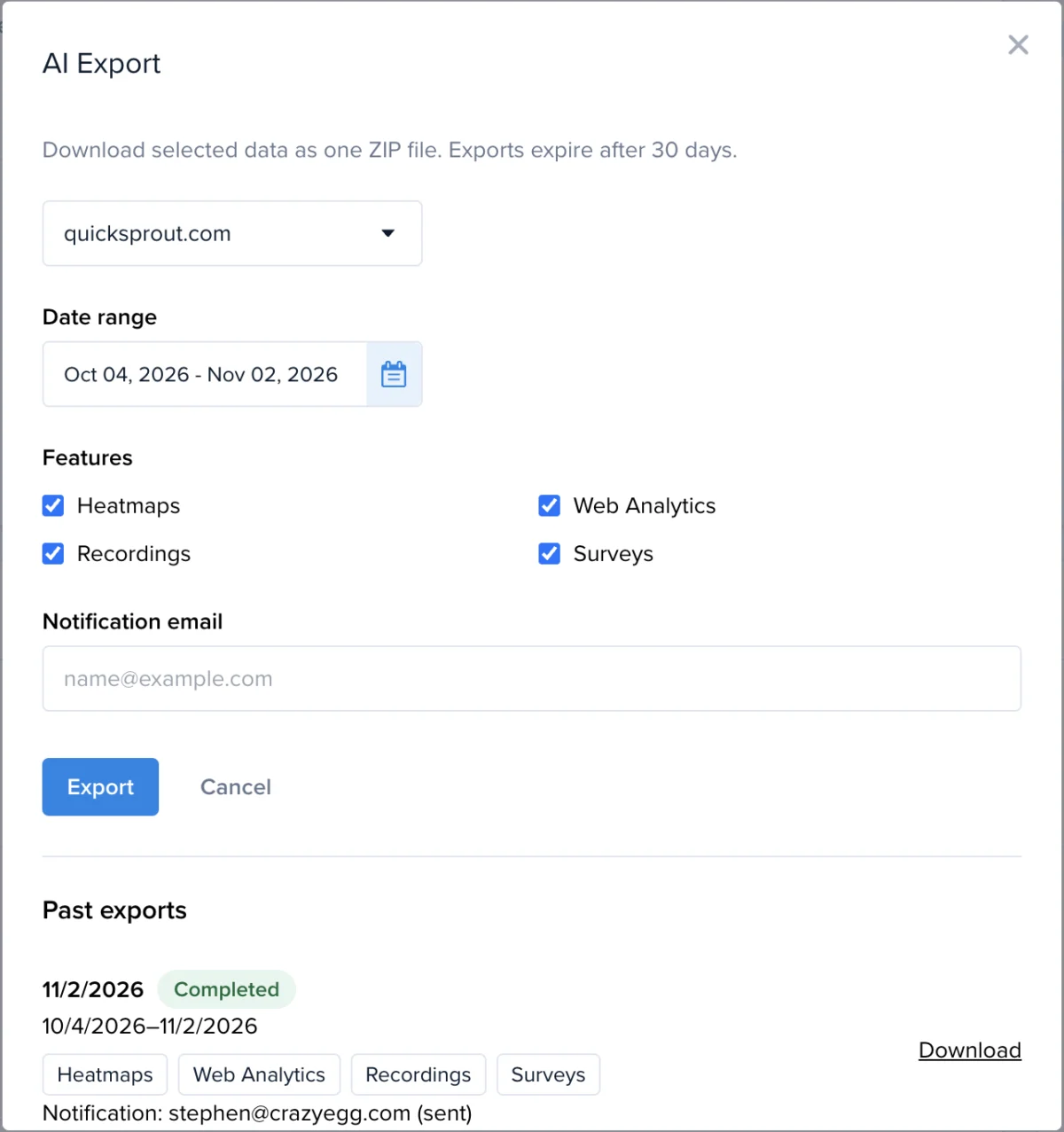
In a significant update to its suite of conversion rate optimization (CRO) tools, Crazy Egg has announced the launch of a comprehensive "AI Export" feature, allowing users to download their entire repository of website data in formats specifically engineered for processing by Large Language Models (LLMs). This development represents a pivotal shift in how digital marketers and data analysts interact with user behavior metrics, moving away from manual visual interpretation toward automated, prompt-based synthesis. The feature is designed to bridge the gap between raw web analytics and the advanced reasoning capabilities of modern artificial intelligence platforms such as OpenAI’s ChatGPT, Anthropic’s Claude, Google’s Gemini, and Microsoft’s Copilot.
The introduction of bulk AI exports addresses a growing challenge in the MarTech (Marketing Technology) industry: data silos and the "token bottleneck." While web analytics tools have long offered data exports, the formats were often cumbersome or unoptimized for the context windows of AI tools. By refining the data structure, Crazy Egg enables its users to feed high-velocity data into LLMs without exceeding token limits or triggering hallucinations caused by poorly structured datasets. This optimization ensures that the AI can accurately "read" heatmaps, session recordings, and survey results as coherent narratives rather than disconnected data points.
A New Paradigm for Behavioral Data Analysis
Historically, Crazy Egg was recognized for pioneering the "heatmap"—a visual representation of where users click, scroll, and move their cursors on a webpage. While these visuals are intuitive for human designers, they were not natively readable by text-based AI. The new AI Export feature transforms these visual insights into structured data that describes user interactions semantically. This allows marketing teams to perform complex analysis simply by prompting an AI. For instance, a user could upload their bulk export to an LLM and ask, "Identify the top three friction points on my checkout page for mobile users in Western Europe," or "Generate a slide deck summary of why our new landing page has a 20% lower conversion rate than the previous version."
The bulk export capability extends across five core data categories:
- Heatmaps: Detailed interaction maps showing click density and scroll depth.
- Recordings: Summarized data from user session replays that highlight navigation paths.
- Conversions: Specific metrics regarding goal completions and funnel drop-offs.
- Web Analytics: General traffic data, including referrers, bounce rates, and device types.
- Surveys: Qualitative feedback from users, which the AI can sentiment-analyze and categorize.
By consolidating these disparate data streams into a single, AI-ready package, Crazy Egg is positioning itself as a central intelligence hub for website performance.
Chronology of AI Integration at Crazy Egg
The rollout of the bulk AI Export feature is the latest milestone in Crazy Egg’s aggressive roadmap toward AI-driven optimization. In early 2024, the company began experimenting with individual AI-optimized exports for specific snapshots. This allowed users to analyze one page at a time. However, the feedback from enterprise-level clients indicated a need for holistic site-wide data.
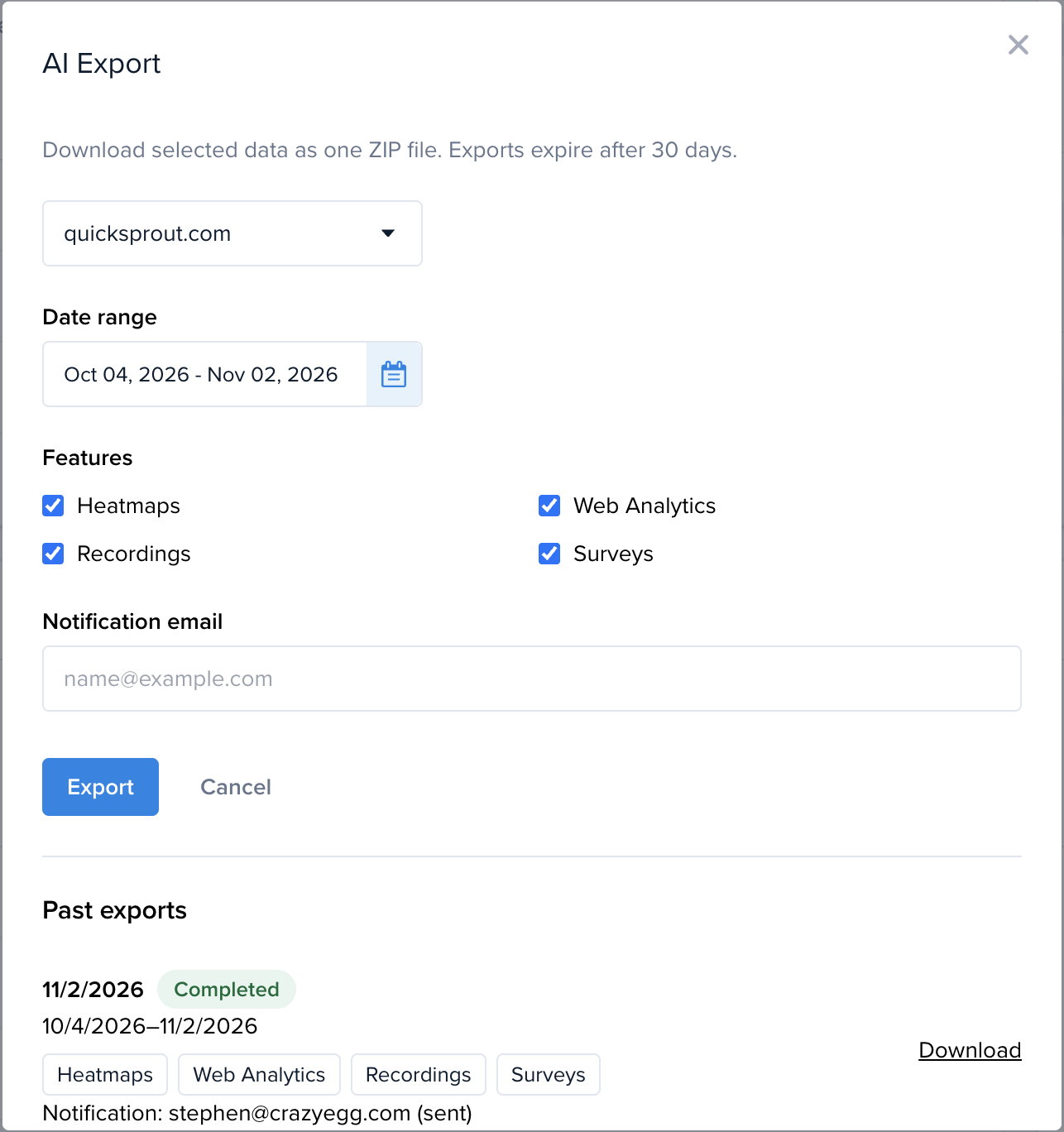
In mid-2024, the company introduced the "AI Export Add-on," testing the market’s appetite for AI-native data structures. Following a successful pilot program that saw increased efficiency in A/B testing roadmap generation, the company decided to expand the feature to all Pro and Enterprise subscribers. The November 2 announcement marks the full-scale availability of bulk processing, a move that aligns with the broader industry trend of "democratizing data science" through generative AI.
Enhancing User Journey Analysis
One of the most technically sophisticated aspects of the bulk export is its impact on user journey analysis. When an AI tool receives a bulk export of both session recordings and conversion data, it can perform what data scientists call "multi-touch attribution analysis" with minimal human intervention.
Previously, a human analyst would have to watch dozens of recordings to find patterns in why users were failing to convert. With the AI Export, the LLM can cross-reference the recording data (which pages were visited and in what order) with the heatmap data (what specific elements were ignored on those pages) and the conversion data (where the final exit occurred). This holistic view allows the AI to find correlations that might be invisible to a human reviewer, such as a specific pop-up advertisement that only triggers a bounce for users who have scrolled exactly 45% down a blog post.
Technical Optimization and Token Efficiency
The "optimized" nature of these exports is a response to the technical constraints of current LLMs. Every AI model has a "context window," which is the amount of information it can process at one time, measured in tokens. A raw export of a million website clicks would likely overwhelm even the most advanced models, leading to errors or high costs.
Crazy Egg’s optimization process involves:
- Data Summarization: Condensing thousands of identical click events into statistical summaries that retain the significance without the bulk.
- Semantic Tagging: Adding metadata to the data points so the AI understands the "intent" behind a user action (e.g., distinguishing between a "rage click" and a standard navigational click).
- Format Standardization: Ensuring that all exported CSV or JSON files follow a consistent schema that LLMs have been pre-trained to recognize.
This efficiency allows users to perform "long-horizon" analysis, looking at data trends over months rather than days, all within a single AI conversation.
Market Context and Industry Reaction
The move by Crazy Egg comes at a time when the CRO landscape is becoming increasingly competitive. Rivals such as Hotjar and FullStory have also begun integrating AI features, such as automated session summaries. However, Crazy Egg’s strategy focuses on "portability"—giving the data back to the user to use in the AI tool of their choice, rather than forcing them to use a proprietary, in-app AI.

Industry analysts suggest that this "open" approach to data may appeal to larger organizations that have already invested in custom AI environments or have strict security protocols requiring them to use specific, vetted LLMs. By providing the data in a format that works with Claude, ChatGPT, and Gemini, Crazy Egg is catering to the "bring your own AI" (BYOAI) trend currently sweeping the corporate sector.
While official statements from third-party partners are pending, early adopters in the digital marketing space have noted that the bulk export feature significantly reduces the "prep time" required for monthly reporting. "We used to spend three days a month just cleaning data for our reports," noted one growth lead at a mid-sized e-commerce firm. "Now, we feed the Crazy Egg export into a custom GPT, and the first draft of our monthly optimization strategy is ready in ten minutes."
Broader Implications for the Future of Web Design
The ability to analyze site-wide data through AI is expected to accelerate the move toward "hyper-personalized" web experiences. As it becomes easier to identify how different segments of users interact with a site, companies can move away from one-size-fits-all designs. The AI can suggest specific A/B tests for different demographics based on the bulk data provided by Crazy Egg.
Furthermore, this feature signals a shift in the role of the web analyst. As AI takes over the "number crunching" and pattern recognition, analysts are expected to transition into "prompt engineers" and strategic decision-makers. The value is no longer in finding the data, but in knowing what questions to ask it.
Access and Availability
The bulk AI Export feature is currently available to users on Crazy Egg’s Pro and Enterprise plans. Recognizing the demand from smaller teams, the company has also made the feature available as a standalone "AI Export Add-on" for those on lower-tier plans.
To facilitate the transition, Crazy Egg has released a series of video tutorials and prompt libraries designed to help users get the most out of their exported data. These resources include specific instructions on how to use the exports with the Advanced Data Analysis features of ChatGPT and the Artifacts feature in Claude.
As the digital landscape continues to evolve, the integration of AI and behavioral analytics is likely to become the standard rather than the exception. Crazy Egg’s latest update ensures that its users are not just collecting data, but are equipped to use that data in the most modern, efficient way possible. For further information or to request access to the feature, the company has directed users to contact their support and sales teams via their official communication channels.

 Dwi Wanna