Asep Darmawan
The evolution of deep learning has been defined by a constant search for architectural components that allow neural networks to generalize better and train faster. Among these components, the activation function—the mathematical "gate" that determines whether a neuron should fire—plays a pivotal role. While the Rectified Linear Unit (ReLU) dominated the landscape for nearly a decade, the emergence of the Transformer architecture and Large Language Models (LLMs) like BERT and GPT has shifted the industry standard toward the Gaussian Error Linear Unit (GELU). This transition represents a fundamental change in how researchers approach nonlinearity, moving from hard thresholds to probabilistic, smooth scaling mechanisms.
The Historical Context of Activation Functions
To understand the significance of GELU, one must first look at the timeline of activation functions in neural networks. In the early days of deep learning, sigmoidal and hyperbolic tangent (tanh) functions were the standard. However, these functions suffered from the "vanishing gradient" problem, where gradients became extremely small for large inputs, effectively halting the learning process.
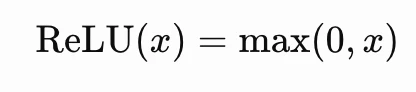
The breakthrough came in 2012 with the success of AlexNet in the ImageNet competition, which popularized the Rectified Linear Unit (ReLU). ReLU, defined as $f(x) = max(0, x)$, offered a simple solution: it was computationally efficient and maintained a constant gradient for all positive inputs. Despite its success, ReLU introduced the "dying ReLU" problem, where neurons receiving negative inputs would output zero and become permanently inactive during training.
In 2016, researchers Dan Hendrycks and Kevin Gimpel introduced the Gaussian Error Linear Unit (GELU) in their seminal paper, "Gaussian Error Linear Units (GELUs)." Their goal was to merge the benefits of ReLU’s gating mechanism with the stochastic properties of dropout, creating a function that was smoother and more robust to different data distributions.
Defining the GELU Mechanism
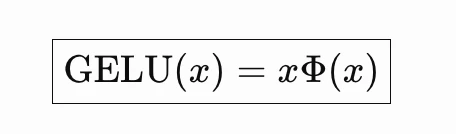
The GELU activation function operates on a principle of probabilistic gating. Unlike ReLU, which performs a deterministic "hard" cutoff at zero, GELU weights inputs by their percentile, effectively deciding how much information to pass through based on the input’s value relative to a standard normal distribution.
Mathematically, GELU is defined as:
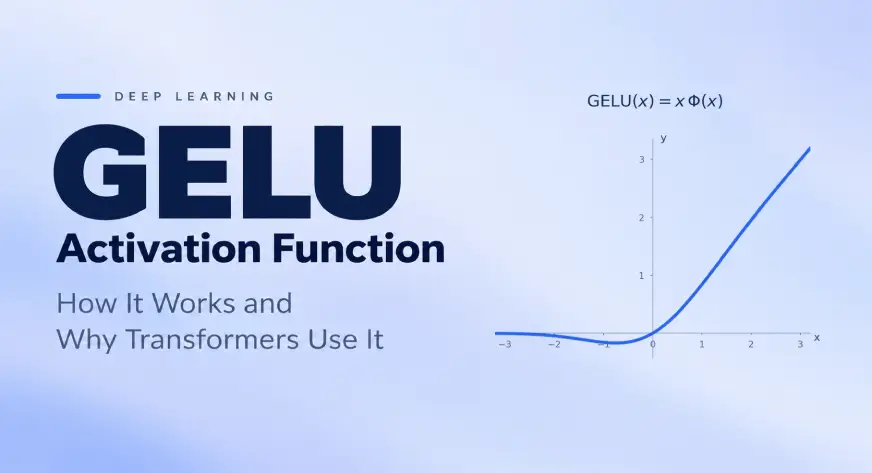
$$GELU(x) = x cdot P(X le x) = x cdot Phi(x)$$
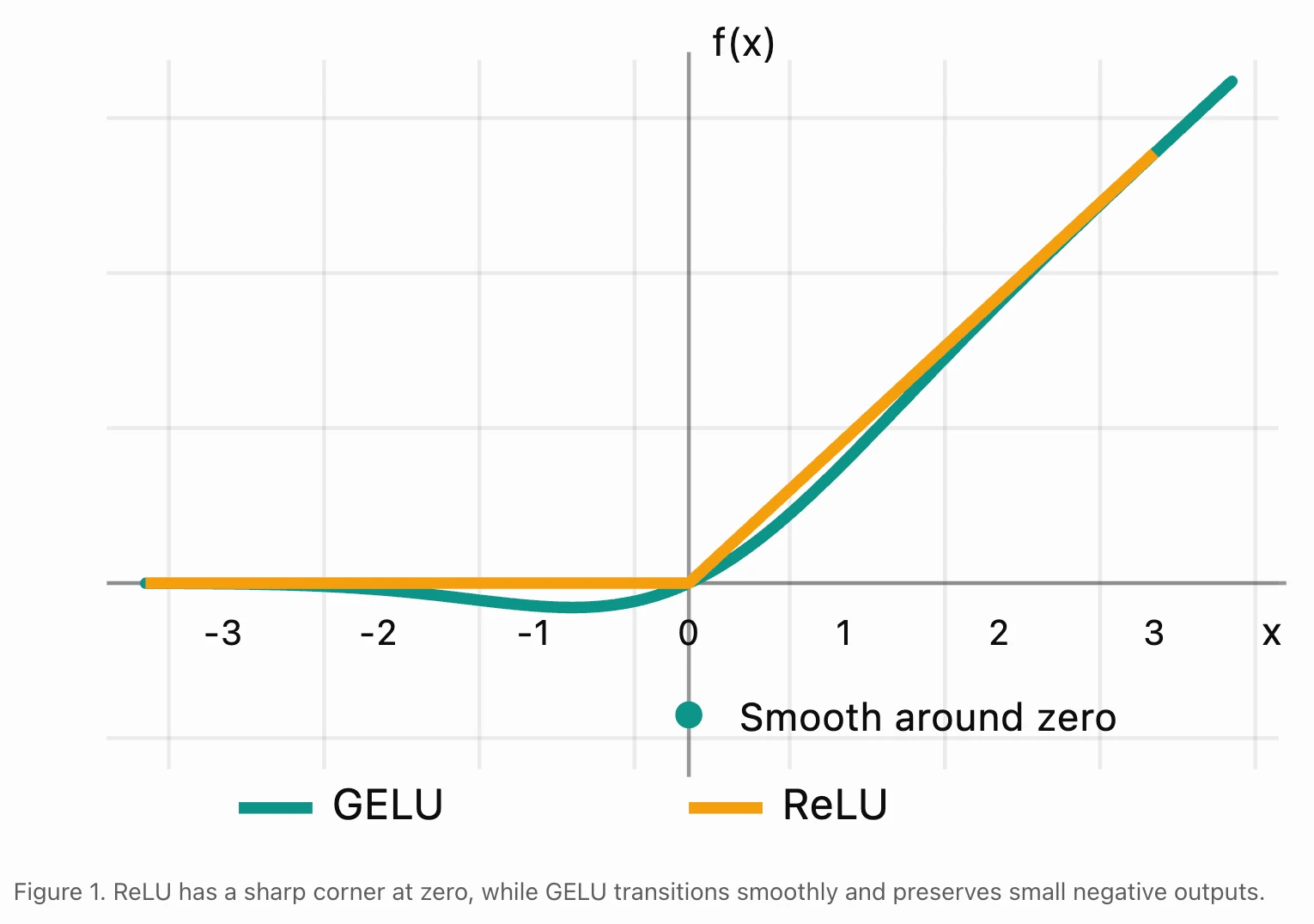
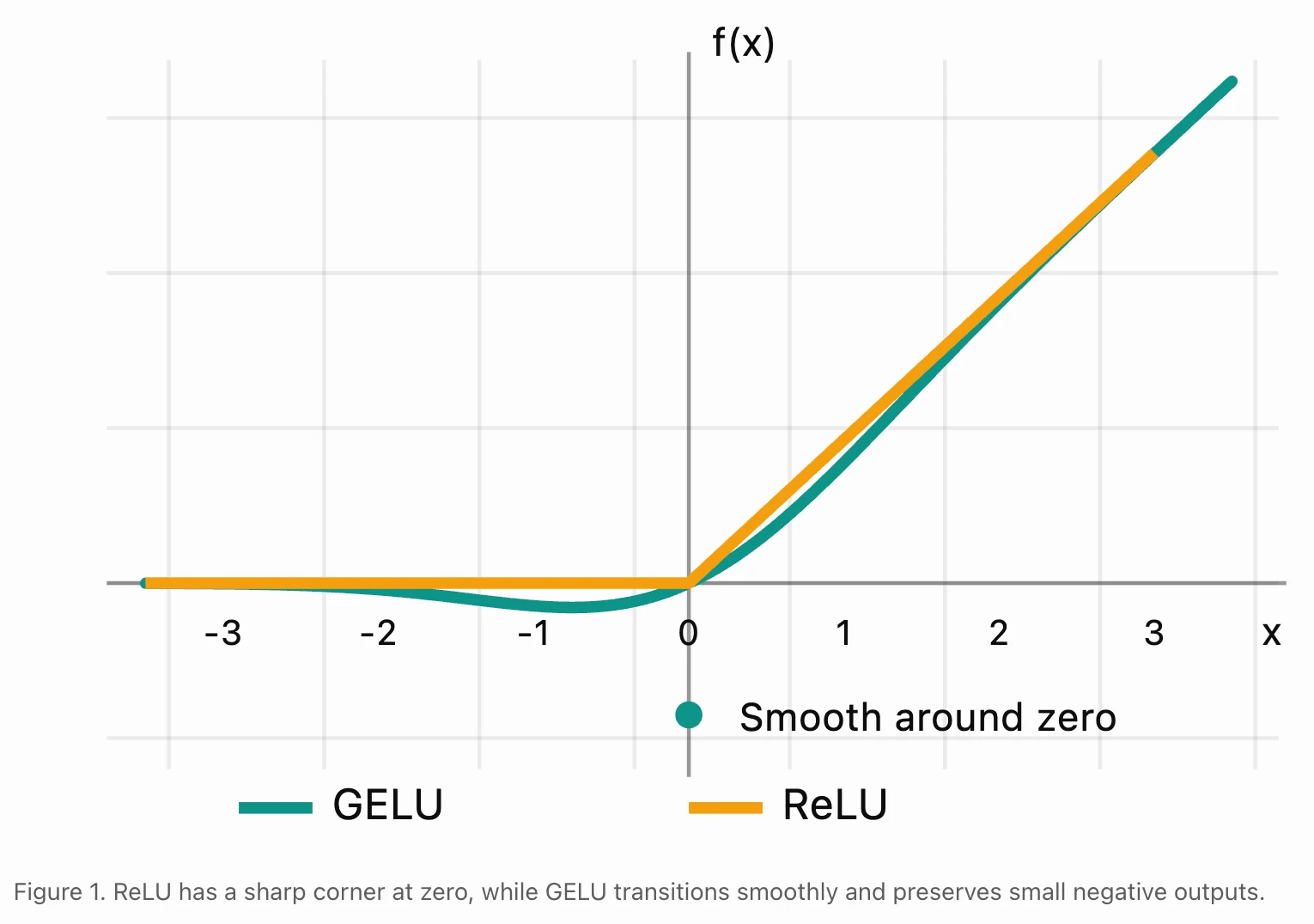
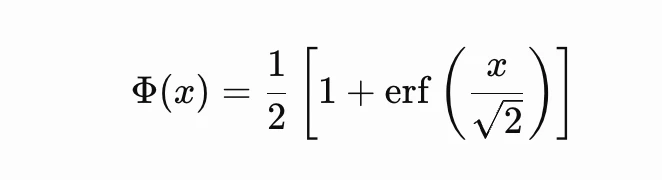
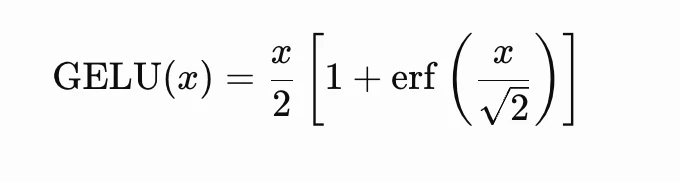
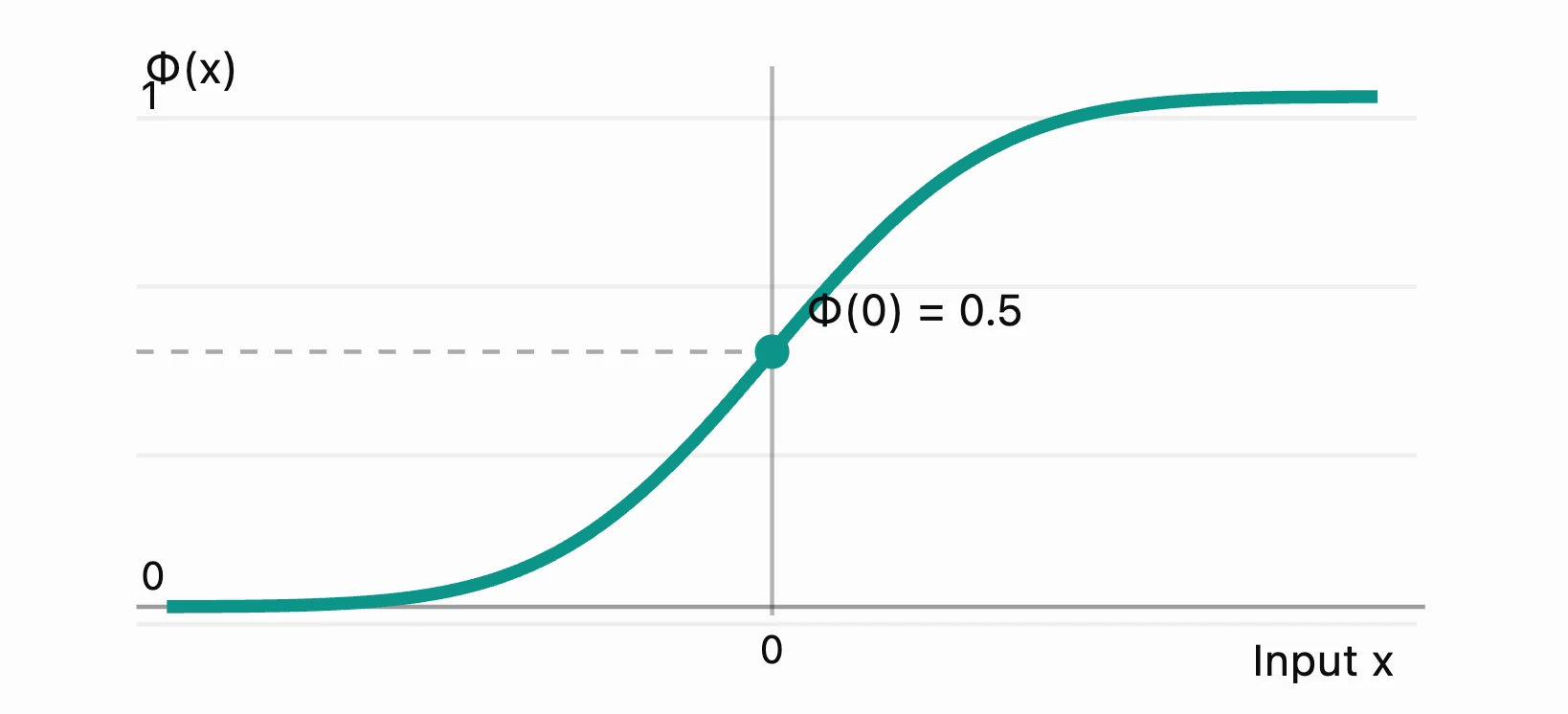
In this equation, $Phi(x)$ is the Cumulative Distribution Function (CDF) of the standard normal distribution. This means that as an input $x$ increases, the probability of it being "dropped" decreases. For very large positive values, the function behaves almost linearly, similar to ReLU. For very large negative values, the output approaches zero. However, in the region around zero, GELU provides a smooth, differentiable curve that allows for a small amount of negative information to pass through.
Why Smoothness Matters: GELU vs. ReLU
The primary distinction between GELU and ReLU is the behavior at the "kink" of the function. ReLU has a sharp transition at $x=0$, where the derivative is undefined (mathematically, it is non-differentiable at that exact point). In contrast, GELU is smooth and differentiable everywhere.
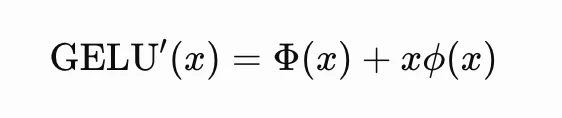
This smoothness has profound implications for gradient-based optimization. During backpropagation, the smooth gradients of GELU allow for more stable updates to the model’s weights. Research indicates that this property helps models converge faster and find better local minima, particularly in very deep architectures like Transformers.
Furthermore, GELU’s ability to retain some negative values (it has a small "dip" below zero for inputs between roughly -1 and 0) provides a regularization effect. This ensures that neurons do not "die" as easily as they do with ReLU, maintaining a more active and expressive hidden state throughout the training process.
The Transformer Revolution and Industry Adoption
The adoption of GELU was not immediate but accelerated rapidly with the rise of Natural Language Processing (NLP) breakthroughs. When Google Research released BERT (Bidirectional Encoder Representations from Transformers) in 2018, the developers chose GELU as the hidden activation function. This was a departure from previous Transformer models and proved to be a critical design choice.
Following BERT, other landmark models adopted GELU, including:
- GPT-2 and GPT-3: OpenAI’s generative models utilized GELU in their feed-forward layers.
- RoBERTa: Facebook’s optimized version of BERT confirmed that GELU contributed to higher performance on benchmarks like GLUE.
- ViT (Vision Transformers): As Transformers moved into computer vision, GELU remained the preferred choice for many state-of-the-art vision models.
Industry experts suggest that GELU’s success in these models is due to its compatibility with Layer Normalization, a standard technique in Transformers. The way GELU scales inputs aligns well with the Gaussian-like distribution of activations typically seen after normalization.

Computational Efficiency and Approximations
One of the few drawbacks of the exact GELU function is its computational complexity. Calculating the CDF of a normal distribution involves an integral, which is more expensive to compute than the simple comparison used in ReLU. To solve this, researchers developed highly accurate approximations that are easier for hardware (like GPUs and TPUs) to process.
The most common approximation is the tanh-based formula:
$$GELU(x) approx 0.5x left(1 + tanhleft[sqrtfrac2pi (x + 0.044715x^3)right]right)$$

Another simpler version uses the sigmoid function (often referred to as SiLU or Swish, though closely related to the GELU approximation):
$$GELU(x) approx x cdot sigma(1.702x)$$
In modern deep learning frameworks like PyTorch and TensorFlow, the GELU module often defaults to these approximations or uses highly optimized kernels to ensure that the performance overhead compared to ReLU is negligible.
Technical Implementation: A Python Walkthrough
For practitioners, implementing and comparing these functions is straightforward using modern libraries. Below is a demonstration of how GELU and ReLU behave within a PyTorch environment, simulating a standard neural network training loop.
import torch
import torch.nn as nn
import torch.nn.functional as F

# Visualization of the functions
x = torch.linspace(-3, 3, 100)
relu_out = F.relu(x)
gelu_out = F.gelu(x)

# Defining a Transformer-style Feed-Forward Network
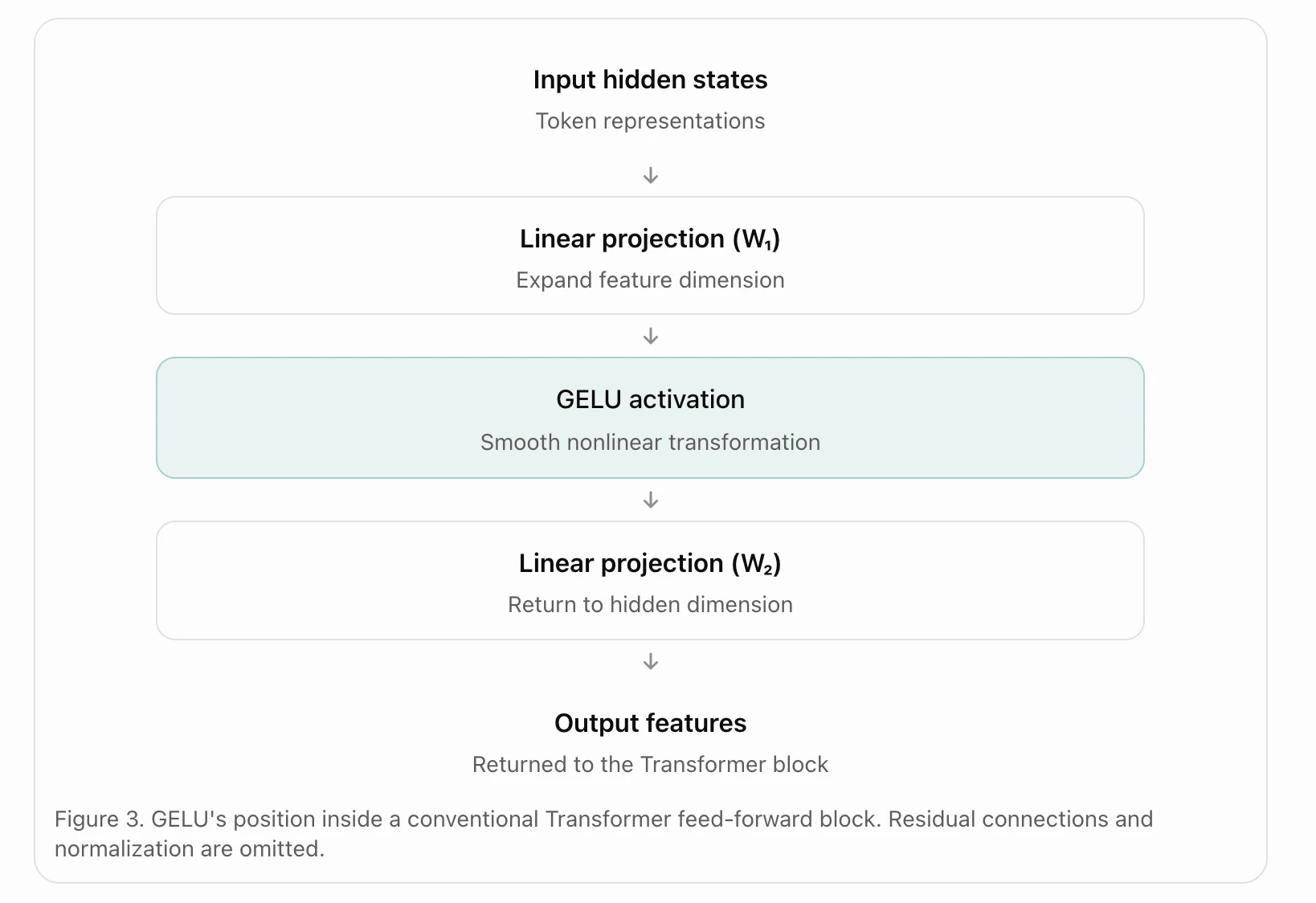
class TransformerFFN(nn.Module):
    def __init__(self, dim, expansion_factor=4, use_gelu=True):
        super().__init__()
        self.fc1 = nn.Linear(dim, dim * expansion_factor)
        self.fc2 = nn.Linear(dim * expansion_factor, dim)
        self.activation = nn.GELU() if use_gelu else nn.ReLU()

    def forward(self, x):
        return self.fc2(self.activation(self.fc1(x)))

# Initializing a sample model
model = TransformerFFN(dim=512)
sample_input = torch.randn(1, 10, 512)
output = model(sample_input)
print(f"Output shape: output.shape")
In this implementation, the expansion_factor mimics the typical Transformer bottleneck, where the hidden dimension is quadrupled before being projected back. This is where the choice of GELU has the most impact on the model’s capacity to learn complex feature representations.

Comparative Analysis: Advantages and Limitations
While GELU is widely regarded as superior for Transformers, it is not a "silver bullet." A balanced analysis reveals specific scenarios where each function excels.
GELU Advantages:
- Gradient Flow: The non-zero gradient for small negative values prevents dead neurons.
- Smoothness: Differentiability at all points aids in complex optimization landscapes.
- State-of-the-Art Performance: Consistently outperforms ReLU in Transformer-based NLP and Vision tasks.
GELU Limitations:
- Computational Cost: Even with approximations, it is slightly more demanding than the nearly-free
max(0, x)operation. - Hardware Optimization: Older mobile or edge hardware may have specific optimizations for ReLU that do not yet exist for GELU.
ReLU Advantages:

- Simplicity: Extremely easy to understand and implement.
- Sparsity: By zeroing out negative values, it naturally creates sparse activations, which can be beneficial for certain types of model compression.
Implications for the Future of AI Architecture
The shift to GELU marks a broader trend in AI research toward "Gated Linear Units" (GLUs). Modern models like Meta’s Llama series have further evolved this concept by using SwiGLU—a variant that combines the Swish activation (a GELU relative) with a gating mechanism.
As models continue to grow in scale, the nuances of activation functions become even more critical. A small gain in convergence speed or a slightly better gradient flow can save millions of dollars in compute costs during the training of a foundation model.
Conclusion
The Gaussian Error Linear Unit (GELU) has transitioned from a theoretical proposal in 2016 to the backbone of the world’s most powerful AI systems. By replacing the rigid threshold of ReLU with a smooth, probabilistic curve, GELU has enabled deeper, more stable, and more expressive neural networks. While ReLU remains a valid choice for simpler tasks and lightweight architectures, the dominance of GELU in the Transformer era underscores a fundamental truth in machine learning: as our models grow in complexity, the mathematical functions that power them must become equally sophisticated. Understanding GELU is no longer just for researchers; it is essential for any developer or engineer looking to work at the cutting edge of modern artificial intelligence.


 rifanmuazin
 Ali Ikhwan