Pevita Pearce
In an increasingly digitized world, the health and veracity of an email list stand as a critical pillar of any effective marketing strategy. Far from being a static asset, an email database is a living entity, constantly undergoing a process of decay due to factors such as job changes, abandoned inboxes, and expired domains. This inherent dynamism necessitates continuous vigilance, making robust email verification not merely a best practice but an indispensable operational requirement for marketing decision-makers aiming to maintain an efficient and impactful email program.
The Evolving Digital Ecosystem: A Background on Email Marketing Challenges
The landscape of digital communication has undergone a profound transformation over the past two decades. What began as a relatively unregulated frontier for mass communication has matured into a sophisticated ecosystem governed by stringent data privacy laws, advanced anti-spam technologies, and evolving consumer expectations. Early email marketing, characterized by broad, often untargeted blasts, quickly gave way to permission-based strategies as recipients became inundated with unsolicited messages. This shift laid the groundwork for the modern imperative of data quality.
As email marketing evolved, so too did the threats to its efficacy. The proliferation of spam, phishing attempts, and sophisticated bot networks created a challenging environment where legitimate messages struggled to cut through the noise. Mailbox providers (MBPs) responded by developing highly advanced algorithms to detect and filter suspicious activity, prioritizing sender reputation and engagement metrics. This technological arms race means that any deviation from best practices, such as sending to invalid addresses, is immediately flagged, leading to a detrimental impact on deliverability across an entire domain. The year 2026, often cited in industry discussions, marks a pivotal point where the margin for error in email deliverability has shrunk to near zero, elevating email list quality and verification from a "nice-to-have" to absolute "table stakes" for marketers.
A Timeline of Regulatory and Technological Shifts
The increasing focus on email verification can be traced through a series of significant regulatory and technological milestones:
- 2003: The CAN-SPAM Act (Controlling the Assault of Non-Solicited Pornography And Marketing Act): Enacted in the United States, this law established national standards for commercial email, giving recipients the right to stop unwanted emails and setting penalties for violations. While not directly enforcing verification, it underscored the need for legitimate sending practices and consent.
- Mid-2000s: Rise of Anti-Spam Technologies: Mailbox providers like Gmail, Outlook, and Yahoo began investing heavily in sophisticated spam filters, incorporating machine learning to identify patterns associated with unsolicited or malicious emails. Sender reputation became a crucial factor.
- 2010s: Growth of Data Analytics and Personalization: As marketing became more data-driven, the quality of contact data became paramount for effective segmentation and personalized campaigns. Invalid emails directly hindered these efforts.
- 2018: General Data Protection Regulation (GDPR): This landmark EU regulation dramatically reshaped data privacy, emphasizing explicit consent for data processing and communication. It mandated that organizations know precisely who they are emailing and have verifiable permission, making email verification a cornerstone of compliance.
- 2020: California Consumer Privacy Act (CCPA): Following GDPR’s lead, the CCPA provided California consumers with extensive rights regarding their personal data, including the right to know what data is collected and to opt-out of its sale. This reinforced the legal need for accurate and consent-driven email practices.
- Early 2020s: Proliferation of Bots and AI-driven Fraud: The sophistication of automated threats surged, with bots filling out web forms with fake data, creating fraudulent accounts, and engaging in credential stuffing. This made real-time email verification at the point of entry essential for data integrity and fraud prevention.
- Present Day (and beyond, towards 2026): Enhanced Mailbox Provider Scrutiny: MBPs continue to refine their algorithms, increasingly penalizing senders with high bounce rates, low engagement, and frequent spam trap hits. The margin for error is consistently shrinking, pushing email verification to the forefront of deliverability strategies.
Understanding the Decay: The Hidden Costs of Stagnant Email Lists
The natural decay of an email list is a persistent challenge. Industry analyses frequently cite an average email list decay rate of 22.5% annually, though some sectors experience rates as high as 30% or more. This means that nearly a quarter of an email list can become obsolete within a year due to various factors: individuals changing jobs, abandoning old email addresses, or domains expiring. Neglecting this inevitable decay means that "bad data" doesn’t just passively occupy space within an Email Service Provider (ESP); it actively works against marketing efforts, leading to a cascade of detrimental effects.

Beyond the immediate symptoms of undelivered emails, the failure to implement regular email verification undermines the entire data life cycle. This translates into tangible financial losses and reputational damage. For instance, if an organization sends a campaign to 10,000 subscribers, and 2,000 of those addresses are invalid, the resources spent on crafting the message, segmenting the audience, and paying the ESP for those sends are effectively wasted. This direct financial drain is often overlooked but accumulates significantly over time.
Six Critical Risks: Why Neglecting Verification is a Strategic Blunder
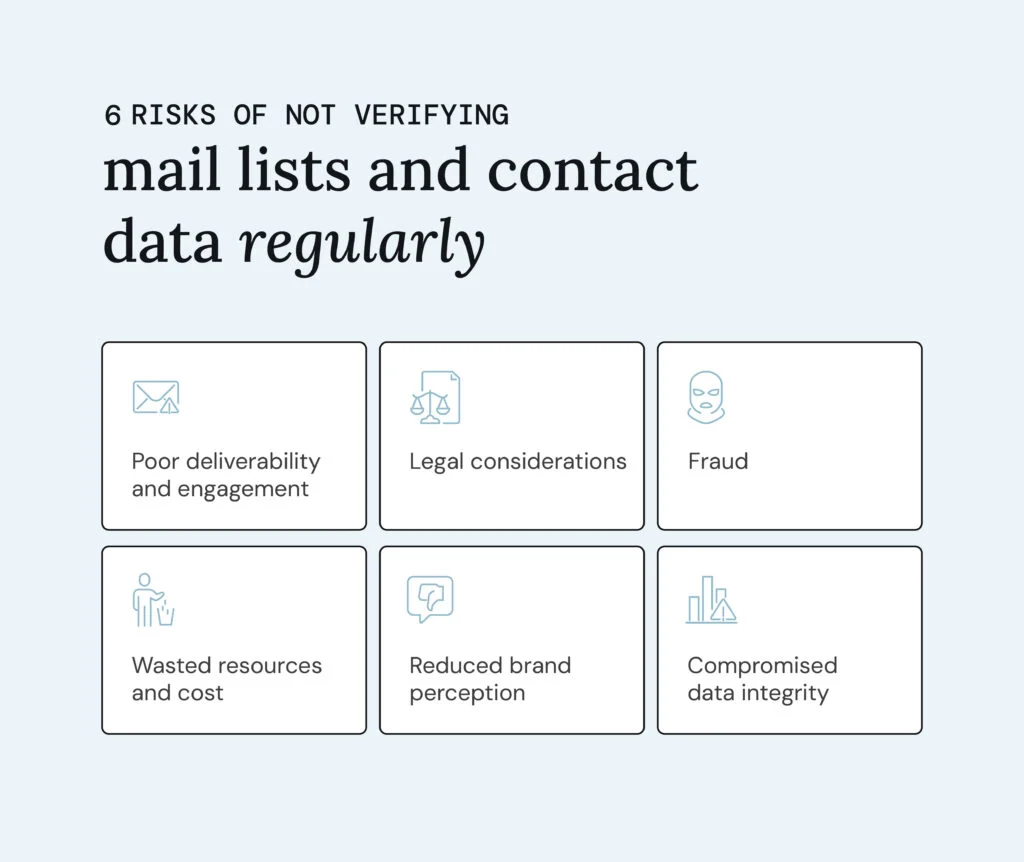
The strategic importance of regular email verification extends beyond mere deliverability. It is a proactive, strategic measure that provides clarity and insights for marketing teams, enabling data-driven decisions and optimizing overall email performance. The following six risks underscore why email data verification is a foundational element of a healthy email marketing ecosystem:
-
Deteriorating Deliverability and Engagement:
One of the most immediate and frustrating consequences of poor email hygiene is the adverse impact on deliverability. High bounce rates, resulting from sending emails to invalid or non-existent addresses, send a clear negative signal to mailbox providers. This acts as an "instant red flag," indicating potentially untrustworthy sending practices and significantly increasing the likelihood that future campaigns will be diverted directly to spam folders, even for legitimate subscribers. Data indicates that one in every seven legitimate emails already fails to reach its intended inbox, even for valid subscribers. Failing to proactively validate lists merely adds an additional, avoidable layer of risk. When a sender’s reputation declines due to these issues, even engaged, legitimate contacts are less likely to see the emails they have opted in to receive, leading to:- Reduced inbox placement rates.
- Lower open and click-through rates.
- Increased spam complaint rates.
- Damage to overall sender reputation.
- Potential blacklisting by MBPs.
Regular validation ensures messages reach real, active contacts, who are genuinely interested in engaging with the brand and potentially converting into customers.
-
Navigating the Complex Legal Landscape:
In an era of heightened data privacy awareness, maintaining a clean and verified email list is paramount for legal compliance. Organizations operating globally must contend with a patchwork of regulations, most notably the GDPR (General Data Protection Regulation) in Europe, the CCPA (California Consumer Privacy Act) in the United States, and the CAN-SPAM Act, which applies federally in the US. These laws share a common thread: they demand transparency, accountability, and consent regarding who an organization emails, why, and whether it has the legitimate right to do so.- GDPR: Requires explicit, unambiguous consent for processing personal data, including email addresses. Sending to unverified or stale addresses can be construed as non-compliant data processing, risking substantial fines (up to 4% of global annual turnover or €20 million, whichever is higher).
- CCPA: Grants consumers specific rights over their personal information, including the right to opt-out of its sale and to request deletion. Maintaining accurate data, verifiable through email addresses, is essential for fulfilling these requests.
- CAN-SPAM: Mandates accurate header information, a clear subject line, a physical postal address, and an opt-out mechanism. While less focused on consent than GDPR/CCPA, sending to invalid addresses can still reflect poorly on a sender’s adherence to legitimate practices.
Email verification serves as the first line of defense in consent management, protecting organizations from severe legal penalties while simultaneously fostering trust and transparency with consumers. Marketing leaders must prioritize this to safeguard their brand from legal exposure.
-
Combating Digital Fraud and Malicious Actors:
The digital realm is rife with fraudulent activities, and email lists are a prime target. Fake email sign-ups, often orchestrated by bots filling out web forms, pose a significant risk. These malicious entries lead to wasted marketing budgets on fake leads and skew performance metrics, rendering data analysis unreliable. Beyond marketing, bots can:- Exploit free trials: Depleting resources and increasing operational costs.
- Degrade service quality: By overwhelming systems designed for genuine users.
- Compromise analytics: Injecting large volumes of fake data makes it harder to identify real security threats or understand genuine user behavior.
- Facilitate broader attacks: Fake profiles can be used to gather sensitive data from actual users, spread misinformation, or launch phishing campaigns.
A robust email verification process, especially at the point of sign-up, acts as a crucial barrier, preventing bot traffic from entering the database and causing widespread damage. This ensures that marketing efforts are directed towards genuine prospects, securing the integrity of customer data and financial investments.
-
Mitigating Wasted Resources and Escalating Costs:
The financial implications of neglecting email verification are often underestimated. Most ESPs employ pricing models based on the number of contacts in a database or the volume of emails sent. Consequently, maintaining a list riddled with invalid addresses means paying for services that deliver no value. Consider a scenario where a large-scale campaign targets 50,000 contacts, with 10,000 being invalid. The organization is effectively paying for 10,000 emails that will never reach an inbox, representing a substantial, recurring waste of budget.
The impact on Return on Investment (ROI) is one of the most noticeable risks. A clean, verified email list ensures that every marketing dollar is allocated to a real person, naturally increasing the potential for engagement and conversion. Furthermore, it offers other significant resource and cost benefits:- Reduced spend on ESP fees for invalid contacts.
- Lower internal operational costs associated with managing a bloated, inaccurate database.
- Improved efficiency for marketing and sales teams, who can focus on genuinely interested leads.
- More accurate budget allocation for future campaigns.
Email verification also reduces the labor and resources spent internally tracking down invalid addresses or dealing with customer service inquiries related to undelivered emails, streamlining processes and improving team morale.
-
Protecting Brand Reputation and Customer Trust:
Organizations invest considerable time and resources into crafting compelling email campaigns. However, poor email verification practices can unravel these efforts in moments. Consistently landing in target customers’ spam folders not only wastes effort but also severely damages brand perception, potentially eroding brand equity and customer loyalty.
Spam folders are inherently associated with scams, junk, and low-quality content. If a brand’s emails frequently end up there, that negative perception can stick, regardless of the quality of the content. Once mailbox providers begin associating a domain with spam-like behavior, recovering sender reputation and deliverability becomes an arduous, protracted process. This tarnished reputation can extend beyond email, influencing customer trust in the brand’s products, services, and overall professionalism. Maintaining a clean list is therefore an act of brand stewardship, preserving the carefully cultivated image and trustworthiness of an organization. -
Upholding Data Integrity Across the Enterprise:
Ultimately, the effectiveness of any email marketing strategy is inextricably linked to the quality and reliability of its underlying data. If contact data is unreliable, the entire analytical and strategic framework built upon it becomes compromised: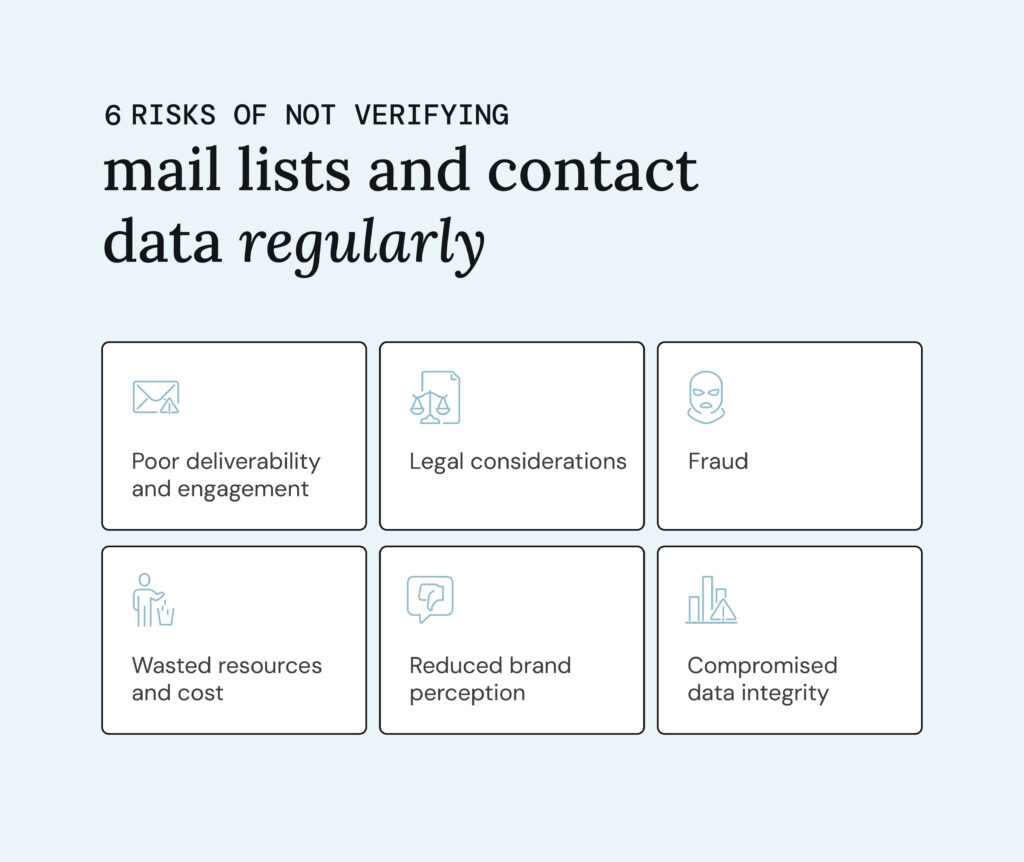
- Flawed Segmentation: Inaccurate data leads to incorrect audience segmentation, meaning personalized messages miss their mark.
- Distorted Analytics: Campaign performance metrics (open rates, click-throughs, conversions) are skewed by the presence of invalid contacts, leading to misleading insights and poor strategic decisions.
- Ineffective Personalization: The ability to tailor content based on user behavior or demographics is severely hampered if the foundational contact information is incorrect or outdated.
- Compromised CRM: Customer Relationship Management systems become cluttered with junk data, hindering sales efforts and customer support.
It’s a domino effect: one bad email at the start of a workflow can disrupt everything downstream. Multiplied across thousands or millions of email contacts, this leads to decisions based on a distorted picture of the audience and marketing campaign performance. Email verification keeps the data foundation solid, ensuring that all subsequent marketing and business intelligence efforts are accurate and actionable. Many businesses are now embracing innovative modern tools to maintain email list hygiene, preventing these pervasive issues from impacting their long-term marketing plans and overall business health.
Strategic Solutions: Implementing Robust Email Data Quality Protocols
While there is no single "perfect" approach to email list verification, the most effective strategies involve layering multiple techniques and integrating automated services into existing workflows. This creates a multi-faceted defense against data degradation. Key methods include:
- Syntax Validation: Basic checks to ensure the email address follows a standard format (e.g.,
[email protected]). - Domain Validation: Verifying that the domain exists and has valid MX (Mail Exchange) records, indicating it can receive emails.
- Role-Based Email Detection: Identifying addresses like
info@,sales@, orsupport@, which often represent departments rather than individuals and may have lower engagement or higher complaint rates. - Disposable Email Address (DEA) Detection: Filtering out temporary email addresses designed for one-time use, which are often employed to bypass registration forms without genuine intent to engage.
- Spam Trap Identification: Detecting addresses that appear legitimate but are specifically designed to catch senders with poor list hygiene. Hitting a spam trap can severely damage sender reputation.
- Real-Time Verification APIs: Integrating verification services directly into web forms, CRM systems, and other data capture points. This checks email validity at the moment of entry, preventing bad data from ever entering the database.
- Batch Verification: Periodically running an entire existing email list through a verification service to identify and remove invalid, risky, or low-quality addresses. This is crucial for ongoing list hygiene.
By leveraging automated email verification services, organizations can implement both batch and real-time strategies, establishing a strong defense against the spread of false email data and contributing to a more reliable communication ecosystem. This continuous process ensures that email campaigns are consistently directed towards a genuinely engaged and reachable audience.
Industry Perspectives and Expert Consensus
Industry analysts and digital marketing strategists universally underscore the non-negotiable nature of email verification in today’s competitive landscape. "The days of ‘spray and pray’ email marketing are long over," states a leading deliverability expert. "With regulatory bodies tightening their grip and mailbox providers becoming more sophisticated, proactive email hygiene isn’t just about avoiding penalties; it’s about maximizing ROI and protecting your most valuable digital asset: your customer relationships." Marketing leaders are increasingly recognizing that investments in data quality, particularly email verification, yield significant returns by enhancing campaign effectiveness, reducing operational costs, and fortifying brand trust. Data privacy advocates further highlight how accurate and verified email lists are fundamental to respecting consumer privacy rights, building an ethical marketing framework that benefits both businesses and their customers.
The Broader Implications: Email Verification as a Business Imperative
The combined risks of poor email list validation underscore a critical truth: email verification is not merely a technical chore for the marketing department but a strategic business imperative that impacts the entire organization. When approached with the right strategy and tools, these risks can be transformed into significant advantages. Verified email lists provide the foundational framework for stronger branding, fewer technical failures, and dramatically reduced wasted budget.
Assessing and cleansing email databases should be viewed as an opportunity to cultivate a stronger, more engaged customer base. With fewer dead ends and a fresh, accurate perspective on the audience, organizations can construct a more efficient, robust email marketing plan that relies on concrete, trustworthy data. In time, this meticulous approach can elevate email marketing from a mere promotional channel to a highly anticipated communication touchpoint, where consumers eagerly await messages, trusting the brand with their time, money, and sensitive information. In an increasingly data-driven and privacy-conscious world, the commitment to email verification is a clear indicator of a business’s dedication to excellence, integrity, and sustainable growth.


 Laily UPN

 rifanmuazin