An AEO checker provides critical insights into whether artificial intelligence answers, increasingly relied upon by consumers, accurately mention and cite a brand. In an era where users frequently turn to generative AI platforms like ChatGPT, Perplexity, and Gemini for direct answers, the traditional visibility once afforded by high search rankings is rapidly diminishing, often disappearing into AI-synthesized responses that bypass traditional click-throughs. This profound shift necessitates a new approach to digital presence, moving beyond mere search engine optimization (SEO) to embrace answer engine optimization (AEO).
The digital landscape has undergone a seismic transformation with the advent and widespread adoption of generative AI. For decades, the internet operated on a click-and-browse paradigm, where search engines presented users with lists of links, and success was measured by ranking high in those lists. Search Engine Optimization (SEO) became the cornerstone of digital marketing, focused on driving traffic to websites. However, the emergence of sophisticated large language models (LLMs) has introduced a new mode of information consumption. Users now pose questions directly to AI, expecting synthesized, concise answers, often negating the need to click on any external links. This "zero-click" phenomenon means that even if a brand’s content is highly ranked and authoritative, its visibility can be entirely obscured if the AI answer engine does not explicitly mention or cite it within its direct response. Industry reports suggest that upwards of 65% of all Google searches now result in zero clicks, a trend that is only accelerating with the integration of generative AI features.
The Evolution of Search: From Links to Answers
The journey from traditional web search to AI-driven answer engines has been rapid and transformative. Initially, search engines like Google revolutionized information access by indexing web pages and presenting them as ranked lists. SEO professionals meticulously optimized content for keywords, backlinks, and technical performance to secure top positions. This model, while effective for its time, was inherently a gateway to information, requiring users to navigate external sites.
The landscape began to shift significantly with the public release of advanced generative AI models. ChatGPT, launched by OpenAI, quickly demonstrated the power of conversational AI to generate human-like text, answer complex questions, and even perform creative tasks. Competitors like Perplexity AI emerged, specifically designed as "answer engines" that not only provide direct answers but also meticulously cite their sources, offering a hybrid model that bridges the gap between traditional search and AI summarization. Google, recognizing this paradigm shift, responded by integrating its own generative AI capabilities directly into its core search product. In May 2024, Google launched "AI Overviews," which proactively provides summarized answers at the top of search results pages for many queries, often before any traditional links, effectively bringing the "answer engine" experience directly into its search interface.
![AEO checker tools that measure answer engine visibility [2026]](https://53.fs1.hubspotusercontent-na1.net/hubfs/53/aeo-checker-1-20260903-3858273.webp)
This fundamental change underscores the critical distinction between SEO and AEO. While SEO aims to improve a page’s ranking in a list of links, AEO focuses on enhancing how frequently and accurately a brand appears within the synthesized answer itself. These two practices are not mutually exclusive; rather, they are complementary. Strong SEO remains foundational, as answer engines still rely on crawlability, authority signals, and well-structured content to identify credible sources for their answers. However, AEO adds a crucial layer, ensuring that once content is identified, the brand behind it receives appropriate recognition and citation within the AI-generated response.
Understanding Answer Engine Optimization (AEO)
Answer Engine Optimization (AEO) is the strategic discipline of optimizing digital content and online presence to maximize a brand’s visibility, accuracy, and citation within the AI-generated responses provided by platforms like ChatGPT, Perplexity, Gemini, and Google AI Overviews. Its primary goal is to ensure that when users ask questions relevant to a brand’s products, services, or expertise, the brand is not only mentioned but also accurately represented and, ideally, cited as a source.
The core tenets of AEO revolve around making content digestible and trustworthy for AI. This includes:
- Clarity and Directness: Providing unambiguous, direct answers to common questions.
- Structured Data: Utilizing schema markup and other structured data formats to help AI understand the context and relationships within content.
- Authority and Verifiability: Backing claims with primary sources, expert opinions, and verifiable data, signaling to AI that the information is reliable.
- Brand Entity Recognition: Ensuring consistent branding and entity information across the web so AI can correctly identify and associate information with the brand.
A robust AEO strategy acknowledges that content must serve two masters: human readers and artificial intelligence algorithms. The shift means that marketers must now think not just about ranking for keywords, but about answering questions comprehensively and authoritatively, anticipating how an AI might synthesize their information.
The Indispensable Role of an AEO Checker
![AEO checker tools that measure answer engine visibility [2026]](https://no-cache.hubspot.com/cta/default/53/9dd5e54b-fbef-4dd0-bc44-1689feb1ea18.png)
In this dynamic environment, an AEO checker emerges as an indispensable tool. It functions as a diagnostic and strategic compass, measuring a brand’s visibility across various answer engines and translating that data into actionable recommendations for improvement. Specifically, an AEO checker performs several critical functions:
- Visibility Measurement: It monitors which questions and queries trigger AI responses that include a brand’s content, either through direct citation or explicit mention. This provides a baseline understanding of current performance.
- Competitive Analysis: It identifies instances where a brand’s content should be surfaced but, instead, a competitor’s content is cited or mentioned. This highlights critical content gaps and competitive vulnerabilities.
- Accuracy Verification: It detects instances where an AI engine might misrepresent a brand, provide incorrect information, or fail to accurately convey its value proposition. This is crucial for reputation management in the AI era.
- Recommendation Generation: Based on its analysis, a sophisticated AEO checker will prioritize specific recommendations. These can range from minor content updates (e.g., adding a direct FAQ section), to implementing specific schema markup, or enhancing entity declarations across the web to reinforce brand identity for AI.
- Performance Tracking: A good AEO checker operates on a continuous loop: measuring, diagnosing, prioritizing, optimizing, and reporting. This ensures ongoing adaptation to the volatile nature of AI responses and evolving algorithm updates.
Manual AEO Checks: A Foundational, Yet Limited, Approach
For brands just beginning to explore AEO, or those with a very narrow focus, manual checks can offer initial insights. However, their scalability and reliability are inherently limited due to the dynamic nature of AI responses.
How to Run an AEO Check in Google AI Overviews (Manual)
Google’s AI Overviews (AIOs) are triggered only when Google’s systems determine that a summary adds value beyond traditional search results, meaning they don’t appear for every query. Furthermore, AIOs can vary significantly between different user sessions, locations, and times, making single lookups unreliable.
- Step 1: Define Your Priority Queries. Begin by compiling a list of your most critical search queries. This should include your brand name, specific product names, and key informational questions that your target audience frequently asks.
- Step 2: Execute and Record Queries. For each query, perform searches in an incognito or signed-out browser session to minimize personalization bias. Record three key pieces of information:
- Whether an AI Overview appears for the query.
- If an AIO appears, whether your domain is listed among its inline source links.
- The exact claims or information provided by the AI Overview.
- Step 3: Interpret Results and Identify Gaps. Compare the queries where your brand was cited against those where a competitor was cited, or where no AIO appeared despite relevance. This forms your initial content gap analysis. Due to AIO volatility, treat a single absence as a prompt for re-checking rather than definitive proof of lost placement.
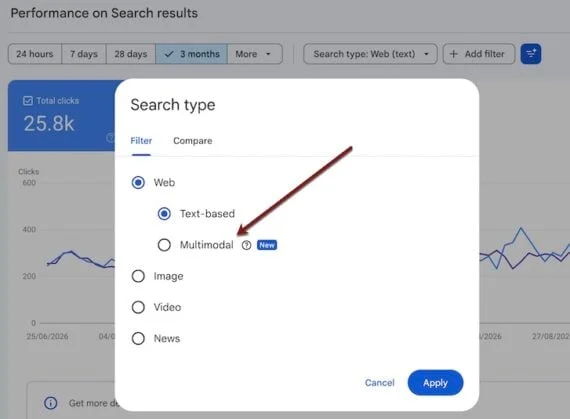
- Step 4: Document and Report. Capture screenshots of each result, noting the query, date, and location. This creates a defensible "before-and-after" record. Currently, Google Search Console’s standard Performance report lumps AI Overview activity into general "Web" search. While Google began rolling out a dedicated generative AI performance report in June 2026, it initially reported only impressions and was limited to a subset of sites, underscoring the need for manual tracking or specialized tools.
How to Check ChatGPT and Perplexity Citations (Manual)
![AEO checker tools that measure answer engine visibility [2026]](https://53.fs1.hubspotusercontent-na1.net/hubfs/53/aeo-checker-2-20260903-852936.webp)
ChatGPT and Perplexity differ slightly in their citation mechanisms, but both offer transparency regarding their sources. Perplexity is known for its strong emphasis on citations, typically attaching them to every answer and often presenting a dedicated panel listing all referenced sources. ChatGPT also shows inline citations when utilizing web search and provides a "Sources" panel.
- Step 1: Conduct Practical Citation Checks. Using your defined priority queries, assess each AI response for two crucial elements:
- Does your domain appear among the cited sources?
- Is your brand explicitly named within the answer text itself? (A direct mention is a separate, valuable win even without a link).
- Step 2: Strategically Phrase Prompts. ChatGPT, in particular, may only search the web when a question requires current information or when explicitly prompted. Phrase your questions to encourage real-time web retrieval, e.g., "What are the best [category] tools for [use case] in 2024?"
- Step 3: Log Results and Prioritize Tasks. Due to the variability of AI responses, run each prompt multiple times across fresh sessions. Maintain a detailed log noting the AI engine, prompt, date, whether your brand was cited or mentioned, and which competitors appeared. This log will highlight inconsistencies and pinpoint areas for improvement. Each absence or competitor citation represents a content optimization task.
While manual checks are a useful starting point for understanding the new search paradigm, they quickly become impractical for comprehensive, ongoing monitoring. The sheer volume of queries, the volatility of AI responses, and the need for continuous tracking make automated AEO checking software an essential investment for any serious brand.
Automated AEO Checkers: Essential Tools for the New Era
As manual checks prove insufficient for sustained AEO, specialized software has emerged to automate the monitoring and optimization process. Selecting the right AEO checker requires careful consideration of several key buyer criteria:
- Engine Coverage: The tool should track visibility across the primary answer engines relevant to your audience, including Google AI Overviews, ChatGPT, Perplexity, and Gemini. Comprehensive coverage ensures a holistic view of your brand’s presence.
- Citation vs. Mention Tracking: A critical distinction, the tool must differentiate between an AI response that merely names your brand and one that actively links back to your domain. Both are valuable, but they represent different levels of AI-driven influence.
- Recommendation Engine: Beyond mere data, the best AEO checkers provide prioritized, actionable recommendations. These insights should guide content creation, updates, schema improvements, and outreach strategies, clearly indicating the "what" and "why" of each task.
- Reporting and Analytics: Robust reporting features are essential for tracking performance trends over time, benchmarking against competitors, and identifying patterns in AI behavior. This includes historical data, performance fluctuations, and insights into content types that perform best.
- Integration Capabilities: Seamless integration with existing marketing technology stacks—such as Content Management Systems (CMS), Customer Relationship Management (CRM) systems, and traditional SEO tools—can streamline workflows and provide a more connected view of marketing performance.
- Scalability and Frequency: The tool should be capable of monitoring a large volume of queries continuously, ideally with daily or weekly refreshes to account for the dynamic nature of AI responses, which can change frequently.
Leading AEO Checking Tools in the Market
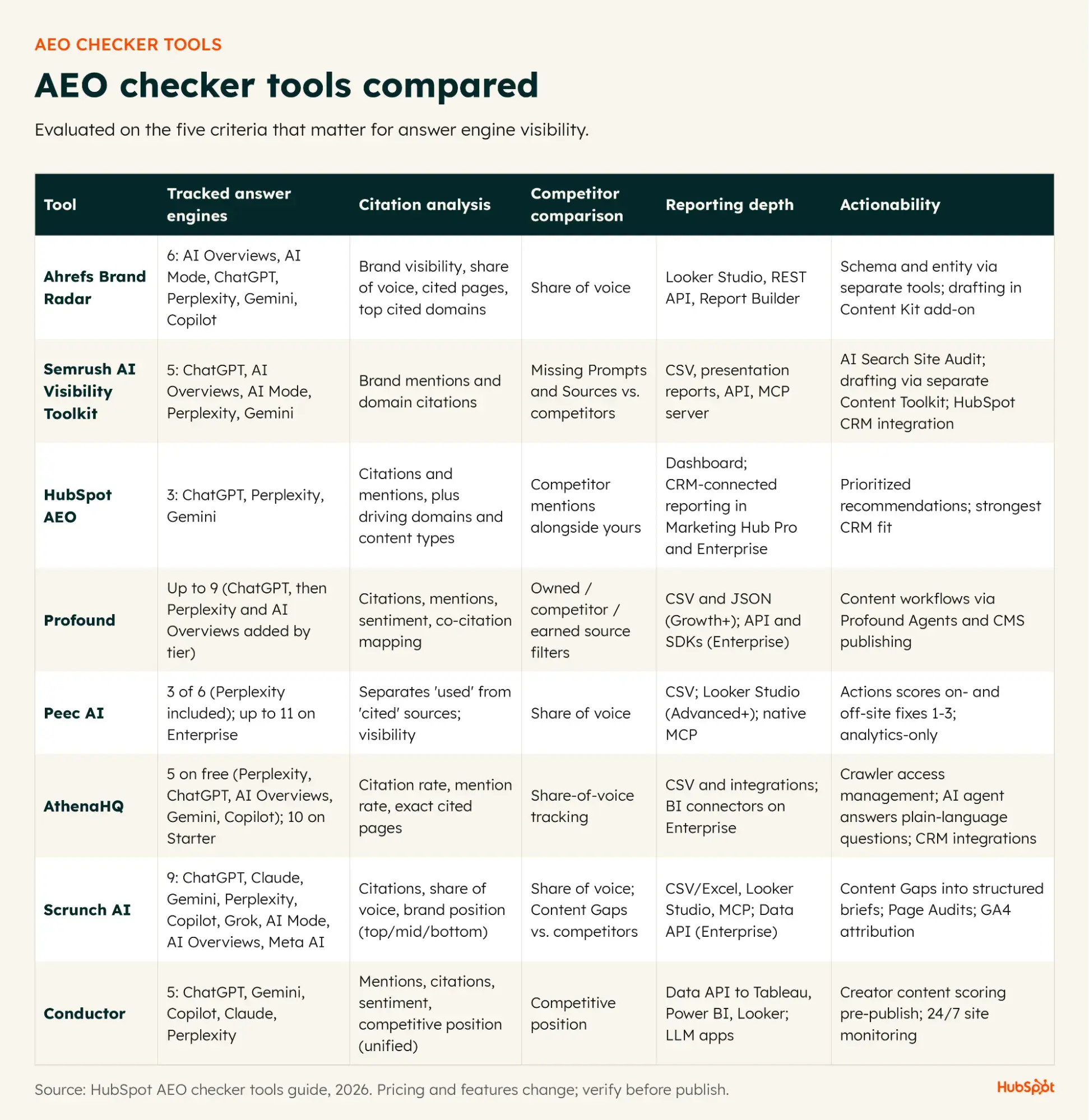
The market for AEO tools is rapidly evolving, with various platforms offering distinct strengths:
![AEO checker tools that measure answer engine visibility [2026]](https://53.fs1.hubspotusercontent-na1.net/hubfs/53/aeo-checker-3-20260903-8904553.webp)
Tools with AI Overviews Tracking:
- Ahrefs Brand Radar: Leveraging real search queries rather than synthetic prompts, Ahrefs Brand Radar focuses heavily on AI Overviews as its largest index. It tracks mentions and citations within Google’s AIOs, providing insights into brand visibility in this critical new search feature.
- Semrush AI Visibility Toolkit: Integrated within its broader suite, Semrush’s Organic Research flags keywords that already trigger AI Overviews for which a brand ranks. This allows marketers to prioritize existing high-ranking pages for AEO optimization, aiming for inclusion in the AIO summary.
Tools with ChatGPT Citation Detection:
- HubSpot AEO: HubSpot AEO offers comprehensive tracking for both citations (AI answers linking to your domain) and mentions (answers naming your brand without a direct link). It also analyzes the domains and content types that drive visibility for both your brand and competitors, providing a detailed competitive landscape. This tool is designed to integrate with HubSpot’s CRM for connected reporting.
- Profound: Profound goes beyond simple citation detection, delving into citation context. It includes sentiment scoring, flags uncited prompts (where your content could have been cited but wasn’t), and breaks down citations by source type (owned content, competitor content, earned media).
Tools with Perplexity Monitoring:
- Peec AI: As a pure-play analytics tool, Peec AI specializes in reporting clean, detailed data specifically from Perplexity AI. Its focused approach ensures deep insights into how Perplexity sources and cites information.
- AthenaHQ: AthenaHQ tracks Perplexity AI across all its plans, including a free tier, and uniquely integrates a conversational assistant to help users interpret data and generate queries.
Tools for Schema and Entity Readiness:
- Scrunch AI: Focusing on the technical foundational aspects, Scrunch AI checks whether AI crawlers can effectively reach and render your web pages. This is crucial for ensuring that your content is even discoverable by answer engines.
- Conductor: Conductor pairs 24/7 technical monitoring, including aspects relevant to AI crawlability, with a sophisticated content scorer. This combination helps optimize content not just for human readability but also for AI parseability and trustworthiness.
AEO Metrics That Truly Matter
Once an AEO checker is operational, a specific set of metrics becomes crucial for evaluating and demonstrating success. These metrics should be viewed as trends over time, rather than isolated snapshots, to truly understand the impact of AEO efforts:
![AEO checker tools that measure answer engine visibility [2026]](https://53.fs1.hubspotusercontent-na1.net/hubfs/53/aeo-checker-4-20260903-6212698.webp)
- Visibility Score: This overarching metric reflects a brand’s overall presence in AI-generated answers across tracked engines. An improving score indicates increased brand recognition by AI.
- Citation Coverage: This measures the percentage of relevant AI answers that explicitly cite or link back to your domain. It’s a direct indicator of your content’s authority and relevance in the eyes of AI.
- Brand Mentions (Uncited): Tracking instances where your brand name appears in an AI answer without a direct link is also important. These "zero-click" mentions contribute to brand awareness and mindshare, even if they don’t drive direct traffic.
- Competitive Citation Gap: This metric identifies the difference between your brand’s citation rate and that of your key competitors for similar queries, highlighting areas where you might be losing ground.
- AI-Referred Sessions and Conversions: While challenging to track due to the zero-click nature of many AI interactions, attributing traffic and conversions that do result from AI-generated responses (e.g., clicks from Google AI Overviews or cited links in Perplexity) is vital for demonstrating ROI.
- Content Type Performance: Analyzing which types of content (e.g., blog posts, product pages, FAQs, case studies) are most frequently cited or mentioned by AI can inform future content strategy.
From Measurement to Action: The HubSpot AEO Ecosystem
While many AEO checkers excel at diagnosis, they often stop short of facilitating direct action, requiring users to export data and implement changes in separate systems. HubSpot bridges this gap, offering an integrated solution that connects diagnosis with direct content creation and optimization, particularly for users of Marketing Hub Professional and Enterprise.
HubSpot AEO, available as a standalone tool ($50/month) or integrated into higher-tier Marketing Hub plans, transforms visibility data into prioritized, actionable recommendations. It not only tracks performance and analyzes citations but also suggests specific content to create, update, or outreach opportunities.
For Marketing Hub Professional and Enterprise subscribers, the integration deepens significantly. The "Content Agent" feature can turn a blog recommendation from the AEO tool into a research-backed first draft, crafted in the brand’s voice, with a single click. This draft lands directly in HubSpot’s content editor, ready for team review, refinement, and immediate publishing through Content Hub and Marketing Hub. This generative capability, currently in public beta, is typically priced at approximately $10 (1,000 HubSpot Credits) per blog post.
Crucially, because this entire workflow operates within HubSpot’s Smart CRM, traffic referred from AI tools can be recorded as its own source and tied directly to contacts and deals within the sales funnel. This provides a clearer picture of AI’s contribution to pipeline and revenue, moving beyond mere visibility scores. It’s important to acknowledge that AI’s zero-click influence means not all visibility will translate into trackable sessions or direct pipeline, but HubSpot’s approach maximizes attribution for what can be measured, offering a more holistic view of AEO’s impact. HubSpot AEO is presented as the logical next step for businesses seeking to move beyond manual checks and establish a continuous, scalable AEO strategy.
Frequently Asked Questions About AEO Checkers
![AEO checker tools that measure answer engine visibility [2026]](https://53.fs1.hubspotusercontent-na1.net/hubfs/53/aeo-checker-5-20260903-8938354.webp)
How often should you run an AEO check?
The frequency depends on the method. Manual spot-checks necessitate sampling several sessions per query due to the volatility of AI responses. Automated checkers are far more efficient, with daily or weekly refreshes being ideal to capture dynamic shifts in AI answers and provide a timely, reliable view of performance. A monthly snapshot would likely obscure too much of this critical volatility.
Is AEO the same as AI search optimization?
While often used interchangeably, AEO (Answer Engine Optimization) is the more precise and preferred term. It specifically refers to the practice of improving how accurately and frequently a brand appears in AI-generated answers from platforms like ChatGPT, Perplexity, and Google AI Overviews. "AI search optimization" is broader and less defined, making AEO the standard for this distinct marketing discipline.
Can you reliably track citations in ChatGPT and Perplexity?
Yes, within certain limitations. Both ChatGPT and Perplexity are designed to surface the sources behind their answers, making any single response readable for citations. However, the results can vary significantly from one query session to the next. Reliability is achieved through repetition: running each prompt multiple times across fresh sessions and tracking the emerging patterns, rather than relying on a single snapshot. Automated AEO checkers handle this repetitive process with greater efficiency and consistency.
Do AEO checkers replace traditional SEO tools?
No, AEO checkers do not replace traditional SEO tools; they complement them. Each measures different aspects of online visibility. SEO tools focus on organic rankings, keyword performance, and backlink profiles, which are crucial for driving traffic to web pages. AEO checkers, conversely, monitor how brands are cited and mentioned within AI-generated answers. Since strong SEO principles (like crawlability and authority) still underpin the content that AI engines draw upon, a comprehensive digital strategy requires running both AEO and SEO tools in tandem to ensure both discoverability and direct brand mentions in the new search landscape.