In the rapidly evolving landscape of software engineering and digital product management, the methodology of releasing new features has undergone a fundamental transformation. Historically, software deployment was a binary event: code was either "live" for everyone or remained in a staging environment. Today, the advent of full-stack experimentation has introduced a more nuanced approach, allowing teams to decouple code deployment from feature release. This paradigm shift is driven by three core mechanisms—feature flags, rollouts, and feature testing. While these terms are frequently used interchangeably in industry discourse, they represent distinct strategic tools with different technical requirements, operational goals, and success metrics.
The transition toward these methods reflects a broader industry trend known as Continuous Integration and Continuous Deployment (CI/CD). According to recent industry benchmarks, high-performing DevOps teams are 200 times more likely to deploy frequently and have a significantly lower change failure rate. Central to this efficiency is the ability to manage code at runtime using conditional logic. By understanding the granular differences between flags, rollouts, and tests, organizations can optimize their user experience while mitigating the inherent risks of backend and infrastructure changes.
The Foundation: Understanding Full-Stack Experimentation
Full-stack experimentation refers to the practice of testing changes across the entire technology stack, encompassing everything from user-facing interface elements to deep-seated backend logic, database configurations, and infrastructure settings. This differs significantly from traditional client-side testing, which primarily operates within the user’s browser. In client-side scenarios, a script typically modifies the Document Object Model (DOM) after the page has started rendering. While effective for simple layout changes or copy updates, this method often results in a "flicker" effect, where the original content is briefly visible before the variant appears.
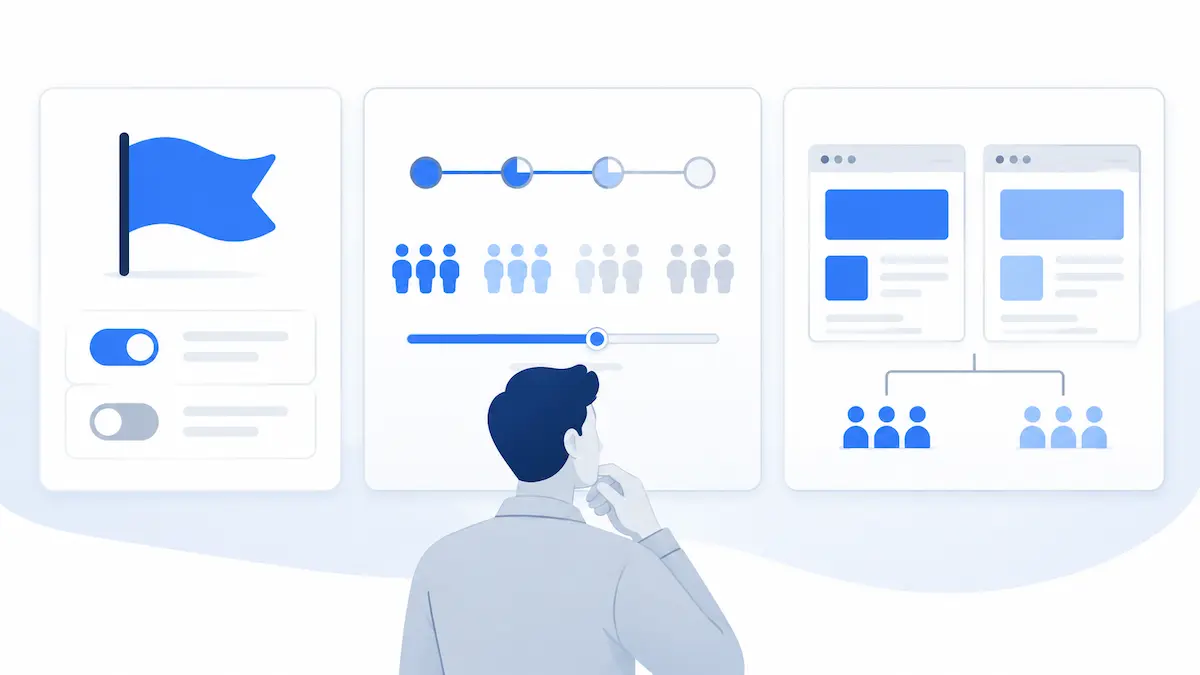
Full-stack experimentation eliminates this latency by bucketing users into specific variants before the application or page even renders. This is achieved through server-side integration via Software Development Kits (SDKs). For instance, platforms like Convert Experiences provide SDKs for a wide array of environments, including JavaScript/TypeScript, PHP, Python, Ruby, iOS, and Android. By utilizing a unified bucketing model across these languages, developers ensure that a visitor’s experience remains consistent regardless of whether they are interacting with a mobile app, a web interface, or an API-driven service.
Feature Flags: The Universal On-Off Switch
At its most fundamental level, a feature flag—also known as a feature toggle—is a piece of conditional logic embedded in the source code. It acts as a switch that allows functionality to be enabled or disabled at runtime without requiring a new code deployment. The primary advantage of a feature flag is its ability to separate the technical act of "shipping" code from the business act of "releasing" a feature.
Feature flags are typically categorized by their lifespan and purpose. A "kill switch" is a permanent or long-lived flag used to disable a third-party integration or a non-critical service if it begins to fail or experience latency. For example, if a payment gateway experiences a global outage, an engineering team can flip a feature flag to disable that specific payment option in seconds, preventing a total checkout failure. Conversely, "permissioning flags" are used to gate features based on a user’s subscription tier or geographic location.
Technically, when an application reaches a flagged section of code, it queries an SDK to determine the status of the flag for that specific user. The SDK returns not just a boolean "true" or "false," but can also provide typed variables such as integers, strings, or JSON objects. This allows developers to pass configuration data dynamically, such as changing a search algorithm’s sensitivity or adjusting a discount percentage, all without touching the underlying codebase.

Feature Rollouts: Managing Exposure and Mitigating Risk
While a feature flag provides the "how" of dynamic control, a rollout defines the "who" and "when." A feature rollout is the process of gradually widening the exposure of a new feature to a subset of the user base. This is a risk-mitigation strategy used when a team has already decided to implement a feature but wants to ensure that it does not negatively impact system stability or performance under load.
The standard chronology of a rollout often follows a percentage-based ramp-up. A team might initially release a new checkout flow to only 1% of traffic. Engineers then monitor "guardrail metrics," such as error rates, API latency, and server CPU usage. If the system remains stable, the exposure is increased to 10%, then 50%, and finally 100%. If an anomaly is detected at the 10% mark, the rollout can be instantly dialed back to 0% through the dashboard, effectively acting as an emergency brake that avoids a full rollback of the code.
In modern experimentation platforms, a rollout is treated as a specific experience type. Unlike an A/B test, a rollout typically does not involve a control group for the purpose of statistical comparison of user behavior. Its success is defined by the absence of technical failure rather than the improvement of a conversion metric.
Feature Testing: Scientific Validation of Product Hypotheses
Feature testing, often referred to as server-side A/B testing, is the most rigorous of the three methods. Its purpose is to answer a specific question: "Does this new functionality improve the user experience or business outcomes?" Unlike a rollout, which assumes the feature is desirable and focuses on safety, a feature test is designed to validate a hypothesis.
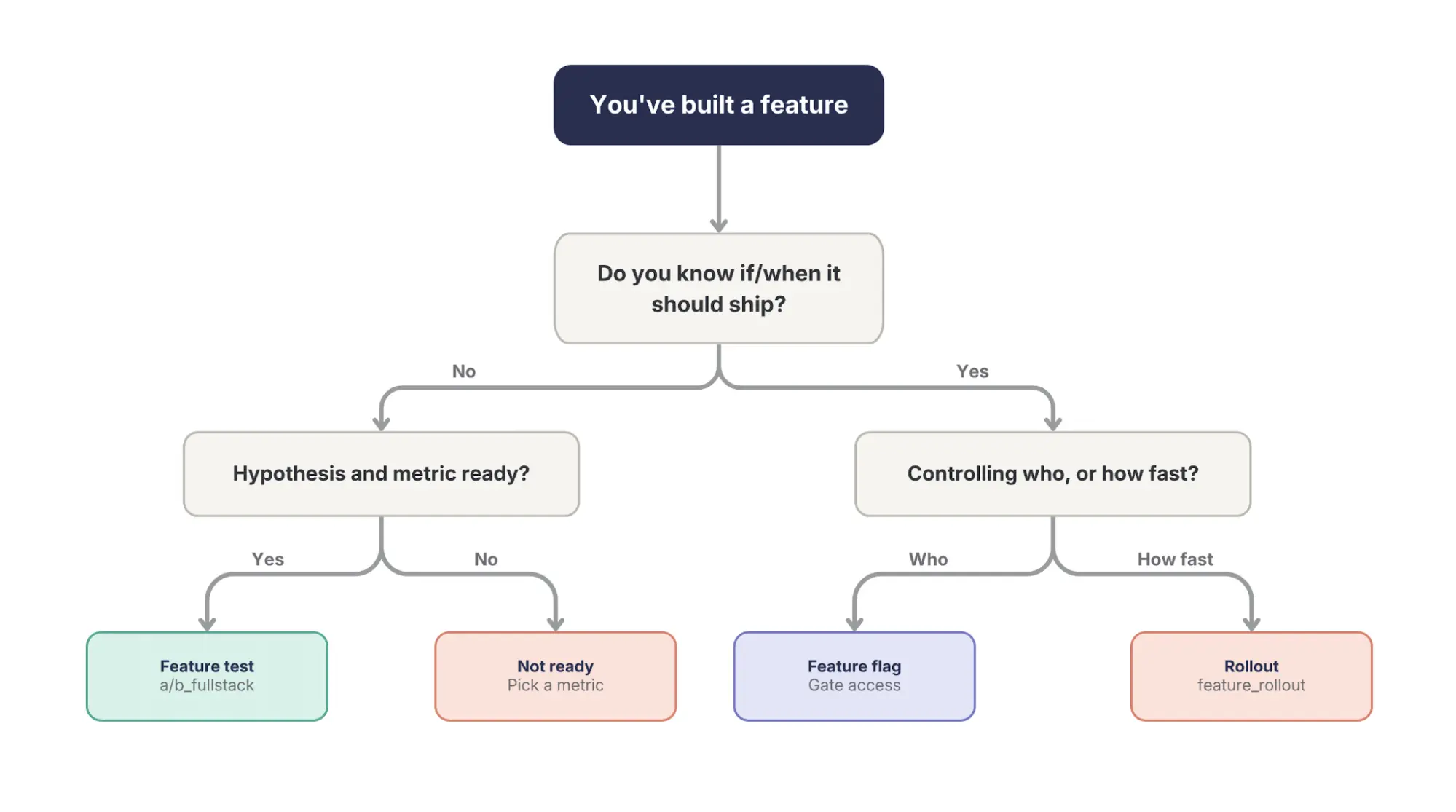
In a feature test, traffic is split between a control group (the original experience) and one or more variations. This split is maintained consistently for the duration of the experiment to ensure statistical integrity. For example, a product team might test two different search algorithms to see which leads to a higher rate of "add-to-cart" actions. Because the test runs at the full-stack level, it can measure the impact of backend changes that are invisible to the naked eye but significantly affect performance, such as database query speeds or recommendation engine logic.
The result of a feature test is determined by whether the variation achieves "statistical significance" against a predetermined primary metric. This requires a sophisticated statistical engine to account for variance and ensure that the observed improvements are not the result of random chance.
Comparative Analysis: Strategic Differences and Failure Modes
To effectively utilize these tools, it is necessary to examine their differences across several key factors. The following analysis outlines the operational distinctions:
- Control Groups: Feature testing is the only method that requires a dedicated control group to measure performance lift. Flags and rollouts do not use control groups, as their goals are operational rather than analytical.
- Traffic Allocation: Feature flags are generally binary (on/off) or targeted by specific user attributes (e.g., "internal employees only"). Rollouts use a dynamic ramp (e.g., 20% to 50%). Feature tests use a fixed split (e.g., 50/50) that remains stable to protect the validity of the data.
- Ownership: Feature flags are primarily managed by engineering teams for technical safety. Rollouts involve a collaboration between engineering and product management. Feature testing is typically driven by product managers, growth hackers, and Conversion Rate Optimization (CRO) specialists.
- Common Failure Modes: Each method carries risks. For feature flags, the primary danger is "flag sprawl" or "technical debt," where old flags are left in the code long after they are needed, leading to complexity and potential bugs. For rollouts, a common error is mistaking "successful exposure" for "successful adoption"—assuming that because a feature didn’t break the server, users actually liked it. For feature testing, the main risks are "underpowered tests," where the sample size is too small to reach a conclusion, or "p-hacking," where teams search for any positive metric after the fact rather than sticking to a predetermined goal.
Implementation Chronology in the Product Lifecycle
In a mature development environment, these three mechanisms are not used in isolation but are woven into a cohesive lifecycle.

- Phase 1: Development. A developer wraps a new feature in a feature flag. The code is merged into the main branch and deployed to production, but the flag remains "off" for all external users.
- Phase 2: Internal Validation. The flag is enabled only for internal QA teams and employees. This allows for real-world testing in the production environment without exposing the public to potential bugs.
- Phase 3: Experimentation. The team initiates a feature test. A portion of the traffic is assigned to the new feature, while the rest remains on the control. The team monitors behavior for two to four weeks until statistical significance is reached.
- Phase 4: Decision and Rollout. If the test proves the new feature is superior, the team decides to ship it. They then use a rollout to gradually increase exposure from the test group to the entire global audience, ensuring that the infrastructure handles the increased load of the new winner.
- Phase 5: Cleanup. Once the feature is at 100% and stable, the feature flag is removed from the codebase to prevent technical debt.
Broader Impact and Industry Implications
The adoption of full-stack experimentation has profound implications for how digital businesses operate. By reducing the "blast radius" of any single deployment, companies can afford to be more ambitious in their product iterations. The ability to test backend logic, such as pricing models or shipping algorithms, allows for optimization in areas that were previously considered too "risky" for traditional A/B testing.
Furthermore, the rise of edge computing—where code runs on servers closer to the user, such as Cloudflare Workers—is further blurring the lines between client-side and server-side testing. Modern SDKs are now designed to run in these edge environments, providing the speed of the server with the flexibility of the browser.
Ultimately, the distinction between flags, rollouts, and tests is a distinction of intent. A switch (flag) provides control; a dimmer (rollout) provides safety; and a measuring scale (test) provides certainty. For organizations looking to remain competitive in a data-driven market, mastering the orchestration of all three is no longer optional—it is a foundational requirement for modern software excellence.