The discipline of Conversion Rate Optimization (CRO) has matured from a niche marketing tactic into a cornerstone of digital business strategy, yet the industry remains divided on one critical front: the accurate forecasting of future revenue based on experimental results. In the contemporary digital economy, where marketing budgets are scrutinized with increasing intensity by Chief Financial Officers (CFOs), the ability to translate a percentage lift in an A/B test into a tangible dollar value is no longer a luxury—it is a requirement for program survival. However, the transition from a controlled experiment to a permanent site implementation is fraught with statistical and environmental variables that can decouple experimental success from bottom-line growth.

The Causality Dilemma in Digital Experimentation
The fundamental challenge in revenue forecasting lies in the gap between experimental validity and real-world permanence. A common scenario in the CRO world involves a test showing a 10% lift in conversion rates or Revenue Per User (RPU). While the immediate reaction of many stakeholders is to apply that 10% increase to the company’s annual revenue, such linear projections rarely materialize in the backend accounting. This discrepancy is often referred to as the "attribution gap."
Industry experts point to the superiority of randomized controlled trials (RCTs) over pre/post comparison models as the only viable method for proving causality. In a pre/post model, a business might implement a change and observe a 10% decline in revenue, concluding the change was a failure. However, an A/B test running simultaneously might reveal that the change actually prevented a 20% decline that would have occurred due to external factors, such as a competitor’s aggressive keyword bidding or a seasonal downturn. By isolating the variable, experimentation serves as the "gold standard" for causality, a methodology borrowed directly from clinical trials in the medical industry.

Statistical Rigor as a Prerequisite for Forecasting
To build a revenue forecast that withstands executive scrutiny, practitioners must first ensure the integrity of the data entering the model. This requires a commitment to robust statistical parameters that minimize the risk of "false positives" or Type I errors.
- Adequate Power and Sample Size: Experiments must run long enough to capture a representative sample of user behavior, accounting for weekly business cycles.
- Confidence Intervals: Forecasting should never rely on a single "point estimate." Instead, it should use the lower bound of a 95% confidence interval to provide a "worst-case" yet realistic expectation of gain.
- Primary Metric Alignment: While micro-conversions (like add-to-carts) are useful for leading indicators, revenue forecasting must be based on RPU or average order value (AOV) to ensure the model reflects actual cash flow.
The quality of a revenue forecast is intrinsically linked to the power of the experiment. If an experiment is underpowered, the "lift" observed may simply be statistical noise, making any subsequent revenue projection entirely speculative.
The Necessity of Conservative Modeling
The history of CRO is littered with case studies claiming multi-million dollar wins from minor adjustments, such as changing the color of a "Buy Now" button. While these outliers exist, veteran practitioners argue that these results are often the product of "selection bias" or the "novelty effect," where users react to a change simply because it is new, only for their behavior to normalize over time.
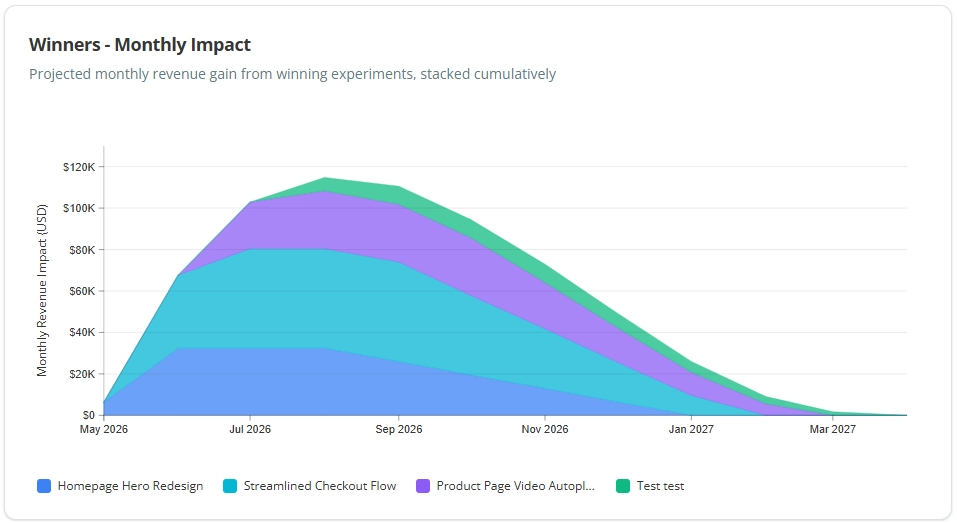
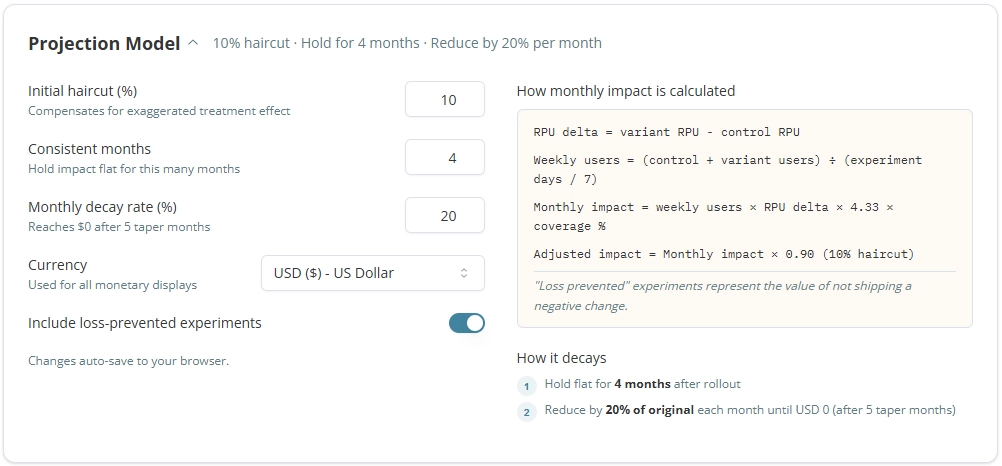
To counter this, a professional revenue forecast must incorporate "haircuts" and "decay rates." A "haircut" is a deliberate reduction of the observed lift—typically by 10% to 20%—to account for the fact that the experimental environment is cleaner than the chaotic reality of full-scale production. Furthermore, the "Novelty Effect" suggests that the impact of a winning variant will naturally diminish. A standard conservative model might hold the full projected impact steady for three to four months before applying a monthly decay rate of 20% until the effect reaches zero or a baseline plateau.
Technical Framework for Revenue Calculation
Moving from theory to practice requires a structured mathematical approach. The calculation for the projected monthly revenue gain from a winning experiment follows a specific chronology:
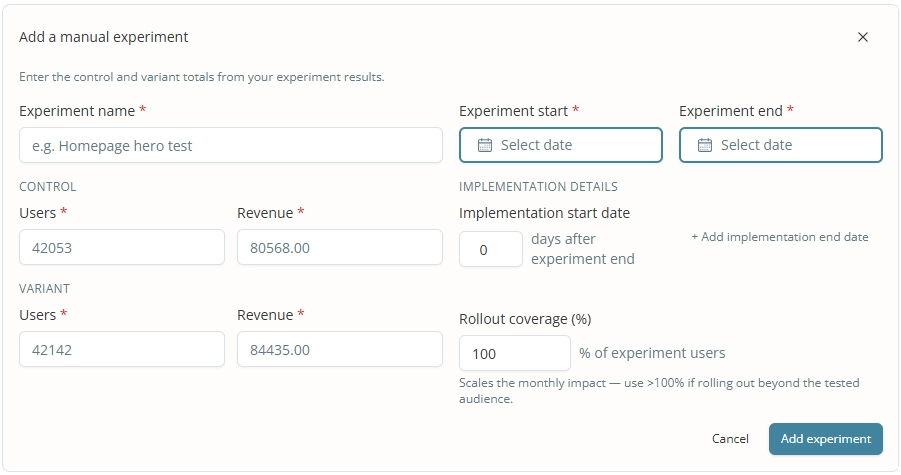
First, determine the Lift in Revenue Per User (RPU). This is calculated by subtracting the Control RPU from the Variant RPU. Second, apply the "Rollout Coverage" factor. This is critical for businesses that test on specific segments or sub-pages. If a test was conducted only on "Mobile Product Pages" but the change will be implemented across all devices, the traffic volume must be adjusted accordingly.
The formula can be summarized as:
(Projected Monthly Users × RPU Lift) × Rollout Coverage % × (1 – Haircut %) = Initial Monthly Impact.
This initial impact is then plotted on a timeline that accounts for "Implementation Lag." In many organizations, there is a significant delay between the conclusion of a test and the deployment of the winning code by the engineering team. A realistic forecast must account for this "dark period" where no revenue gain is realized despite a successful test result.

Integrating "Loss Prevention" into the Value Proposition
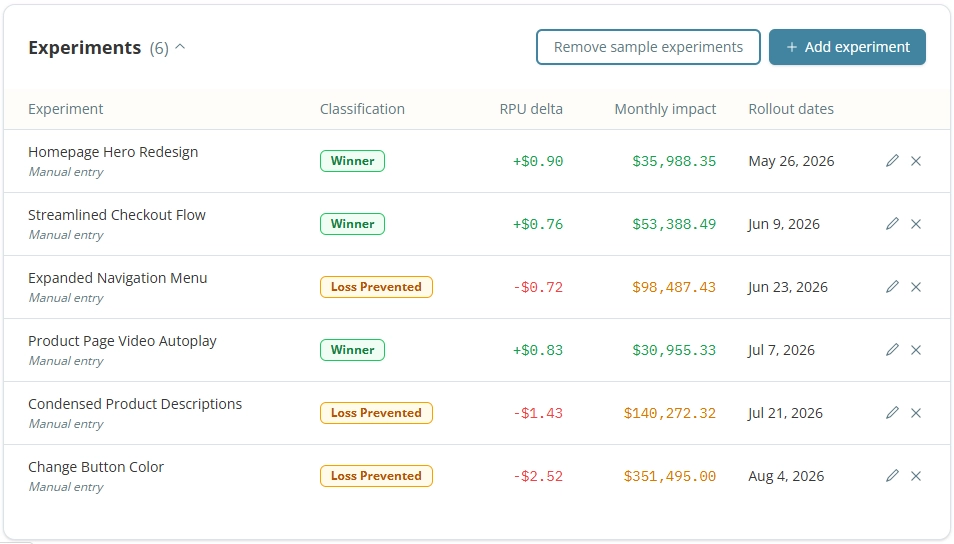
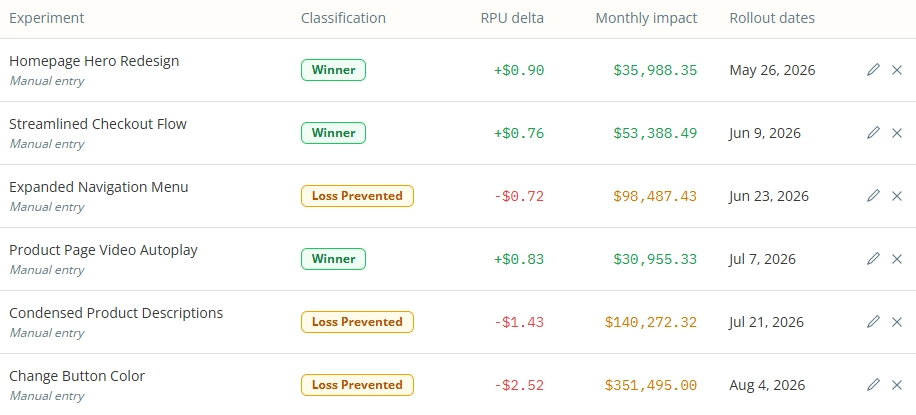
A sophisticated view of CRO value includes not just the revenue gained from "winners," but also the revenue protected by "prevented losses." In a typical testing program, a significant percentage of experiments will result in a "loss," meaning the proposed change would have decreased revenue.
By identifying these negative variants in a controlled environment before they are deployed to 100% of the traffic, the CRO team provides a "preventative ROI." For example, if a proposed redesign is shown in an A/B test to reduce RPU by $0.50, and that redesign was scheduled for a site-wide launch, the testing program has effectively saved the company the projected loss over the coming year. Documenting these instances is vital for proving the program’s utility during periods of economic contraction when "not losing money" is as important as "making more money."
Evaluating Program ROI: The Investment Side
To arrive at a true Return on Investment (ROI) figure, the projected revenue gains must be weighed against the total cost of the experimentation program. This "Investment Side" of the equation often includes:
- Human Capital: The salaries or agency fees for CRO strategists, data analysts, and designers.
- Engineering Overhead: The cost of developer time used to build test variants and, more importantly, to permanently implement the winners.
- Software Stack: Licensing fees for A/B testing platforms (such as Convert or Optimizely), analytics tools, and heatmapping software.
A professional journalistic analysis of the sector suggests that internal CRO programs often struggle with "Engineering Debt." If a team identifies ten winning experiments but the engineering team only has the capacity to implement two, the "Realized ROI" is only a fraction of the "Potential ROI." Therefore, the most successful programs are those that have a dedicated "implementation pipeline" to ensure that the forecasted revenue actually hits the ledger.
Broader Implications for Business Intelligence
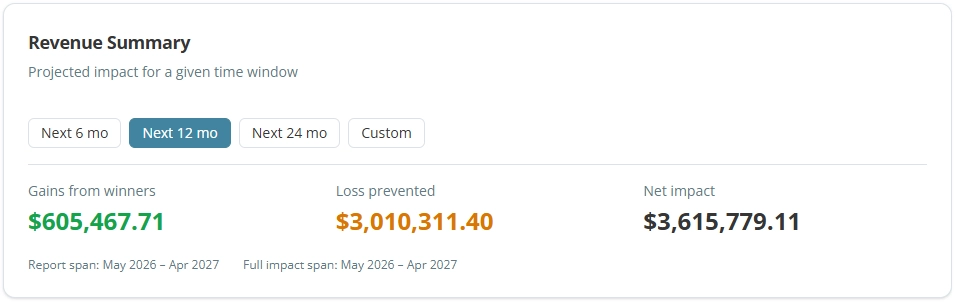
The shift toward rigorous revenue forecasting represents a broader trend in business: the "democratization of data science." Tools like Katsed and other experimentation analytics platforms are automating the complex statistical modeling previously reserved for PhD-level statisticians. This allows CRO leads to present cumulative, stacked revenue charts to stakeholders that look and feel like traditional financial reports.
These reports show how individual wins stack on top of each other over time. When visualized, this "compounding effect" of experimentation becomes clear. A 2% win in January, followed by a 3% win in March, creates a cumulative growth curve that far exceeds the sum of its parts.
Conclusion: The Move Toward Accountability
Forecasting revenue from CRO experiments is not an exact science, but it is an essential management tool. By adopting a conservative, statistically sound, and transparent modeling approach, experimentation teams can move away from "marketing fluff" and toward "financial accountability."
The goal of a revenue forecast is not to predict the future with 100% accuracy—no financial model, from stock market projections to weather patterns, can claim such precision. Instead, the goal is to provide a logical, evidence-based estimate that allows executives to make informed decisions about resource allocation. As digital markets become more competitive and customer acquisition costs continue to rise, the businesses that master the art of forecasting their experimental gains will be the ones that secure the budgets necessary to out-innovate their competition. In the final analysis, CRO is not just about changing button colors; it is about building a predictable engine for business growth.