An AEO checker identifies whether artificial intelligence (AI) answers, upon which consumers increasingly rely, accurately mention and cite a specific brand. This capability has become critical as platforms like ChatGPT, Perplexity, and Gemini deliver direct, synthesized replies to user queries, often eliminating the need for users to click on traditional search links. Consequently, brand visibility that once manifested through search engine rankings can now disappear into unseen AI-generated answers.
This fundamental shift in information consumption necessitates a new approach to digital presence management. Businesses must now monitor not only which questions surface their content but also which queries prioritize competitors and where AI engines might misrepresent their brand. An effective Answer Engine Optimization (AEO) checker provides these insights, utilizing diverse methodologies to analyze AI-generated content. This comprehensive guide explores the function of AEO checkers, outlines methods for conducting manual checks across prominent AI platforms, and compares leading AEO tools to inform strategic adoption in this evolving era of search.
The Rise of Answer Engines: A Chronological Overview
The landscape of online search has undergone a profound transformation with the advent and widespread adoption of generative AI. Historically, search engines like Google functioned as sophisticated directories, returning pages of links ranked by relevance and authority. Users would navigate these results, clicking through to websites to find answers. This model, governed by Search Engine Optimization (SEO) principles, prioritized discoverability through ranking algorithms.
The paradigm began to shift significantly with advancements in Natural Language Processing (NLP) and the development of large language models (LLMs). Key milestones include:
- 2018-2021: The emergence of sophisticated transformer models like Google’s BERT and later OpenAI’s GPT series (GPT-2, GPT-3) began to demonstrate AI’s capacity for understanding and generating human-like text.
- Late 2022: OpenAI’s public release of ChatGPT marked a pivotal moment. Its ability to generate coherent, contextually relevant, and often comprehensive answers directly to user prompts rapidly captured public imagination and widespread adoption. This dramatically accelerated the shift towards "answer engines."
- 2023: Other AI platforms, such as Perplexity AI, specifically designed to provide cited, synthesized answers from multiple web sources, gained traction. Google further evolved its AI capabilities, integrating Bard (later Gemini) into its ecosystem.
- May 2024: Google formally launched "AI Overviews" (formerly Search Generative Experience or SGE) directly into its main search results. This integration signaled a definitive move by the dominant search engine to embrace summary-first answers, further cementing the answer engine model as a mainstream search behavior.
This chronology underscores a rapid evolution from a link-based search ecosystem to an answer-based one. Users are increasingly bypassing traditional website clicks in favor of immediate, synthesized information, fundamentally altering how brands connect with their audience.
![AEO checker tools that measure answer engine visibility [2026]](https://53.fs1.hubspotusercontent-na1.net/hubfs/53/aeo-checker-1-20260903-3858273.webp)
Defining Answer Engine Optimization (AEO)
Answer Engine Optimization (AEO) is the strategic discipline focused on enhancing how frequently and accurately a brand, its products, or its content appears within the AI-generated responses provided by tools such as ChatGPT, Perplexity, Gemini, and Google’s AI Overviews. Unlike traditional SEO, which aims to rank web pages in a list of links, AEO strives to achieve direct brand mentions and content citations within the AI’s synthesized answer itself.
AEO and SEO are not competing strategies but rather complementary halves of a unified digital marketing approach. Strong SEO practices continue to be foundational for AEO. Answer engines rely on the crawlability, authority, and relevance signals established by robust SEO to identify and trust content sources. Content that is well-structured, directly answers user questions, and is backed by verifiable primary sources is more likely to be parsed and cited by AI. Therefore, while SEO optimizes for discovery in a list of links, AEO optimizes for inclusion within the AI’s direct answer, leveraging the groundwork laid by effective SEO.
The Indispensable Role of AEO Checkers
An AEO checker serves as a crucial diagnostic and strategic tool in this new search paradigm. Its primary function is to measure a brand’s visibility across various answer engines and then translate these insights into actionable recommendations for improvement. Specifically, an AEO checker performs several key functions:
- Visibility Tracking: It monitors whether a brand’s content is cited or mentioned within AI-generated answers for a defined set of queries. This includes identifying direct links back to a brand’s domain (citations) and instances where the brand name appears in the answer text without a direct link (mentions).
- Competitor Analysis: It identifies instances where competitors are cited or mentioned for relevant queries, providing crucial insights into content gaps and competitive advantages.
- Accuracy Assessment: It verifies the accuracy of brand information presented by AI, flagging any misrepresentations or outdated data.
- Content Gap Identification: By comparing queries where a brand is cited against those where competitors are favored, the checker highlights specific informational needs or content weaknesses.
- Recommendation Generation: Based on its analysis, the checker provides prioritized recommendations for content updates, schema markup improvements, and entity optimization strategies designed to increase citation and mention frequency. This includes flagging content that needs to be created, updated, or repurposed to better suit AI parsing.
- Performance Reporting: It tracks changes in visibility over time, allowing marketers to measure the effectiveness of their AEO strategies and adapt as AI algorithms evolve.
The workflow typically involves a continuous loop: measure current visibility, diagnose issues, prioritize actions, optimize content, and report on outcomes. This systematic approach is essential for adapting to the dynamic nature of AI-driven search.
Navigating Manual AEO Checks: A Practical Guide
![AEO checker tools that measure answer engine visibility [2026]](https://no-cache.hubspot.com/cta/default/53/9dd5e54b-fbef-4dd0-bc44-1689feb1ea18.png)
While automated AEO checkers offer scalability, understanding how to perform manual checks is foundational, especially for initial assessments or smaller query sets.
1. How to Run an AEO Check in Google AI Overviews:
Checking visibility in Google’s AI Overviews (AIOs) is initially a manual, query-by-query process. AIOs are not triggered for every search; Google’s systems display them only when they determine a summary adds significant value beyond traditional links. Additionally, AIO content can vary between sessions, making multiple checks advisable. When an AIO appears, it typically cites its sources inline with the text, often with a hover preview for desktop users.
- Step 1: Define Your Priority Queries. Compile a list of critical queries, including your brand name, specific product terms, and common informational questions your target audience asks.
- Step 2: Execute and Record Searches. For each query, perform searches in a signed-out or incognito browser session. Record three key data points:
- Whether an AI Overview appears.
- If your domain is listed among the inline source links.
- The exact claim or information presented by the AIO.
- Step 3: Interpret Results and Identify Gaps. Compare queries that trigger an AIO and cite your brand against those where an AIO appears but cites competitors. The latter group indicates content gaps. Due to AIO variability, a single absence should prompt re-checking, not immediate conclusion of lost placement.
- Step 4: Document and Report. Screenshot each result, noting the query, date, and location. This creates a defensible record for before-and-after comparisons. Google Search Console’s standard Performance report currently aggregates AI Overview activity into "Web" search types, making dedicated AIO reporting challenging. While Google began rolling out a dedicated generative AI performance report in June 2026, it reports impressions only and has limited initial reach.
Pro Tip: Manual AIO checks are feasible for small lists but become unreliable and unscalable at volume due to the dynamic nature of AIOs. Automated tools are essential for continuous, large-scale monitoring.
2. How to Check ChatGPT and Perplexity Citations:
These platforms generally provide citations within the response itself, making manual verification straightforward.
-
Perplexity AI: By default, Perplexity attaches citations to every answer, linking directly to the source. It also provides a dedicated panel listing all referenced sources.
-
ChatGPT: When utilizing web search capabilities (e.g., through plugins or its default browsing mode), ChatGPT shows inline citations and often includes a "Sources" panel below the response.
-
Step 1: Conduct Practical Citation Checks. Use your defined branded and informational queries. For each response, verify:
![AEO checker tools that measure answer engine visibility [2026]](https://53.fs1.hubspotusercontent-na1.net/hubfs/53/aeo-checker-2-20260903-852936.webp)
- If your domain appears among the cited sources.
- If your brand is explicitly named within the answer text. A direct mention is a separate, valuable outcome from a citation.
-
Step 2: Optimize Prompts for Retrieval. ChatGPT only searches the web when current information is beneficial or explicitly requested. Phrase prompts as direct, current questions (e.g., "best [category] tools for [use case]") to encourage web retrieval.
-
Step 3: Log Results and Convert Gaps to Tasks. Since sources can vary between runs, execute each prompt multiple times across fresh sessions. Record the AI engine, prompt, date, whether your brand was cited/mentioned, and which competitors appeared. This log helps identify inconsistencies. Any absence or competitor citation where your brand should be present becomes an actionable task. Update relevant content or structure, then re-test.
Key Criteria for Selecting an AEO Checker
For continuous, scalable monitoring of AI visibility, automated AEO checking software is indispensable. When evaluating tools, consider the following factors:
- Engine Coverage: Does the tool track visibility across the most critical answer engines (e.g., Google AI Overviews, ChatGPT, Perplexity, Gemini)?
- Citation vs. Mention Detection: Can it differentiate between a direct link (citation) and a brand name appearing in the text without a link (mention)? Both are valuable but represent different levels of AI integration.
- Competitor Analysis: Does it provide insights into competitor citations and mentions, highlighting content gaps and competitive advantages?
- Accuracy and Sentiment Analysis: Can it assess the accuracy of information presented about your brand and gauge the sentiment (positive, negative, neutral) of AI-generated content?
- Recommendation Engine: Does it offer prioritized, actionable recommendations for content optimization, schema improvements, and entity readiness?
- Reporting and Analytics: Does it provide clear, comprehensive reports, trend analysis, and performance metrics (e.g., visibility score, citation coverage)?
- Integration Capabilities: Can it integrate with existing marketing platforms (e.g., CRM, CMS) to streamline workflows from diagnosis to action?
- Data Refresh Rate: How frequently does the tool update its data to reflect the dynamic nature of AI responses? Daily or weekly refreshes are ideal.
- Scalability: Can it handle a large volume of queries and track multiple domains effectively?
- Ease of Use: Is the interface intuitive, and are the insights easily digestible for marketers and content creators?
Comprehensive Review of Leading AEO Checker Tools
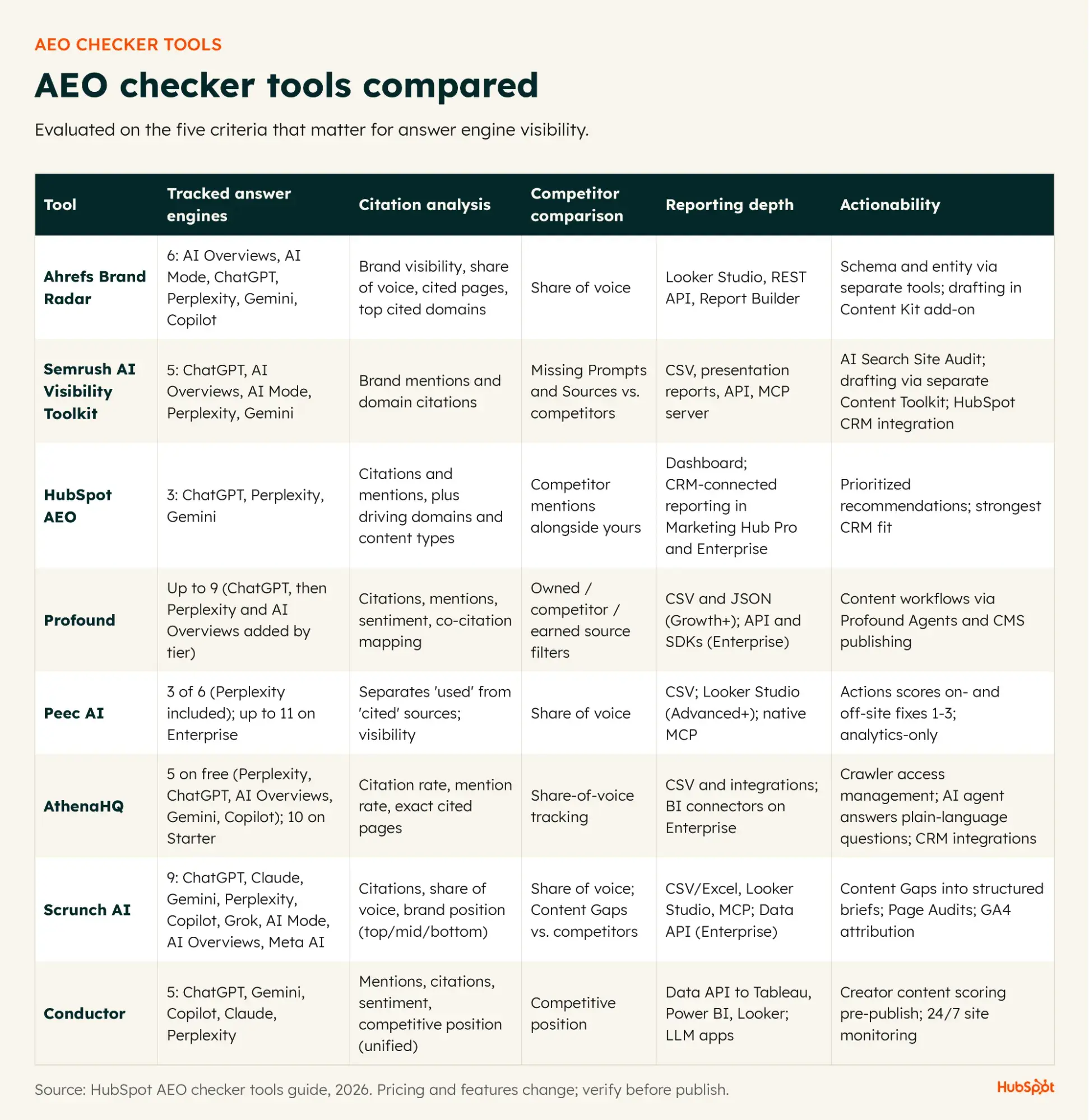
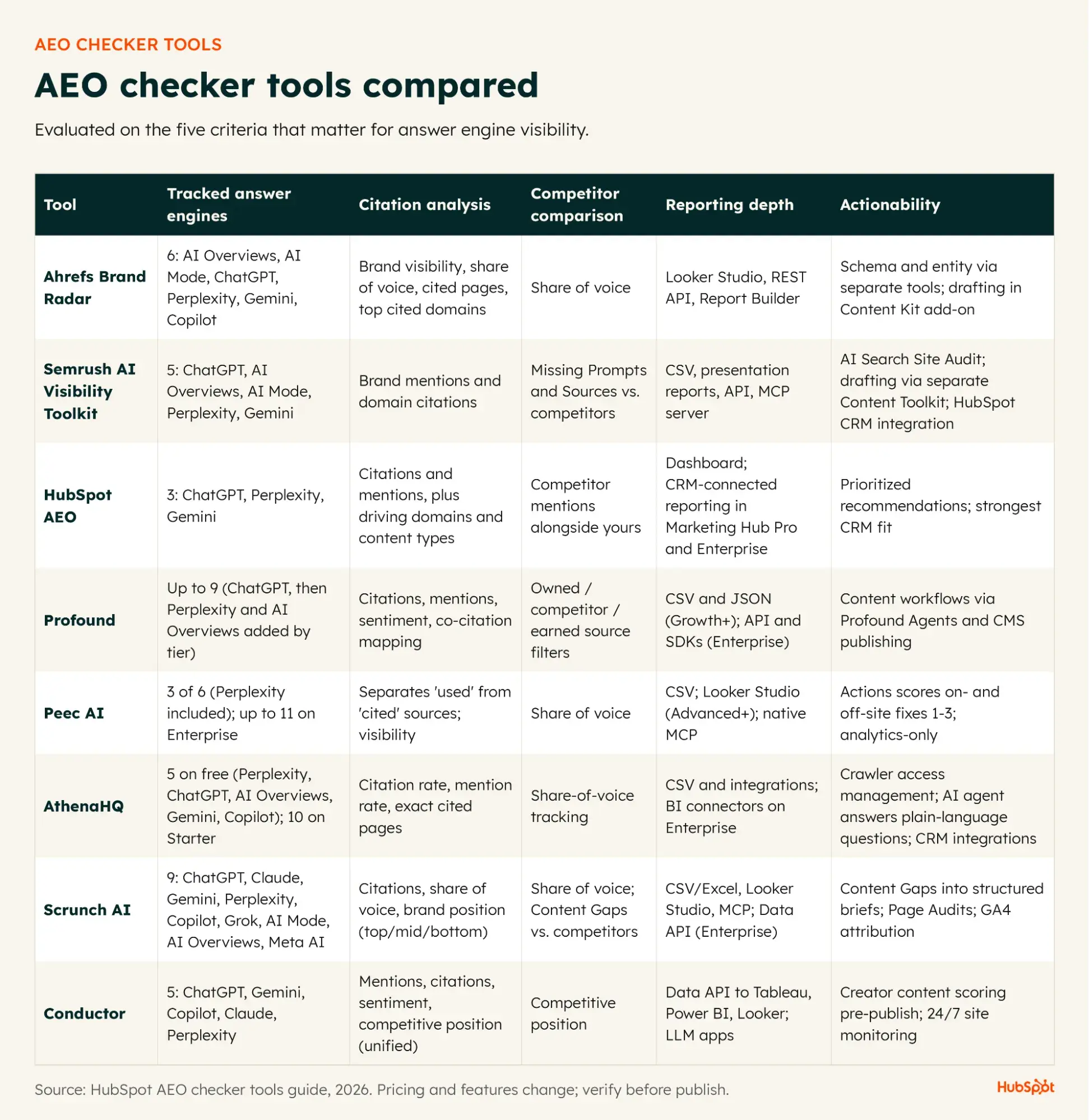
The market for AEO tools is rapidly expanding, with various solutions catering to different needs. Here’s a comparative overview of prominent tools:
Tools with AI Overviews Tracking:
![AEO checker tools that measure answer engine visibility [2026]](https://53.fs1.hubspotusercontent-na1.net/hubfs/53/aeo-checker-3-20260903-8904553.webp)
- Ahrefs Brand Radar: This tool leverages real search queries and boasts AI Overviews as its largest index. It tracks mentions, identifies top-performing content, and provides competitor insights. Its strength lies in its extensive data collection from actual search sessions.
- Semrush AI Visibility Toolkit: Semrush’s Organic Research feature can flag keywords that already trigger AI Overviews, enabling marketers to prioritize existing content for near-inclusion. It integrates AIO insights with broader SEO data, offering a holistic view of search performance.
Tools with ChatGPT Citation Detection:
- HubSpot AEO: HubSpot AEO tracks both citations (AI answers linking back to your domain) and mentions (answers naming your brand without a link). It also analyzes the domains and content types driving visibility for both your brand and competitors, providing prioritized recommendations. Available as a standalone product or integrated into Marketing Hub Professional and Enterprise, it connects AEO data to CRM insights.
- Profound: Profound delves deeper than simple citation detection, offering citation context through sentiment scoring and flagging uncited prompts. It also provides a breakdown of citations by source type (owned, competitor, earned), offering a nuanced understanding of brand representation.
Tools with Perplexity Monitoring:
- Peec AI: As a pure-play analytics tool, Peec AI focuses specifically on reporting clean Perplexity data. It’s ideal for businesses primarily concerned with their visibility on this answer engine, offering dedicated insights into Perplexity’s citation behavior.
- AthenaHQ: AthenaHQ tracks Perplexity across all its plans, including a free tier, and uniquely offers a conversational assistant feature. This makes it accessible for initial exploration and provides an interactive way to query and understand Perplexity citations.
Tools for Schema and Entity Readiness:
- Scrunch AI: Scrunch AI specializes in ensuring that AI crawlers can effectively reach and render your web pages. It focuses on the technical aspects of crawlability, which is crucial for AI engines to discover and process content for citation.
- Conductor: Conductor combines 24/7 technical monitoring with a content scorer. This dual approach helps ensure not only that content is technically accessible to AI but also that it is optimized in terms of relevance and quality, increasing the likelihood of citation.
AEO Metrics that Matter
To gauge the effectiveness of AEO strategies, marketers must track specific metrics as trends over time, rather than relying on single snapshots:
- Citation Coverage: The percentage of target queries for which your brand’s content is cited by an answer engine. This indicates the direct attribution of your content.
- Brand Mention Frequency: The number of times your brand is named in AI-generated answers, even without a direct link. This reflects general brand awareness within the AI ecosystem.
- Accuracy Score: A qualitative or quantitative measure of how accurately your brand’s information is represented by AI.
- Sentiment Score: The overall sentiment (positive, neutral, negative) associated with your brand in AI answers, crucial for reputation management.
- Competitor Citation Share: Your brand’s share of citations relative to key competitors for specific query sets.
- AI-Referred Sessions/Traffic: The direct traffic driven to your website from AI answers (if a click-through occurs).
- Branded Search Lift: An increase in direct branded searches, potentially indicating increased top-of-funnel awareness generated by AI mentions, even in zero-click scenarios.
These metrics should be read as trends. A single data point offers limited insight; the direction and velocity of these trends over weeks and months reveal the true impact of AEO efforts. It’s important to track citation coverage alongside brand visibility, while engagement and qualified traffic proxies (like AI-referred sessions and branded search lift) help capture the often "zero-click" influence of AI answers that might not directly lead to website visits but still build brand equity.
Integrated Solutions: The HubSpot AEO Ecosystem
![AEO checker tools that measure answer engine visibility [2026]](https://53.fs1.hubspotusercontent-na1.net/hubfs/53/aeo-checker-4-20260903-6212698.webp)
While many AEO checkers excel at diagnosis, translating insights into actionable content changes often requires exporting data and working within separate content management systems (CMS). HubSpot addresses this by integrating the diagnosis and remediation within a single platform, particularly for subscribers to Marketing Hub Professional or Enterprise.
HubSpot AEO, available as a standalone product at $50/month, provides core tracking, prompt suggestions, citation analysis, and prioritized recommendations. However, its full potential is realized within the Marketing Hub. Here, AEO leverages CRM data to refine prompt and recommendation suggestions. A key feature, Content Agent (currently in public beta), can transform a blog recommendation into a research-backed first draft in the brand’s voice with a single click. This draft then lands directly in HubSpot’s content editor, allowing teams to review, refine, and publish it through Content Hub and Marketing Hub. This generation capability is credit-based, costing approximately $10 (1,000 credits) per blog post.
This integrated approach, built on HubSpot’s Smart CRM, ensures that traffic referred from AI tools is tracked as its own source and directly linked to contacts and deals. This allows AEO reporting to sit alongside other funnel metrics, providing a holistic view of marketing performance. It’s important to acknowledge a limitation: answer engines frequently resolve queries without requiring a click. While HubSpot can attribute AI traffic that does click through, the broader impact of AI visibility that never results in a session won’t directly register as pipeline revenue. Therefore, visibility scores and referral revenue should be considered as related but distinct measures of success. HubSpot AEO represents a practical solution for businesses ready to move beyond manual checks and establish a continuous, integrated AEO strategy.
The Broader Implications for Digital Marketing and Content Strategy
The rise of answer engines has profound implications for digital marketing and content strategy. Brands must now prioritize creating content that is not only discoverable by traditional search engines but also digestible, trustworthy, and directly answerable by AI. This requires a shift towards:
- Structured Content: Utilizing schema markup and clear headings to help AI parse information efficiently.
- Direct Answers: Crafting content that directly addresses common user questions in a concise and authoritative manner.
- Entity-First Optimization: Focusing on building a strong brand entity and associations, ensuring AI understands who you are and what you offer.
- Authoritative Sourcing: Grounding claims in verifiable primary sources to build trust with AI models and users alike.
- Reputation Management: Proactively monitoring how AI represents the brand to quickly correct inaccuracies or mitigate negative sentiment.
The future of digital marketing demands an integrated strategy where SEO and AEO work in tandem. Brands that adapt early to this answer-first environment, leveraging sophisticated AEO checkers and integrated platforms, will be better positioned to maintain visibility, manage brand perception, and drive engagement in the evolving digital landscape.
Frequently Asked Questions About AEO Checkers
![AEO checker tools that measure answer engine visibility [2026]](https://53.fs1.hubspotusercontent-na1.net/hubfs/53/aeo-checker-5-20260903-8938354.webp)
How often should you run an AEO check?
The frequency depends on the method. Manual spot-checks should involve sampling several sessions per query due to the variability of AI responses. Automated checkers are designed for continuous monitoring, with daily or weekly refreshes being ideal to capture volatility and provide timely insights, whereas monthly snapshots might obscure crucial shifts.
Is AEO the same as AI search optimization?
While often used interchangeably, AEO (Answer Engine Optimization) is the more precise term. It specifically refers to improving how accurately and frequently a brand appears in AI-generated answers from tools like ChatGPT, Perplexity, and Gemini. AI search optimization is a broader concept that could encompass various ways AI influences search, but AEO targets the direct answer aspect. Marketers should standardize on AEO for clarity.
Can you reliably track citations in ChatGPT and Perplexity?
Yes, within certain limits. Both platforms can surface the sources behind their answers, making individual responses readable. However, the results can shift from one query run to the next. Therefore, reliability comes from repetition: running each prompt multiple times across fresh sessions and tracking the emerging patterns, rather than relying on a single snapshot. Automated tools significantly enhance this reliability by performing these repetitions at scale.
Do AEO checkers replace traditional SEO tools?
No, AEO checkers do not replace traditional SEO tools; they complement them. Each measures different aspects of online visibility. AEO checkers focus on how answer engines cite and mention brands, while SEO tools track rankings, keywords, backlinks, and technical performance in traditional search results. Since robust SEO still provides the crawlability and authority signals that answer engines rely on for source selection, both sets of tools are essential and should be run side-by-side for a comprehensive digital marketing strategy.