The digital landscape of search is undergoing a profound transformation, shifting from a link-based discovery model to one dominated by AI-generated answers. This paradigm shift, spearheaded by large language models (LLMs) like ChatGPT, Perplexity, and Gemini, and integrated into traditional search engines via features such as Google’s AI Overviews, has introduced a critical new frontier for digital marketers: Answer Engine Optimization (AEO). An AEO checker is an indispensable tool in this evolving environment, designed to reveal whether AI responses, which buyers increasingly rely on, actually mention or cite a specific brand. As users act directly on these synthesized replies without clicking through to source links, a brand’s visibility, once measured by search rankings, can now vanish into an unseen answer, making dedicated AEO monitoring paramount.
The Evolution of Search: From Links to Direct Answers
For decades, Search Engine Optimization (SEO) focused on ranking websites high in a list of links, guiding users to discover information by navigating through various sources. This model, while effective, has begun to yield to the efficiency of generative AI. The advent of sophisticated AI models, particularly ChatGPT’s public release in November 2022, rapidly accelerated this transition. These "answer engines" are capable of reading, synthesizing, and summarizing vast amounts of information from across the web, presenting users with a single, often comprehensive, answer to their queries. This immediacy appeals strongly to users seeking quick resolutions, contributing to a rise in "zero-click searches" where the user’s information need is met directly on the search results page or within the AI interface itself, eliminating the need to visit an external website.
Google, recognizing this fundamental shift and the competitive pressure from AI-first search initiatives, formally launched its AI Overviews (AIOs) in May 2024. This integration brings summary-first behavior directly into Google Search results, further cementing the importance of optimizing for direct answers. The generative AI market, valued at approximately $40 billion in 2023, is projected to surge to over $200 billion by 2030, underscoring the rapid and pervasive integration of these technologies into everyday digital interactions. This rapid adoption necessitates a strategic adaptation from brands and marketers who must now ensure their content is not only discoverable by traditional crawlers but also interpretable and citable by advanced AI.
Understanding Answer Engine Optimization (AEO)
![AEO checker tools that measure answer engine visibility [2026]](https://53.fs1.hubspotusercontent-na1.net/hubfs/53/aeo-checker-1-20260903-3858273.webp)
Answer Engine Optimization (AEO) is the strategic practice of enhancing how frequently and accurately a brand, its products, or its content appear within the AI-generated answers provided by platforms like ChatGPT, Perplexity, Gemini, and Google’s AI Overviews. It is a complementary discipline to SEO, addressing a different facet of the same overarching goal: maximizing online visibility and influence. While SEO traditionally aims to rank web pages within a list of links, AEO focuses on securing direct mentions and citations of a brand or its content within the AI’s synthesized answer itself.
The synergy between AEO and SEO is undeniable. Strong SEO practices — encompassing technical crawlability, content authority, structured data, and high-quality, relevant information — continue to be foundational. Answer engines rely on these very signals to identify credible and authoritative sources from which to draw their answers. Therefore, robust SEO provides the essential raw material and credibility that AI models parse and trust when determining what content to cite. The content most likely to be cited by AI engines is typically clearly structured, directly answers specific questions, and backs its claims with verifiable primary sources, often leveraging schema markup to enhance machine readability.
The Critical Role of AEO Checkers
In this evolving landscape, manually tracking a brand’s presence in AI answers quickly becomes impractical due to the sheer volume of queries, the variability of AI responses, and the multitude of platforms. This is where an AEO checker becomes indispensable. An AEO checker is a specialized software solution designed to continuously monitor and measure a brand’s visibility across various answer engines. Its primary functions include:
- Tracking Brand Mentions: Identifying instances where the brand name appears within an AI-generated answer, even without a direct link.
- Monitoring Citations: Detecting when a brand’s website or specific content is cited or linked as a source for an AI’s response.
- Competitive Analysis: Revealing which competitors are being cited or mentioned for similar queries, highlighting content gaps.
- Accuracy Assessment: Identifying instances where an AI engine misrepresents a brand or provides incorrect information derived from its content.
- Performance Benchmarking: Providing a quantifiable measure of AEO performance over time, tracking trends in visibility.
From this comprehensive data, an effective AEO checker can then diagnose issues and generate prioritized recommendations. These recommendations often pinpoint specific content updates, schema markup corrections, or entity optimization improvements that are most likely to increase citation rates and brand mentions. This continuous loop of measurement, diagnosis, prioritization, optimization, and reporting is crucial for adapting to the dynamic nature of AI search.
Manual AEO Checks: A Foundational Approach (and its Limitations)
![AEO checker tools that measure answer engine visibility [2026]](https://no-cache.hubspot.com/cta/default/53/9dd5e54b-fbef-4dd0-bc44-1689feb1ea18.png)
For those just beginning to explore AEO or operating with a very limited set of target queries, manual checks can offer initial insights. However, it’s essential to understand their inherent limitations.
How to Run an AEO Check in Google AI Overviews:
Checking visibility in Google’s AI Overviews (AIOs) is a manual process that involves executing priority queries in a live search session. AIOs appear only when Google’s systems determine that a summary adds value beyond standard links, meaning they won’t trigger for every query. Furthermore, AIO results can vary across different sessions, necessitating multiple lookups for a more reliable sample. When an AIO does appear, it typically cites its sources inline, next to the supporting text, often with a desktop hover preview indicating the originating site.
- Define Important Queries: Create a list of essential queries, including your brand name, branded product terms, and key informational questions your target audience asks.
- Execute and Record: Run each query in an incognito or signed-out browser session. Record three crucial pieces of information: whether an AI Overview appeared, if your domain was cited among the inline source links, and the exact claim made by the AI.
- Interpret Results: Compare queries where an AIO cited your content against those where competitors were cited. This forms your content gap analysis. Due to session variability, a single absence should prompt re-checking rather than being taken as definitive proof of lost placement.
- Build Reporting: Screenshot each result, noting the query, date, and location. This provides a defensible record. While Google is rolling out dedicated generative AI performance reports in Search Console (as of June 2026, still in limited release and primarily reporting impressions), these often don’t provide the granular detail needed for comprehensive AEO analysis.
How to Check ChatGPT and Perplexity Citations:
Both ChatGPT and Perplexity embed citations within their responses. Perplexity, by default, attaches citations to every answer and also displays a panel listing all sources. ChatGPT shows inline citations when utilizing web search and also lists them in a "Sources" panel.
- Practical Citation Checks: Using your defined branded and informational queries, check for two things: whether your domain appears among the cited sources and if your brand is explicitly named in the answer text. A citation and a direct mention are distinct wins.
- Phrase Prompts for Retrieval: ChatGPT only accesses web search for current information or when explicitly prompted. Frame questions directly to encourage web retrieval, e.g., "best [category] tools for [use case]."
- Log Results and Identify Gaps: Run each prompt multiple times across fresh sessions due to response variability. Record the engine, prompt, date, whether your brand was cited/mentioned, and which competitors appeared. This log will highlight inconsistencies and content gaps that can be converted into actionable tasks.
Limitations of Manual Checks: While foundational, manual checks are time-consuming, prone to human error, and do not scale effectively for comprehensive monitoring. The dynamic and often volatile nature of AI responses means that "sampling them by hand gets unreliable at volume," as noted by industry observers. For continuous, reliable monitoring, automated AEO checkers are essential.
The Need for Automation: Key Criteria for AEO Software
As manual checks quickly become unmanageable, selecting robust AEO checking software is critical for any brand serious about optimizing for AI answers. When evaluating tools, consider the following buyer criteria:
![AEO checker tools that measure answer engine visibility [2026]](https://53.fs1.hubspotusercontent-na1.net/hubfs/53/aeo-checker-2-20260903-852936.webp)
- Comprehensive Engine Coverage: The ideal tool should monitor visibility across a broad spectrum of answer engines, including Google AI Overviews, ChatGPT, Perplexity, and Gemini. Coverage dictates the completeness of your AEO insights.
- Granular Data & Reporting: Beyond simple mentions, the software should provide detailed data on citation context, source types (e.g., owned content, competitor content, earned media), and the specific claims made by the AI. It should also track both direct citations (links) and brand mentions (text references).
- Actionable Recommendations: The tool should go beyond raw data to offer prioritized, data-driven recommendations for content creation, updates, or outreach strategies, translating insights into tangible tasks.
- Competitive Intelligence: A robust AEO checker provides deep insights into how competitors are performing in the answer engine landscape, revealing their strengths and your opportunities.
- Historical Tracking & Trend Analysis: The ability to track performance over time is crucial for understanding the impact of optimization efforts and adapting to algorithm changes.
- Integration with Existing Workflows: Seamless integration with CRM systems, content management systems (CMS), and other marketing tools can significantly streamline the "measurement to action" loop.
- User-Friendly Interface: The data and recommendations should be presented in an intuitive and accessible format, allowing marketing teams to quickly understand and act on insights.
Digital marketing agencies and strategists consistently emphasize that an effective AEO tool is one that not only identifies critical visibility gaps but also delivers actionable, data-driven recommendations that can be seamlessly integrated into a brand’s existing content and marketing workflows.
Leading AEO Checker Tools in the Market
The market for AEO tools is rapidly evolving, with various platforms adapting their offerings to address the unique challenges of AI search. Here’s a look at some prominent players:
Tools with AI Overviews Tracking:
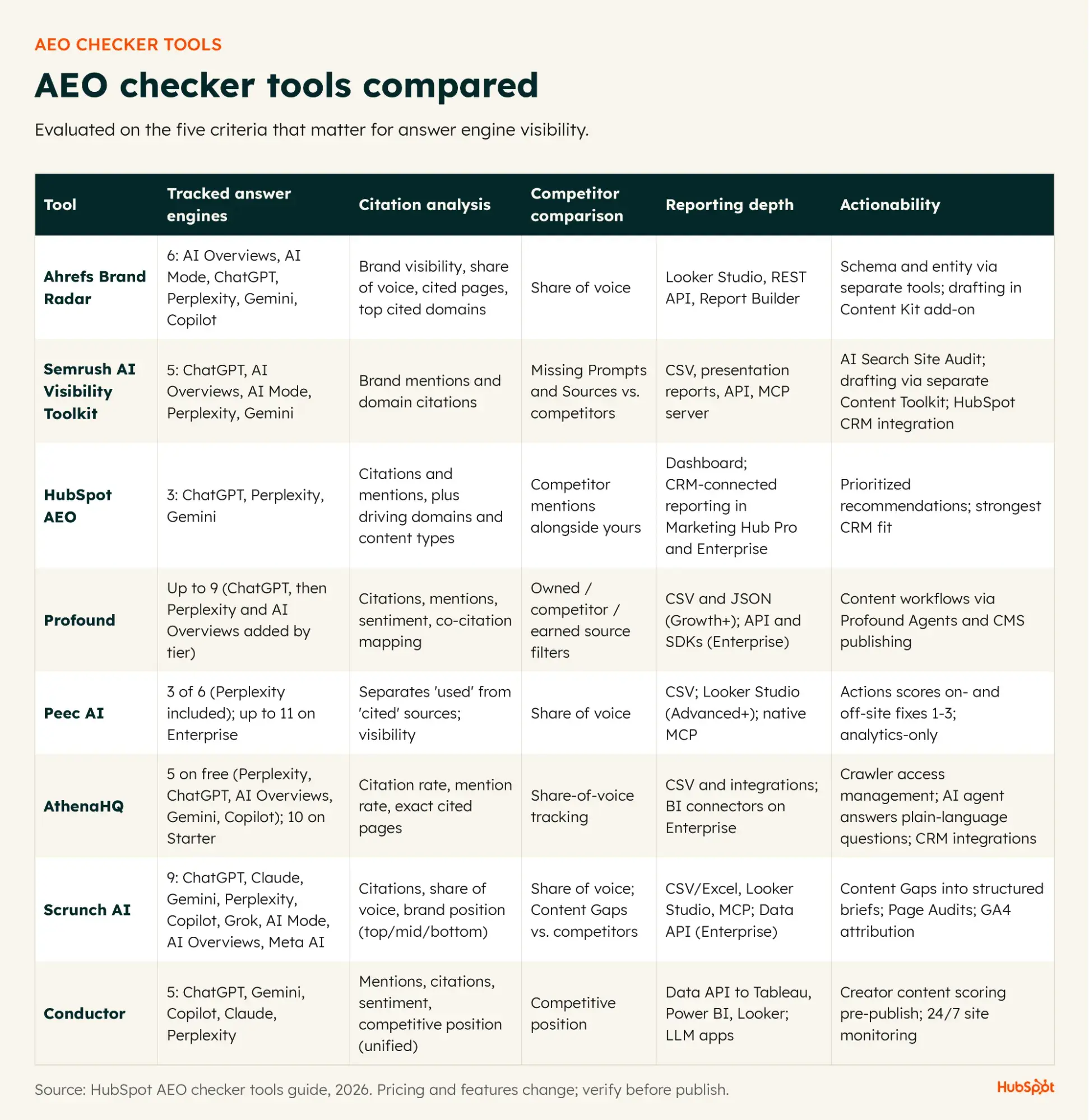
- Ahrefs Brand Radar: Leveraging its extensive search query database, Ahrefs Brand Radar focuses on real search queries rather than synthetic prompts, with AI Overviews forming a significant portion of its indexed data. It provides alerts for new mentions and citations, helping brands stay proactive.
- Semrush AI Visibility Toolkit: Integrating with its established Organic Research functionalities, Semrush’s toolkit flags keywords that already trigger AI Overviews for a brand’s ranking pages. This allows marketers to prioritize content optimization efforts for pages that are "near-inclusion" in AI answers.
Tools with ChatGPT Citation Detection:
- HubSpot AEO: HubSpot’s dedicated AEO tool tracks both explicit citations (AI answers linking back to a domain) and implicit mentions (answers naming a brand without a link). It also provides insights into the domains and content types driving visibility for both the user and their competitors, offering prioritized recommendations.
- Profound: Profound distinguishes itself by moving beyond simple citation detection into citation context. It offers sentiment scoring of AI-generated content, flags uncited prompts (where a brand should have been cited but wasn’t), and breaks down citations by source type, including owned, competitor, and earned media.
Tools with Perplexity Monitoring:
![AEO checker tools that measure answer engine visibility [2026]](https://53.fs1.hubspotusercontent-na1.net/hubfs/53/aeo-checker-3-20260903-8904553.webp)
- Peec AI: As a pure-play analytics tool, Peec AI specializes in providing clean and comprehensive data specifically for Perplexity AI, focusing on its unique citation mechanisms and answer generation.
- AthenaHQ: AthenaHQ tracks Perplexity across all its plans, including a free tier, and augments its monitoring capabilities with a conversational AI assistant designed to help users interpret data and formulate strategies.
Tools for Schema and Entity Readiness:
- Scrunch AI: Recognizing the fundamental importance of technical optimization for AI crawlers, Scrunch AI focuses on checking whether a brand’s pages are easily reachable and renderable by AI systems, ensuring the underlying infrastructure supports AEO efforts.
- Conductor: Conductor offers a robust platform that combines 24/7 technical monitoring with a content scorer, helping brands ensure their content is not only technically sound for AI parsing but also strategically optimized for relevance and authority.
This diverse range of tools reflects the multifaceted nature of AEO, encompassing everything from direct citation tracking to technical readiness and competitive intelligence.
AEO Metrics that Matter
Once an AEO checker is deployed, a specific set of metrics becomes crucial for evaluating performance and driving strategic decisions. These metrics should be tracked as trends over time, as a single snapshot provides limited insight; the direction and velocity of change over weeks and months are what truly matter.
- Citation Coverage: This metric tracks the percentage of relevant queries for which your brand’s content is cited as a source by an answer engine. It’s a direct measure of credibility and authority in the AI landscape.
- Brand Visibility (Mentions): Beyond direct citations, this measures how often your brand name appears in AI-generated answers, even without a linked source. It speaks to brand awareness and mindshare within the AI ecosystem.
- Competitive Share of Voice: This metric compares your brand’s citation and mention rates against those of your primary competitors, providing crucial insights into market positioning within AI answers.
- Engagement Proxies: While AI often resolves questions without a click, tracking AI-referred sessions (traffic that does click through from an AI answer or overview) and branded search lift (an increase in direct branded searches potentially influenced by AI exposure) can provide indirect measures of engagement and influence.
- Qualified Traffic & Conversion: Ultimately, AEO aims to contribute to business objectives. Tracking the volume and quality of traffic referred from AI sources, and its subsequent conversion into leads and customers, provides a tangible link to ROI.
These metrics represent a fundamental evolution in how marketers evaluate performance, moving beyond traditional click-through rates to encompass the often-invisible, yet powerful, influence of AI-generated answers.
From Measurement to Action in HubSpot: An Integrated Approach
![AEO checker tools that measure answer engine visibility [2026]](https://53.fs1.hubspotusercontent-na1.net/hubfs/53/aeo-checker-4-20260903-6212698.webp)
While many AEO checkers excel at diagnosis, the true value for marketers lies in seamless integration with content creation and CRM workflows. HubSpot’s AEO capabilities, particularly within its Marketing Hub Professional and Enterprise tiers, exemplify this closed-loop approach.
HubSpot AEO provides prioritized recommendations based on visibility data, guiding marketers on what content to create, update, or promote, and explaining the rationale behind each suggestion. Priced at $50/month as a standalone tool, it covers tracking, prompt suggestions, and citation analysis. However, its full power is unleashed when integrated with HubSpot’s broader marketing ecosystem.
Within Marketing Hub Professional and Enterprise, the Content Agent feature transforms a blog recommendation into a research-backed first draft, written in the brand’s voice, with a single click. This draft lands directly in HubSpot’s content editor, where teams can review, refine, and publish it through Content Hub and Marketing Hub. This generation capability, currently in public beta, operates on HubSpot Credits, costing approximately $10 (1,000 credits) per blog post.
Crucially, this integrated workflow sits atop HubSpot’s Smart CRM. This allows HubSpot to track traffic referred from AI tools as a distinct source and link it directly to specific contacts and deals. This provides a clear line of sight into how AEO efforts contribute to the overall sales funnel, allowing marketers to report on AI-driven pipeline alongside traditional marketing channels. It’s important to acknowledge, however, an inherent limitation: answer engines often resolve queries without generating a click. While HubSpot can attribute AI traffic that does click through, the broader, "zero-click" influence of brand visibility in AI answers won’t directly register as pipeline. Therefore, visibility scores and referral revenue should be considered two related but distinct measures of AEO success.
The Broader Implications for Digital Marketing
The rise of AEO and AI-generated answers has profound implications across the entire digital marketing spectrum:
![AEO checker tools that measure answer engine visibility [2026]](https://53.fs1.hubspotusercontent-na1.net/hubfs/53/aeo-checker-5-20260903-8938354.webp)
- Content Strategy: Marketers must shift from simply creating content for keywords to crafting highly authoritative, structured, and direct answers to user questions. Emphasis on schema markup, clear topic clustering, and primary source data will be paramount.
- Technical SEO: The technical health of a website—crawlability, indexability, site speed, and structured data implementation—becomes even more critical as AI models rely on these foundations to accurately parse and understand content.
- Brand Reputation and Trust: The potential for AI to misrepresent information or cite incorrect sources highlights the need for vigilant monitoring and proactive content governance to protect brand integrity.
- Competitive Intelligence: AEO tools provide a new lens through which to understand competitive positioning, revealing which brands dominate the "answer economy" for specific queries.
- Attribution and ROI Measurement: The "zero-click" phenomenon necessitates a re-evaluation of attribution models. Marketers will increasingly rely on brand lift studies, direct branded search volume increases, and comprehensive visibility scores alongside traditional referral traffic to quantify AI’s impact.
- Human-AI Collaboration: The future of content creation will likely involve greater collaboration between human strategists and AI tools, with AI assisting in research, drafting, and optimization, while human oversight ensures accuracy, brand voice, and creativity.
Challenges and Future Outlook
The landscape of AI search is dynamic and rapidly evolving. New models emerge, algorithms are updated, and user behaviors shift continuously. This volatility presents a significant challenge for marketers, demanding continuous learning, adaptation, and investment in flexible AEO strategies. Ethical considerations surrounding AI bias, hallucination, and data privacy will also continue to shape the development and deployment of answer engines, influencing how brands engage with these platforms.
Despite these challenges, the trajectory is clear: AI is fundamentally reshaping how information is accessed and consumed online. Answer Engine Optimization is not a fleeting trend but a core discipline that will define success in the new era of search. By embracing AEO, investing in robust AEO checkers, and integrating these insights into holistic marketing strategies, brands can ensure they remain visible, authoritative, and relevant in a world increasingly powered by AI answers. The synergy between traditional SEO and nascent AEO practices will be crucial, with SEO providing the foundational credibility and AEO ensuring direct, impactful visibility in the answers that matter most to today’s digitally empowered buyer.