An AEO checker serves as a crucial diagnostic tool, evaluating whether artificial intelligence-generated answers, increasingly relied upon by consumers, accurately mention and cite a brand. As platforms like ChatGPT, Perplexity, and Gemini become primary information sources, users frequently act on AI replies without clicking traditional links. This phenomenon means that brand visibility, once reflected in search engine rankings, can now dissipate into unseen AI answers, posing a significant challenge for digital marketers and businesses. The recent integration of AI Overviews into Google’s search results, launched in May 2024, further underscores this shift, making the ability to monitor and optimize for AI answers an immediate imperative.
The Evolving Landscape of Information Retrieval
The digital information ecosystem is undergoing a profound transformation, moving beyond the traditional link-based search engine results pages (SERPs) to a more synthesized, answer-first approach powered by generative AI. For decades, Search Engine Optimization (SEO) has been the cornerstone of digital marketing, focused on ranking web pages in a list of links. However, the advent of large language models (LLMs) and their integration into search experiences has introduced a new paradigm. Users now frequently pose complex questions directly to AI assistants, expecting concise, comprehensive answers that often negate the need to navigate multiple websites. This shift has given rise to "zero-click searches," where users find their answers directly within the AI’s response, bypassing a brand’s website entirely, even if that brand’s content was instrumental in generating the answer.
This evolution presents a unique dilemma: a brand’s meticulously crafted content, authoritative expertise, and robust SEO efforts might contribute to an AI’s answer, yet the brand itself might not be credited or even mentioned. This "dark funnel" of AI-driven information consumption risks eroding brand recognition, diluting thought leadership, and ultimately impacting customer acquisition funnels. Industry reports suggest that upwards of 60% of Google searches now result in no clicks, a figure that is expected to rise with the proliferation of AI Overviews and similar features across other search engines.
Understanding Answer Engine Optimization (AEO)
![AEO checker tools that measure answer engine visibility [2026]](https://53.fs1.hubspotusercontent-na1.net/hubfs/53/aeo-checker-1-20260903-3858273.webp)
Answer Engine Optimization (AEO) is the strategic discipline focused on enhancing the frequency and accuracy with which a brand appears in AI-generated answers. It is distinct from, yet highly complementary to, traditional SEO. While SEO aims to elevate a brand’s pages in a list of links, AEO strives to ensure that the brand is directly mentioned and its content is cited within the AI’s synthesized answer. This dual approach is critical for comprehensive digital visibility in the current and future search environment.
The foundational principles of AEO revolve around making content highly parseable, trustworthy, and directly answerable for AI models. This includes:
- Clear Content Structure: Utilizing headings, subheadings, bullet points, and concise paragraphs that enable AI to easily extract key information.
- Direct Answers to Common Questions: Creating content that explicitly addresses user queries in a straightforward manner.
- Verifiable Primary Sources: Backing claims with credible, authoritative data and research.
- Entity Recognition: Ensuring that the brand, its products, and key personnel are consistently identified as distinct entities across content.
- Schema Markup: Implementing structured data to provide explicit semantic meaning to content, aiding AI in understanding context and relationships.
The Indispensable Role of AEO Checkers
An AEO checker is a specialized software tool designed to measure a brand’s visibility across various answer engines and translate that data into actionable recommendations for improvement. Its primary function is to bridge the visibility gap created by AI answers, offering insights into how a brand is perceived and represented by these new information gatekeepers.
The typical workflow of an AEO checker involves several critical steps:
- Measurement: Continuously monitoring designated keywords and queries across platforms like ChatGPT, Perplexity, Gemini, and Google AI Overviews to identify if and how a brand is mentioned or cited.
- Diagnosis: Analyzing the collected data to pinpoint instances where a brand is absent, misrepresented, or outranked by competitors in AI answers.
- Prioritization: Ranking potential fixes based on their likely impact, such as content updates, schema corrections, or improvements in entity recognition.
- Optimization: Providing concrete, data-driven recommendations for adjusting content, technical SEO, or brand messaging to enhance AI visibility.
- Reporting: Generating comprehensive reports that track performance trends, competitive benchmarking, and the impact of optimization efforts over time.
This continuous loop ensures that brands can adapt swiftly to the dynamic nature of AI models and their evolving understanding of information.
![AEO checker tools that measure answer engine visibility [2026]](https://no-cache.hubspot.com/cta/default/53/9dd5e54b-fbef-4dd0-bc44-1689feb1ea18.png)
Manual AEO Checks: Initial Insights and Inherent Limitations
For businesses just beginning to explore AEO, manual checks can offer initial insights, particularly for a limited set of high-priority queries. However, this approach is inherently unscalable and prone to inconsistencies.
Checking Google AI Overviews Manually:
To manually assess visibility in Google AI Overviews (AIOs), one must perform priority queries in an incognito or signed-out browser session. AIOs do not trigger for every query; Google’s systems display them only when they determine a summary adds value beyond standard links. Furthermore, AIO results can vary significantly between sessions, necessitating multiple checks for a single query. When an AIO appears, it cites its sources inline, often with a desktop hover preview revealing the source domain.
- Procedure: Define a list of crucial queries (brand name, product terms, informational questions). Run each query, noting if an AIO appears, if your domain is cited, and the exact claim made.
- Interpretation: Compare queries where your brand is cited against those where competitors are featured. Treat single absences as prompts for re-checking rather than definitive losses, given AIO volatility.
- Reporting Challenges: Google Search Console’s standard Performance report aggregates AI Overview activity under "Web" search types, offering limited granularity. While Google began rolling out a dedicated generative AI performance report in June 2026, it reports impressions only and initially reached a subset of sites, making comprehensive, attributable data elusive through manual means.
Checking ChatGPT and Perplexity Citations Manually:
Both ChatGPT and Perplexity embed citations within their responses, making manual inspection possible. Perplexity typically provides inline citations and a right-hand panel listing all sources. ChatGPT, when utilizing web search, also displays inline citations and a "Sources" panel.
- Procedure: For branded and informational queries, check for your domain among cited sources and explicit brand mentions within the answer text. A direct mention, even without a link, is a crucial win.
- Prompt Engineering: ChatGPT only performs web searches when current information is beneficial or explicitly requested. Craft prompts to encourage web retrieval (e.g., "best [category] tools for [use case]").
- Logging and Action: Run each prompt multiple times across fresh sessions, meticulously recording the engine, prompt, date, citation/mention status, and competitor presence. Inconsistencies highlight areas for content improvement, especially where competitors are cited and your brand is not.
While these manual checks provide a foundational understanding, their lack of scale and the inherent volatility of AI responses render them inadequate for a robust, continuous AEO strategy. Industry analysts consistently advise that relying solely on manual methods is unsustainable for any serious attempt at comprehensive AI visibility.
Automated AEO Checkers: The Scalable Imperative
![AEO checker tools that measure answer engine visibility [2026]](https://53.fs1.hubspotusercontent-na1.net/hubfs/53/aeo-checker-2-20260903-852936.webp)
The rapid evolution of AI in search has underscored the necessity for automated AEO checking software. These tools provide continuous monitoring and scalable insights that manual processes simply cannot match. When selecting an AEO checker, several buyer criteria are paramount:
- Comprehensive Engine Coverage: A robust checker must monitor not just Google AI Overviews, but also leading generative AI platforms like ChatGPT, Perplexity, and Gemini, ensuring a holistic view of brand presence across the AI ecosystem.
- Granular Data and Insights: The tool should differentiate between a brand mention (the brand name appears in the answer) and a brand citation (a link back to the brand’s content). It should also identify the specific content types and domains driving visibility for both your brand and competitors.
- Actionable Recommendations: Beyond simply flagging issues, the best checkers offer prioritized, data-driven recommendations for optimizing content, schema, and entity structures.
- Integration Capabilities: Seamless integration with existing marketing technology stacks, such as Content Management Systems (CMS) and Customer Relationship Management (CRM) platforms, is vital for streamlining the workflow from diagnosis to implementation and impact measurement.
- Advanced Reporting and Analytics: Features for trend tracking, competitive benchmarking, sentiment analysis (if applicable), and custom reporting are essential for demonstrating ROI and refining strategy.
- Scalability: The ability to handle large volumes of queries, track multiple domains, and perform continuous, automated checks without manual intervention.
The emergence of specialized AEO tools has accelerated dramatically since Google’s introduction of AI Overviews in May 2024. This move by a dominant search provider spurred rapid innovation within the martech sector, leading to a diverse array of solutions tailored to different aspects of AI visibility.
Key Players in the AEO Checker Landscape
The market for AEO tools is rapidly expanding, with various platforms offering specialized functionalities:
Tools with AI Overviews Tracking:
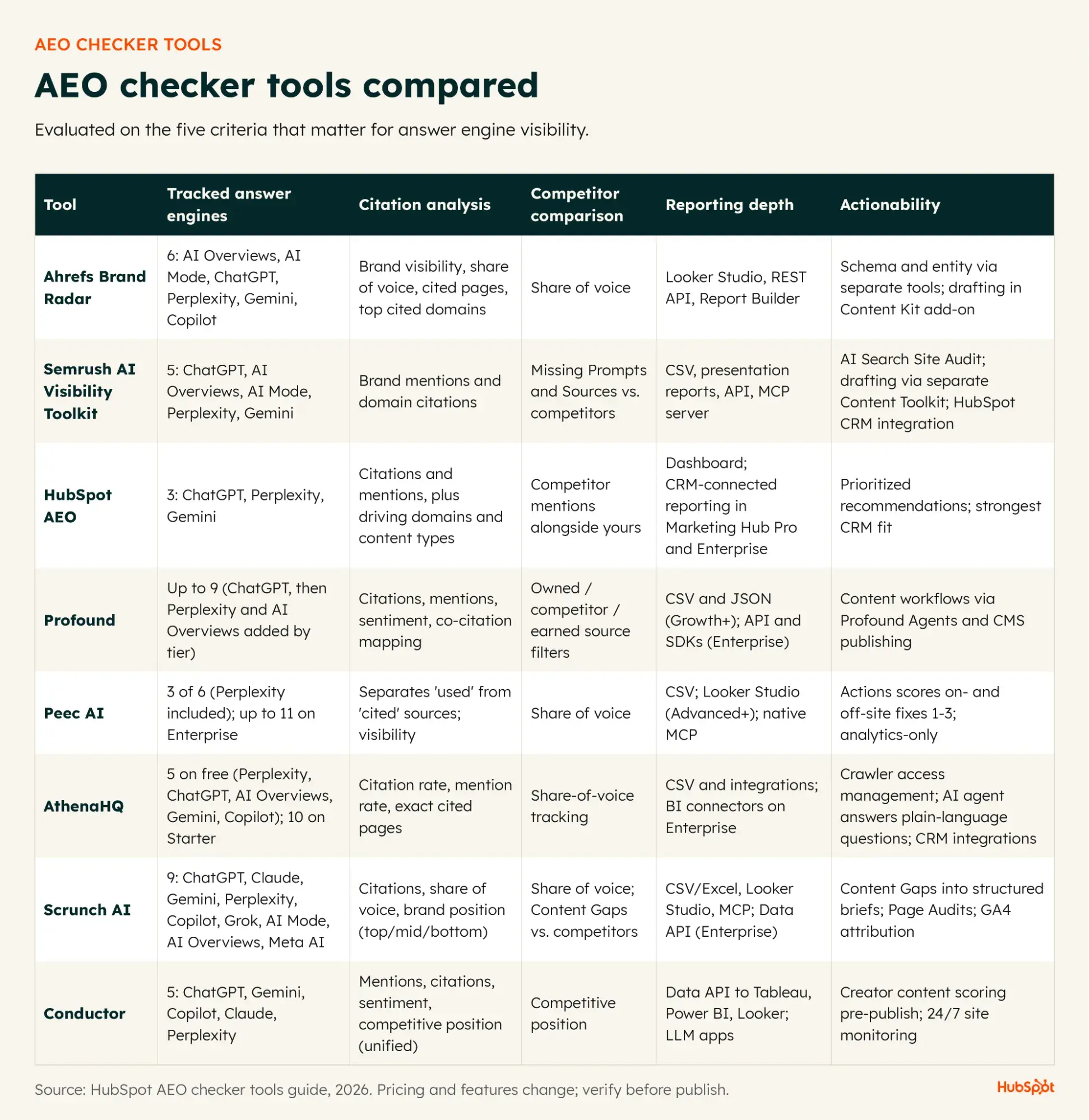
- Ahrefs Brand Radar: This tool leverages real search queries rather than synthetic prompts, offering a substantial index for AI Overviews. Its strength lies in providing a genuine reflection of how Google’s AI summarizes information based on actual user behavior. Implication: Ideal for brands prioritizing Google’s AI Overviews and seeking insights derived from real-world search data.
- Semrush AI Visibility Toolkit: Semrush’s Organic Research feature can identify existing keywords that trigger AI Overviews, allowing marketers to prioritize and optimize content that is already on the cusp of AI inclusion. Implication: Beneficial for leveraging existing SEO investments and quickly adapting high-performing content for AI visibility.
Tools with ChatGPT Citation Detection:
![AEO checker tools that measure answer engine visibility [2026]](https://53.fs1.hubspotusercontent-na1.net/hubfs/53/aeo-checker-3-20260903-8904553.webp)
- HubSpot AEO: HubSpot’s offering tracks both explicit citations (AI answers linking to your domain) and mentions (AI answers naming your brand without a direct link). It also analyzes the domains and content types that drive visibility for both the user and competitors. When integrated with Marketing Hub Professional and Enterprise, it connects AEO data to CRM records for a comprehensive view of marketing impact. Implication: A holistic solution for brands embedded in the HubSpot ecosystem, offering integrated marketing, sales, and service data.
- Profound: Profound goes beyond simple citation detection, delving into citation context. It offers sentiment scoring, flags uncited prompts (where content should have been cited but wasn’t), and breaks down citations by source type (owned, competitor, earned). Implication: Suited for brands requiring deep qualitative analysis of their AI presence, including brand perception and competitive intelligence.
Tools with Perplexity Monitoring:
- Peec AI: As a pure-play analytics tool, Peec AI focuses exclusively on reporting clean, actionable data specifically for Perplexity. Implication: Best for organizations that see Perplexity as a primary or emerging channel for their target audience and need dedicated insights.
- AthenaHQ: AthenaHQ tracks Perplexity across all its plans, including a free tier, and features a conversational assistant. Implication: An accessible entry point for smaller businesses or those looking to experiment with Perplexity monitoring without significant upfront investment.
Tools for Schema and Entity Readiness:
- Scrunch AI: This tool is designed to verify whether AI crawlers can effectively reach and render a brand’s web pages. This technical foundation is crucial for AI models to properly ingest and understand content. Implication: Essential for ensuring the technical accessibility of content for AI, particularly for complex websites.
- Conductor: Conductor combines 24/7 technical monitoring with a content scorer. This dual approach ensures that not only is the technical infrastructure sound for AI parsing, but the content itself is optimized for relevance and quality. Implication: A comprehensive solution for brands that prioritize both the technical SEO underpinnings and the quality of their content for AI readability.
Crucial AEO Metrics and Their Strategic Significance
Once an AEO checker is operational, a specific set of metrics provides a clear picture of a brand’s AI visibility and its trajectory. These metrics should be tracked as trends over weeks and months, as single data points offer limited insight into the dynamic nature of AI responses.
- Citation Coverage: This metric quantifies the percentage or number of relevant queries for which an AI answer explicitly cites the brand’s content. It directly measures the brand’s authoritative presence in AI-generated information.
- Brand Mention Rate: This tracks how often the brand name appears within AI answers, regardless of whether a direct link (citation) is provided. It’s a key indicator of brand awareness and influence in the AI domain, even in zero-click scenarios.
- Accuracy Score: This metric assesses the correctness and consistency of information presented by AI about the brand. Inaccuracies can be detrimental to brand reputation and must be promptly addressed.
- Competitive Share of Voice (AI): By comparing a brand’s citation and mention rates against key competitors, this metric reveals relative prominence in AI answers, identifying competitive gaps and opportunities.
- AI-Referred Sessions: Where measurable (e.g., through UTM tracking or specific analytics integrations), this metric quantifies the direct traffic driven to a brand’s website from AI answers that do include clickable links. While AI often resolves questions without clicks, any direct referral is a tangible win.
- Branded Search Lift (Indirect): An increase in direct branded searches following AEO efforts can indirectly indicate enhanced brand awareness and trust stemming from AI exposure, even if direct clicks aren’t attributed.
These metrics collectively offer a dynamic view of a brand’s health in the AI ecosystem. They move beyond traditional traffic metrics to encompass a brand’s presence, influence, and accuracy within environments where direct clicks are no longer the sole measure of success.
From Measurement to Action: Integrating AEO into Marketing Strategy
![AEO checker tools that measure answer engine visibility [2026]](https://53.fs1.hubspotusercontent-na1.net/hubfs/53/aeo-checker-4-20260903-6212698.webp)
The true value of an AEO checker lies not just in diagnosis but in its ability to facilitate action. Traditionally, identifying a content gap required exporting data, briefing a writer, and implementing fixes in a separate Content Management System (CMS). However, modern AEO solutions, particularly those integrated into broader marketing platforms, streamline this process significantly.
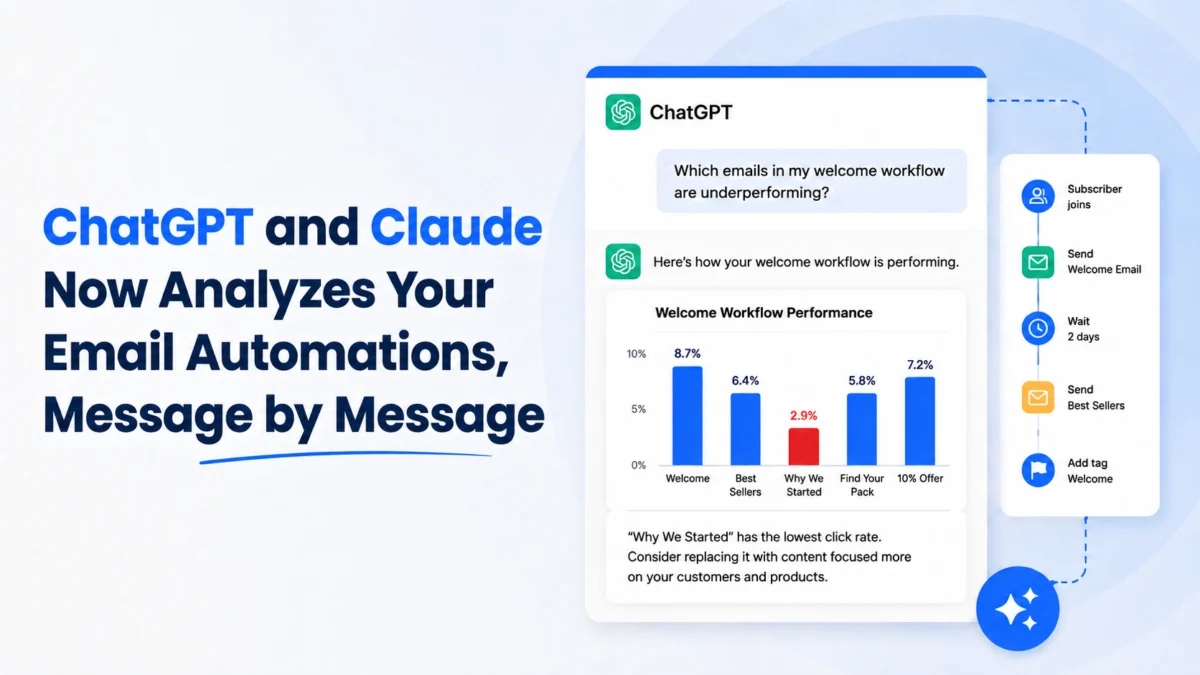
HubSpot AEO, for instance, available as a standalone product or integrated within Marketing Hub Professional and Enterprise, exemplifies this integrated approach. It translates visibility data into prioritized recommendations, detailing what content to create, update, or where to engage for maximum impact. When part of Marketing Hub, the Content Agent feature can transform a blog recommendation into a research-backed first draft in the brand’s voice with a single click. This draft then lands directly in HubSpot’s content editor, ready for refinement and publication through Content Hub and Marketing Hub. This capability, currently in public beta, uses HubSpot Credits (approximately $10 per blog post) to significantly accelerate content creation.
Crucially, because this work is built upon HubSpot’s Smart CRM, traffic referred from AI tools can be attributed as a distinct source and linked to specific contacts and deals. This allows AEO reporting to sit alongside other funnel metrics, providing a more complete picture of marketing ROI. However, an honest limitation remains: answer engines often resolve questions without sending a click. While HubSpot can attribute AI traffic that does click through, the broader impact of "zero-click influence" – enhanced brand awareness, authority, and trust that doesn’t immediately translate into a session – remains a challenge to quantify directly in pipeline metrics. Therefore, visibility scores and referral revenue should be viewed as two related but distinct measures of AEO success.
The broader implications of AEO extend across various facets of digital marketing and business strategy:
- Content Strategy: A shift towards creating "answer-first" content that is highly structured, directly addresses user queries, and is backed by authoritative sources.
- Technical SEO: Renewed emphasis on schema markup, entity optimization, and ensuring content is technically accessible and understandable for AI crawlers.
- Brand Management: Proactive monitoring for potential misinformation or misrepresentation of the brand within AI answers, allowing for swift corrective action.
- Competitive Advantage: Early adopters of sophisticated AEO strategies stand to gain a significant edge in capturing attention and establishing authority in the evolving AI-driven search landscape.
- Future of Search: AEO is not a fleeting trend but a permanent fixture, destined to evolve alongside advancements in AI capabilities and user interaction models.
Frequently Asked Questions About AEO Checkers
How often should an AEO check be run?
The frequency depends heavily on the method employed. For manual spot-checks, the inherent volatility of AI responses necessitates sampling several sessions per query to gain a reliable pattern. Automated checkers, however, are designed for continuous monitoring. Daily or weekly refreshes are ideal for capturing the dynamic nature of AI answers and providing timely insights, whereas less frequent, monthly snapshots risk obscuring critical shifts.
![AEO checker tools that measure answer engine visibility [2026]](https://53.fs1.hubspotusercontent-na1.net/hubfs/53/aeo-checker-5-20260903-8938354.webp)
Is AEO the same as AI search optimization?
While the terms are often used interchangeably, AEO (Answer Engine Optimization) is the more precise and preferred label. It specifically refers to the practice of improving how accurately and frequently a brand appears within AI-generated answers from platforms like ChatGPT, Perplexity, Gemini, and Google AI Overviews. "AI search optimization" is a broader term that could encompass many aspects of AI interaction, but AEO narrows the focus to the direct, answer-based output of these engines.
Can citations be reliably tracked in ChatGPT and Perplexity?
Yes, within certain limits. Both platforms are designed to surface the sources behind their answers, making individual responses readable for citation analysis. However, the reliability comes from repetition, not single snapshots. AI models are dynamic; their responses and cited sources can vary from one query session to the next due to factors like real-time web access, model updates, and contextual nuances. Therefore, running each prompt multiple times across fresh sessions and tracking the emerging patterns is essential for reliable data.
Do AEO checkers replace traditional SEO tools?
No, AEO checkers do not replace traditional SEO tools; rather, they complement them. They measure different, albeit related, aspects of digital visibility. AEO checkers focus on how answer engines cite and mention a brand within synthesized responses, while SEO tools track traditional rankings, keywords, backlinks, and website traffic. Strong SEO remains foundational, as it supplies the crawlability, authority signals, and quality content that answer engines rely on when choosing what to cite. Therefore, an integrated strategy that utilizes both AEO and SEO tools concurrently is crucial for comprehensive digital success in the current landscape.