The Bill and Melinda Gates Foundation released its inaugural Goalkeepers report in 2017, marking a significant milestone in the global effort to track and accelerate progress toward the United Nations Sustainable Development Goals (SDGs). This comprehensive document, titled "Goalkeepers 2017: The Stories Behind the Data," was designed to diagnose urgent global problems, identify promising solutions, and spread best practices in the fight against poverty and preventable diseases. By utilizing high-fidelity information design—including text, images, video, and interactive charts—the report aimed to engage a broad audience of policymakers, activists, and the general public. Among the most critical issues highlighted in the report is maternal mortality, a metric that serves as a profound indicator of a nation’s overall health system strength and social equity.
The Evolution of Global Health Monitoring: A Chronology
The trajectory of global health monitoring has shifted dramatically over the last three decades. To understand the context of the 2017 Goalkeepers report, one must look back at the establishment of the Millennium Development Goals (MDGs) in 2000. These eight goals provided a framework for international development, with MDG 5 specifically targeting a 75% reduction in the maternal mortality ratio (MMR) between 1990 and 2015.
In 2015, as the MDG era concluded, the United Nations transitioned to the Sustainable Development Goals (SDGs). This new framework expanded the scope of global development to 17 goals, with Goal 3 focusing on "Good Health and Well-being." Specifically, Target 3.1 aims to reduce the global maternal mortality ratio to less than 70 per 100,000 live births by 2030. The Goalkeepers initiative was launched by the Gates Foundation in 2017 to ensure that the momentum gained during the MDG era did not stall. The foundation committed to publishing this report annually until 2030, providing a consistent data-driven check-up on the world’s progress.
The Statistical Landscape of Maternal Health in 2015
According to data compiled by UNICEF and the World Health Organization (WHO), the year 2015 served as a critical benchmark for maternal health. During that year, approximately 302,530 women died due to complications related to pregnancy or childbirth. This figure translates to a global maternal mortality ratio of 168.7 deaths per 100,000 live births. While this represented a significant decline from 1990 levels—where the ratio was nearly double—the absolute number of deaths remained a stark reminder of the work left to be done.
Maternal mortality is defined by the WHO as the death of a woman while pregnant or within 42 days of termination of pregnancy, irrespective of the duration and site of the pregnancy, from any cause related to or aggravated by the pregnancy or its management. The vast majority of these deaths occur in low-resource settings and are largely preventable. The primary clinical causes of death include severe bleeding (mostly after childbirth), infections (usually after childbirth), high blood pressure during pregnancy (pre-eclampsia and eclampsia), and complications from delivery.
Success in Ethiopia: A Model for Development
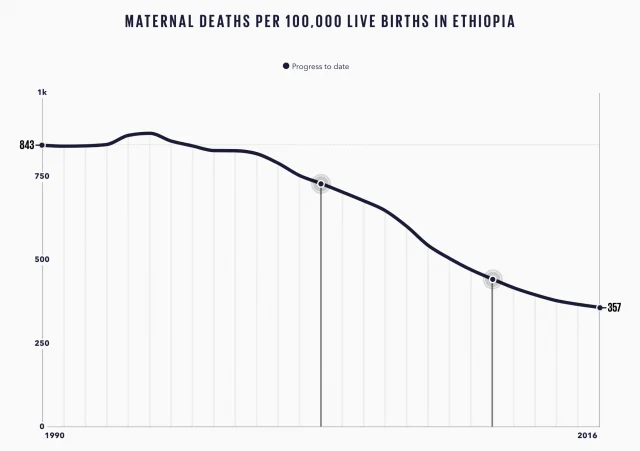
The Goalkeepers 2017 report placed a specific spotlight on Ethiopia as a primary case study for success in reducing maternal mortality. In 1990, Ethiopia faced one of the highest maternal mortality ratios in the world, with 843 deaths per 100,000 live births. By 2015, the nation had successfully reduced this figure to 357 deaths per 100,000 live births. This remarkable progress was not accidental but the result of a deliberate, multi-decade strategy focused on community-based healthcare.
Ethiopia’s Health Extension Program (HEP), launched in the early 2000s, played a pivotal role. The government trained and deployed over 38,000 female health extension workers to rural villages. These workers provided essential health services, including antenatal care, immunizations, and education on safe delivery practices. By bringing healthcare directly to the doorsteps of those in need, Ethiopia bridged the gap between rural populations and the formal medical system. Bill and Melinda Gates noted in the report that Ethiopia’s success demonstrates that even in resource-constrained environments, significant health gains are possible through political will and innovative delivery models.
Regional Disparities and the Burden on Sub-Saharan Africa
Despite the progress seen in countries like Ethiopia, the UNICEF maternal mortality dataset reveals deep regional disparities. Sub-Saharan Africa continues to bear the heaviest burden, accounting for roughly two-thirds of all maternal deaths globally. In 2015, the maternal mortality ratio in this region was estimated at 546 per 100,000 live births. In contrast, the ratio in high-income countries was approximately 12 per 100,000.
The data indicates that the lifetime risk of maternal death for a woman in Sub-Saharan Africa is 1 in 36, compared to 1 in 4,900 in developed nations. These figures underscore the "lottery of birth," where a mother’s survival is largely dictated by her geographic location and the quality of the healthcare infrastructure available to her. Southern Asia also remains a high-priority region, though it has seen faster rates of decline than Sub-Saharan Africa over the last decade.
Institutional Reactions and Policy Frameworks
The release of the Goalkeepers report prompted various reactions from international health organizations and government bodies. The World Health Organization emphasized that the findings aligned with their "Global Strategy for Women’s, Children’s and Adolescents’ Health." Dr. Tedros Adhanom Ghebreyesus, Director-General of the WHO and former Minister of Health for Ethiopia, has frequently cited Ethiopia’s model as a blueprint for Universal Health Coverage (UHC).
Policy experts argue that reducing maternal mortality requires a "continuum of care" approach. This includes family planning services, skilled attendance at birth, and emergency obstetric care. The Gates Foundation has advocated for increased funding toward these specific interventions, noting that for every dollar invested in maternal and neonatal health, there is an estimated $9 return in social and economic benefits. The 2017 report served as a call to action for donor nations to maintain their commitments to official development assistance (ODA), particularly in an era of shifting political priorities.
The Role of Data Transparency in Global Health
A central theme of the Goalkeepers initiative is the importance of data transparency and accessibility. The report utilizes datasets from UNICEF, the Institute for Health Metrics and Evaluation (IHME), and the United Nations Population Division. By making this data publicly available and presenting it through user-friendly visualizations, the foundation empowers researchers and citizen-journalists to conduct their own analyses.
In the digital age, the ability to format and import complex datasets into tools like Google Data Studio has democratized health informatics. This allows for the creation of localized reports that can help community leaders understand how their specific regions compare to national and global averages. Transparency in data not only helps in identifying where interventions are succeeding but also holds governments accountable for their promises to improve public health.
Economic and Social Consequences of Maternal Death
Beyond the immediate tragedy of a lost life, maternal mortality has devastating long-term effects on families and communities. When a mother dies, the survival and well-being of her surviving children are severely compromised. Research indicates that children who lose their mothers are less likely to receive proper nutrition, complete their education, or receive necessary medical care.
Economically, maternal mortality contributes to a cycle of poverty. The loss of a primary caregiver often forces older children out of school to take on household responsibilities or manual labor. Furthermore, the loss of a woman’s economic productivity impacts the household income and, by extension, the local economy. Bill and Melinda Gates summarized this impact by stating, “If you were trying to invent the most efficient way to devastate communities and put children in danger, you would invent maternal mortality.”
Conclusion: The Path to the 2030 Targets
As the international community moves further into the SDG era, the 2017 Goalkeepers report remains a foundational document that set the stage for modern health advocacy. While the trends in maternal mortality show significant improvement, the pace of progress must accelerate to meet the 2030 target of fewer than 70 deaths per 100,000 live births.
The success of Ethiopia provides a glimmer of hope and a practical roadmap, but the challenges in other regions—exacerbated by conflict, climate change, and economic instability—remain formidable. The fight against maternal mortality is not merely a medical challenge; it is a fight for human rights, gender equality, and global stability. The continued monitoring of data, as championed by the Gates Foundation and UNICEF, will be essential in ensuring that no mother is left behind in the pursuit of a healthier, more equitable world.