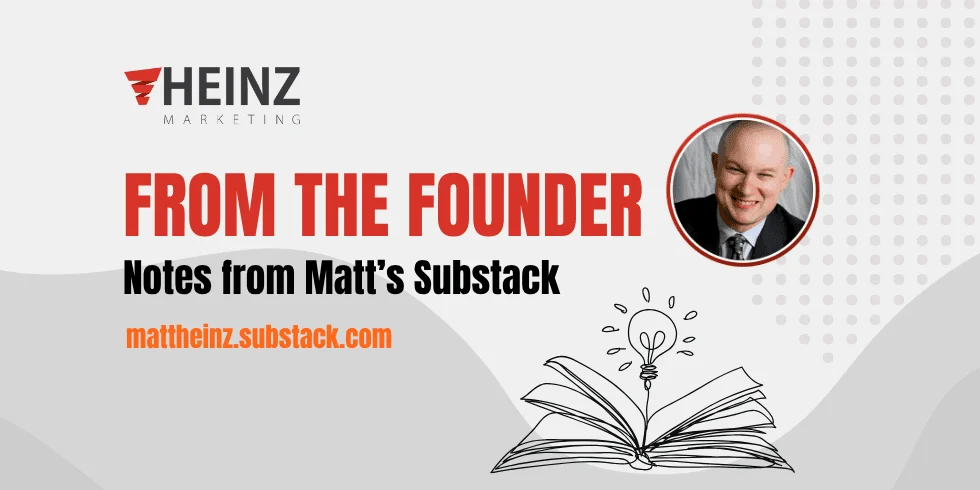
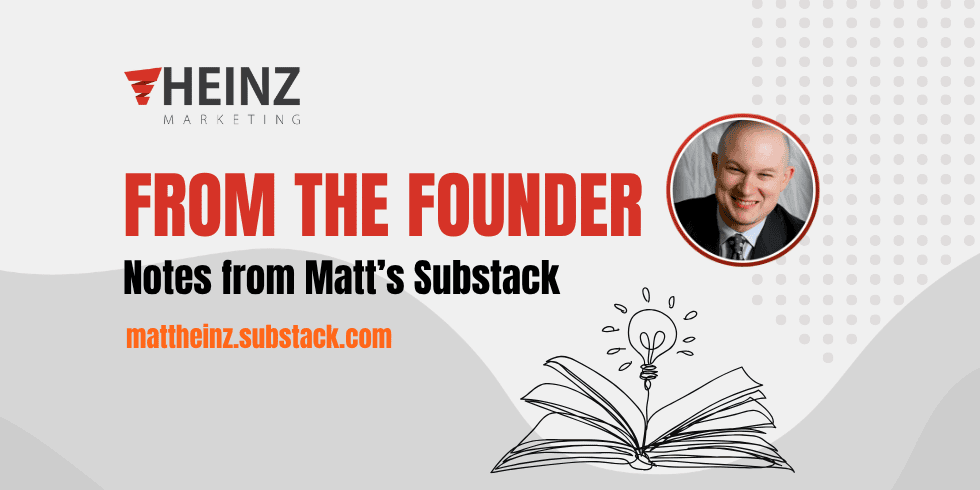
Matt Heinz, founder of Heinz Marketing, marked his 50th birthday by sharing a candid and introspective look at the crucial lessons learned over nearly 18 years of building his business. In a piece published on his Substack, Heinz distills his experiences into ten fundamental principles, emphasizing that these are not merely platitudes but hard-won truths that even his younger self would have likely dismissed. The reflections offer a profound insight into the mindset and strategic thinking that have guided him through economic downturns, personal milestones, and the ever-evolving landscape of marketing.
The article, which began with a personal anecdote about a photograph of himself and his wife, Beth, taken in his younger, leaner days, sets a tone of authentic self-assessment. Heinz acknowledges that the lessons he now holds dear are the very ones he likely heard but failed to internalize until life’s experiences forced their acceptance. This perspective underscores the idea that true learning often comes through direct engagement and personal consequence, rather than passive reception of advice.
The Imperative of Action: Launching Heinz Marketing Against the Odds
One of the most striking lessons is Heinz’s advice: "Don’t wait for the right moment." He recounts the founding of Heinz Marketing on November 24, 2008, a period marked by significant economic uncertainty. The stock market had recently experienced a severe downturn, and his wife was pregnant with their first child. Despite these challenging circumstances, he left his job and benefits to embark on his entrepreneurial journey. This decision, he admits, was not born of perfect timing but rather a confluence of necessity, a supportive partner, and perhaps a degree of naivete.
"If I had waited for the right moment to get married, to have kids or to start a business, I would still be waiting," Heinz states, highlighting a common human tendency to delay action in pursuit of an idealized future. He frames the "right moment" as a self-imposed narrative that justifies procrastination, rather than a strategic advantage. His own experience, he suggests, was a blend of luck and a lack of foresight that shielded him from excessive fear. Crucially, he credits his wife, Beth, for her unwavering confidence in him during those nascent, uncertain days, underscoring the vital role of a strong support system in entrepreneurial endeavors. The anecdote serves as a powerful reminder that inaction, driven by the pursuit of perfect conditions, can be a greater impediment to success than imperfect beginnings.
Enduring Principles in a Shifting Landscape: The Job Outlasts the Tools
Heinz draws a poignant parallel between his father’s long career in marketing and sales for a Caterpillar Tractor territory and the modern marketing profession. His father, who managed his responsibilities for three decades without the aid of computers, emails, or digital analytics, focused on fundamental principles. Heinz explains that his father’s approach—identifying target accounts, understanding intent, discerning needs, navigating decision-makers, and building trust—remains the core of the marketing job, irrespective of the tools employed.
This perspective offers a critical counterpoint to anxieties surrounding technological advancements, such as artificial intelligence. "So when people ask me whether AI is going to end marketing, I think about my dad with no computer, doing my job," Heinz muses. He asserts that while methods, media, channels, and even organizational structures are transient, the underlying objective of marketing—connecting with the right audience with the right message at the right time—endures. This insight is particularly relevant in today’s rapidly evolving digital marketing landscape, where the constant emergence of new platforms and technologies can be overwhelming. The emphasis on foundational marketing principles provides a stable anchor for professionals navigating this dynamic environment.
The Power of Consistency: Showing Up as a Non-Negotiable
The principle of "Show up" is articulated through Heinz’s consistent commitment to his media platforms, including over 370 episodes of Sales Pipeline Radio and regular appearances on CMO Coffee Talk. He dismisses the notion of genius, attributing his success in these endeavors to sheer consistency and commitment. The mere act of being present, of keeping appointments on the calendar, is paramount.
"Plenty of those episodes were mediocre and a few were genuinely bad," Heinz admits, acknowledging that not every output will be stellar. The critical takeaway is that one cannot predict which engagements will resonate or prove significant. The only path to discovering those impactful moments is by consistently participating, even on days when motivation wanes. He observes that individuals often overvalue meticulous planning while underestimating the power of consistent action and commitment to scheduled engagements. His personal admission of experiencing last-minute anxieties about meetings, only to find himself consistently happier for having attended, reinforces the message: the act of showing up, of fulfilling commitments, is often more beneficial than the perceived perfection of what is delivered.
Evaluating Decisions, Not Just Outcomes: A Deeper Hiring and Self-Assessment Strategy
Heinz’s experience in hiring has led him to a crucial realization: "Judge how people decide, not what they produce." He notes that past hiring missteps often stemmed from an overemphasis on a candidate’s tangible outputs rather than the underlying decision-making processes. A resume, he argues, is a record of achievements, but it offers limited insight into the individual’s capacity for critical thinking and problem-solving in diverse situations.
He advocates for a deeper evaluation, asking candidates to articulate their reasoning behind decisions, including those that did not yield favorable results. Individuals who can candidly explain their thought processes, even in retrospect, are more likely to be valuable assets. This evaluative framework extends to self-assessment. Heinz acknowledges that he has sometimes received credit for outcomes that were not solely the product of his own sound judgment, and conversely, has experienced pride in well-reasoned decisions that ultimately failed to materialize. This approach encourages a more nuanced understanding of competence, recognizing that resilience and strategic thinking are often more valuable than a perfect track record.
Prioritizing Well-being: The Necessity of Putting Yourself First
A cornerstone of Heinz’s philosophy, revisited and reinforced on the ten-year anniversary of Heinz Marketing, is the principle of "Put yourself first." He contends that this is not an act of selfishness but a prerequisite for effective service to others. By identifying and prioritizing personal needs, individuals can dedicate more time and energy to their professional and personal relationships, transforming obligations into opportunities for fulfillment rather than sources of resentment.
Heinz advises articulating these needs to trusted individuals, such as spouses, mentors, or managers. He suggests that perceived impositions are often more manageable than anticipated, and the avoidance of expressing needs can lead to damaging resentment. As a leader, Heinz recognizes the inclination to shield employees and clients by taking on excessive work. However, he cautions that this can manifest as micromanagement and hinder the professional growth of others. Open and direct communication about needs, he asserts, fosters greater happiness and understanding for all involved.
The Discipline of Rest: Reclaiming Time for Renewal
Heinz champions the idea that "Rest is a discipline, not a reward." His family’s annual two-week vacation in Encinitas, California, during which he strictly avoids work, exemplifies this principle. He emphasizes the importance of structured time off, not as an earned privilege after arduous labor, but as a deliberate practice essential for sustained performance and well-being.
He contrasts his experience ten years ago, when returning from vacation meant confronting a daunting backlog, with his current reality, where the workload is significantly more manageable. The key, he explains, lies in systemic preparation: completing critical dependencies before departure, delegating tasks with clear assignments, crafting out-of-office messages that effectively close loops, and scheduling the first day back to prevent immediate meeting conflicts. The resulting fatigue upon returning, he notes, is not a sign of falling behind but an indicator of genuine rest. This perspective reframes time off as a strategic investment in personal and professional efficacy.
Confronting Anxiety: Taming the Inner Critic
Heinz openly addresses his ongoing struggle with anxiety, referring to it as a "lying asshole." He acknowledges that despite therapeutic interventions, periods of high stakes can trigger an internal narrative of worst-case scenarios. This battle, he suggests, stems from the inherent human desire for control in a world where absolute control is illusory.
He shares strategies that have proven effective in managing his anxiety, emphasizing the importance of externalizing these fears:
- Verbalizing to Another Person: Speaking anxieties aloud to a partner, friend, or professional is crucial for diminishing their power. This act of articulation can be more effective than journaling or internal rumination.
- Physical Activity: Engaging in physical movement during periods of escalating anxiety can interrupt negative thought spirals and retrain the brain and body’s response mechanisms.
- Naming the Actual Worst-Case Scenario: Articulating the specific fears and then outlining a plan of action, however rudimentary, can make the perceived threat more manageable. This process, while initially daunting, consistently shrinks the perceived magnitude of the problem.
Redefining Failure: Courage as the Missing Ingredient
Heinz posits that "Most failures are courage failures." He observes that many setbacks are not due to flawed processes or strategies but a lack of nerve to take necessary actions. Examples include avoiding difficult conversations, delaying critical personnel decisions, or hesitating to raise prices due to fear of rejection.
He criticizes the tendency to seek external solutions, such as new frameworks or books, when the underlying issue is a deficit in courage. The allure of redesigning processes or adopting new methodologies can serve as a temporary distraction from confronting uncomfortable truths and making difficult choices. Heinz stresses that most decisions are reversible and can be amended, which should foster bravery rather than excessive caution. The ultimate message is to avoid allowing others to dictate one’s path through inaction or fear.
Empowering Others: The Art of Building Self-Confidence
Drawing inspiration from figures like Brent Adamson, Heinz highlights the profound impact of helping others "feel confident in themselves." This principle, he notes, transcends professional interactions and extends to parenting and personal relationships. While the instinct to be the most knowledgeable person in the room is common, it can inadvertently foster dependence.
The alternative, a more challenging but ultimately more rewarding approach, involves asking questions that guide individuals to their own conclusions and solutions. This method has reshaped Heinz’s approach to sales, parenting, and leadership, fostering a deeper sense of self-reliance and capability in those around him. It is a subtle yet powerful shift from providing answers to facilitating discovery.
Authenticity and Connection: Being the Whole Person in the Frame
In an era of curated online personas, Heinz advocates for "Be the whole person in the frame." He rejects the notion of presenting a sterile, professional facade, arguing that authenticity, which includes acknowledging the complexities and realities of one’s life, fosters genuine connection. His own basement office, visible in virtual presentations, includes elements of his personal life – a piano, baseball bats, children’s art – signaling a relatable humanity.
He extends this principle to interpersonal interactions, encouraging a second, more probing inquiry into how someone is truly doing. While initially uncomfortable, this deeper engagement can yield more honest and meaningful responses. The analogy of a treadmill running at maximum speed illustrates the need to probe beyond superficial answers to understand true challenges and experiences. By granting permission, space, and grace, individuals are more likely to share their authentic selves, leading to richer and more impactful connections.
Heinz concludes by reiterating that his younger self would have likely dismissed these lessons. He acknowledges that the path of learning often involves personal mistakes and that this is a crucial element of growth, a lesson he is now actively trying to impart to his own children. He expresses a forward-looking perspective, promising to reflect further on which of these principles he has managed to embody and which still require further cultivation by the time he reaches 60.