The digital marketing paradigm is undergoing a profound transformation, driven by the rapid ascent of AI-powered search and conversational interfaces. Traditional SEO metrics, once the bedrock of online visibility strategies, are increasingly proving insufficient as buyers shift from keyword-based Google searches to conversational prompts with AI answer engines like ChatGPT, Gemini, and Perplexity. In this new era, understanding "AI visibility" – how a brand appears in AI-generated responses – has become paramount for marketers aiming to maintain relevance and drive measurable business outcomes. Peec AI emerged as an early contender in this space, offering robust monitoring capabilities. However, as the market matures and marketer needs evolve, a new generation of sophisticated AI visibility platforms, or Answer Engine Optimization (AEO) tools, are emerging, offering functionalities that extend far beyond mere monitoring to encompass remediation, CRM attribution, and scalable workflows.
The Dawn of Answer Engine Optimization: A Shifting Search Paradigm
For over two decades, Google’s search engine results pages (SERPs) dictated the rules of online visibility. Marketers meticulously tracked keyword rankings, organic traffic, and click-through rates, optimizing content to secure coveted top positions. However, the introduction and rapid adoption of generative AI models have fundamentally altered buyer behavior. Consumers and B2B decision-makers are now posing complex questions directly to AI chatbots, seeking synthesized answers and recommendations before ever visiting a vendor’s website. These AI systems don’t just "rank" pages; they interpret, synthesize, and cite sources to formulate direct answers, often presenting them in digestible formats that bypass traditional search results entirely.
This shift has created an urgent need for Answer Engine Optimization (AEO), a discipline focused on ensuring a brand’s favorable and frequent appearance within these AI-generated responses. Unlike classic rank tracking, which measures a page’s position for a keyword, AI visibility monitoring gauges a brand’s "presence" – how often it’s mentioned, its positioning (favorable, neutral, negative), and the specific sources AI systems cite. This new form of digital presence is critical, as it directly influences pre-purchase research and brand perception.
Peec AI: Strengths, Limitations, and the Catalyst for Innovation
Peec AI established itself as a significant player in the nascent AEO market by effectively tracking brand mentions, citations, and sentiment across a range of AI models. Its ability to distinguish between Google AI Overviews and Google AI Mode, for instance, provides a nuanced understanding of Google’s evolving AI integration, offering more accurate reporting than tools that conflate these distinct functionalities. Peec AI’s Source Identification feature, which surfaces the specific third-party reviews, comparison pages, or documentation an AI system cited, is particularly valuable. This allows content and SEO teams to reverse-engineer why a competitor might be favored and to prioritize content investments accordingly. For global brands and multilingual content teams, Peec AI’s per-country and per-language tracking capabilities are also noteworthy.
Despite these strengths, the rapid evolution of marketing needs in 2026 has exposed several critical limitations in standalone monitoring platforms like Peec AI. Foremost among these is the lack of native remediation capabilities. While Peec AI excels at identifying gaps and opportunities, it doesn’t offer tools to close them. Teams are left to manually generate briefs, draft copy, or automate publishing workflows using separate systems.
-1.png)
A more significant gap for RevOps-minded organizations is the absence of native CRM attribution. Visibility data within Peec AI’s dashboard remains isolated, requiring arduous manual work, data exports, and separate attribution models to connect AI visibility to pipeline, revenue, or campaign performance. This disconnect makes it challenging for marketing teams to quantify the ROI of their AEO efforts to executive leadership. Furthermore, Peec AI lacks historical data backfill, meaning tracking only begins upon subscription, preventing benchmarking against prior performance. Its prompt methodology, relying on AI-generated queries rather than real user prompts, also raises questions about the accuracy and real-world applicability of its reported visibility. These limitations have spurred the development of a diverse ecosystem of Peec AI alternatives, each addressing specific pain points and offering more comprehensive solutions.
Key Evaluation Criteria for Next-Generation AI Visibility Platforms
Selecting the right AEO platform in 2026 demands a sophisticated evaluation framework that extends beyond basic monitoring. Marketers must consider several critical criteria to ensure their chosen tool drives tangible business value:
- Native CRM Integration & Attribution: Can the platform connect AI visibility data directly to contact records, deal stages, and revenue metrics within a CRM? This is paramount for proving ROI and integrating AEO into the sales pipeline.
- Actionability & Remediation: Does the tool merely identify gaps, or does it provide capabilities for content generation, brief creation, and automated publishing workflows to close those gaps efficiently?
- Data Depth & Accuracy: Does it use real user prompts for analysis, or synthetic queries? Does it offer AI crawler analytics to understand how AI systems interpret content? Is historical data available?
- Scalability & Coverage: How many AI answer engines does it monitor? Does it support multi-region, multi-language, or multi-brand workflows? Are enterprise-grade security, compliance (SSO, role-based access), and data residency features available?
- Workflow Integration: Can it integrate with existing content management systems (CMS), marketing automation platforms, or project management tools to streamline operations?
- Cost-Effectiveness: Is the pricing model transparent and aligned with actual usage (e.g., prompt volume, number of engines, unlimited seats)? Does it offer a clear path from a low-cost entry to enterprise solutions?
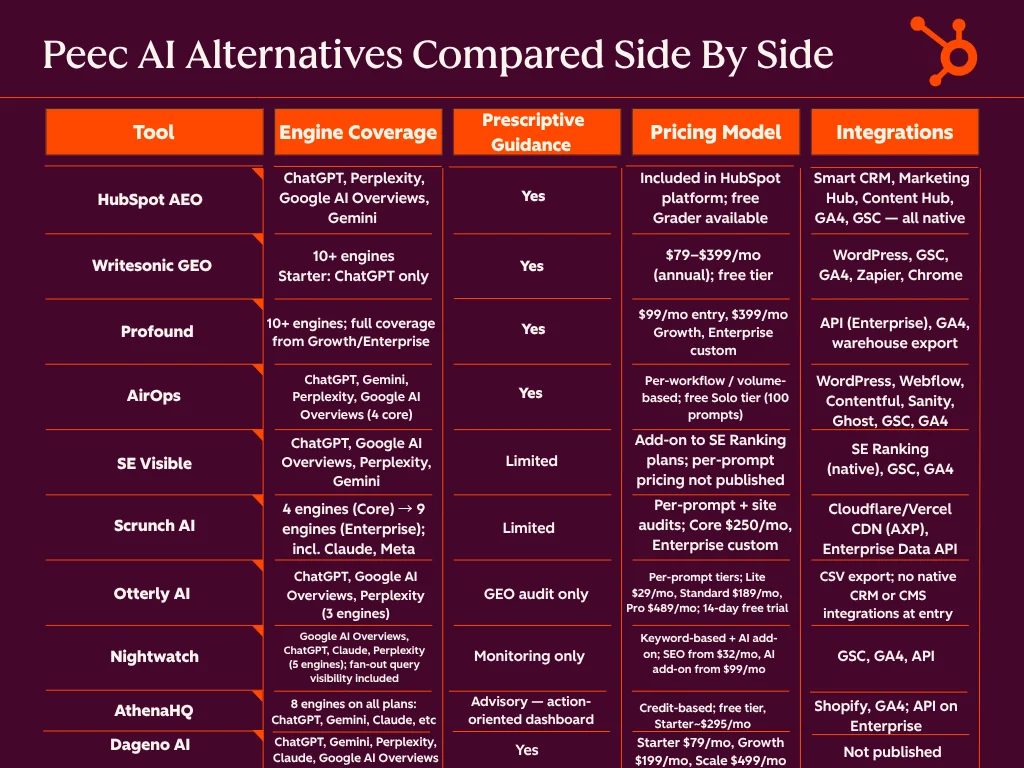
Leading Peec AI Alternatives: A Side-by-Side Analysis
The competitive landscape of AI visibility platforms has rapidly matured, offering specialized solutions for diverse organizational needs.
-
HubSpot AEO – The CRM-Native Advantage:
- Core Strength: Unrivaled native integration with HubSpot’s Smart CRM. HubSpot AEO tracks brand mentions, citation rates, and competitive benchmarks across major AI answer engines, embedding this data directly alongside contact records, deal stages, and campaign performance.
- Value Proposition: Solves the critical attribution challenge by automatically connecting AI-sourced visits, contacts, and deals to CRM data. Sales teams gain invaluable context, understanding how prospects engaged with AI-generated recommendations. This eliminates the need for manual data exports, Zapier integrations, or parallel dashboards, providing a unified view of the customer journey.
- Limitations: While strong on attribution, it may not offer the deepest prompt dataset analytics or AI crawler diagnostics found in more specialist tools.
- Pricing: $50/month standalone; included in Marketing Hub Professional and Enterprise. Offers a free AI Search Grader for baseline assessment.
-
Writesonic GEO – Prescriptive Optimization from Insight to Action:
- Core Strength: End-to-end answer engine optimization, combining AI visibility monitoring with integrated content generation capabilities.
- Value Proposition: When Writesonic GEO identifies a citation gap, teams can immediately act on it using the platform’s content creation tools, streamlining the entire optimization workflow. This integration creates a compounding advantage for teams with active content operations.
- Limitations: The monitoring layer is newer compared to dedicated trackers, and engine coverage on entry plans might be slightly narrower.
- Pricing: Starts at $79/month, making it a budget-friendly option for both writing and monitoring.
-
Profound – Enterprise Analytics, Security, and Compliance:

- Core Strength: Comprehensive feature set designed for enterprise marketing teams, large agencies, and organizations with stringent security and compliance requirements.
- Value Proposition: Tracks mentions, citations, sentiment, and prompt volume across 10+ AI platforms. Its "Agents" feature enables scaled AEO-optimized content creation with human oversight. Profound boasts one of the largest datasets of real user prompts (1.5B+) and anonymized conversations (400M+), offering unparalleled measurement credibility. Its enterprise security features (SSO, role-based access, data residency) align with rigorous corporate standards.
- Limitations: Price is a significant barrier for smaller teams, with real functionality starting at the $399/month Growth plan.
- Pricing: Growth plan at $399/month.
-
AirOps – The Agency and Multi-Site Workflow Solution:
- Core Strength: A content operations platform with integrated AEO research and visibility analysis, specifically tailored for agencies and teams managing multiple brands or extensive content libraries.
- Value Proposition: AirOps Insights tracks citation, mention, and sentiment rates, while Page360 connects this data to Google Search Console and GA4. Crucially, its "Quill" (Playbooks) feature can research, draft, and publish content directly to various CMS platforms (Webflow, WordPress, Contentful, Sanity, Ghost), closing the loop from insight to publication within a single workflow. Templated playbooks offer operational leverage for agencies.
- Limitations: Tracking depth may be newer than dedicated monitors. Teams focused purely on measurement might find some production capabilities to be overhead.
- Pricing: Free entry tier available, with paid plans scaling with volume and complexity.
-
SE Visible (by SE Ranking) – Unified SEO + AEO Intelligence:
- Core Strength: Integrates AI overview tracking into the established SE Ranking ecosystem, providing a unified view of traditional SEO and new AI visibility metrics.
- Value Proposition: Leverages SE Ranking’s 13+ years of historical SEO context, offering comparative benchmarking that pure-play AEO tools cannot match. Unlimited seats across all plans make it accessible for entire marketing teams, eliminating seat-based pricing friction. Ideal for teams already using SE Ranking who want to add AEO without a separate subscription.
- Limitations: AI visibility data is a relatively newer addition compared to SE Ranking’s core SEO functionality.
- Pricing: Available as part of SE Ranking plans.
-
Scrunch AI – Enterprise AI Crawler Analytics:
- Core Strength: Enterprise-grade platform offering not just brand visibility tracking but also advanced AI crawler analytics, revealing how AI bots interact with a site before generating answers.
- Value Proposition: Provides insights into the inputs AI systems use, offering a unique diagnostic capability for technical SEO teams. Its Agent Experience Platform (AXP) automatically serves AI-optimized content to AI agents without affecting the human-facing site.
- Limitations: High entry cost ($250/month for the Core plan). Content generation capabilities are less robust than Writesonic or AirOps.
- Pricing: Core plan at $250/month; Enterprise is custom.
-
Otterly AI – The Affordable Entry Point:
- Core Strength: The most affordable credible entry point into AI visibility monitoring, ideal for startups, SMBs, or teams testing AEO concepts.
- Value Proposition: Tracks brand mentions and citations across multiple answer engines, including a GEO audit feature that evaluates 25+ on-page factors and provides fix-it checklists. Provides real monitoring capability at a low cost ($29/month Lite plan).
- Limitations: Narrower engine coverage compared to top-tier tools (3 engines vs. 10+). No CRM integrations at entry price points.
- Pricing: Lite at $29/month, scaling up to Premium at $489/month.
-
Nightwatch – Understanding the "Why" Behind AI Citations:
- Core Strength: Offers "fan-out query visibility," showing the real-time web searches AI systems perform before composing answers.
- Value Proposition: Provides a diagnostic capability beyond just measuring results. It reveals why an AI system isn’t citing a brand by showing which sources it fetched and what queries it ran. Crucial for SEO and content teams focused on understanding citation pathways.
- Limitations: Narrower engine coverage than enterprise alternatives. AI tracking is an add-on to a separate SEO subscription, potentially feeling fragmented.
- Pricing: Base SEO from $32/month; AI tracking add-on from $99/month.
-
AthenaHQ – Risk-Free AEO Exploration:
- Core Strength: Offers a free entry tier, making it ideal for early-stage programs or teams needing a proof of concept before securing budget.
- Value Proposition: Positions itself as a brand intelligence tool with AI visibility, covering mentions, citations, and competitive share of voice. Allows organizations to build a business case for AEO with real data without initial financial commitment.
- Limitations: Lacks auditing and optimization capabilities. Limited enterprise-grade security and compliance features. A starting point, not a long-term solution for serious AEO initiatives.
- Pricing: Credit-based; free tier, Starter ~$295/mo, Custom pricing.
-
Dageno AI – Full-Workflow GEO Execution (Emerging):
- Core Strength: An ambitious, newer tool aiming for a full workflow from data monitoring to strategy, content generation, and result attribution at a non-enterprise price point.
- Value Proposition: Seeks to bridge the gap between monitoring and execution, providing an integrated platform to detect gaps, create content, and attribute outcomes. Positioned as a direct upgrade path for teams ready to move beyond basic monitoring.
- Limitations: Being early-stage, the depth and maturity of its broad claims (monitoring + strategy + content + attribution) require careful validation during trials.
- Pricing: Starter $79/mo, Growth $199/mo, Scale $499/mo, Custom Enterprise.
Connecting AI Visibility to Revenue: The Imperative of Attribution
.png?width=650&height=488&name=White%20Simple%20Comparison%20Graph%20(2).png)
The true value of any AEO program materializes when AI visibility translates into measurable revenue. This necessitates a robust attribution model that links AI-sourced interactions directly to business outcomes.
- Tagging AI-Sourced Traffic: AI answer engines often don’t pass standard referrer data, leading to "dark traffic" appearing as "direct" in analytics platforms. Marketers must proactively implement dedicated UTM parameters for AI-sourced campaigns, configure channel groupings in GA4 to capture known AI referrer patterns (e.g., perplexity.ai, chatgpt.com), and ensure CRMs like HubSpot’s Smart CRM capture the source at contact creation.
- Standardized UTM Taxonomy: Every piece of content published as part of an AEO workflow should include campaign parameters that map back to the specific AI visibility gap it aims to close. This creates a clear lineage from "tool X identified a citation gap for [query Y]" to "we published content Z, which generated N pipeline-influenced contacts." Custom CRM properties can then tag deals with "AI Visibility Initiative" to signal its contribution.
- Revenue-Centric Reporting: The ultimate goal is to present leadership with a Smart CRM dashboard that filters contacts by lifecycle stage, deal stage, and revenue, specifically highlighting those "originated from AI search." This concrete evidence transforms AEO from a qualitative "reach" metric into a quantifiable "revenue-generating investment."
Strategic Implementation: The AEO Playbook and Best Practices
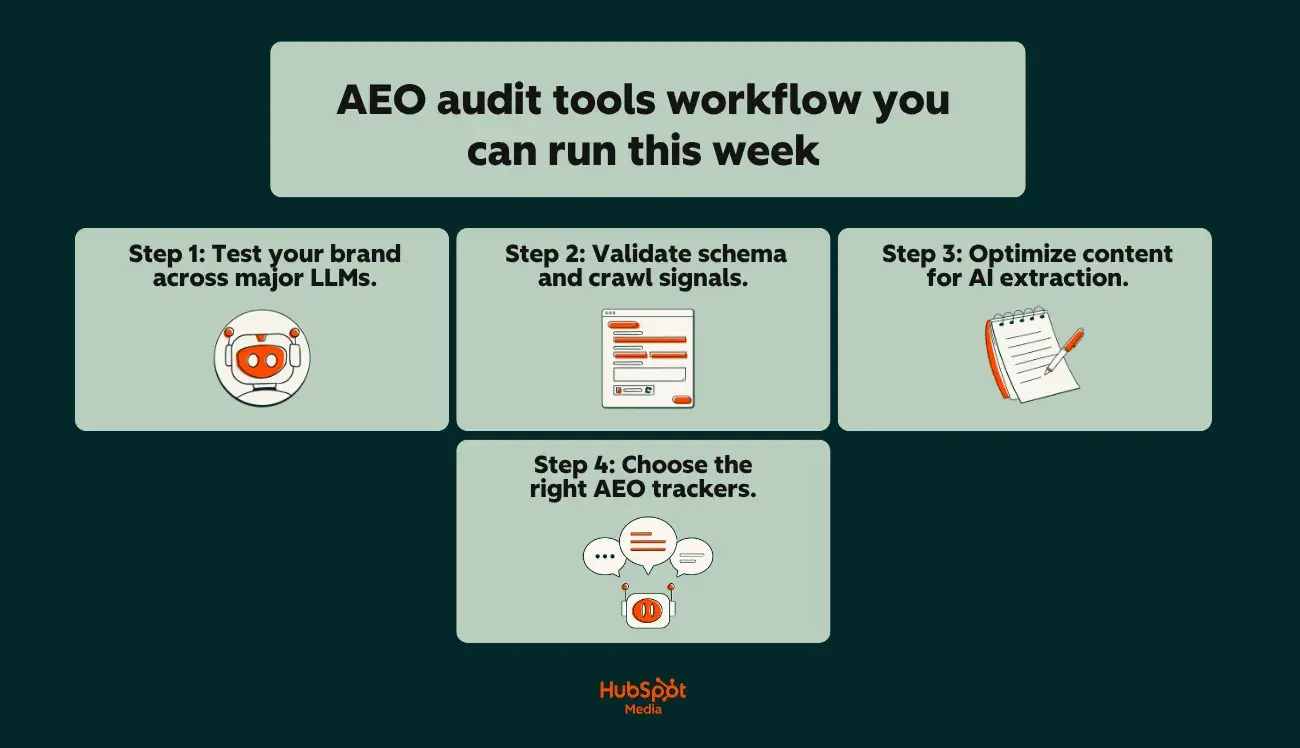
Effective AEO programs follow a repeatable six-step cycle:
- Discovery: Identify key buyer prompts and target AI answer engines.
- Analysis: Benchmark current brand visibility, citation rates, and competitor positioning.
- Strategy: Prioritize citation gaps and identify content opportunities.
- Content Creation: Develop or optimize content specifically for AI systems (answer-first, entity-rich).
- Publishing & Distribution: Deploy content and monitor its indexing by AI crawlers.
- Measurement & Iteration: Track changes in AI visibility, attribute outcomes, and refine strategies.
Beyond this playbook, several best practices amplify ROI:
- Audience-First Prompt Design: Segment prompts by buyer persona to ensure visibility data reflects actual audience needs.
- Competitive Citation Auditing: Analyze competitor citations to understand why they rank and identify differentiation angles.
- Entity and Schema Hygiene: Clearly define brand, products, and personnel with structured data to aid AI entity resolution.
- Brand Descriptor Consistency: Use specific, indexable language when describing offerings to enhance citable opportunities.
- Answer-First Content Standards: Prioritize utility and direct answers in the first 100 words of content to cater to AI summarization.
- Cross-Channel Validation: Always cross-reference AEO tool data with GA4, Search Console, and manual spot checks to ensure accuracy.
- Citation Retention: Treat citation retention as an active maintenance task, refreshing high-priority pages regularly to counter competitor activity.
The Future of AI Visibility: Continuous Adaptation
The landscape of AI search is dynamic, with constant innovations in multimodal AI, personalized AI agents, and evolving algorithm capabilities. Marketers must embrace a mindset of continuous adaptation, regularly reviewing their AEO strategies, testing new tools, and refining their content approaches. The ability to pivot quickly, driven by accurate data and integrated workflows, will differentiate successful brands in this rapidly changing environment.
Ultimately, the choice among Peec AI alternatives hinges on an organization’s specific needs, budget, and strategic priorities. Whether prioritizing native CRM attribution with HubSpot AEO, end-to-end content creation with Writesonic GEO, enterprise-grade analytics with Profound, or diagnostic depth with Nightwatch, the underlying principle remains constant: move beyond mere monitoring to actionable insights that directly contribute to the bottom line. The journey begins with establishing a baseline using tools like the free AI Search Grader, followed by a strategic selection that empowers marketing teams to transform AI visibility into tangible revenue.