The digital marketing landscape is undergoing a profound transformation, driven by the rapid evolution of artificial intelligence (AI) and the emergence of "answer engines." This shift presents both challenges and unprecedented opportunities, particularly for solopreneurs and small businesses traditionally overshadowed by larger enterprises in conventional search engine optimization (SEO). A recent experiment conducted by a solopreneur highlights the surprising efficacy of LinkedIn as a platform for Answer Engine Optimization (AEO), suggesting a new frontier for individual professionals seeking AI visibility.
For months, a pattern emerged in AI search queries for B2B reports and insights: alongside reputable sources like Gartner and McKinsey, AI platforms like Perplexity were increasingly citing LinkedIn articles and posts from individual professionals. This observation sparked a groundbreaking idea for one solopreneur: could LinkedIn serve as a potent tool for AEO, allowing individual experts to compete for visibility in a space previously dominated by institutional giants? The traditional search environment made it virtually impossible for solopreneurs to outrank large agencies or corporations; however, AI’s unique sourcing mechanisms appeared to level the playing field. This article delves into the methodology, findings, and broader implications of this solopreneur’s AEO experiment on LinkedIn, offering a blueprint for others to navigate this evolving digital domain.
The Rise of Answer Engines and the AEO Paradigm Shift
To fully appreciate the significance of this experiment, it’s crucial to understand the foundational shift from traditional search engines to answer engines. Traditional search primarily functions as an index, presenting users with a list of links to websites that might contain the answer to their query. Users then navigate these links to find the information they need. Search Engine Optimization (SEO) has historically focused on ranking websites high on these results pages through keywords, backlinks, and technical optimizations.
![Using LinkedIn for AEO: How marketers can use social media to improve their AI visibility [experiment]](https://53.fs1.hubspotusercontent-na1.net/hubfs/53/AEO-for-LinkedIn-piece-1-20260826-6108454.webp)
Answer engines, conversely, aim to provide direct, synthesized answers to complex queries, often citing their sources. Powered by Large Language Models (LLMs) and generative AI, platforms like ChatGPT, Perplexity, Gemini, and Google AI Mode interpret user intent, pull information from a vast array of online sources, and construct a coherent, human-like response. This paradigm shift means that users are less likely to click through multiple links and more likely to consume the AI-generated answer directly. Consequently, the goal of optimization moves from simply ranking high in search results to being cited or recommended by these AI systems – a practice termed Answer Engine Optimization (AEO).
The implications for content creators are immense. Instead of merely driving traffic to a website, the objective now includes influencing the AI’s "understanding" of a topic and positioning oneself as a credible source that the AI will reference. This often means creating content that directly answers questions, demonstrates clear expertise, and is easily digestible by AI models.
LinkedIn: An Unexpected AEO Powerhouse?
While traditional SEO often prioritizes standalone websites and established news outlets, AI models have demonstrated a broader, sometimes less hierarchical, approach to sourcing information. This is where LinkedIn enters the spotlight. As a professional networking platform, LinkedIn hosts a vast repository of expert profiles, articles, and posts. Its content is typically vetted for professional relevance, often authored by individuals with verifiable industry experience. This inherent credibility, combined with LinkedIn’s strong domain authority, makes it an attractive source for AI models seeking reliable, expert-driven insights.
Data corroborates this observation. Various studies have indicated that AI tools frequently draw from LinkedIn. For instance, reports suggest that platforms like Google AI Mode and Gemini exhibit a propensity to cite LinkedIn content more often than some of their peers, possibly due to the platform’s focus on professional identity and verified expertise. This trend democratizes content visibility, allowing individuals to potentially stand shoulder-to-shoulder with established institutions in AI-generated answers.
![Using LinkedIn for AEO: How marketers can use social media to improve their AI visibility [experiment]](https://no-cache.hubspot.com/cta/default/53/9dd5e54b-fbef-4dd0-bc44-1689feb1ea18.png)
For solopreneurs, who often lack the extensive marketing budgets and SEO teams of larger companies, LinkedIn’s potential as an AEO channel represents a significant strategic advantage. It offers a direct conduit to showcase specialized knowledge and build digital authority in a way that can be recognized by AI, without needing to compete on the same scale as traditional enterprise websites.
The Solopreneur’s AEO Experiment: A Detailed Chronology
The solopreneur’s experiment was born from the realization that AI was increasingly featuring individual LinkedIn profiles and posts. The core hypothesis was that strategic content creation and profile optimization on LinkedIn could significantly boost AI visibility for a solopreneur business. With 73% of B2B buyers now utilizing AI tools in their research, according to Loginix, this wasn’t just a speculative endeavor but a pragmatic response to evolving market behavior.
Phase 1: Establishing the Baseline (Week 0)
The experiment focused on a specific service area: "case study writer," a niche the solopreneur was growing but had not actively marketed. To establish a baseline, the HubSpot AEO tool was employed. This involved:
![Using LinkedIn for AEO: How marketers can use social media to improve their AI visibility [experiment]](https://53.fs1.hubspotusercontent-na1.net/hub/53/hubfs/Frank%20H/AEO-for-LinkedIn-piece-2-20260826-896145.webp?width=1999&height=1085&name=AEO-for-LinkedIn-piece-2-20260826-896145.webp)
- Onboarding: Inputting brand details, domain, services, and ideal customer profile (ICP).
- Competitor Analysis: Identifying a few direct competitors in the "case study writer" space.
- Prompt Brainstorming: Generating a list of prompts a target customer might use, both branded (e.g., "Can you recommend a case study writer for X industry?") and unbranded (e.g., "What are best practices for writing a case study?"). HubSpot AEO also suggested related prompts.
- Initial Scan: The tool then ran these prompts across ChatGPT, Perplexity, and Gemini to measure the solopreneur’s initial visibility.
The results were stark: a mere 0.11% visibility across the chosen prompts. This low baseline underscored the significant work ahead but also confirmed the opportunity for growth.
Phase 2: Methodology – Optimization and Content Creation (Weeks 1-3)
With a clear baseline and goal, the solopreneur embarked on a three-week intensive optimization and content creation strategy:
- LinkedIn Profile Optimization: The solopreneur meticulously reviewed and updated their LinkedIn profile. The phrase "case study writer" was strategically incorporated into multiple sections, including the headline, summary, experience, and skills. This was a critical step to clearly signal expertise to AI models, ensuring that the profile accurately reflected the desired area of authority.
- Targeted Content Publication: Two LinkedIn articles and two posts, all centered on case studies, were published. Drawing inspiration from HubSpot AEO’s topic suggestions, the solopreneur crafted original content based on direct experience, eschewing AI writing tools. The articles covered "case study best practices" and "lessons learned as a case study writer," each featuring a cover image, the main text, and a professional bio. Active engagement with comments on these publications was also maintained.
- Progress Monitoring: Throughout the three weeks, metrics were consistently tracked using HubSpot AEO. Additionally, manual searches were conducted in incognito mode on ChatGPT, Perplexity, and Google AI Mode to personally observe the responses to various prompts. This hands-on monitoring provided qualitative insights alongside the quantitative data.
Phase 3: Results and Analysis (Post-Experiment)
For the initial two weeks of the experiment, citation numbers remained largely unchanged. However, by the third week, subtle yet significant movements began to emerge.
![Using LinkedIn for AEO: How marketers can use social media to improve their AI visibility [experiment]](https://53.fs1.hubspotusercontent-na1.net/hubfs/53/AEO-for-LinkedIn-piece-2-20260826-896145.webp)
- Increased Citations: The solopreneur’s brand visibility rate modestly increased to 0.95% on Gemini, while remaining relatively flat on ChatGPT and Perplexity. More notably, brand mention citations and owned domain citations against competitors saw an increase from 2% to 5.3%. While these numbers might seem small in isolation, they represented a significant percentage increase from the initial baseline, demonstrating movement in the right direction.
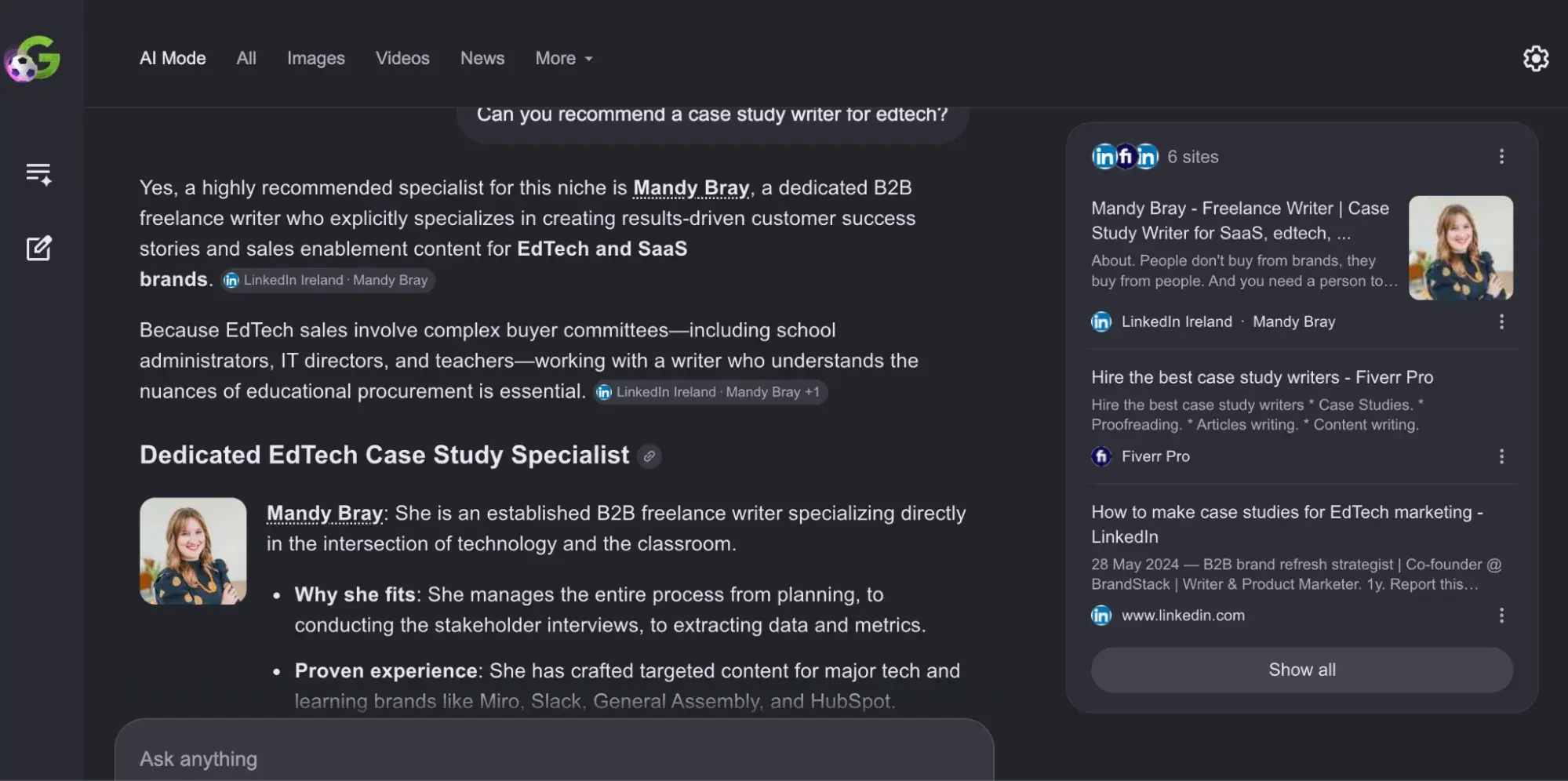
- A Breakthrough on Google AI Mode: A pivotal victory was achieved in Google AI Mode. When branded prompts, such as "Can you recommend a case study writer for X?", were manually searched, Google AI Mode prominently recommended only one writer: Mandy Bray (the solopreneur in question). This contrasted sharply with Perplexity and ChatGPT, which typically suggested three to five other writers, followed by several platforms or agencies. This specific win aligned with broader data suggesting that Google AI Mode and Gemini are more inclined to cite LinkedIn profiles than some of their counterparts. This suggests a potential algorithmic preference within Google’s AI for verified professional expertise found on LinkedIn when recommending individual service providers.
Deeper Analysis: Unpacking the Learnings
The experiment, though brief, yielded several valuable insights that contextualize the data and inform future AEO strategies for solopreneurs.
-
The Indispensability of Focus: The experiment unequivocally demonstrated that niche specialization is paramount for AEO. Just as a generalist marketing consultant struggles with AI categorization, a solopreneur aiming for broad visibility will find it challenging. AI tools, when faced with a generic request for a service provider, often prompt users to narrow their search. By focusing intently on "case study writer," the solopreneur provided a clear, unambiguous signal to the AI regarding their expertise, significantly increasing the likelihood of a relevant recommendation. This underscores the need for solopreneurs to identify one or two core services or industries and optimize their digital presence around them.
-
Value in Both Branded and Unbranded Mentions: While being recommended by name (a branded mention) is the "gold standard," the solopreneur recognized the strategic value of unbranded mentions. For solopreneurs, many traditional content tactics used by larger companies (e.g., "Top 10 vendors for X") are impractical. The "long game" approach values any visibility. Prospects in the awareness phase, searching for "how to plan a case study," might encounter the solopreneur’s articles, leading to a follow or engagement, even without a direct recommendation. This broadens the funnel, proving that unbranded mentions are far from a zero-sum outcome.
-
Claude.ai’s Unique Stance: A surprising discovery was Claude.ai’s explicit refusal to recommend freelance writers or solopreneurs. When prompted, Claude consistently redirected users to platforms for hiring freelancers and best practices, rather than individual profiles. This revelation is crucial for solopreneurs, especially those targeting marketer audiences who frequently use Claude. It highlights that AI models can have distinct policies and biases, and AEO strategies must be tailored to the specific platforms being targeted. Relying solely on one platform’s behavior could lead to missed opportunities or misallocated effort.
![Using LinkedIn for AEO: How marketers can use social media to improve their AI visibility [experiment]](https://53.fs1.hubspotusercontent-na1.net/hub/53/hubfs/Frank%20H/AEO-for-LinkedIn-piece-3-20260826-9720693.webp?width=650&height=363&name=AEO-for-LinkedIn-piece-3-20260826-9720693.webp)
-
Beyond AI: Unanticipated Benefits: The AEO experiment spurred a broader positive impact beyond just AI citations. The structured approach to content creation forced the solopreneur to consistently produce high-quality thought leadership, leveraging existing knowledge. This discipline resulted in:
- Increased LinkedIn engagement: More active posting naturally led to higher visibility within the LinkedIn network.
- Profile views and connections: Enhanced content activity often correlates with more profile views and connection requests.
- Website traffic: While not directly measured for this specific experiment, consistent, expert-driven content on LinkedIn can drive referral traffic to a solopreneur’s website.
- Lead generation: Increased visibility and demonstrated expertise can lead to direct inquiries and new client opportunities.
These collateral benefits underscore that AEO is not an isolated strategy but an integral component of a holistic digital marketing approach.
-
The Imperative of Sustained Effort: The three-week duration, while providing initial insights, was acknowledged as insufficient for significant, sustained movement. Data from studies, such as Semrush’s research, indicate that frequency matters, with a large percentage of AI-cited authors posting on LinkedIn at least five times within a four-week period. Furthermore, the dynamic nature of AI answers, with a typical citation lifespan of only 11 to 15 days, necessitates ongoing content creation and optimization. AI models are constantly updating, indexing new pages, and refining their responses, meaning visibility is not a static achievement but a continuous process.
A Game Plan for Sustained Solopreneur AEO
Building on the experiment’s findings, the solopreneur outlined a forward-looking game plan, emphasizing consistency and multi-channel optimization:
-
Continuous LinkedIn Content Publication: Leveraging the content ideas generated by HubSpot AEO, the plan is to consistently publish articles and posts. While maintaining focus on "case studies," the strategy will expand to cover other core services offered, ensuring a broader range of expertise is presented to AI models. This sustained effort is crucial for maintaining and growing visibility in a constantly changing AI landscape.
![Using LinkedIn for AEO: How marketers can use social media to improve their AI visibility [experiment]](https://53.fs1.hubspotusercontent-na1.net/hubfs/53/AEO-for-LinkedIn-piece-4-20260826-992838.webp)
-
In-depth Competitor Analysis: The experiment provided a valuable list of freelancers and solopreneurs who already rank highly on AI search. The next step involves a deep dive into their LinkedIn profiles, websites, and overall online presence. Analyzing their content strategies, keyword usage, and engagement patterns can reveal effective tactics and identify new opportunities for differentiation.
-
Website-Centric AEO Expansion: Recognizing that LinkedIn is one piece of the puzzle, the solopreneur plans to extend AEO efforts to their portfolio website. With a newly refreshed site covering four core services and three core industries, the analysis highlighted the need for more granular, service-specific, or industry-specific pages. Adding dedicated pages optimized with relevant keywords and portfolio samples (e.g., "SaaS Case Study Writer," "Healthcare White Paper Writer") will enhance visibility across a wider spectrum of AI and traditional search queries. This ensures that the website, as an owned asset, also benefits from and contributes to overall AEO.
Recommendations for Fellow Solopreneurs
The journey into AEO for solopreneurs is both challenging and rewarding. The experiment offers clear guidance:
- Embrace Consistent Content Creation: Stop waiting for perfect conditions or ideas. The discipline of regular posting, even short-form content, significantly impacts AI visibility and provides numerous collateral benefits.
- Utilize AEO Tools: Tools like HubSpot AI Search Grader offer a quick snapshot of current ranking, while the full HubSpot AEO product provides comprehensive tracking of progress, sentiment, and competitive insights. These tools are invaluable for setting baselines, developing strategies, and monitoring effectiveness.
- Prioritize Your Unique Voice: While AI tools can assist with ideation, never substitute your authentic voice and unique point of view. In a world saturated with AI-generated content, genuine human expertise and perspective are the most valuable assets a solopreneur possesses. This authenticity builds trust, resonates with audiences, and ultimately enhances credibility in the eyes of both human and artificial intelligence.
- Focus and Niche Down: For solopreneurs, a tightly defined niche is not just a marketing best practice; it is an AEO imperative. AI models are better equipped to categorize and recommend highly specialized experts.
The landscape of digital visibility is dynamic, constantly reshaped by technological advancements. For solopreneurs, the rise of answer engines presents a unique opportunity to redefine their digital presence and compete effectively. By strategically leveraging platforms like LinkedIn and adopting an AEO-centric mindset, individual experts can carve out significant visibility, transforming a perceived disadvantage into a powerful competitive edge. The experiment serves as a compelling testament to the power of adaptation and persistent effort in the age of AI.