Google Ads has introduced a significant new capability: Automated promotions, designed to seamlessly identify and apply active promotional offers directly from advertisers’ websites to eligible Search and Performance Max campaigns. This development marks another step in Google’s ongoing effort to leverage automation for enhanced advertising efficiency and effectiveness, promising to connect potential customers with deals more directly and efficiently.
Understanding the New Automated Promotions Feature
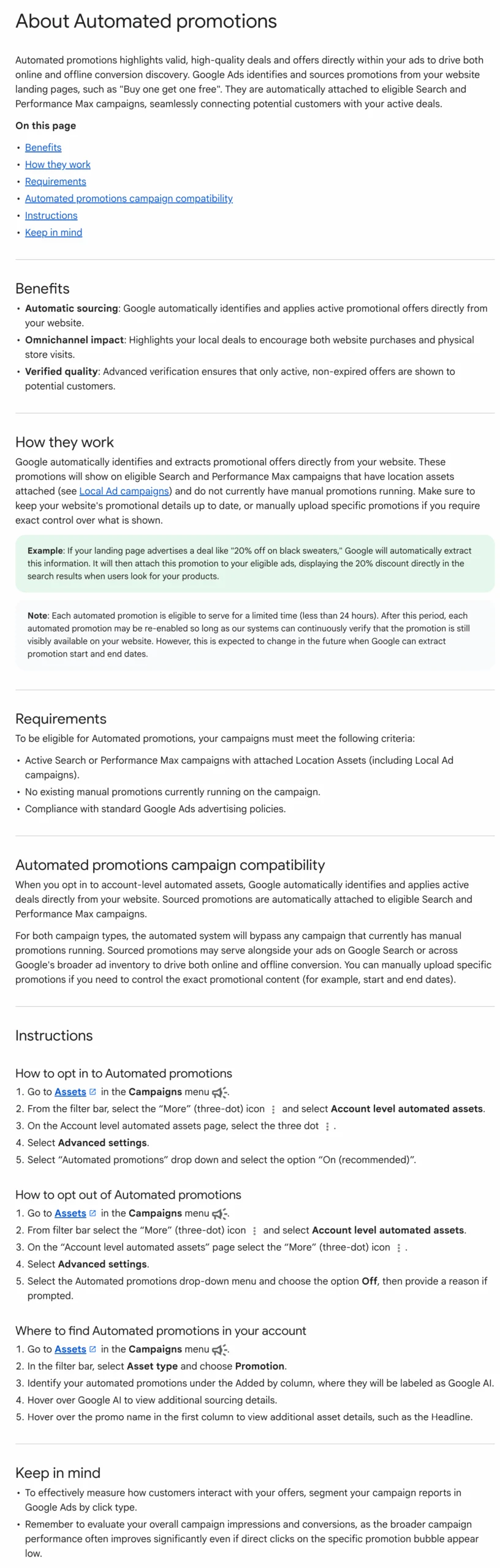
The core functionality of Automated promotions lies in its ability to scan website landing pages for valid, high-quality deals and offers. Once identified, these promotions are automatically attached to relevant ad campaigns, aiming to drive both online and offline conversion discovery. According to Google’s recently published help document, the system is designed to source common promotional types, such as "Buy one get one free" or specific percentage discounts, and integrate them into ad creatives. This means that if a landing page advertises a deal like "20% off on black sweaters," Google’s system will extract this information and display the 20% discount directly within search results, making offers more prominent to users.
This new asset, identified first by Hana Kobzová on PPC News Feed, operates at an account level, streamlining the process for advertisers who previously had to manually input promotional details. It is specifically targeted at eligible Search and Performance Max campaigns that have location assets attached and are not concurrently running manual promotions. A critical aspect highlighted by Google is the importance of maintaining up-to-date promotional details on the advertiser’s website. For situations requiring precise control over displayed offers, advertisers retain the option to manually upload specific promotions, thereby overriding the automated system.
A Chronology of Google’s Automation Efforts in Promotions
Google’s journey towards automating promotional assets is not entirely new, but this latest iteration represents a distinct advancement. A few years prior, Google Merchant Center began automatically adding promotions to product listings, primarily for e-commerce retailers utilizing Shopping ads. While that feature focused on product-specific promotions within the Merchant Center ecosystem, the new Google Ads Automated promotions broadens the scope to general website offers and applies them across a wider range of ad campaign types, including Search and Performance Max. This evolution underscores a strategic shift towards more comprehensive, AI-driven automation across Google’s advertising platforms.
The trajectory of Google Ads, formerly Google AdWords, has consistently leaned into automation since its inception. Initially, automation primarily focused on bidding strategies, optimizing bids based on performance goals. Over time, this expanded to include dynamic ad creatives, responsive search ads, and smart campaigns, all designed to reduce manual effort and improve campaign performance through machine learning. The introduction of Performance Max campaigns further solidified this direction, integrating various Google channels under a single, automated campaign structure. Automated promotions can be seen as a natural extension of this philosophy, applying automation to a crucial, yet often labor-intensive, aspect of campaign management: showcasing deals and offers.
Driving Conversion Discovery: The Strategic Imperative
Promotions play a pivotal role in consumer decision-making. Studies consistently show that discounts and special offers significantly influence purchasing intent, acting as powerful motivators for consumers navigating a competitive marketplace. A 2023 survey by Statista indicated that over 70% of consumers actively seek out deals and promotions before making a purchase, highlighting the immense value of prominently displaying such offers. By automatically highlighting these deals directly within ads, Google aims to increase click-through rates (CTR) and conversion rates (CVR) for advertisers.
In a digital advertising landscape that is becoming increasingly crowded, standing out is paramount. Advertisers are constantly looking for ways to capture user attention amidst a deluge of information. The immediate visibility of a "20% off" or "Buy one get one free" offer directly in the search results or other ad placements can be a decisive factor in a user choosing one ad over another. This feature not only enhances the user experience by presenting relevant deals upfront but also provides a tangible competitive advantage to advertisers who can effectively leverage their on-site promotions.
Implications for Advertisers: Efficiency, Control, and Performance
The introduction of Automated promotions carries significant implications for various stakeholders within the digital advertising ecosystem.
For Small and Medium Businesses (SMBs):
SMBs often operate with limited marketing resources and personnel. The manual upkeep of promotional ad extensions or adjusting ad copy to reflect ongoing sales can be a time-consuming task. Automated promotions offers a substantial efficiency gain, allowing SMBs to focus on their core business operations while ensuring their active deals are consistently highlighted in their ads. This can democratize access to sophisticated promotional strategies, previously more feasible for larger enterprises with dedicated marketing teams.
For Digital Marketing Agencies and Large Enterprises:
While the efficiency benefits are clear, agencies and larger advertisers might approach this feature with a balance of enthusiasm and caution. For broad, evergreen promotions, automation can be a major time-saver. However, complex campaigns that rely on highly specific, segmented, or time-sensitive promotions may still necessitate manual control. Agencies will need to advise clients on maintaining impeccable website hygiene, ensuring promotional information is clearly structured and accurate to prevent misinterpretation by Google’s system. The manual override option becomes critical here, allowing for strategic intervention when granular control is paramount. This feature shifts the agency’s role from purely manual setup to more strategic oversight, ensuring website content aligns with automated ad objectives and monitoring performance closely.
Potential Performance Uplift:
The direct display of promotions is likely to improve ad performance metrics. Enhanced visibility of value propositions typically leads to higher CTRs. Furthermore, by directly connecting users with active deals, the feature is expected to improve conversion rates as users arriving on landing pages are already pre-qualified and aware of the offer. This can translate into a more efficient ad spend and a stronger return on investment (ROI) for advertisers.
The Balance of Automation and Control:
A key consideration for advertisers will be the delicate balance between leveraging automation for efficiency and maintaining strategic control. Google’s explicit guidance to "make sure to keep your website’s promotional details up to date, or manually upload specific promotions if you require exact control over what is shown" underscores this point. Advertisers must treat their website’s promotional sections with the same rigor as their ad campaigns, ensuring clarity, accuracy, and timeliness.
Broader Landscape: AI and Machine Learning in Digital Advertising
Automated promotions is a testament to the increasing integration of Artificial Intelligence (AI) and Machine Learning (ML) into core advertising functions. Google’s advanced algorithms are now capable of not just processing vast amounts of data for bidding and targeting but also interpreting semantic content on web pages to extract meaningful business information. This represents a significant leap from rule-based automation to more intelligent, context-aware systems.
The trend towards AI-driven optimization is pervasive across major advertising platforms. From Meta’s Advantage+ campaigns to Amazon Ads’ automated solutions, platforms are striving to reduce the operational burden on advertisers while simultaneously maximizing campaign performance through sophisticated algorithms. This paradigm shift means that the role of a PPC manager is evolving from tedious manual tasks to one of strategic oversight, data analysis, and continuous learning to adapt to the ever-changing capabilities of automated systems. Advertisers who embrace and understand these automated tools, rather than resisting them, will be better positioned for success.
Technical Eligibility and Best Practices for Implementation
For advertisers looking to leverage Automated promotions, understanding the eligibility criteria and adopting best practices is crucial:
- Campaign Type Eligibility: The feature applies to eligible Search and Performance Max campaigns. This covers a significant portion of Google Ads’ offering, emphasizing its broad utility.
- Location Assets: Campaigns must have location assets attached. This suggests a potential bias towards businesses with physical locations or those that benefit from local search intent, though the benefit extends to online conversions as well.
- No Manual Promotions: The automated system will not run if manual promotions are already active on the eligible campaigns. This prevents conflicts and ensures advertisers can choose their preferred method of promotion management.
- Website Hygiene: This is perhaps the most critical aspect. Advertisers must ensure their website’s landing pages clearly and accurately display promotional offers. Using clear headings, distinct sections for promotions, and potentially even structured data (though not explicitly required by Google for this feature) can aid Google’s system in accurately identifying and extracting offers. Ambiguous or poorly structured promotional content may lead to misinterpretation or the feature not activating.
- Monitoring and Reporting: Advertisers should vigilantly monitor the performance of campaigns utilizing Automated promotions. While automation aims to improve results, continuous tracking of CTR, CVR, and cost-per-conversion will be essential to validate its effectiveness and make informed adjustments.
- Strategic Use of Manual Overrides: For highly specific sales, exclusive discounts, or promotions requiring precise timing and targeting, advertisers should be prepared to use manual promotions to ensure exact control. The automated feature is best suited for general, widely applicable offers.
Future Outlook: The Trajectory of Ad Automation
The launch of Automated promotions is likely just another waypoint in Google’s journey towards increasingly sophisticated ad automation. We can anticipate further enhancements in the future, possibly including:
- Expanded Asset Types: Automation could extend to more ad asset types, such as automatically generating images or videos based on product feeds and promotional content.
- Deeper Integration: Tighter integration with other Google services, such as Google Analytics 4, to provide even more granular insights into how automated promotions influence the user journey.
- Predictive Analytics: More advanced AI capabilities that could predict optimal times to run promotions or suggest promotional strategies based on market trends and user behavior.
- Multi-Platform Synchronization: The ability to synchronize promotions across Google Ads, Google Business Profile, and even Google Shopping in a more unified, automated manner.
The ongoing evolution of AI in advertising platforms suggests a future where the complexities of campaign management are significantly reduced, allowing advertisers to focus more on strategic objectives and creative development. However, human oversight, strategic input, and a deep understanding of the underlying technology will remain indispensable for maximizing the benefits of these powerful automated tools.
In conclusion, Google Ads’ new Automated promotions feature represents a significant stride in simplifying and enhancing the delivery of promotional offers to potential customers. By leveraging advanced machine learning to identify and apply deals directly from websites, Google aims to boost advertiser efficiency and campaign performance. While offering substantial benefits, particularly for SMBs, it also necessitates a renewed focus on website accuracy and strategic management from all advertisers to harness its full potential in the ever-evolving landscape of digital advertising.