In an increasingly interconnected world, customer expectations for seamless and immediate support have reached unprecedented levels. Modern consumers demand the flexibility to engage with businesses across their preferred communication channels, expecting a consistent and personalized experience at every touchpoint. This profound shift has propelled omnichannel customer service from a nascent concept to a critical strategic imperative for companies striving to maintain relevance and foster lasting customer relationships.
The Evolution of Customer Engagement: From Multichannel to Omnichannel
Understanding omnichannel service requires differentiating it from its predecessor, multichannel support. While often used interchangeably, these terms represent distinct philosophies in customer engagement.
Multichannel customer service involves a business offering support through various independent channels—such as email, phone, live chat, or social media. The convenience of choice is present, but these channels frequently operate in silos. A customer initiating contact via live chat might find themselves needing to repeat their issue, account details, and previous interactions if they switch to a phone call or email. This fragmentation often leads to frustrating experiences, extended resolution times, and a perception of a disconnected brand.
Omnichannel customer service, conversely, represents a significant evolution. It builds upon the multichannel foundation by integrating all communication channels into a single, unified ecosystem. In an omnichannel model, customer history, context, and vital data are seamlessly shared across every interaction point. This means an agent answering a phone call can immediately access the customer’s previous chat logs, purchase history, and even their browsing behavior, regardless of how or where the prior interaction occurred. This holistic view empowers support teams to deliver faster, more personalized, and genuinely connected service, eliminating the need for customers to reiterate information and fostering a sense of being known and valued.
The rise of digital transformation, accelerated by technological advancements and shifting consumer habits, has underscored the urgency for businesses to adopt omnichannel strategies. As e-commerce expanded and mobile devices became central to daily life, customers began interacting with brands through a multitude of digital avenues. From instant messaging apps to social media platforms, the sheer volume of potential touchpoints necessitated a cohesive strategy to prevent customer service from becoming a chaotic and disjointed affair. Industry analysts widely agree that companies failing to adapt risk losing market share to competitors who prioritize a unified customer journey.
Core Benefits Driving Omnichannel Adoption
The strategic implementation of an omnichannel customer service model yields tangible benefits for both customers and the businesses serving them. These advantages extend beyond mere convenience, impacting operational efficiency, customer loyalty, and ultimately, a company’s bottom line.
-
Reduces Customer Friction: A primary pain point for customers is the constant need to re-explain their situation when transferred between agents or channels. Research from Salesforce indicates that a significant 56% of customers report having to re-explain their issue every time they are transferred. Omnichannel service directly addresses this by preserving conversation history and customer context across all touchpoints. This continuity means customers can effortlessly transition from a chat session to a phone call, or vice-versa, without interruption, leading to a smoother, less frustrating support experience.
-
Enables Faster, More Efficient Support: When agents have immediate access to a centralized customer record—enriched with data from emails, calls, web interactions, and purchase history—they spend significantly less time gathering information. This unified view allows them to jump directly into problem-solving, dramatically accelerating resolution times. Studies cited by industry sources, such as Zendesk, highlight that companies utilizing integrated omnichannel solutions can experience a 31% reduction in first-resolution times and a 39% decrease in customer wait times compared to those operating in silos. The efficiency gained also enables support teams to handle a larger volume of requests without compromising service quality.
-
Creates More Personalized Customer Experiences: In today’s competitive landscape, personalization is no longer a luxury but an expectation. Surveys consistently show that a high percentage of customers, up to 82% according to research, prefer companies to recognize them and anticipate their needs. Omnichannel customer service facilitates this by providing agents with a comprehensive view of the customer, encompassing past purchases, prior support interactions, demographic data, and other critical account context. This rich data empowers agents to tailor their conversations, offer relevant recommendations, and foster a deeper, more meaningful interaction that builds trust and loyalty. Advanced omnichannel platforms can even leverage AI to personalize agent interactions with tailored content and specific routing rules based on customer data.
-
Offers Enhanced Visibility into the Entire Customer Journey: An omnichannel strategy provides organizations with an unparalleled, holistic understanding of how customers interact with their brand across all support channels. This unified perspective eliminates the need to analyze individual channel performance in isolation. Instead, customer support leaders can readily identify cross-channel trends, pinpoint bottlenecks, and discover areas for improvement across the entire customer journey. Such visibility is crucial for optimizing workflows, making informed staffing decisions, and proactively addressing customer pain points before they escalate into larger issues.

-
Improves Collaboration for Support Teams: Operating within a connected service platform that centralizes customer data streamlines internal processes, particularly customer handoffs between agents or teams. Whether a case is transferred or a customer switches channels, the receiving agent has instant access to the complete conversation history and context. This minimizes duplicate work, reduces miscommunication, and ensures that vital information is never lost in transition, fostering a more collaborative and efficient support environment.
Essential Features of a Robust Omnichannel Platform
The successful execution of an omnichannel strategy hinges on selecting the right technological platform with a comprehensive set of features designed to unify and optimize customer interactions.
-
Shared Inbox: A central shared inbox consolidates all customer conversations from various channels (email, live chat, social media, messaging apps) into a single, unified workspace. This eliminates the need for agents to monitor multiple inboxes and applications, preventing siloed communication, reducing the chance of duplicate or missed responses, and fostering better collaboration and ticket prioritization.
-
CRM Data Connection: Deep integration with a Customer Relationship Management (CRM) system is fundamental. This connection links service interactions directly to a single customer record, providing agents with instant access to crucial data such as purchase history, subscription details, previous support tickets, and more. This complete customer context is vital for delivering personalized and efficient support.
-
Intelligent Routing: Advanced omnichannel platforms incorporate intelligent routing capabilities that automatically direct conversations to the most appropriate agent or team. Routing rules can be configured based on factors like product expertise, language, geographical location, customer tier, issue type, or even AI-surfaced insights into customer intent or urgency. This ensures customers reach the right expert faster, reducing wait times and improving first-contact resolution rates.
-
AI and Automation: Modern omnichannel solutions heavily leverage Artificial Intelligence (AI) and automation to enhance efficiency. AI can summarize conversations, draft responses, classify and tag tickets, detect sentiment, recommend relevant content, and automate repetitive tasks. AI-powered chatbots and virtual agents can autonomously resolve common issues, freeing human agents to focus on complex cases. This not only accelerates resolution times but also improves agent productivity and customer satisfaction.
-
Connected Knowledge Base: An integrated knowledge base is crucial for both self-service and agent support. It allows organizations to easily surface relevant information—FAQs, troubleshooting guides, how-to articles—to customers, empowering them to resolve issues independently. For agents, a connected knowledge base provides quick access to necessary documentation, improving response consistency and reducing search times. Some platforms even utilize AI to convert successful service interactions into new knowledge base content.
-
SLA Management: For service teams, adhering to Service Level Agreements (SLAs) is a critical performance metric. Robust omnichannel platforms include SLA management features that automatically apply SLAs to tickets based on predefined criteria (customer tier, ticket priority, issue type, channel). The system tracks progress, alerts teams when deadlines are at risk, automates ticket prioritization, and helps standardize service delivery.
-
Data Analytics and Reporting: Centralized dashboards and comprehensive reports are essential for understanding performance across channels and the entire customer journey. These analytics provide insights into key metrics like response time, resolution time, customer satisfaction (CSAT), customer effort score (CES), and ticket volume. This data empowers leaders to identify bottlenecks, measure team performance, forecast staffing needs, and optimize resource allocation based on customer behavior and channel preferences.
-
Security and Permissions: Given the sensitive nature of customer data, robust security settings and a granular permission structure are paramount. Omnichannel platforms must offer advanced data protection controls, user roles, and transparent AI recommendations to ensure compliance with regulations, safeguard customer information, and maintain data integrity.
Crafting a Seamless Omnichannel Strategy: A Phased Approach
Implementing an effective omnichannel customer service strategy requires careful planning and a phased approach rather than a simultaneous overhaul.

-
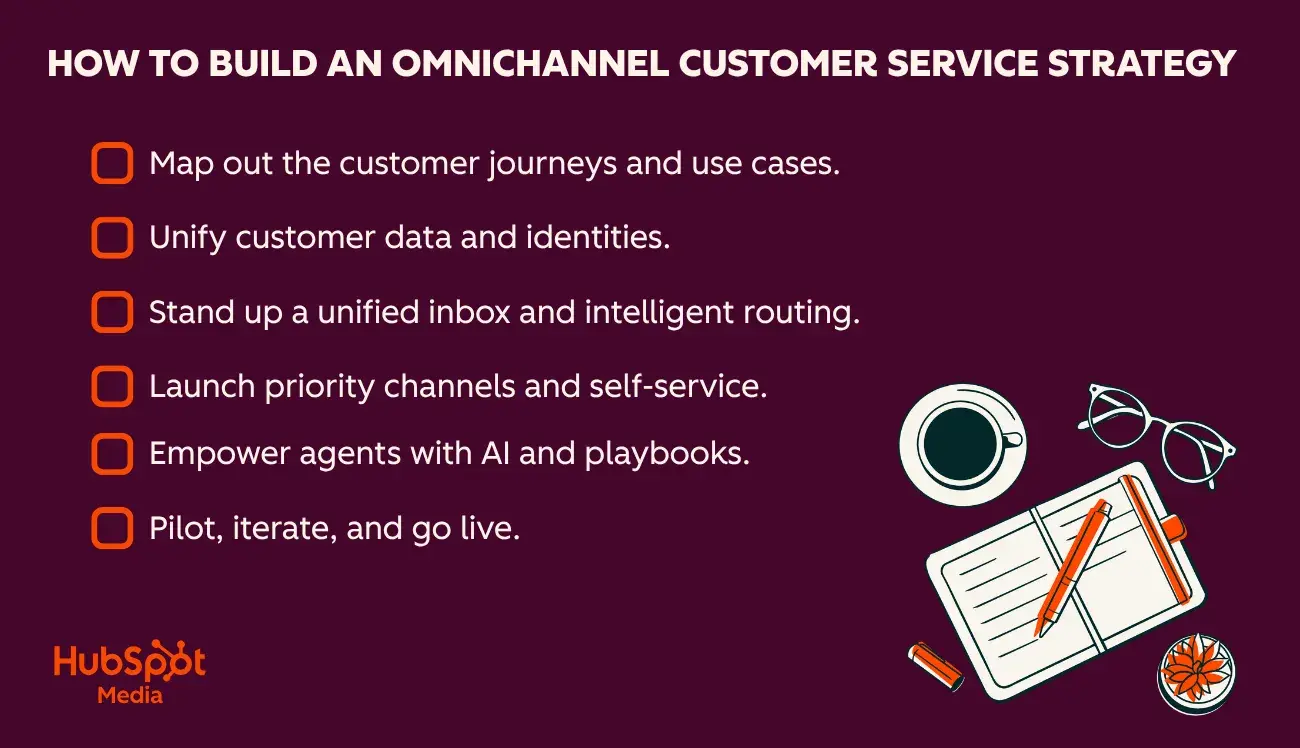
Map Out Customer Journeys and Use Cases: Begin by thoroughly mapping the customer journey, identifying every touchpoint and the preferred channels customers use at different stages. Document common support use cases to pinpoint areas of friction and opportunities for automation. This foundational understanding, critically informed by customer feedback, will guide subsequent strategic decisions. Customers are often quick to highlight where their experience is disjointed or inefficient.
-
Unify Customer Data and Identities: The bedrock of any successful omnichannel strategy is a complete, unified customer data profile. Integrate customer data—conversations, purchase history, account information, support interactions—into a centralized platform. This unification enables agents to provide personalized support and allows customers to move between channels without losing context. Training agents on how to smoothly transition conversations across channels is also key to confidence and customer experience.
-
Stand Up a Unified Inbox and Intelligent Routing: Once data is unified, channel all support inquiries into a shared inbox. Establish clear routing rules that automatically assign conversations based on factors like issue type, customer tier, agent expertise, or urgency. This significantly enhances agent efficiency and provides leaders with better visibility into queue health and agent capacity. Consider using AI to fast-track high-value or at-risk customers to priority queues.
-
Launch Priority Channels and Self-Service: Adopt a phased rollout, starting with the channels customers use most frequently (e.g., email, live chat, phone, or specific messaging apps relevant to your industry). Simultaneously, invest heavily in self-service resources such as comprehensive knowledge bases, FAQs, AI-powered chatbots, and customer portals. Customer communities can also empower peer-to-peer support and foster idea sharing.
-
Empower Agents with AI and Playbooks: Leverage AI not as a replacement for human agents, but as a powerful assistant. AI can provide intent detection, conversation summaries, suggested replies, relevant knowledge base articles, and automate repetitive tasks. This frees human agents to focus on complex, empathetic problem-solving. Develop comprehensive playbooks for common procedures across all channels, including escalation paths, troubleshooting workflows, and communication guidelines, ensuring agents are well-equipped and understand how AI tools integrate into their workflow.
-
Pilot, Iterate, and Go Live: Implement the omnichannel strategy in phases, perhaps starting with a limited scope (a few channels, specific customer segments, or a subset of the support team). This pilot phase allows leaders to monitor performance, gather crucial feedback from both customers and agents, and refine workflows. Once performance goals are consistently met and processes are optimized, gradually expand the strategy across the organization.
Measuring Success and Ensuring Governance
Tracking the right metrics and establishing clear governance are vital for ongoing success. Omnichannel customer service metrics should directly align with business outcomes and be easily trackable within the chosen service software. Key Performance Indicators (KPIs) to monitor include:
- Response Time: Time taken to initially respond to a customer inquiry across channels.
- Resolution Time: Time taken to fully resolve a customer’s issue.
- Customer Satisfaction (CSAT): Customer’s satisfaction with a specific interaction.
- Customer Effort Score (CES): Ease of resolving an issue.
- First Contact Resolution (FCR): Percentage of issues resolved on the first interaction.
- Channel Preference/Usage: Which channels customers prefer and utilize most often.
- Agent Productivity: Volume of tickets handled per agent, per channel.
- SLA Compliance: Adherence to defined service level agreements.
- AI Feedback Score: Measures how agents rate the helpfulness of AI-generated recommendations or responses, crucial for improving AI accuracy and trust.
Regular review cadences are essential for proactive performance evaluation and issue resolution:
- Weekly Operation Reviews: Focus on the day-to-day health of support operations, monitoring metrics like ticket volume, response/resolution times, SLA compliance, queue health, and agent workloads. These meetings, involving managers, team leads, and operations staff, allow for quick adjustments to staffing and processes.
- Monthly Customer Journey Reviews: A higher-level review evaluating the end-to-end customer experience across all channels. Analyze customer feedback, CSAT/CES trends, self-service adoption, and channel performance. Participants typically include customer service leadership, CX leadership, and potentially customer education or digital experience teams, focusing on strategic improvements to content, AI, and workflows.
- Quarterly Strategy and Roadmap Reviews: These reviews, often involving senior directors and VPs, focus on long-term strategy and alignment with broader business goals. They assess overall performance trends, customer insights, and strategic priorities. The output often includes a roadmap for future investments, such as expanding to new channels or implementing advanced AI-driven workflows.
Strategic Considerations for Platform Selection
Choosing the right omnichannel customer service platform is a critical decision that extends beyond a simple feature checklist. Decision-makers must evaluate how well the platform can support their customer experience strategy over time.
- Channel Compatibility: Does the platform seamlessly support all current and anticipated future communication channels that your customers use and prefer? Ensure it facilitates smooth transitions between all channels without loss of context.
- Unified Customer View: Can the platform genuinely connect customer conversations with CRM records, purchase history, help desk interactions, and other essential business systems? Critically, will agents have immediate and intuitive access to this unified history during interactions?
- Scalability: Will the platform scale effectively with your business growth, accommodating increasing ticket volumes, additional channels, larger teams, and evolving customer expectations without prohibitive costs or performance degradation?
- Reporting and Analytics: Does the platform offer robust, actionable reporting and analytics that provide cross-channel insights? The ability to easily visualize and understand key metrics across the entire customer journey is paramount for informed decision-making.
- AI Alignment and Governance: Do the platform’s AI capabilities align with your strategic AI goals for support? Evaluate the quality of AI output, data privacy protections, and the level of transparency and governance provided for AI recommendations to ensure trust and effectiveness.
Connected Data is the Foundation of Omnichannel Service
Omnichannel customer service transcends merely offering multiple support channels; it is fundamentally about leveraging unified customer context and history to deliver a truly personalized and connected experience. Building a successful omnichannel strategy is an ongoing journey that demands thorough preparation, the right technological infrastructure, and a steadfast commitment to continuous improvement. By embracing this strategic approach, businesses can not only meet but exceed the evolving expectations of today’s digital consumer, fostering deeper loyalty and securing a competitive edge in the marketplace.