Brevo, formerly known as Sendinblue until its 2023 rebrand, employs a distinctive pricing strategy predicated on monthly email volume coupled with specific per-tier contact caps. This model is particularly advantageous for marketers aiming to manage costs effectively as their subscriber lists expand, especially if their large contact database is engaged with less frequent email campaigns. Unlike many competitors that charge primarily by the number of contacts stored, Brevo’s approach means that a substantial list, when emailed infrequently, can result in lower costs compared to contact-based platforms.
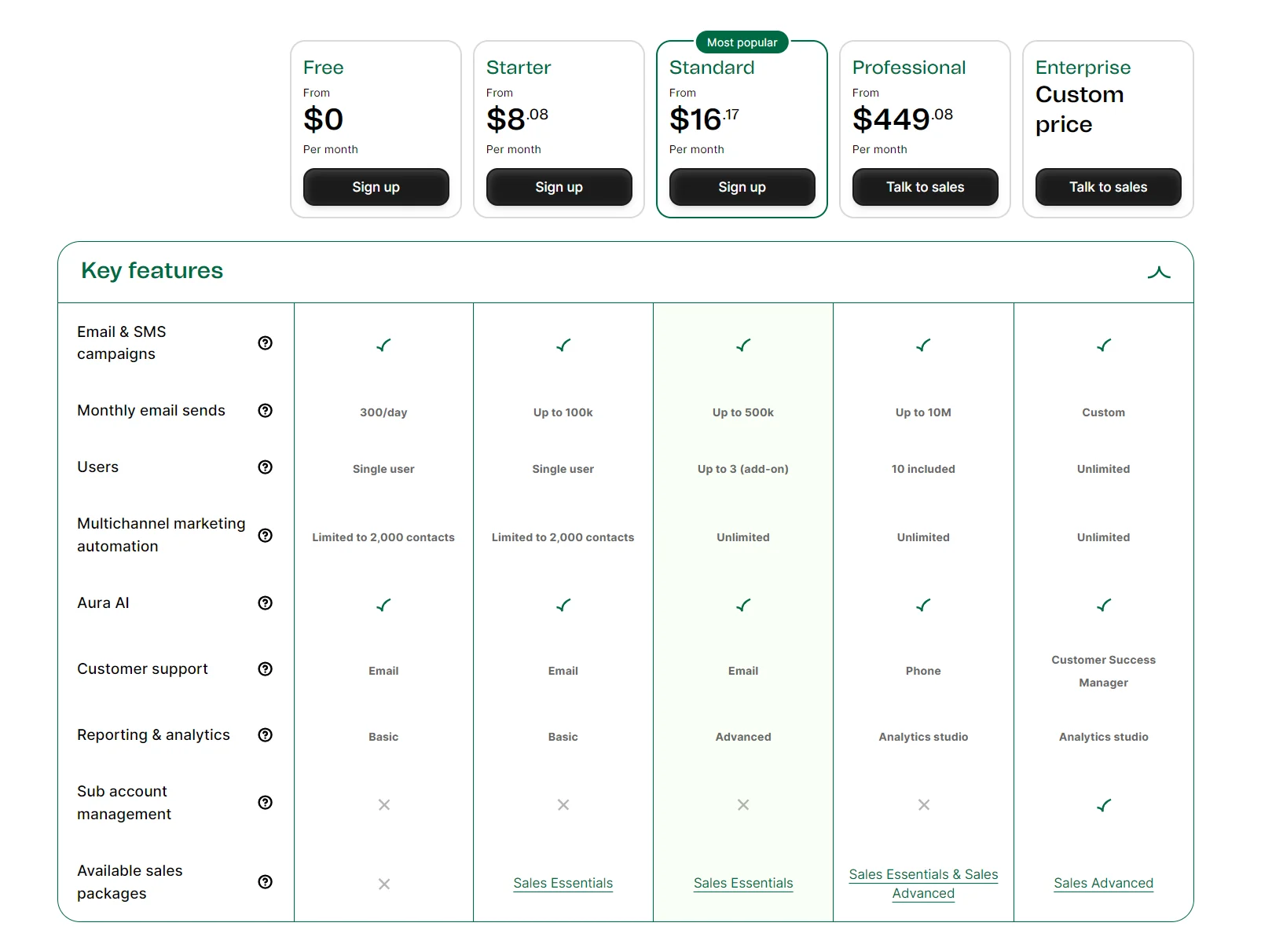
The company’s pricing structure is meticulously tiered, commencing with a Free plan and progressing through Starter, Standard, Professional, and Enterprise options. A notable aspect of Brevo’s model is the dynamic scaling of contact storage linked to monthly send volumes. For instance, both Starter and Standard plans permit the storage of up to 500,000 contacts once a user commits to 20,000 monthly sends. Marketers can maintain their monthly expenditure under $30 by utilizing the Free plan, the Starter plan with up to 15,000 sends, or the Standard plan for up to 5,000 sends. This foundational understanding of Brevo’s send-based model is crucial for businesses evaluating their email marketing platform options, particularly in comparison to rivals like Omnisend and Klaviyo.
The Evolution of Brevo’s Pricing Strategy
Brevo’s journey in the email marketing sphere has been marked by strategic shifts, most notably its transition from Sendinblue in 2023. This rebrand was more than a mere name change; it solidified the company’s commitment to its send-based pricing model, a core tenet since its inception. While the fundamental principle of charging by email volume remained, specific parameters have evolved. Prior to the rebrand, Sendinblue offered unlimited contacts on its paid plans. However, post-2023, Brevo introduced tiered contact caps for plans below Enterprise, directly linking contact storage capacity to monthly email send volumes. This adjustment reflects a strategic decision to refine its value proposition and better segment its customer base based on usage patterns rather than just list size.
This pricing philosophy positions Brevo as a potentially cost-effective solution for businesses with extensive contact lists but conservative sending frequencies. It contrasts sharply with platforms that might levy significant charges purely for storing a large number of contacts, irrespective of how often they are emailed. This historical context underscores Brevo’s continuous adaptation to market demands and its attempt to carve out a distinct niche in a highly competitive industry.
Decoding Brevo’s Email Marketing Plans
As of August 2026, Brevo offers a comprehensive suite of plans designed to cater to a spectrum of business needs, from nascent startups to large enterprises. Each plan is carefully constructed with varying email volume allowances, contact storage capacities, and feature sets, ensuring scalability and flexibility.
How Brevo Prices Email Marketing:
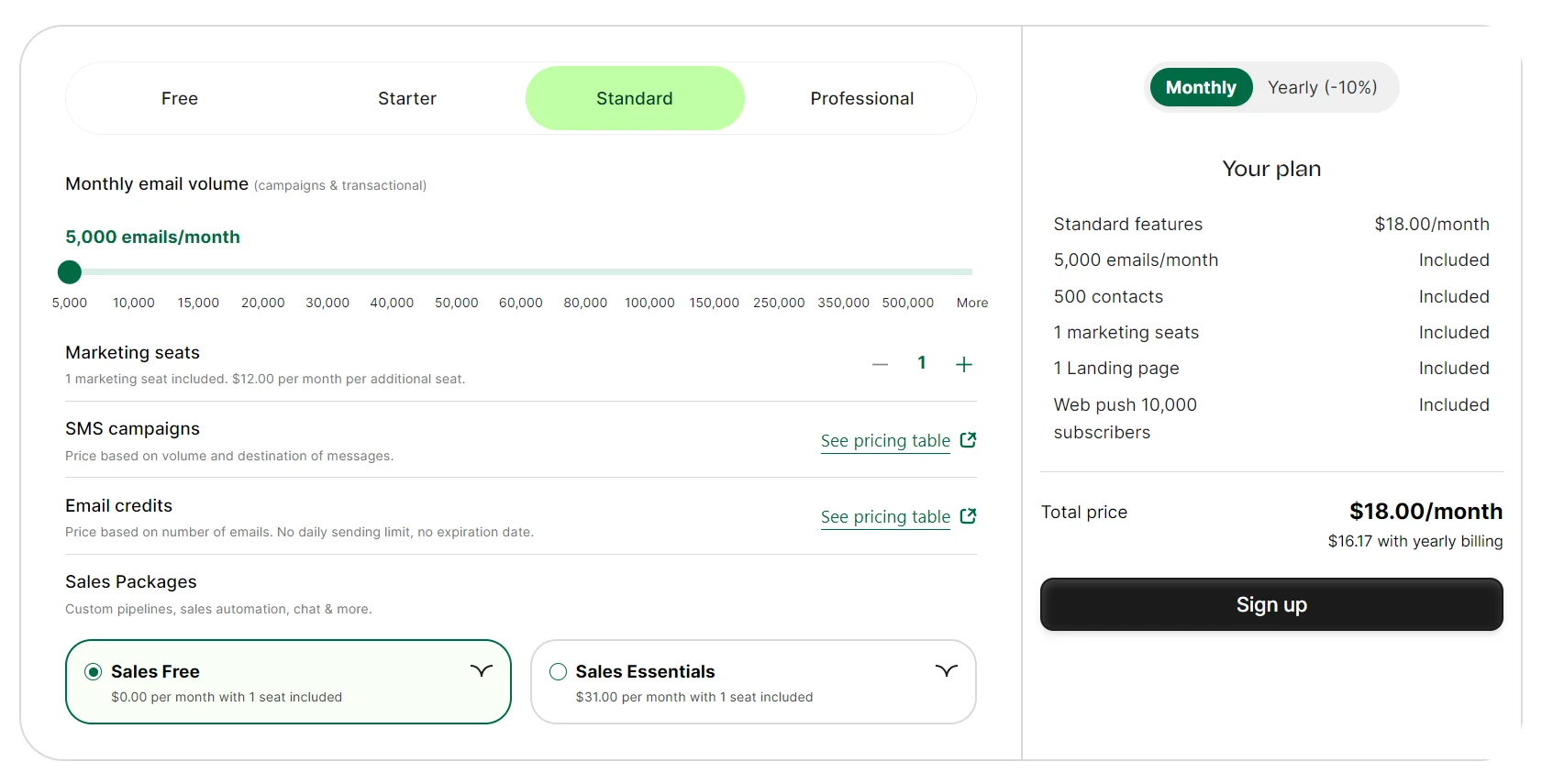
Brevo’s email marketing pricing initiates at 5,000 emails per month, encompassing both transactional and marketing messages. The contact storage limits vary significantly across plans, starting from 500 contacts on lower tiers and extending to unlimited on the Enterprise plan. A key characteristic is the tiered contact storage: reaching 20,000 sends on Starter or Standard plans unlocks a contact storage capacity of 500,000, while the Professional plan allows for 2,000,000 contacts. Below these thresholds, strict contact limits of 500, 1,500, or 2,500 apply, emphasizing the incentive to increase send volume to expand contact storage. This structure is particularly valuable for businesses with large, infrequently messaged lists, as storing 50,000 contacts, for instance, would typically incur lower costs on Brevo than on platforms utilizing a contact-based pricing model.
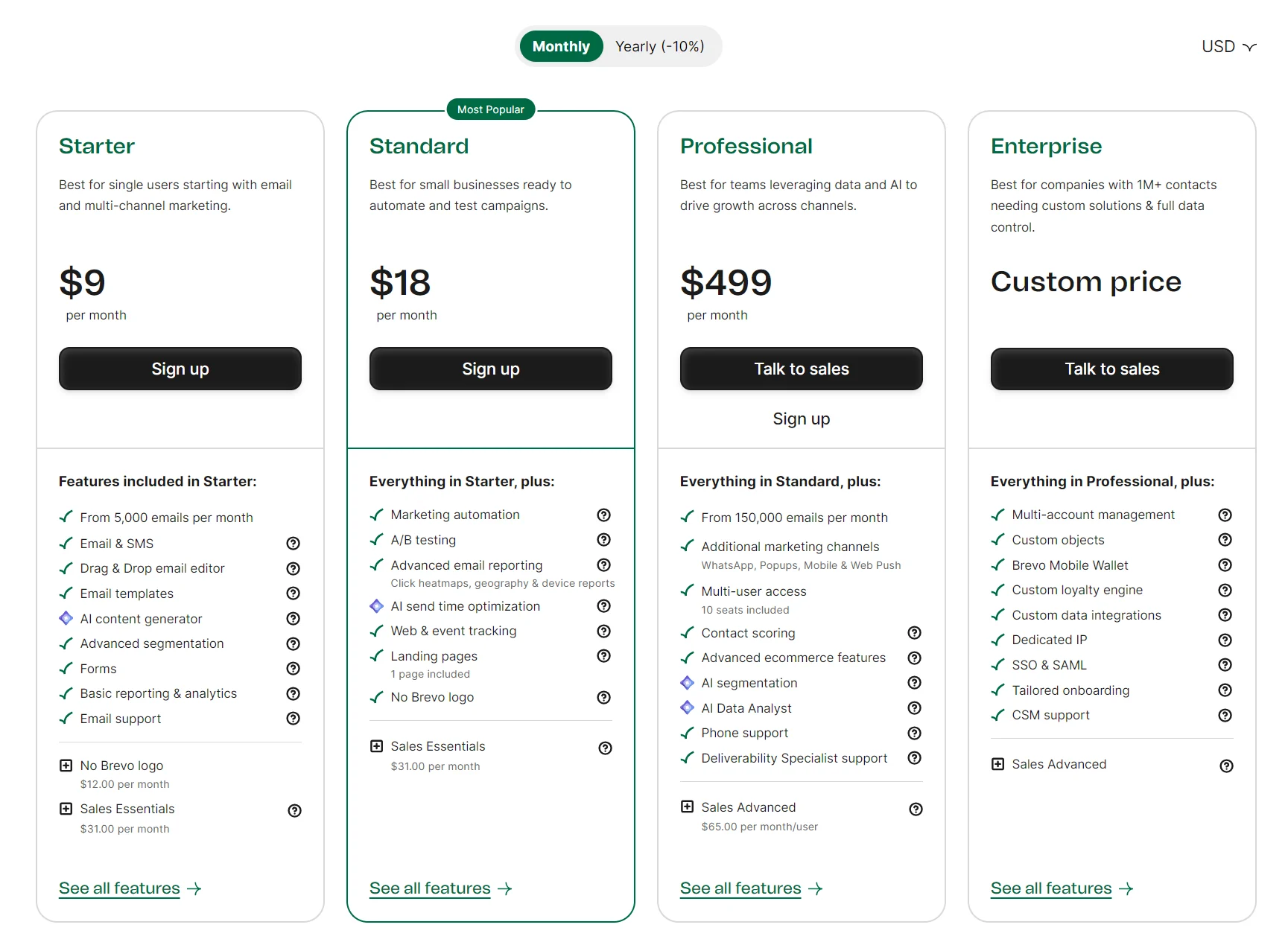
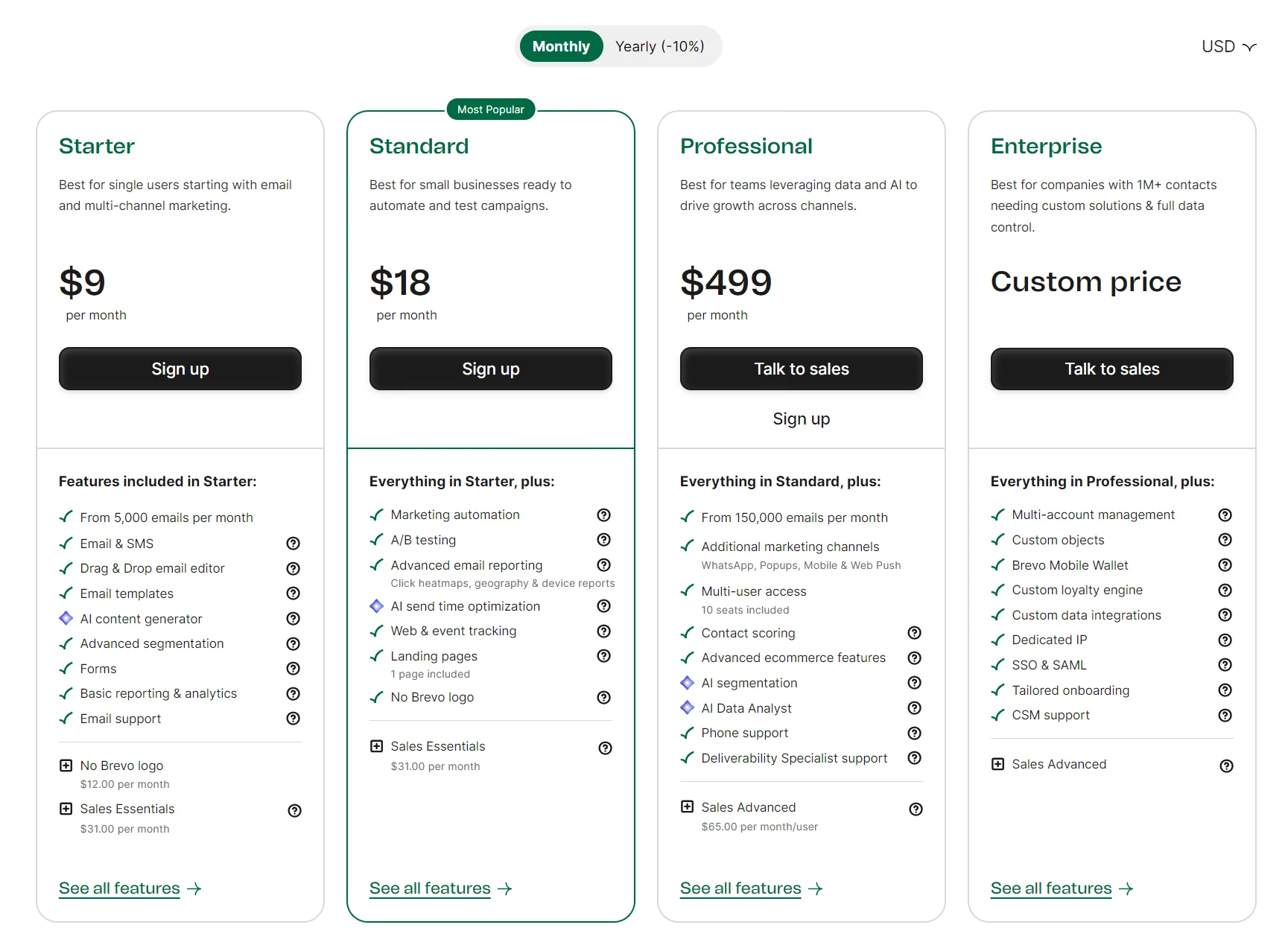
Brevo Plans and Prices (August 2026):
-
Free Plan: At $0/month, this plan offers a daily send limit of 300 emails (approximately 9,000/month) and allows storage for up to 100,000 contacts. It includes essential features like campaigns, ad retargeting, abandoned cart recovery, and sign-up forms, making it suitable for very small businesses or those testing the platform.
-
Starter Plan: Beginning at $9/month ($8.08/month annually), the Starter plan supports monthly email volumes from 5,000 up to 100,000. Contact storage starts at 500 but can scale up to 500,000 once the 20,000 sends/month threshold is met. Key features include advanced segmentation, forms, basic reports, and email support. However, it requires an additional $12/month add-on to remove Brevo branding, effectively raising the minimum cost to $21/month for a white-label experience.
-
Standard Plan: Priced from $18/month, the Standard plan caters to monthly email volumes ranging from 5,000 up to 500,000. Similar to Starter, contact storage begins at 500 and expands to 500,000 with 20,000+ sends. This plan introduces critical features such as A/B testing, marketing automation, advanced email reporting, AI send time optimization, and click heatmaps. It also removes Brevo branding by default and allows for up to three users, offering a more robust solution for growing businesses.
-
Professional Plan: Starting at a significantly higher $499/month, the Professional plan is designed for businesses with substantial email requirements, supporting 150,000 up to 10,000,000 monthly emails. It offers a flat contact storage of 2,000,000. This tier unlocks advanced features like pop-ups, WhatsApp integration, multi-user access, contact scoring, email frequency management, reusable content sections, and crucial phone support—a step up from the email-only support on lower plans.
-
Enterprise Plan: This custom-priced plan offers bespoke solutions for large organizations, featuring custom email volumes and unlimited contact storage. It provides exclusive benefits such as multi-account management, dedicated onboarding, a dedicated IP (billed annually), and a custom loyalty engine, indicating its suitability for very large, complex operations.
The granular pricing within Starter and Standard plans demonstrates how costs escalate with increased send volumes. For example, 5,000 emails cost $9/month (Starter) or $18/month (Standard), while 100,000 emails jump to $82/month (Starter) or $139/month (Standard). Beyond 100,000 sends, Starter is no longer an option, pushing users to Standard, which caps at 500,000 sends for $429/month. The Professional plan then takes over for volumes up to 10,000,000 emails, reaching $4,543/month before requiring a custom Enterprise quote.
Prepaid Email Credits: A Cost-Saving Mechanism
To mitigate the rapid escalation of monthly plan costs, Brevo offers prepaid email credits. These credits, purchasable in increments from 5,000 to 1,000,000, act as a buffer against exceeding plan limits. A significant advantage is that these credits never expire, although they are non-refundable. This flexibility allows businesses to manage unpredictable surges in email activity without immediately upgrading to a more expensive monthly plan. For instance, 5,000 credits cost $32, while 100,000 credits are $275 (as of August 2026), providing a supplementary layer of cost control.
Beyond Core Email: Sales Packages and Add-ons
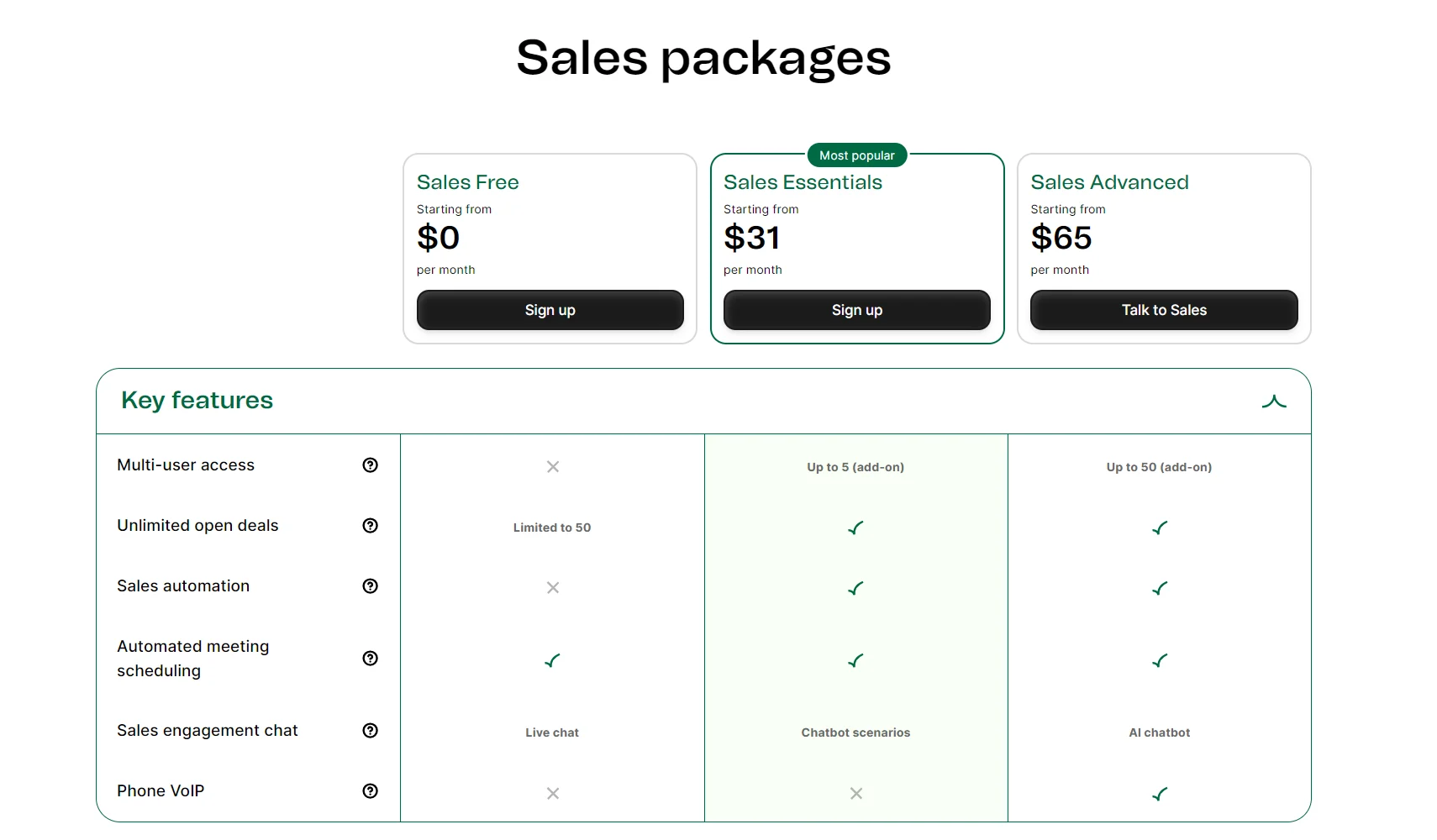
Brevo extends its ecosystem beyond email marketing with integrated sales packages designed to enhance customer relationship management (CRM) functionalities. These tools are particularly beneficial for business-to-business (B2B) sales cycles and service-oriented companies that manage pipelines and deals. For product-focused e-commerce businesses or those already utilizing a separate CRM, these packages might be redundant.
- Sales Free: Included with all Brevo plans at no extra cost, this package offers 50 open deals, automated meeting scheduling, revenue reports, and forecasting capabilities.
- Sales Essentials: Priced at $31/month per seat, this add-on expands capabilities to include multi-user access for five individuals, unlimited open deals, and sales automation features.
- Sales Advanced: At $65/month per seat, this premium package provides advanced features such as Phone VoIP, support for multiple currencies, outreach sequences, and 1:1 SMS capabilities.
These sales packages, along with other add-ons, contribute to the overall Brevo cost. Other notable add-ons include a dedicated IP address (often crucial for deliverability for high-volume senders), additional multi-user access beyond plan limits, and the aforementioned option to remove Brevo branding on lower-tier plans. These additional expenses must be factored into a business’s budget, as they can sometimes push the total cost towards what might be available in more comprehensive, albeit differently priced, competitor platforms.
Multichannel Capabilities: SMS and WhatsApp Pricing
Brevo integrates multichannel communication, with SMS available across all plans and WhatsApp reserved for Professional and Enterprise tiers. Both operate on a credit-based system, purchased separately from email plans.
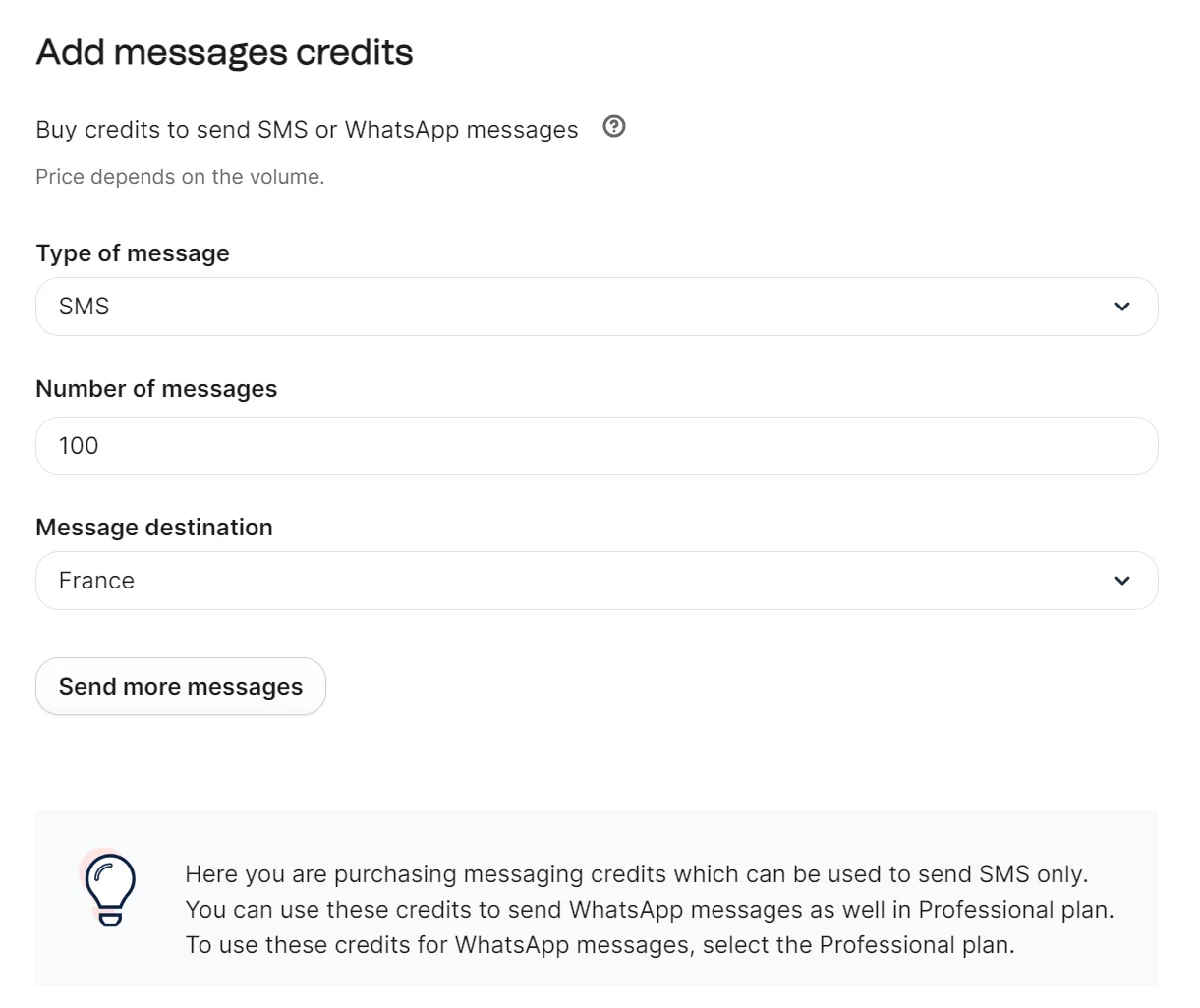
- SMS Pricing: SMS credits are non-refundable but never expire. For U.S. destinations, 100 messages cost $1.09, scaling up to $1,090 for 100,000 messages (as of August 2026). Brevo supports SMS to over 180 countries, with MMS capabilities exclusive to the United States, consuming 2.1 SMS credits per message.
- WhatsApp Pricing: Available only on Professional and Enterprise plans, WhatsApp credits are also sold in batches of 100. Pricing is dynamic, varying by destination country and message type (e.g., marketing vs. utility). For U.S. and Canadian customers, 100 marketing messages cost $3.27, while utility messages are $1.09. This distinction in pricing reflects the varying commercial models for different types of WhatsApp communication.
The availability and pricing of these channels underscore Brevo’s ambition to be a holistic communication platform, though the tiered access to WhatsApp can be a limiting factor for businesses on lower plans seeking comprehensive multichannel strategies.
The E-commerce Divide: Feature Gating and the "$499/Month Wall"
A significant consideration for e-commerce businesses evaluating Brevo is the substantial "e-commerce wall" presented by its Professional plan. While the Free and Starter plans offer basic e-commerce functionalities like abandoned cart recovery, they impose a critical 2,000-contact cap on multichannel automations. This limitation means that automated messages (e.g., welcome series, post-purchase follow-ups) will only reach the first 2,000 contacts entering the automation, severely hindering scalability for growing stores. Lifting this cap requires upgrading to the Standard plan or higher, which offers unlimited automation quotas.
However, even the Standard plan doesn’t unlock Brevo’s full suite of e-commerce features. Many advanced tools vital for maximizing revenue and customer retention are exclusively available on the Professional plan, which starts at $499/month. These include:
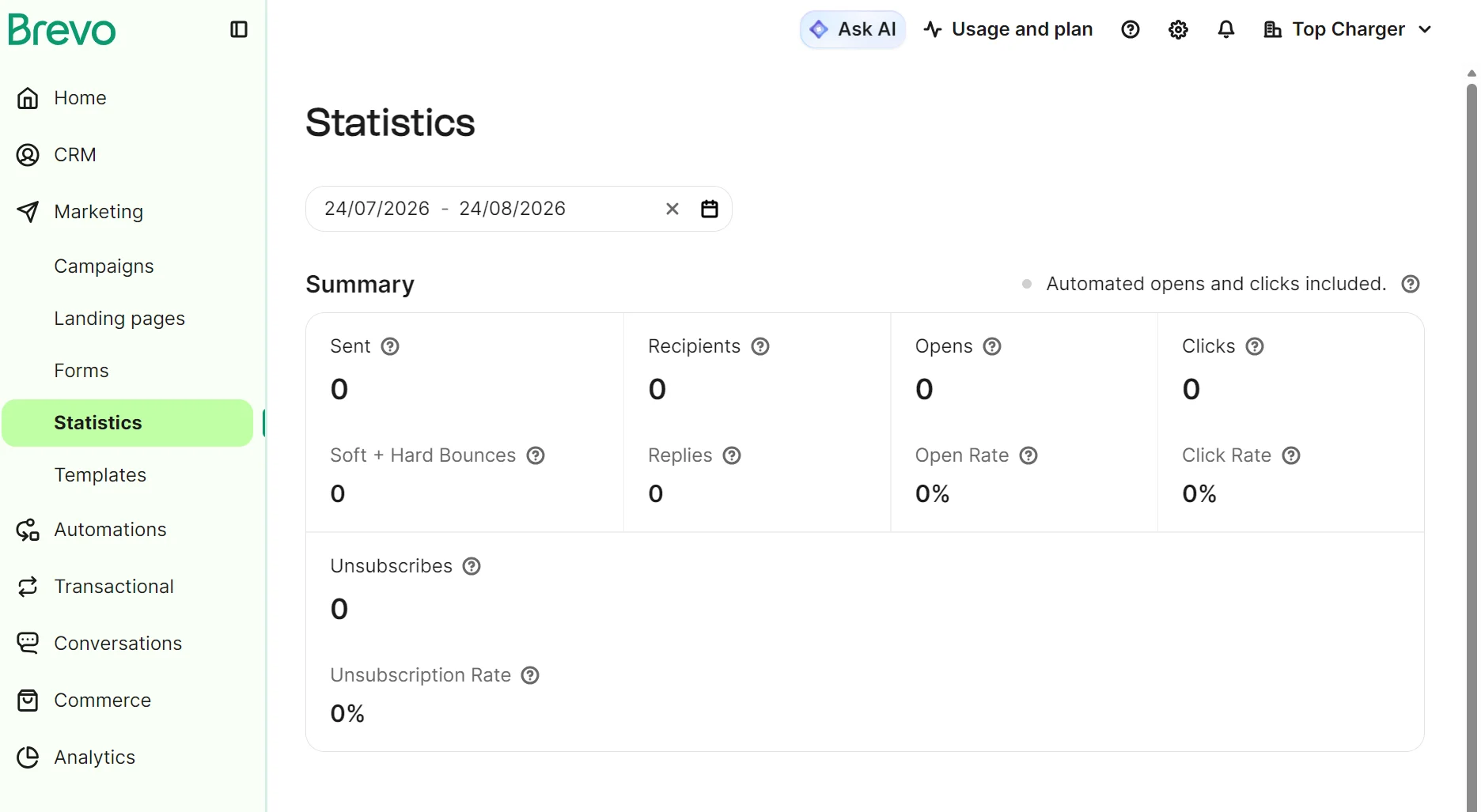
- Advanced Analytics: A dedicated analytics studio with pre-built reports, a dashboard builder, and an AI data analyst (Aura AI). Lower plans are limited to basic statistics.
- Engagement Tools: Pop-ups, back-in-stock alerts, and dynamic coupons.
- Personalization & Optimization: AI product recommendations, AI segmentation, contact scoring, multi-branch testing in automations, and randomized list splits for testing.
This feature gating creates a substantial financial leap for e-commerce businesses. For instance, a store with 100,000 sends and up to 500,000 contacts on the Standard plan would pay $139/month. If that same store requires critical e-commerce features like dynamic coupons or AI product recommendations, they are compelled to upgrade to the Professional plan, incurring a minimum cost of $499/month—a 259% increase ($360/month extra). This significant price jump can force businesses to either compromise on essential e-commerce functionalities or explore alternatives.
Furthermore, custom-priced Enterprise plans are the sole tier offering a loyalty program add-on, sub-account management, asset sharing, data warehouse/SFTP connections, and a dedicated customer success manager, highlighting the premium placed on comprehensive e-commerce and enterprise solutions.
Competitive Landscape: Brevo vs. Omnisend vs. Klaviyo
The competitive landscape in email marketing is fierce, with platforms offering diverse pricing models. Brevo’s send-based approach contrasts directly with the contact-based models of popular e-commerce platforms like Omnisend and Klaviyo.
- Entry-Level Advantage: Brevo generally holds an advantage at the low end, with entry-level paid plans starting at $9/month, compared to Omnisend’s $16/month and Klaviyo’s $20/month. This makes Brevo appealing for small businesses or those with infrequent sending needs, offering a competitive cost per send on lower tiers.
- Scaling Costs: Brevo’s advantage diminishes as sending requirements increase. Since Brevo charges by monthly email volume, exceeding a quota pushes users into a pricier tier, even if the contact count remains the same. The lower-tier contact caps (500, 1,500, 2,500) also reduce the sends-per-contact ratio as list size grows, potentially making it less efficient for frequent senders. For example, 5,000 sends with 500 contacts yield 10 sends per contact, but 15,000 sends with 2,500 contacts drop to 6 sends per contact.
- Contact-Based Alternatives: Omnisend and Klaviyo, which charge a flat rate based on list size with sending included, often become more cost-effective for large lists that are emailed frequently. Omnisend’s Pro plan offers unlimited sends, while its Standard plan caps emails at 12 times the contact count. Klaviyo caps emails at 10 times the contact count.
- E-commerce Features Comparison: A critical differentiator lies in e-commerce feature accessibility. Omnisend’s Pro plan, at $59/month for 2,500 contacts, offers a robust set of e-commerce features that are often locked behind Brevo’s $499/month Professional plan. For 30,000 contacts, Omnisend’s Pro plan reaches $497/month, while Klaviyo would be around $500/month. This means that for e-commerce stores with fewer than 30,000 contacts needing advanced features, Omnisend and Klaviyo can be significantly more affordable than Brevo’s Professional tier, offering a more native e-commerce experience at a lower price point.
| Feature/Platform | Brevo | Omnisend | Klaviyo |
|---|---|---|---|
| Billed on | Monthly email volume with contact caps per tier | Contacts (subscribed and non-subscribed) | Active profiles |
| Free plan | 100,000 contacts, 300 emails/day | 250 contacts, 500 emails/month | 250 active profiles, 500 emails/month |
| Entry paid plan | $9/month | $16/month | $20/month |
| Emails included | 6-10 per contact on lower tiers | 12x contacts on Standard; unlimited in Pro | 10x contacts |
| Price increase trigger | Crossing send/contact limit (auto-upgrade) | Moving into higher contact tier | Crossing profile threshold (auto-upgrade next cycle) |
| Free plan support | Email only | 24/7 email and live chat | Email (first 60 days only) |
| Entry paid plan support | Email only | 24/7 email and live chat | Email and chat |
| Annual discount | 10% | Not available | Not available |
This comparison highlights that while Brevo may offer a lower entry point, its cost-effectiveness for e-commerce businesses with specific feature needs or high sending frequencies quickly becomes questionable due to its tiered feature access and volume-based pricing.
Strategic Billing Terms and Automatic Upgrades
Brevo’s billing terms offer flexibility but also carry important implications for cost management. Monthly billing is the most expensive option, while an annual commitment provides a 10% discount (e.g., a $9/month Starter plan becomes $8.08/month, and a $499/month Professional plan drops to $449.08/month). This discount incentivizes longer-term commitment but removes the option to pause a plan, a feature available only with monthly subscriptions for a maximum of three months.
A critical aspect of Brevo’s billing is its automatic upgrade path. If a user reaches or exceeds their contact limit within a given plan, Brevo automatically upgrades them to the next appropriate tier, consequently increasing their subscription cost. This mechanism ensures service continuity but requires vigilant monitoring of usage to avoid unexpected cost increases. Prepaid email credits, while non-refundable, offer a way to manage peak sending periods without triggering an automatic plan upgrade, providing a degree of control over monthly expenditures.
Is Brevo the Right Choice for Your Business?
Determining Brevo’s value proposition ultimately depends on a business’s specific needs, particularly its email sending frequency and reliance on advanced e-commerce features.
Brevo is generally the more economical choice if:
- You manage a large contact list but send emails infrequently (e.g., quarterly newsletters, infrequent promotional campaigns). The send-based model means you pay less for storing many contacts if your monthly send volume is low.
- You have a smaller list and primarily require core email marketing functionalities (campaigns, basic automation) without needing advanced e-commerce tools or analytics. The Free and Starter plans offer an accessible entry point.
- Your business model is B2B or service-oriented, where the integrated sales packages might offer a good value proposition, especially if you don’t already have a robust CRM.
Brevo becomes more expensive if:
- You email your customers frequently. A large list combined with high sending frequency will quickly push you into higher, more expensive send tiers.
- Your e-commerce business relies heavily on advanced features such as pop-ups, dynamic coupons, AI product recommendations, or sophisticated analytics. These are primarily locked behind the Professional plan, which carries a substantial minimum cost of $499/month, potentially making it significantly more expensive than competitors offering similar e-commerce functionalities at lower price points for comparable contact volumes.
- You need extensive multichannel automation beyond 2,000 contacts on lower plans, as this necessitates an upgrade to Standard or higher.
Our advice for evaluation:
Calculate your estimated monthly sends by multiplying your contact count by your average emails per contact each month. If this figure is low, Brevo’s pricing might be highly competitive. However, if you anticipate high sending volumes or require a comprehensive suite of e-commerce tools, a contact-based platform like Omnisend or Klaviyo, despite their higher entry prices, might offer better overall value and more predictable costs for active e-commerce operations. Understanding this balance between send volume, contact storage, and feature access is paramount for making an informed decision about Brevo’s suitability for your marketing strategy.
Conclusion
Brevo’s distinct send-based pricing model, evolved from its Sendinblue origins, represents a strategic play in the competitive email marketing landscape. It offers a compelling proposition for specific market segments, particularly those with large, infrequently engaged lists or businesses primarily focused on core email functionalities. However, the tiered access to critical e-commerce features and the significant cost jump to the Professional plan present a notable challenge for scaling online stores. As the digital marketing ecosystem continues to evolve, platforms like Brevo must continuously adapt their offerings and pricing structures to meet the diverse and dynamic needs of businesses, balancing accessibility with advanced capabilities. The choice for marketers ultimately hinges on a meticulous analysis of their specific sending patterns, feature requirements, and long-term growth aspirations.
FAQs
Is Brevo a good tool for ecommerce?
Brevo offers good basic e-commerce functionalities like abandoned cart recovery and email campaigns. However, many advanced e-commerce features, such as pop-ups, dynamic coupons, contact scoring, and AI product recommendations, are tiered to the expensive Professional plan, starting at $499/month. This can make it less cost-effective for e-commerce businesses compared to alternatives that include these features in lower-priced plans.
Does Brevo really offer unlimited contacts?
Brevo offers unlimited contacts exclusively on its custom-priced Enterprise plan, which requires direct consultation with their sales team. For plans below Enterprise, there are specific contact limits tied to monthly email volume tiers, with the Professional plan capping at 2,000,000 contacts.
Is Brevo pricing cheaper than Omnisend or Klaviyo?
Brevo typically has a lower entry price, starting at $9/month compared to Omnisend’s $16/month and Klaviyo’s $20/month. Brevo can be cheaper for businesses with large lists that send emails infrequently. However, for businesses with high sending frequencies or those requiring advanced e-commerce features, Omnisend and Klaviyo, which bill primarily by contacts, can become more cost-effective as they include higher send volumes and more features in their contact-based tiers.
Does Brevo’s free plan work for a real business?
Yes, Brevo’s free plan can be suitable for small businesses with basic automation and campaign needs, especially if they have a large list that needs free storage (up to 100,000 contacts). It allows sending up to 300 emails per day and automated messages to up to 2,000 contacts. However, it offers limited analytics and lacks advanced e-commerce features like pop-ups or contact scoring, making it less ideal for scaling online stores.
Has Sendinblue pricing changed since the rename?
Yes, since the 2023 rebrand to Brevo, there have been changes. The entry price for paid plans was lowered to $9/month from $25/month, although the included email volume simultaneously decreased from 20,000 to 5,000 emails. Additionally, while Sendinblue offered unlimited contacts on its paid plans, Brevo’s plans below Enterprise now have contact limits that are tied to specific monthly email volume tiers.