The landscape of commerce has always been shaped by questions and the avenues through which answers are sought. From direct inquiries to salespeople and the subsequent rise of search engines as primary information gateways, the journey of discovery has continuously evolved. Today, Artificial Intelligence (AI) has fundamentally reshaped this paradigm, integrating itself into the fabric of information retrieval and introducing a new imperative for businesses: understanding and measuring the return on investment (ROI) of their AI search visibility efforts. This shift, while promising unprecedented engagement opportunities, also presents complex challenges in attribution, making traditional measurement frameworks insufficient.
The Evolving Landscape of Commerce and Information Retrieval
For centuries, the exchange of goods and services revolved around direct human interaction, with salespeople acting as the primary fount of information. The advent of the internet and subsequently, search engines like Google, democratized access to information, empowering consumers to research independently. This era necessitated the rise of Search Engine Optimization (SEO) to ensure brand visibility. Now, AI has taken center stage, with generative AI models like ChatGPT, Google Gemini, Perplexity, and others, offering synthesized answers to user queries, often citing multiple sources. This transformation means brands must not only optimize for traditional search but also for their appearance and prominence within AI-generated responses, a discipline increasingly referred to as AI Search Optimization (AEO). The critical question for businesses is no longer just "Are we appearing in search results?" but "Are we being cited and recommended by AI, and what is the tangible business impact?"
The Attribution Conundrum: Why Measuring AI’s Impact is Difficult
Despite the clear shift in buyer behavior, quantifying the impact of AI search remains a significant hurdle. Unlike traditional organic search, which often provides clear referral data, AI search engines rarely share detailed attribution metrics. This creates a "dark funnel" problem, where AI touchpoints influence a buyer’s journey without direct, trackable credit.
Consider a common AI-influenced buyer journey: A potential customer asks an AI system for recommendations, and a specific brand is mentioned. Three days later, the buyer directly searches for that brand name on Google, perhaps converts through a paid ad, and traditional last-click attribution credits the paid search channel. In this scenario, the AI’s crucial role in initial awareness and consideration receives zero credit, obscuring its true value. This challenge is amplified by recent market trends; U.S. organic search traffic experienced a 2.5% year-over-year decline in January 2026, while AI referral traffic to retail sites surged by an astounding 693% during the same period. This stark contrast underscores a fundamental shift in how buyers initiate their research, making the lack of AI attribution data a critical gap in marketing analytics.
The absence of robust referral data from AI platforms means marketers cannot simply rely on existing attribution models. Instead, a more holistic approach is required, one that acknowledges the indirect influence of AI and integrates new measurement layers capable of detecting these often-invisible touchpoints.
A Three-Layered Framework for AI Search Visibility ROI
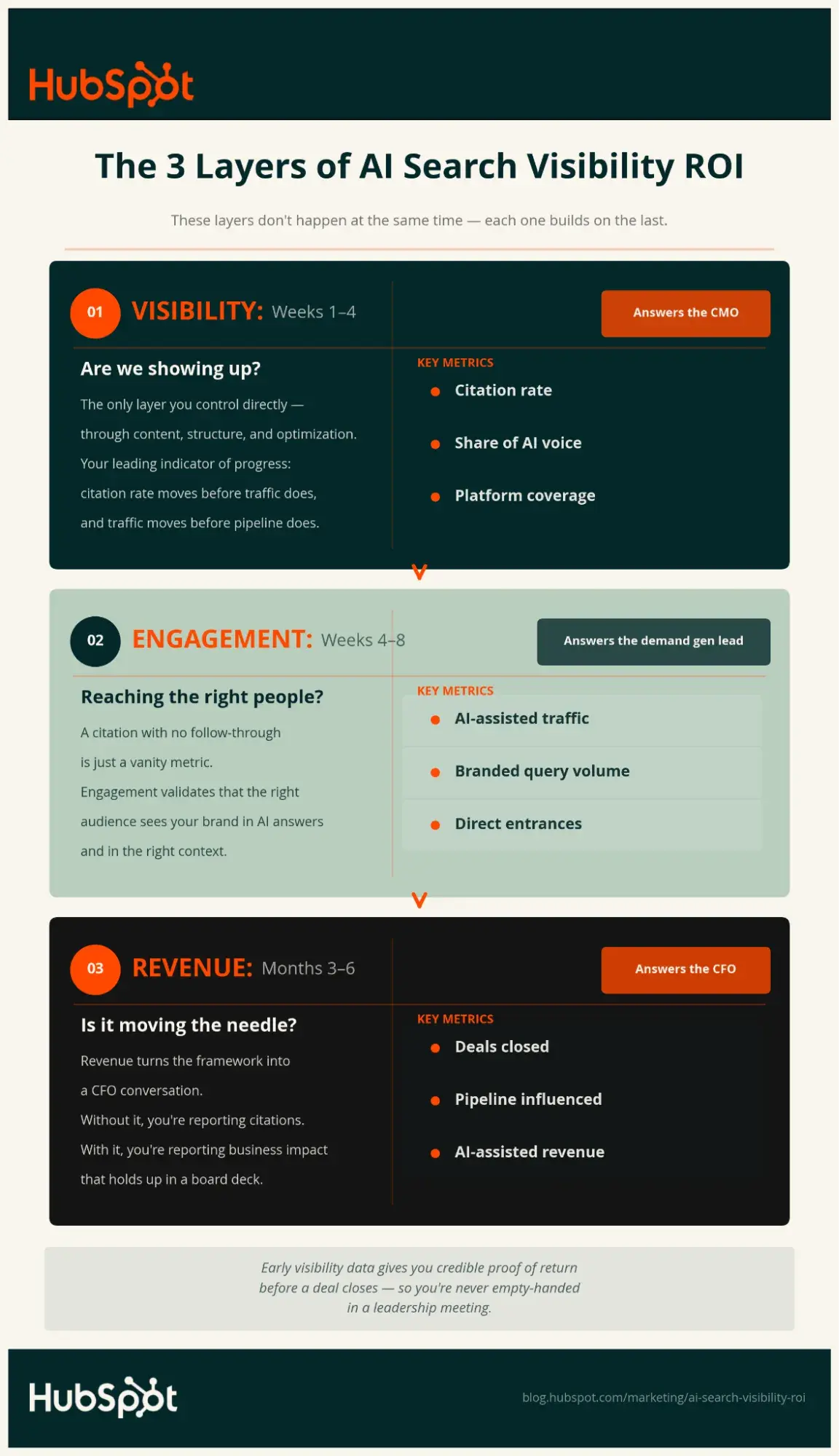
To bring clarity to the ambiguous impact of AI search, a structured, three-layer measurement framework is essential. This framework moves beyond direct clicks, encompassing visibility, engagement, and revenue metrics, each playing a distinct role in building a comprehensive understanding of AI search ROI. These layers represent a delayed funnel, meaning their impact and measurability unfold over different timelines.

Layer 1: Visibility – Tracking Share of AI Voice and Citations
The foundational layer focuses on a brand’s presence within AI-generated answers.
- Share of AI Voice (SAIV): This metric quantifies the percentage of tracked AI prompts where a brand appears in the AI’s answer. It offers a broad measure of a brand’s presence in the AI conversation.
- Citation Tracking: Going deeper, this measures whether a brand’s content is explicitly linked or mentioned as a source by the AI system. Being cited signals that AI models consider the content authoritative and relevant.
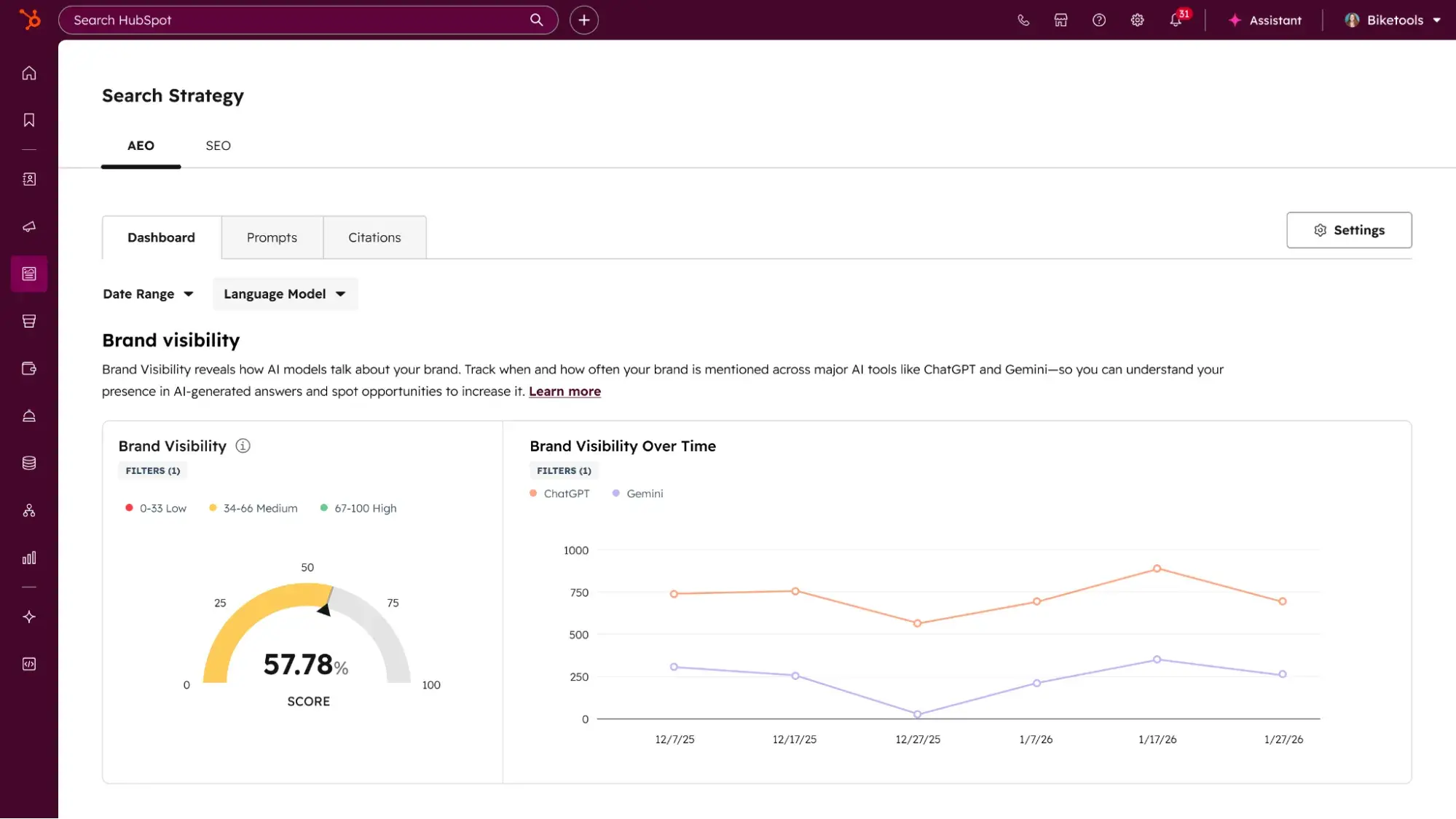
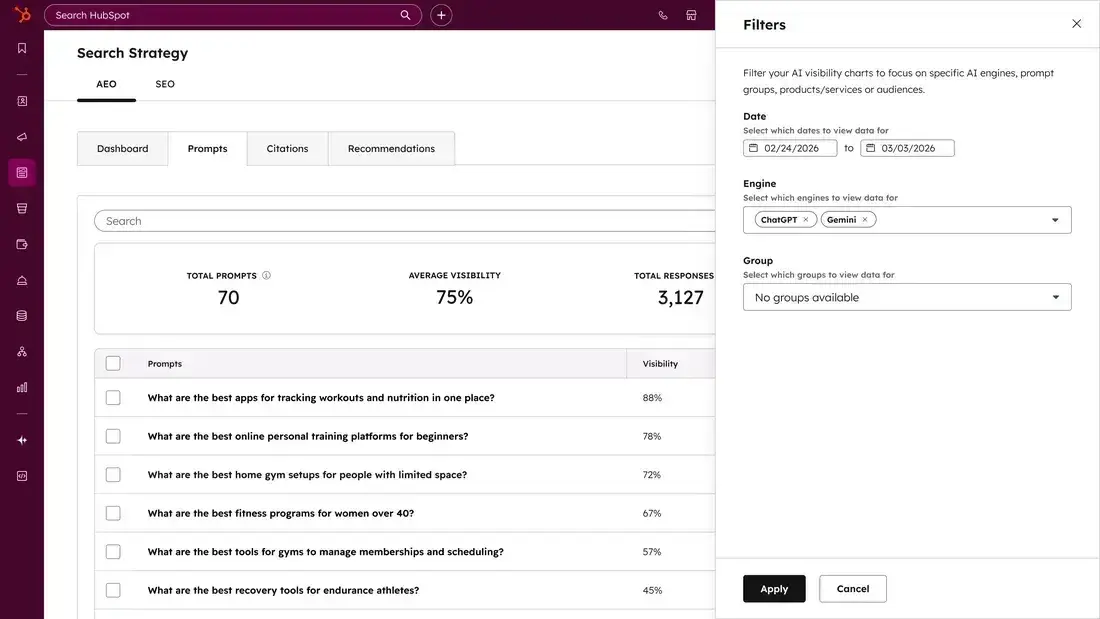
Calculation: To calculate SAIV, define a comprehensive set of buyer-centric prompts relevant to your industry. Input these prompts into various AI platforms (e.g., ChatGPT, Gemini, Perplexity) and record every instance your brand is mentioned or cited. Tools like HubSpot AEO can automate this process, tracking Brand Visibility Scores across multiple platforms and monitoring competitor mentions, identifying content gaps, and connecting visibility data to a CRM. This allows for a real-time understanding of a brand’s performance relative to competitors.
Layer 2: Engagement – Gauging Branded Search Lift and Direct Traffic
While direct referrals from AI may be scarce, AI visibility often leads to indirect engagement signals. When a brand is mentioned in an AI answer, users frequently conduct a subsequent search for that brand directly.
- Branded Search Lift: This refers to an increase in searches for a brand’s specific keywords. A sustained lift, particularly without corresponding paid campaigns, strongly indicates that AI awareness is driving user interest.
- Direct Traffic: Users influenced by AI might navigate directly to a brand’s website in a new browser window. An unexplained increase in direct traffic can be a signal of AI-driven interest.
Calculation: Monitor these metrics in platforms like Google Search Console and Google Analytics 4 (GA4). Track branded keyword search volume over time and analyze direct traffic trends. Correlate these movements with changes in AI visibility to infer AI’s influence. This layer provides crucial context, demonstrating that visibility is translating into tangible user interest, even if not through a direct click.
Layer 3: Revenue – Attributing Pipeline Influence in Your CRM
Achieving perfect AI attribution is inherently challenging due to the fragmented nature of buyer journeys and the lack of direct referral data. Therefore, the goal shifts to assisted attribution – identifying where AI touchpoints influenced a customer’s path to purchase. Industry data supports this investment: A January 2026 HubSpot survey of over 3,000 CRM purchase decision-makers revealed that AI search was the single strongest predictor of purchase intent, surpassing demos, review sites, and sales calls. Buyers who utilized AI search were 36% more likely to make a purchase.
Calculation: Build a simple model within your CRM to track AI’s influence. This involves:
- Tagging AI-influenced contacts: Create custom fields or tags in your CRM to mark contacts who have interacted with AI content where your brand was visible.
- Mapping AI touchpoints to pipeline stages: Integrate visibility data with your CRM to identify deals where an AI touchpoint occurred at an early stage.
- Applying an assisted credit model: Assign a percentage of revenue credit to AI for deals where it played an influencing role, even if not the final touchpoint. This assisted revenue model is crucial for demonstrating financial impact. Unifying visibility and pipeline data in a Smart CRM with custom fields allows Marketing Hub to automate multi-touch attribution and reporting across all channels, providing a holistic view.
Benchmarking for Actionable Insights: Understanding the Competitive Landscape

Benchmarking transforms raw visibility data into actionable insights by providing a competitive reference point and a trend line. This allows businesses to understand their performance relative to competitors and track the effectiveness of their AEO strategies over time.
1. Identify Your Answer Competitors: In the AI search realm, "competitors" extend beyond direct product rivals. AI answers cite sources deemed most authoritative and clearly structured on a topic. This often includes industry media sites, analyst blogs, review platforms (e.g., G2, Yelp), and niche publications. Document all sources appearing in AI answers for each topic cluster in your prompt set, not just direct business competitors. This mapping reveals the full citation landscape and helps identify content gaps versus product issues. For example, if a media site consistently outranks your brand for buying-stage prompts, it points to a content strategy opportunity.
2. Build a Share of Citations Chart: Run your full prompt set monthly, recording every cited source and aggregating by topic cluster. This yields a clear view of where your brand leads, where it trails, and where the widest gaps exist. For instance, a chart might show your brand with 12/20 citations for "CRM software comparisons" but only 6/20 for "Sales pipeline management," while a top competitor has 14/20. Such data immediately prioritizes "Sales pipeline management" for content optimization.
3. Interpret Trends: A rising citation share in a cluster could signify improved content, a competitor’s decline, or an AI model update shifting source preferences. It’s crucial to establish a fresh baseline after any major AI model release (GPT, Gemini, Perplexity update regularly), as these can independently reshuffle citation patterns. The trend line, spanning three or more months, is more indicative of strategy effectiveness than any single snapshot, providing a compelling narrative for leadership.
Implementing an AI Search Measurement Strategy: A Step-by-Step Guide
Effectively measuring AI search visibility requires a systematic approach, beginning with defining clear objectives and establishing consistent tracking.
1. Define Your Prompt Set: Select 20-30 prompts that accurately reflect how buyers research your category across all funnel stages:
- Awareness prompts: Broad, informational questions (e.g., "What is CRM software?").
- Consideration prompts: Comparative questions (e.g., "Best CRM for small businesses?").
- Decision prompts: Specific vendor-related questions (e.g., "HubSpot vs. Salesforce CRM?").
Prioritize specificity over brevity to capture genuine buyer intent and ensure more consistent, trackable AI answers.
2. Input Prompts into Your AI Visibility Tool: Manually test prompts across platforms like ChatGPT, Gemini, and Perplexity, or utilize automated tools like HubSpot AEO, which provides daily updates on citations across these key platforms. Multi-platform tracking is non-negotiable, as AI search visibility is not confined to a single ecosystem. Goodie’s 2026 Wave 2 report highlighted a significant shift, with ChatGPT’s share of B2B AI referrals dropping from 89% to 63% in eight months, while Claude rose to 18.5% and Gemini to 10.6%. Understanding retrieval logic, citation behavior, and user intent across these diverse platforms is crucial for a comprehensive strategy.
3. Record Your Brand Visibility Score and Audit Content: Score each prompt on a simple scale: not mentioned, mentioned, cited as a source, or recommended. Aggregate these into a Brand Visibility Score across all prompts and platforms to establish a baseline. Re-run this assessment monthly to track movement. Concurrently, conduct an AI search visibility audit using tools like HubSpot’s free AI Search Grader to pinpoint where your brand is visible and where competitors dominate. This audit should feed into a detailed tracking table, recording date, prompt, platform, model version, brand mention/citation, competitor citation, answer sentiment, and verbatim response for each query.
4. Repeat and Refine: Based on the insights from your data, implement content changes and optimizations. Consistently repeat the prompt tracking and analysis on a weekly or bi-weekly schedule to monitor the impact of your efforts and refine your strategy over time.
Calculating AI Search Visibility ROI: The Financial Equation
Given the attribution ambiguities, calculating AI Search Visibility ROI requires a pragmatic approach that leverages the three-layer framework. The core formula remains consistent:
ROI (%) = (AI-Assisted Revenue – AI Costs) ÷ AI Costs × 100
AI-Assisted Revenue: Since direct click attribution is rare, marketers must construct an assisted revenue model. This relies on:
- AI-Influenced Behavior: Identifying contacts who exhibited AI-influenced behavior (e.g., searching for your brand after an AI mention).
- CRM Integration: Utilizing custom fields and tagging within a Smart CRM (like HubSpot’s) to track AI touchpoints.
- Multi-Touch Attribution: Employing Marketing Hub’s capabilities to automate attribution, assigning partial credit to AI alongside other channels. This integration allows for a nuanced understanding of AI’s contribution to the pipeline.
AI Costs: These are more straightforward and typically include:
- AI Visibility Tools: Subscriptions to platforms like HubSpot AEO.
- Content Creation and Optimization: Resources dedicated to producing and refining content for AI visibility.
- Personnel Costs: Salaries for AEO specialists or marketing team members focused on AI search.
Example Calculation: Imagine a team spending $2,000/month on AI tools and content. Over a quarter, this amounts to $6,000. During the same period, the CRM flags $30,000 in pipeline where contacts had a confirmed AI touchpoint. Applying a conservative 25% assisted credit (as AI was one of several influences), this translates to $7,500 in AI-assisted revenue.
Using the formula: ROI (%) = ($7,500 – $6,000) ÷ $6,000 × 100 = 25% ROI.
This provides a defensible, data-driven figure to present to leadership as the model matures.
Making the Business Case to Leadership: Overcoming Skepticism
Presenting the case for AI search investment to leadership requires a strategic argument focused on opportunity cost, competitive risk, and a clear measurement plan, leading with the cost of inaction.
Opportunity Cost: HubSpot data indicates that AI-referred leads convert at three times the rate of traditional search leads. Every month without measuring or optimizing for AI visibility represents lost opportunities, with high-intent buyers making decisions without your brand in the conversation. This is not a hypothetical risk; it’s revenue already being left on the table.
Competitive Risk: Early adopters are already seeing significant gains. HubSpot customers actively optimizing for AI search generate 170% more Marketing Qualified Leads (MQLs) and 82% more deals than comparable non-investing customers. The gap between those investing in AI visibility and those adopting a "wait-and-see" approach is widening quarterly, posing a substantial competitive disadvantage.
Measurement Plan: Leadership demands concrete plans, not vague promises. A robust 30/60/90-day roadmap should be presented, detailing a defined baseline, a comprehensive prompt set, a clear metric framework, and a CRM attribution model that links visibility signals directly to the pipeline. This demonstrates exactly how success will be measured and reported, fostering confidence and securing necessary resources.
Setting Realistic Expectations: A Timeline for AI Search Visibility
A common pitfall in AI search visibility strategies is expecting immediate results, akin to paid media. AEO is a long-term play, with results building in layers. Setting realistic expectations for your team and leadership is critical for sustained investment.
Typical AI Search Visibility Milestone Windows:
- Days 1–30: Baseline established, prompt set running. Report on visibility score, competitor benchmark.
- Days 30–60: First citation data, branded search trend. Report on Share of AI Voice (SAIV), direct traffic delta.
- Days 60–90: AI-influenced contacts appearing in CRM. Report on AI-influenced MQL rate, pipeline touch data.
- Days 90–180: Pipeline influence data, revenue model live. Report on AI-assisted close rate, deal velocity.
Leading Indicators to Watch First: While awaiting full pipeline data, several leading indicators can signal strategy effectiveness:
- Rising Brand Visibility Score.
- Increasing Share of AI Voice.
- Growing branded search volume.
- Positive direct traffic trend.
- Higher average session duration from direct traffic.
If two or more of these indicators show positive movement by day 60, a credible case can be made that the strategy is working, even before direct pipeline numbers fully mature.
Optimizing for AI Search Visibility: Best Practices
Improving AI search visibility requires a multi-faceted approach centered on content, reputation, and multi-platform strategy.
1. Content Structure and Clarity: AI systems favor content that provides direct, clear answers upfront. Prioritize rewriting important pages so the first 150 words directly address the prompt. Utilize question-based headings that mirror how buyers search and incorporate FAQ and Article schema to make content easily parsable by AI.
2. Third-Party Citations and Reputation: AI answers draw from diverse sources beyond a brand’s own site, including review platforms, industry publications, and analyst reports. Therefore, enhancing AI visibility is both a content problem and a public relations challenge. Earning citations in authoritative external sources carries significant weight.
3. Multi-Platform Strategy: Do not optimize for a single AI engine. ChatGPT, Gemini, Perplexity, and Google AI Overviews all cite differently and draw from varying source sets. A strategy focused on just one platform will miss a growing share of AI-referred buyers.
4. Timeline for Improvements: Expect 30-60 days for content improvements to translate into citation rate changes and 90-180 days for those gains to influence measurable pipeline. AI systems do not index and update in real-time like traditional search engines; changes require time to be picked up and reflected.
5. Prompt Selection Strategy: To select effective prompts, draw from sales call recordings, customer support tickets, and existing keyword research. Focus on specific, buyer-centric questions that reflect actual intent, rather than generic, short-tail queries. Structure the prompt set across all funnel stages and refresh it quarterly to align with evolving buyer language.
6. Addressing Low Initial Visibility: A low visibility score is an opportunity. Audit topic clusters with the lowest citation rates to identify competing sources and content gaps. Prioritize optimizing high-priority pages using AEO content checklists, focusing on clarity, direct answers, and E-E-A-T (Experience, Expertise, Authoritativeness, Trustworthiness) signals. Begin with 2-3 topic clusters where the competitive gap is smallest and buyer intent is highest; visibility compounds over time.
Conclusion: Start Measuring Before Your Competitors Do
The fundamental truth of commerce remains: whoever best answers buyer questions—clearly, credibly, and at the opportune moment—wins the business. AI search has irrevocably altered where those answers originate, but not the underlying principle. The good news is that initiating an AI search visibility strategy doesn’t demand an exorbitant budget or a dedicated AI team. Starting small, defining your first prompts, tracking your Brand Visibility Score with tools like HubSpot AEO, and identifying early AI-influenced contacts in your CRM will provide invaluable data. This initial data collection forms the critical head start for the leadership case that will inevitably be made in the coming months. The shift towards AI-driven information retrieval is already underway; the decisive question is whether your brand will be a definitive part of the answer.