Google Ads is set to implement a significant change to its Smart Bidding strategies on August 17, 2026, fundamentally altering how budget limitations interact with performance targets. This forthcoming update, detailed in Google’s official documentation, aims to decouple budget constraints from efficiency metrics, a move anticipated to bring greater predictability to campaign scaling for advertisers. Historically, campaigns utilizing target-based bid strategies like Target CPA (Cost Per Acquisition) and Target ROAS (Return on Ad Spend) have experienced a peculiar phenomenon: when a campaign hit its daily budget cap, Smart Bidding would aggressively restrict its bidding to secure only the most cost-effective conversions. This created an artificial baseline of efficiency that often destabilized once budgets were increased, leading to performance volatility and extended learning periods. The upcoming change is designed to eliminate this "budget-cap overperformance," ensuring that Smart Bidding strictly adheres to the set CPA or ROAS targets, regardless of budget limitations.
The Historical Bottleneck: How Budget Limits Skewed Smart Bidding Performance
For years, PPC managers have navigated a common challenge: the anxiety surrounding the scaling of successful campaigns. A campaign might be performing exceptionally well, consistently hitting a target CPA of $50 while operating under a $100 daily budget, with Smart Bidding even optimizing to a more efficient $35 CPA. This scenario, often met with client satisfaction and internal accolades, naturally leads to the impulse to increase the budget to capture more volume. However, the execution of this logical next step has historically been fraught with peril.
Upon raising the daily budget to $500, advertisers would often witness a rapid destabilization of performance. The algorithm, accustomed to operating within a narrow, budget-constrained window, would struggle to adapt to the expanded auction pool. This led to the actual CPA skyrocketing past the $50 target, eroding the initial gains and requiring a significant re-learning period for the bidding strategy. This behavior was not an inherent flaw in Smart Bidding’s core intelligence but rather a consequence of how it was engineered to operate under budget limitations.
The core issue stemmed from the artificial throttle imposed by the daily budget. When a campaign was "Limited by budget," Smart Bidding’s primary directive shifted from broad optimization to a laser focus on acquiring the cheapest possible conversions within that stringent financial boundary. This meant that the $35 CPA was not necessarily indicative of the campaign’s true potential but rather a reflection of its inability to explore broader, potentially more valuable, but slightly more expensive, inventory. The algorithm was essentially cherry-picking the easiest wins, leaving a vast amount of potential inventory untapped.
When the budget valve was subsequently opened, Smart Bidding was forced to reassess its bidding mechanics without the benefit of prior learning in this expanded environment. This sudden shift often resulted in a period of unpredictable performance, inflated CPAs, and extended recalibration, frustrating advertisers and clients alike. The disconnect between the desired efficiency (represented by the low CPA) and the available opportunity (limited by budget) created a self-defeating cycle.
The August 17 Transformation: Uncoupling Budget from Efficiency
The forthcoming change on August 17, 2026, marks a pivotal moment in Google Ads’ evolution. As per Google’s official documentation, Smart Bidding strategies employing Target CPA and Target ROAS will no longer allow budget limitations to dictate bidding behavior in the same manner. Instead, the algorithm will be programmed to optimize solely towards the stated target, whether that target is $50 or $10.
This shift has been framed by some within the PPC community as a potential loss of "cheap conversions." However, a deeper analysis reveals a substantial strategic upside: the permanent decoupling of the budget lever from the efficiency lever. This means that when a campaign with a $10 Target CPA is currently delivering at $5, the post-August 17 algorithm will work to maintain that $10 target, rather than continuing to operate at the artificially low $5. While this might initially sound like a reduction in immediate efficiency, it is, in fact, a crucial stabilization fix.
Google’s approach involves a fundamental rewiring of the algorithm’s internal logic. When the budget and efficiency levers operate independently, the scaling process is expected to become far more linear and predictable. If an advertiser increases the budget on a campaign locked into a $35 target CPA, the algorithm will now be empowered to acquire more volume at that $35 target, rather than undergoing a chaotic re-evaluation of its bidding parameters in an attempt to decipher the advertiser’s true efficiency expectations.
This separation means that the daily budget will primarily serve its intended purpose: to define the maximum spend, not to act as an implicit constraint on bidding strategy. Smart Bidding will now focus on finding the most efficient way to achieve the defined target CPA or ROAS within the allocated budget, rather than attempting to achieve an artificially low CPA by severely limiting its reach.
A Shift in Strategy: Understanding the Scope of the Change
The implications of this update are significant, but it is crucial to understand which campaigns will be affected. Not all campaigns on an account will operate under these new rules, making targeted audits and strategic adjustments essential.

| Campaign Type / Category | Bidding Strategies Impacted | Post-August 17 Behavior |
|---|---|---|
| Search, Shopping, Performance Max, Demand Gen, Travel | Target CPA, Target ROAS, Target CPC (Demand Gen) | Changes: Will strictly deliver toward the stated target, eliminating budget-cap overperformance. |
| Display & Hotel | Target CPA, Target ROAS | No Change: Already operate under this strict target behavior. |
| App Campaigns, Video Reach, Video View (VVC) | Target CPA, Target ROAS / Cost-Per-View | Retain historical bidding behavior. |
| Manual Bidding, Max Conversions, Max Value | Manual CPC, Target Impression Share | Unaffected by target-based bidding changes. |
The table above highlights that the primary impact will be felt by campaigns utilizing Target CPA and Target ROAS across major formats like Search, Shopping, Performance Max, Demand Gen, and Travel. These campaigns, which historically benefited from budget-constrained efficiency, will now align with the stricter target-driven approach. Conversely, Display and Hotel campaigns, along with manual bidding strategies and those focused on maximizing conversions or value without a specific target, will remain unaffected by this particular behavioral shift. App campaigns and certain video campaign types will also retain their existing bidding mechanics.
This clarification is vital for PPC managers to focus their audit efforts on the most relevant campaign structures and to avoid unnecessary adjustments to unaffected campaigns.
Preparing for the Transition: Capitalizing on Predictable Scaling
While the initial reaction in the PPC community has understandably focused on the potential loss of exceptionally low CPAs achieved under budget constraints, the long-term outlook presents a significant growth opportunity. The ability to scale campaigns predictably, without the fear of performance destabilization, is a powerful advantage. However, this update requires proactive preparation. Google will not automatically adjust bid targets to reflect current actual performance. This means that doing nothing is an active choice that will allow CPAs to trend upwards towards the legacy targets that have been sitting in the settings.
To leverage this update as a scaling opportunity, advertisers are encouraged to adopt a structured approach, utilizing Google’s Bid Target Adjustment Tool, which became available in accounts starting July 6, 2026. This tool provides a streamlined way to manage the transition.
1. Accessing the Bid Target Adjustment Tool:
The first step involves accessing the Bid Target Adjustment Tool directly from Google Ads notifications. Google has pre-populated this view with campaigns that have experienced "Limited by budget" constraints over the past 12 months, saving advertisers the time and effort of manually sifting through historical status logs. For those who wish to manually verify, filtering the campaign table by "Search Lost IS (budget) > 0%" over a 12-month period is recommended. It is also crucial to cross-reference this data with the last 30 days of performance to ensure that the chosen target is realistic and achievable in the current market conditions.
2. Evaluating and Adjusting Current CPA Bids:
This step involves a critical review of the existing CPA bids. Advertisers have two primary options:
- Maintain the current CPA bid: If the current CPA target in the settings accurately reflects the desired performance level and the campaign has been consistently performing at or near this target (even if actual performance was lower due to budget caps), it can be maintained.
- Adjust the CPA bid to align with current actual performance: This is the recommended approach for campaigns that have been operating at a significantly lower CPA than their target due to budget limitations. The Bid Target Adjustment Tool allows advertisers to input the actual CPA achieved over a recent period (e.g., the last 30 days). This ensures that the new target is grounded in realistic, current performance data. For example, if a campaign had a $50 target CPA but consistently delivered at $35 due to budget caps, adjusting the target to $35 would be a prudent move to align with the new system’s behavior.
3. Respecting the Conversion Cycle Window:
A critical aspect of Smart Bidding is its reliance on conversion data and learning periods. Following any bid adjustment, Smart Bidding will require approximately 1-2 conversion cycles to re-stabilize. This means that if an account has a longer sales cycle, for instance, a week, advertisers must account for this when making bid adjustments. Changing the bid well in advance of the August 17 deadline ensures that the campaign has sufficient time to stabilize its performance based on the new bid target before the system-wide change takes effect. For example, if a campaign has a 7-day conversion lag, adjustments should be made at least two weeks prior to August 17 to ensure stability.
4. Incremental Reality Check and Re-evaluation:
The update presents an opportunity to reassess the true incremental value of campaigns. Campaigns that have been overperforming with a much lower CPA than their target often achieve this by capturing low-hanging fruit, such as branded searches or highly specific, low-competition queries. With the new system, these campaigns will be encouraged to explore broader inventory to meet the adjusted target. This is an opportune moment to re-evaluate whether the campaign is still generating genuinely incremental value or if its performance is primarily driven by existing brand recognition. Advertisers should make any necessary adjustments to campaign settings, targeting, or creative to ensure that increased spend translates into meaningful, incremental growth rather than simply capturing existing demand at a higher cost.
The Broader Implications and Future Outlook
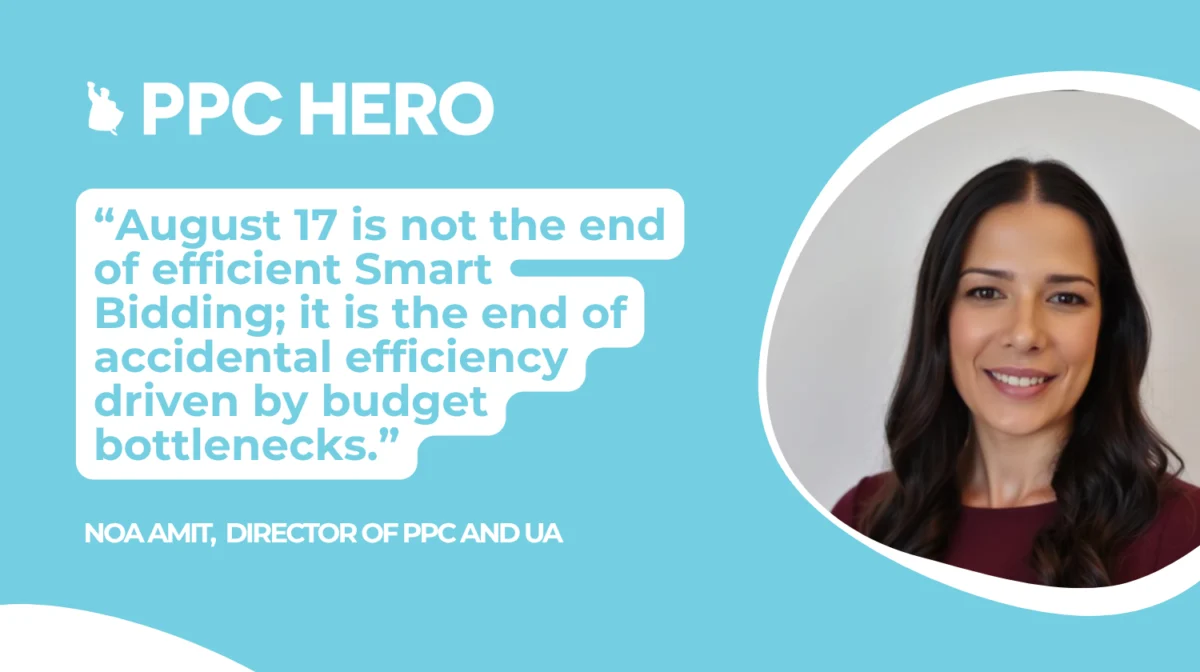
The August 17, 2026, update represents not the demise of efficient Smart Bidding but rather the end of accidental efficiency driven by artificial budget bottlenecks. By encouraging advertisers to pull stale targets back down to match current actual performance, PPC managers can effectively eliminate the risk of unwanted CPA drift.
More importantly, this change sets accounts up for a future where increasing a budget is a direct pathway to scaling results predictably, without the disruptive side effects that have plagued advertisers for years. The ability to forecast and manage campaign growth with greater certainty will empower businesses to allocate their advertising spend more effectively, driving sustained and measurable ROI.
This strategic shift by Google Ads signifies a commitment to providing advertisers with more robust and reliable tools for growth. While adaptation is required, the underlying principle is a move towards greater transparency and predictability in campaign performance, ultimately benefiting businesses striving for efficient and scalable digital advertising success. The era of budget-induced performance volatility in Smart Bidding is drawing to a close, ushering in a new phase of controlled and predictable expansion for those who prepare strategically.