The promise of Artificial Intelligence in marketing has largely been framed around efficiency and speed. Businesses have invested in AI tools, expecting a significant acceleration in content creation, a reduction in production costs, and a streamlined workflow. However, a growing body of evidence and anecdotal reports from marketing leaders suggests a significant, often overlooked, cost associated with this rapid AI-driven output: the "revision tax." This phenomenon describes the substantial time and cognitive load placed on human reviewers, particularly senior and experienced personnel, as they sift through and refine the sheer volume of AI-generated content. The initial business cases for AI often focused solely on the production side, neglecting the crucial downstream impact on review and quality assurance, thereby creating an unforeseen bottleneck that can undermine the very efficiencies AI was meant to deliver.
The Illusion of Savings: Deconstructing the AI ROI Math
The economic rationale behind adopting AI in marketing has historically centered on quantifiable production gains. These calculations typically include metrics such as reduced hours for first drafts, increased asset output per week, repatriation of agency work, and avoidance of headcount. While these are undoubtedly valuable considerations, they represent only one side of the ledger. The critical oversight has been the failure to adequately account for the amplified effort required in the review and editing stages.
When content production was at a lower volume, the review process, though always important, was manageable. However, as AI tools empower individuals to generate content at an unprecedented rate – often several times their previous output – this accelerated production directly translates into an equally accelerated influx of material requiring human oversight. The core issue is that the reviewer’s day has not proportionally lengthened to accommodate this surge. This imbalance creates a significant strain, particularly on the most skilled and trusted members of a marketing team, who are often tasked with ensuring accuracy, brand consistency, and strategic alignment.
Quantifying the Burden: The "Revision Tax" and "Workslop"
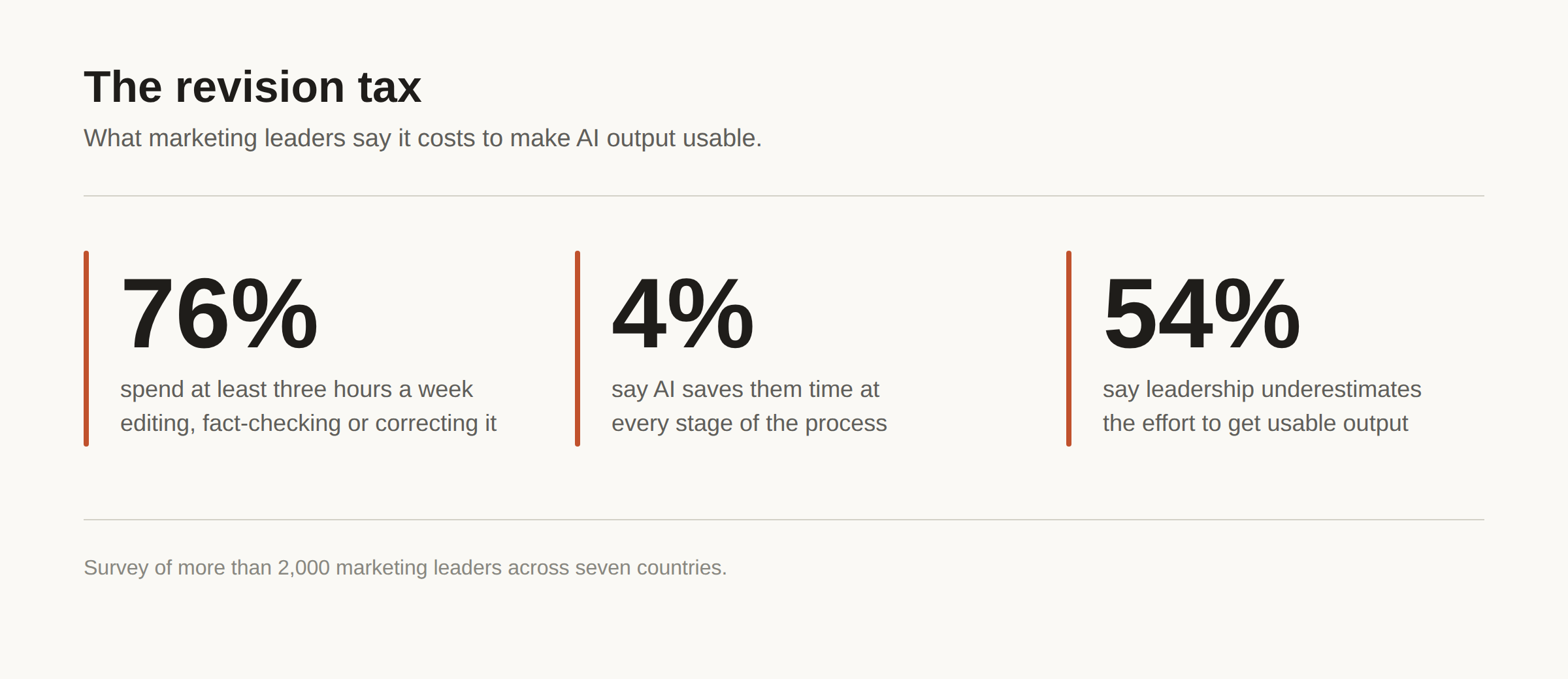
Empirical data is beginning to shed light on the tangible impact of this oversight. A comprehensive global survey, encompassing over 2,000 marketing leaders across seven countries, revealed that a staggering 76% of respondents dedicate at least three hours per week to editing, fact-checking, or correcting AI-generated output. Conversely, only a meager 4% reported that AI genuinely saves them time across all stages of the content lifecycle. This survey, conducted by a company specializing in AI marketing software, lends significant credibility to the findings, highlighting the "revision tax" as a critical, yet often unacknowledged, cost.
Further exacerbating this issue, 54% of respondents indicated that their leadership significantly underestimates the true effort required to transform raw AI output into usable marketing assets. This perception gap means that the burden on reviewers is likely to be even greater than officially recognized.
Researchers from Stanford University and BetterUp Labs have provided a theoretical framework for this phenomenon, coining the term "workslop." Workslop is defined as content that appears polished and professionally formatted but lacks substantive value, effectively deferring the intellectual heavy lifting back to the recipient. A study involving over 1,000 desk workers found that approximately 40% had encountered "workslop" within the preceding month. The estimated cost of this workslop was approximately two hours per instance, translating to an estimated $186 per employee per month. For a large organization of 10,000 employees, this could amount to an annual cost nearing $9 million, underscoring the financial implications of unexamined AI output.
The Cognitive Dissonance: Why We Underestimate the Impact
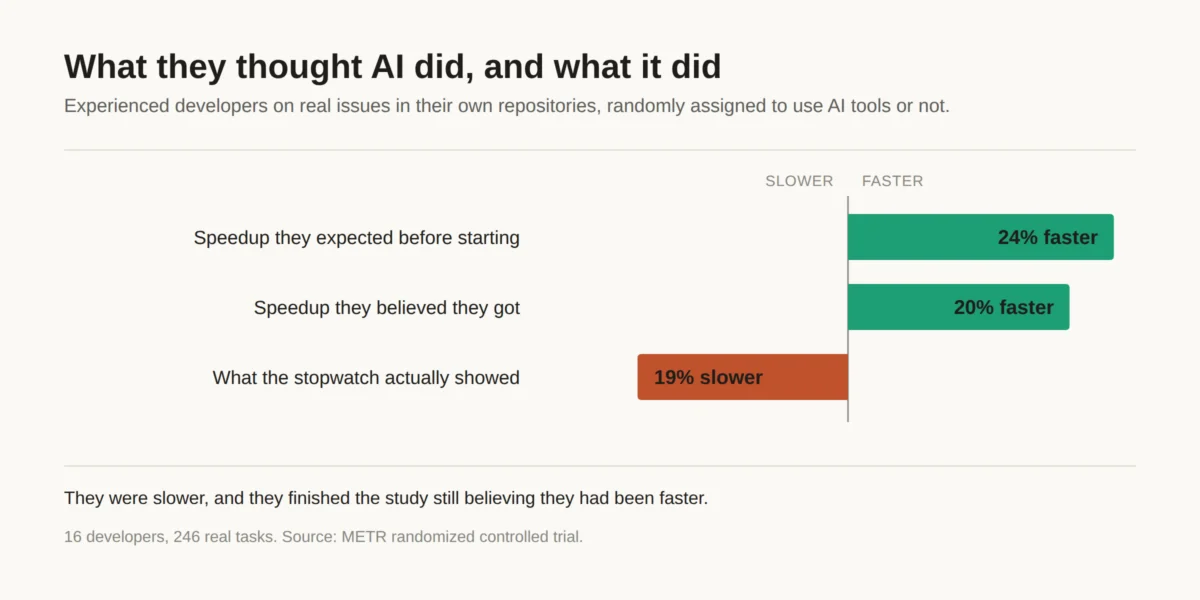
The disconnect between perceived and actual AI productivity gains is striking, as illustrated by a recent randomized study involving experienced software developers. Working on real-world projects, these developers, when equipped with AI tools, actually took 19% longer to complete their tasks. Crucially, before commencing the study, they anticipated the AI tools would accelerate their work by roughly a quarter. Even after experiencing a slowdown, they still maintained a belief that AI had improved their speed by approximately 20%.
This phenomenon can be attributed to a cognitive bias where the ease and speed of content generation are readily perceived, while the subsequent, often invisible, labor of reading, understanding, and refining that content is not. The cost of reading is diffuse; it is often borne by individuals other than the creator of the AI-generated material, leading to its omission from initial AI adoption business cases. The person generating the content benefits from the perceived speed, while the cost of ensuring its quality is absorbed elsewhere in the organization.
The Bottleneck Effect: When Speed Creates Congestion
The implications of this "revision tax" become particularly acute when applied to typical marketing team structures. Consider a scenario where eight team members, each producing four AI-assisted documents daily – a volume they would not have previously attempted – are funneling their output towards one or two senior reviewers. This scenario mirrors fundamental operational principles observed in other industries: bottlenecks do not disappear when upstream processes accelerate; they merely become more pronounced. Speeding up everything before a constraint only serves to lengthen the queue behind it.
In marketing, the most senior and trusted reviewers often become this critical choke point. The AI programs that were implemented with the intention of enhancing productivity have, paradoxically, made the jobs of these essential personnel more demanding and time-consuming. This creates a situation where the organization’s capacity for high-quality, strategically sound output is limited not by creation speed, but by the capacity for thoughtful review and refinement.
The Rise of the "Hollow Expert" and the Erosion of Trust
This phenomenon can lead to the emergence of what some are calling the "hollow expert" – an individual who can produce a remarkable volume of work but lacks the deep understanding or critical insight to discuss or defend it. This is a dangerous path toward scaling mediocrity. While the analogy of a calculator user being trusted over someone performing long division holds true, the critical distinction lies in understanding. The calculator user still comprehends the underlying mathematical principles and the significance of the result. In the case of AI-generated content, the lack of genuine human thought and critical engagement in the creation process can lead to an inability to answer questions or adapt the content when challenged, a crucial capability in any strategic marketing discussion.
Writing, at its core, is an act of thinking. Every document generated by an AI model, without thorough human vetting and critical input, represents a thought process that has not been fully completed by a human. While this might be acceptable for simple status updates, it becomes prohibitively expensive and risky for strategic documents where nuanced understanding and foresight are paramount to success.
Strategies for Mitigating the "Revision Tax"
Addressing the "revision tax" requires a strategic re-evaluation of how AI is integrated into workflows, shifting the focus from mere production speed to the holistic quality and impact of the final output. Several practical strategies are emerging among forward-thinking marketing leaders:
-
Establishing Clear Quality Gates and Content Ownership: One effective approach is to implement stringent quality control measures at the point of creation. A marketing leader who declares they will not read AI-generated content unless it has been thoroughly reviewed and edited by the originator is essentially pushing the cost and responsibility back to the creator. This rule ensures that content is subjected to a human filter before reaching senior reviewers, effectively addressing the accounting problem at its source. The business case for AI adoption must evolve to include not only the hours saved in initial drafting but also the hours spent by reviewers in ensuring quality.
-
Embedding Context Across the Organization: A significant portion of "workslop" originates not solely from marketing but also from other departments like sales, product, and customer success. To combat this, there’s a growing recognition of the need to embed essential contextual information – such as brand voice, positioning guidelines, and operational context – directly into the tools used across the entire company, not just within marketing. When this foundational context is universally accessible, the initial drafts generated by AI are more likely to be closer to a usable state, regardless of the originating department.
-
Making the Editing Effort Visible and Accountable: Some marketing leaders are implementing systems to track the extent of revisions required for content landing on their desks. This data is then used constructively in one-on-one meetings, not as a punitive measure, but as a signal to individuals about the importance of thoroughly reviewing their own work before submission. This transparency encourages a greater sense of ownership and diligence in the initial stages of content creation.
-
Prioritizing "What Sucks" Before Accelerating: A critical insight is that not all processes are candidates for AI-driven acceleration. Some workflows are fundamentally broken and attempting to speed them up will only lead to faster failures, albeit with a more detailed audit trail. A more effective strategy involves first identifying and addressing the most problematic or inefficient processes within a team. By directly asking directors and team members what "sucks" about their current workflows, leaders can then target AI solutions specifically at these pain points. This approach not only addresses genuine inefficiencies but also garners buy-in and political capital, as it tackles issues that are already widely acknowledged and complained about.
-
Focusing on Orchestration and Workflow Design: Ultimately, effectively integrating AI requires sophisticated orchestration. This involves meticulously designing intake processes, defining clear work ownership, and establishing robust capacity planning for execution teams. While these aspects may lack the immediate allure of cutting-edge technology, they are the bedrock of sustainable efficiency. Organizations that have successfully navigated this challenge, often after previous failed attempts, have implemented streamlined intake systems, trackable service level agreements (SLAs), and credible capacity planning. This level of operational maturity is what distinguishes teams that have merely increased their speed from those that have achieved speed in the right areas, driving meaningful business outcomes.
The Future of AI in Marketing: Quality Over Quantity
In an era where AI tools can generate content at an unprecedented volume, the true differentiator for marketing teams will be their ability to produce defensible, high-quality output. The focus must shift from the sheer quantity of AI-generated material to the quality and strategic value of the final product. As more organizations grapple with the "revision tax," the emphasis will increasingly be on thoughtful integration of AI that augments human expertise and critical thinking, rather than simply automating the creation of potentially superficial content. The ultimate goal is not to produce more, but to produce better, and to ensure that the tools we adopt serve to elevate, not dilute, the strategic impact of our marketing efforts.