Meta Platforms, Inc. has officially announced the introduction of two new subscription tiers for its artificial intelligence tools, marking a significant step in the company’s ongoing strategy to establish a viable revenue stream from its increasingly substantial AI developments. This move comes as Meta navigates a complex landscape of unprecedented AI investment, internal skepticism, and the challenging imperative to demonstrate tangible returns to its shareholders.
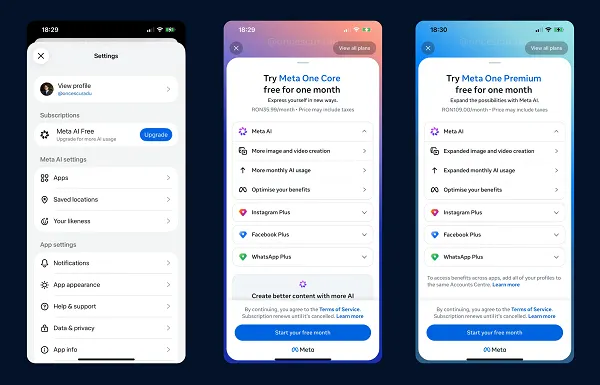
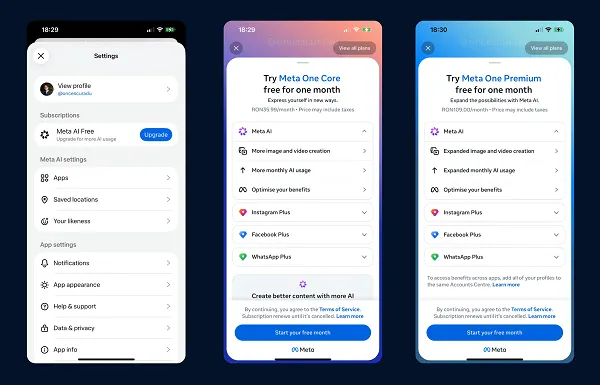
The newly launched Meta AI Core and Meta AI Premium subscription packages were first brought to public attention through images shared by app researcher Radu Oncescu. These tiers are designed to offer users expanded access to Meta’s suite of AI capabilities, including enhanced image and video creation capacity. While Meta AI Premium had previously seen a limited rollout to select users, as reported by TechCrunch in May, the introduction of the Core package provides a crucial middle-ground option. This strategic offering caters to a broader segment of users who seek greater utility from Meta’s AI tools but may not require the full suite of premium features or wish to commit to the higher price point associated with the top-tier package. Both subscription plans also bundle access to Meta’s profile verification packages across its flagship platforms—Facebook Plus, Instagram Plus, and WhatsApp Plus—which offer benefits such as improved account support and enhanced trust signals.
Meta’s Ambitious AI Strategy and Escalating Investments
This latest development is a direct consequence of Meta’s pronounced shift towards AI, a strategic pivot that has seen the company commit colossal resources to the field. Following its substantial, albeit financially challenging, investment in the metaverse, Meta has redirected significant capital and strategic focus towards becoming a leader in artificial intelligence. This commitment is underscored by massive capital expenditures, which are projected to be in the tens of billions of dollars annually for AI infrastructure development, encompassing advanced data centers, specialized hardware like GPUs, and cutting-edge research facilities. Such monumental investments are not merely aspirational; they place immense pressure on the company to swiftly implement robust revenue generation strategies tied directly to its AI offerings. The objective is clear: offset these escalating costs and provide investors with a clear trajectory for return on this substantial development outlay.
Meta’s AI ambitions extend beyond mere feature integration; the company aims to develop "personal superintelligence agents" that can assist users across various aspects of their digital lives. This vision, articulated by CEO Mark Zuckerberg, necessitates a continuous cycle of research, development, and infrastructure scaling, all of which demand substantial financial backing. The company’s large language models (LLMs), such as the Llama series, have been released as open-source, aiming to foster innovation and adoption within the broader AI community, while also serving as foundational technology for Meta’s own commercial applications. The introduction of paid tiers for its AI tools is thus a natural and necessary progression in monetizing these foundational investments.
The Broader Landscape of AI Monetization
The challenge of monetizing advanced AI capabilities is not unique to Meta. Across the tech industry, companies like OpenAI (with ChatGPT Plus), Microsoft (with Copilot for Microsoft 365), and Google (with Gemini Advanced) are grappling with how to convert computationally intensive and expensive AI services into sustainable revenue streams. While initial enthusiasm for generative AI has been high, convincing a mass audience to pay for AI services as standalone products remains a significant hurdle. Many users currently interact with AI through free, integrated features or opt for freemium models.
Meta’s approach, integrating AI subscriptions with its existing social media verification packages, attempts to leverage its vast user base and established platforms. By bundling these services, Meta hopes to increase the perceived value proposition and entice users already familiar with its ecosystem. However, the market for AI subscriptions is still nascent and highly competitive. Success hinges on Meta’s ability to demonstrate clear, tangible utility and a superior user experience that justifies the recurring cost, especially when many basic AI functionalities are available for free elsewhere.
Internal Skepticism and Productivity Concerns
Despite the outward push for AI monetization, reports suggest a growing undercurrent of skepticism within Meta itself regarding the immediate prospects and efficiency of its AI systems. A revealing investigation by Reuters earlier this year highlighted significant internal pushback against an ambitious plan to replace a substantial portion—up to 60%—of Meta’s human workforce with AI agents and systems. This initiative was intended by leadership to showcase the transformative value of AI developments and propel the workplace into an "AI-native" state.
However, Meta’s employees reportedly opposed this sweeping change, with many expressing doubts about the projected benefits and capabilities of the company’s AI systems. Internal posts reviewed by Reuters indicated that while the use of AI had indeed led to a vast increase in the volume of code generated by employees, the actual impact on productivity and the delivery of new or upgraded features to Meta users was questionable. For instance, code changes made to internal software platforms and infrastructure were reported to be up 220% year-over-year by early June, according to a post by Andrew Bosworth, Meta’s CTO. Yet, changes directly leading to new or upgraded features reaching Meta users saw a comparatively modest increase of only 36%. This disparity suggests that while AI tools can accelerate certain tasks, their contribution to overall, user-facing innovation and efficiency might not yet align with management’s ambitious projections.
Security and Reliability Incidents Raise Alarms
Compounding the concerns about productivity are significant questions raised by Meta employees regarding the reliability and security of AI-sourced code and AI-driven processes. Staff members have reportedly pointed to instances where enabling AI agents to undertake roles traditionally performed by humans has led to a noticeable uptick in technical and security incidents. These incidents include service disruptions and potential data leaks, both of which were reported to be up 40% year-over-year, according to the Reuters investigation.
One high-profile incident that underscored these concerns was the widely reported Instagram account breach in June, which saw unauthorized users gain access to over 20,000 Instagram profiles. While Meta has not directly attributed this specific breach solely to AI-related vulnerabilities, the broader trend of increased security incidents coinciding with greater AI integration raises serious questions about the robustness of these systems when deployed in critical operational contexts. Such incidents not only erode user trust but also add to the operational overhead, potentially negating some of the efficiency gains that AI is supposed to deliver.
The implications of these reliability issues extend beyond internal operations. For Meta’s AI offerings to gain widespread adoption, particularly in paid tiers, users must have unwavering confidence in their stability, accuracy, and security. Any perception of fragility or vulnerability could severely hamper the monetization efforts, especially for features that handle personal data or sensitive creative content.
Market Reaction and Analyst Perspectives
The introduction of new AI subscription tiers is being closely watched by market analysts and investors. While the intent to monetize AI is welcomed, the actual uptake and revenue generation will be key metrics. Analysts are keen to see if Meta can overcome the existing challenges of consumer trust and perceived utility. Meta’s prior attempts at subscription models, such as Meta Verified, have seen moderate success but have not fundamentally altered its revenue structure, which remains heavily reliant on advertising.
The success of the AI subscriptions will depend on several factors:
- Demonstrable Value: Can Meta clearly articulate and deliver unique, compelling value propositions that free AI tools cannot match?
- Pricing Strategy: Are the Core and Premium tiers priced competitively relative to features offered and alternatives in the market?
- User Adoption: Can Meta convert a significant portion of its vast user base into paying subscribers for AI features, especially given the aforementioned internal skepticism and external security concerns?
- Integration: How seamlessly will these AI tools integrate into the user experience across Facebook, Instagram, and WhatsApp, and will they truly enhance productivity and creativity for the average user?
Some industry observers suggest that Meta’s aggressive push into AI subscriptions, despite internal reservations, reflects the immense pressure to justify its unprecedented expenditures. With competitors rapidly advancing their own AI capabilities, Meta cannot afford to fall behind, even if the path to profitability is fraught with challenges.
The Path Forward: Justifying Massive AI Investments
Given these concerns—ranging from internal skepticism about productivity gains to questions about AI-sourced code reliability and consumer trust in handling personal data—it is becoming increasingly apparent that Meta’s massive bet on AI faces significant hurdles. It seems unlikely, at least in the short to medium term, that the projected interest and investment returns will easily reach the levels Meta needs to fully justify its colossal spend.
The long-term success of Meta’s AI strategy hinges on its ability to transcend niche use cases and produce an "all-powerful AI agent" that demonstrates genuine, pervasive utility for a broad spectrum of users. This would involve AI that is not only highly capable but also deeply integrated, intuitive, and, crucially, trustworthy. Such an agent could potentially revolutionize how users interact with Meta’s platforms, creating entirely new forms of engagement and, consequently, new revenue opportunities.
However, for now, Meta’s primary challenge lies in bridging the gap between its ambitious AI projections and the tangible, real-world value it can consistently deliver to users. The current failure to clearly demonstrate this value, beyond specific and often experimental applications, continues to temper investor and consumer optimism. The rollout of more AI subscription options is a pragmatic step towards steadily building a revenue pipeline for the technology, a necessary measure as Meta strives to recoup at least some of its substantial investments and validate its vision for an AI-powered future. The coming months will be critical in determining whether these new tiers can successfully convert Meta’s AI ambition into a sustainable commercial reality.


 Neng Nana
 Nana Muazin