A groundbreaking European Union regulation, the E.U. AI Act (Regulation (EU) 2024/1689), designed to bring transparency to artificial intelligence-generated content, is inadvertently raising significant concerns among marketers. While intended to foster trust by making "synthetic" content machine-detectable, the framework could inadvertently create a robust infrastructure for surveillance and censorship, allowing governments and platforms to potentially segregate and penalize text based on its origin rather than its intrinsic quality or factual accuracy. In response to this evolving regulatory landscape, leading AI developer Anthropic has announced that all future iterations of its Claude models will incorporate identifiable, text-based "watermarks," a move expected to be emulated by other major players in the AI industry.
The E.U. AI Act, which officially entered into force on June 14, 2024, with a phased implementation over the next two years, represents a monumental effort to govern the rapidly expanding domain of artificial intelligence. The core objective is to establish a clear legal framework that addresses the risks associated with AI systems, promoting innovation while safeguarding fundamental rights and democratic values. A key component of this ambitious legislation is the requirement for transparency regarding AI-generated content. The Act mandates that users must be informed when they are interacting with content that has been produced or manipulated by AI. This includes deepfakes, synthetic audio, and, critically for the marketing sector, AI-generated text.
The challenge lies in reliably identifying AI-generated text. While some might point to stylistic quirks like the use of em dashes or colons as indicators, these are hardly definitive. Such punctuation marks have been standard linguistic tools for centuries, long predating the advent of sophisticated language models like ChatGPT or Claude. The very nature of AI development is geared towards mimicking human writing styles, making any reliance on superficial textual anomalies an increasingly futile endeavor. As AI models become more sophisticated, their output grows more nuanced and human-like, rendering subjective or easily mimicked identification methods obsolete. The E.U.’s insistence on detectability, however, necessitates a more robust, systemic approach.
Anthropic’s proactive adoption of a watermarking strategy highlights the industry’s response to this regulatory imperative. The company has detailed its approach, which leverages a Google-developed technique known as SynthID-Text. This method embeds a subtle, imperceptible watermark directly into the text as it is being generated by the AI model. Crucially, this watermark is designed to be detectable without requiring the original AI model, access to a massive database, or significant computational resources for analysis. This makes real-time or near real-time detection feasible across various platforms and applications.
The Technical Underpinnings of AI Content Identification
At its core, the generation of text by Large Language Models (LLMs) involves the processing of data in discrete units called "tokens." These tokens can represent parts of words, whole words, numbers, or punctuation. When an AI model is tasked with generating content, such as a blog post, product description, or email marketing campaign, it begins with an initial token and then statistically predicts the most probable subsequent token. This sequential prediction process, driven by complex algorithms trained on vast datasets, is what constructs coherent and contextually relevant text.
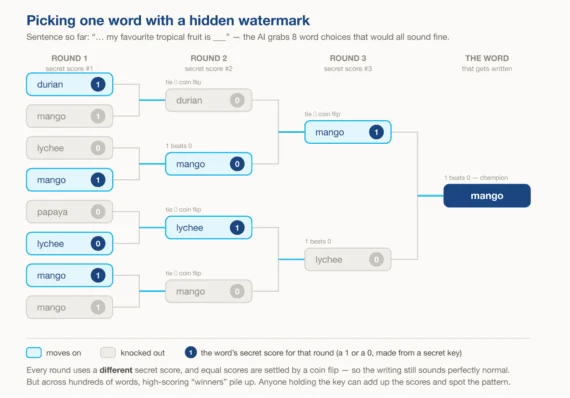
For instance, if an AI model is prompted to complete the sentence "My favorite tropical fruit is," it will analyze statistical probabilities to select the next token. While "mango" might be a highly probable choice, the model might also select "papaya," "durian," or "lychee" with varying degrees of likelihood, depending on its training data and the specific prompt. This inherent variability in token selection is precisely what SynthID-Text exploits to embed its watermark.
The SynthID-Text approach operates on a principle akin to a statistical tournament for each generated token. When the AI model considers multiple plausible next tokens, SynthID introduces a hidden scoring mechanism. These "competitor" tokens are evaluated based on their likelihood and the model’s internal scoring, with a "winner" being subtly influenced by the watermarking algorithm. This process is not about forcing a specific word but about introducing a statistically detectable bias in the selection of tokens.

The "Tournament" Mechanism: Building a Statistical Watermark
The "tournament" analogy is particularly apt for understanding how SynthID builds its watermark. Imagine the AI model considering eight potential next tokens for a given position in a sentence. SynthID doesn’t simply pick one; instead, it assigns scores to each of these tokens based on their probability and other internal metrics. Through a series of rounds, analogous to a sports bracket, these scores determine which tokens advance. The final winning token, while still appearing natural to a human reader, carries a subtle statistical imprint from the watermarking process.
For example, if the AI is deciding between "durian," "mango," "lychee," and "papaya" to complete a sentence about tropical fruits, SynthID might run a series of comparisons. In one instance, "mango" might emerge as the statistically favored token after several rounds of scoring. However, in a different sentence or under slightly varied conditions, "papaya" might win. The key is that the sequence of winning tokens across a longer piece of text will exhibit a pattern that deviates from what pure random chance would produce.
This pattern is the watermark. While a single "winning" token might not be conclusive, hundreds or thousands of such "tournament" wins within a passage create a robust statistical signature. The more tokens generated under the influence of the watermarking algorithm, the stronger and more reliable the watermark becomes. This statistical deviation from natural language probabilities is what allows for the identification of AI-generated content.
Detection: Unveiling the Hidden Signal
The detection of these watermarks is facilitated by a specialized "detector" algorithm. This algorithm, armed with a secret key that corresponds to the watermarking process, can deconstruct a passage of text. It breaks the text down into its constituent tokens and then essentially "replays" the scoring and selection process that occurred during generation. By reconstructing the "tournament scores" for each token, the detector can ascertain whether the sequence of token choices strongly correlates with the expected statistical patterns of the watermark.
The confidence in detection increases significantly with the length of the text. A short passage might contain a few token choices that coincidentally align with the watermark, leading to a potential false positive. However, as the passage grows, the statistical significance of the watermark becomes more pronounced. Hundreds of instances where token choices align with the watermark provide compelling evidence that the AI’s generation process was influenced by the watermarking algorithm, rather than by pure probabilistic selection.
Conversely, factual content or text that undergoes significant human editing or user feedback during its creation may exhibit fewer detectable watermarking signals. This is because such inputs can narrow the range of plausible token choices, potentially overriding the subtle statistical biases introduced by the watermarking process. Nevertheless, even in these scenarios, any passage that scores above a predefined detection threshold is flagged as either fully AI-generated or, at the very least, AI-assisted.
The Marketing Dilemma: From Content Creation to Content Control
The ability to identify AI-generated text with a high degree of confidence presents a significant inflection point for the marketing industry. Search engines, social media platforms, LLMs used as research tools, and even email clients now possess the technical capability to isolate and potentially filter or suppress content based on its origin. This has profound implications for ecommerce marketers who have increasingly relied on generative AI to scale their content creation efforts efficiently and cost-effectively.
The core advantage of generative AI for marketing teams, particularly smaller ones, has been its capacity to produce a high volume of diverse content – from blog posts and social media updates to product descriptions and email newsletters – with minimal human intervention and at a fraction of the cost of traditional content creation. The E.U. AI Act’s mandate for identifiable AI content, coupled with the detection capabilities it enables, risks undermining this advantage.

There is a palpable concern that AI-generated content could be effectively treated as a proxy for content quality or authenticity. Search engines, for instance, might de-prioritize AI-aided pages in their search rankings, fearing a proliferation of low-quality or manipulative content. LLMs might be programmed to avoid using AI-generated text as sources for their own responses, limiting the utility of AI-produced research. Social media platforms, such as Pinterest which has already begun to label AI-generated content, could further reduce the distribution of such material, effectively throttling its reach. Even email clients might begin routing AI-generated marketing messages to spam folders or dedicated "likely AI" inboxes, significantly impacting open rates and engagement.
This potential for segregation and censorship raises critical questions about the future of digital content and marketing strategies. While the E.U. AI Act aims to protect consumers and ensure fair competition, its implementation could inadvertently create a tiered system of content, where human-created or traditionally produced content is implicitly favored over AI-assisted material.
Furthermore, the inherent statistical nature of AI detection means that the system is not infallible. The accuracy of detection hinges on the chosen threshold for identifying a watermark. If this threshold is set too low to ensure broad detectability, the likelihood of false positives – incorrectly flagging human-generated content as AI-generated – increases. Such errors could lead to unwarranted penalties and reputational damage for businesses and creators.
Broader Implications and the Path Forward
The E.U. AI Act’s approach to content identification is part of a global trend towards greater AI governance. Many countries are exploring similar regulatory frameworks, aiming to balance the benefits of AI with the need for ethical deployment. The E.U.’s model, with its emphasis on transparency and detectability, is likely to influence these international discussions.
For marketers, this regulatory shift necessitates a strategic re-evaluation. Instead of solely focusing on cost savings and speed of production through AI, there will be an increased emphasis on the quality, originality, and perceived authenticity of content. This might involve a hybrid approach, where AI is used for initial drafts, ideation, or content repurposing, but with significant human oversight and editing to ensure compliance with evolving identification standards and to imbue the content with a distinct human touch.
The development of watermarking technologies like SynthID-Text is a crucial step in enabling the E.U. AI Act’s objectives. However, the potential for these technologies to be used for broader surveillance or censorship remains a significant concern. As AI continues to permeate every aspect of our digital lives, the dialogue surrounding its regulation must remain open, adaptive, and mindful of the delicate balance between fostering innovation and protecting fundamental freedoms. The marketing industry, in particular, will need to navigate this new landscape with agility, prioritizing transparent communication and authentic engagement with their audiences. The era of easily scalable, purely AI-generated marketing content may be giving way to a more nuanced and carefully curated approach, driven by both technological capabilities and regulatory imperatives.