The digital advertising landscape is undergoing a significant recalibration, prompting brands and marketers to critically reconsider the fundamental definition of "engagement," particularly concerning video view metrics. This imperative is underscored by recent methodological updates from major platforms like YouTube, which has altered how it calculates video views. These changes highlight a long-standing inconsistency in how social media platforms measure what constitutes a "view," creating a complex environment where accurate campaign reach and audience interest can be easily misconstrued. Understanding these nuances is no longer a matter of best practice but a foundational requirement for effective digital strategy.
The Evolving Landscape of Video View Definitions
For years, the "view count" has served as a primary, albeit often superficial, indicator of content performance and audience reach in the digital realm. However, this seemingly straightforward metric harbors significant complexities. Each social media platform, driven by its unique content formats, user interaction models, and internal algorithms, has developed distinct criteria for what qualifies as a video view. This divergence creates a fragmented measurement ecosystem, making direct comparisons across platforms challenging and potentially misleading.
YouTube’s recent adjustments, for instance, are part of an ongoing industry-wide effort to refine metrics, combat fraudulent activity, and provide more meaningful data to content creators and advertisers. While specific details of YouTube’s latest recalibration are often proprietary, such updates typically aim to filter out bot traffic, low-quality views, and accidental plays, thereby providing a more authentic representation of human engagement. This move, however, inevitably shifts baseline numbers, necessitating a re-evaluation of historical data and future projections for all stakeholders. The definition of a view can vary significantly, even within a single platform, depending on factors such as video length, autoplay settings, and whether the view originated from an organic feed or a paid advertisement.
Decoding Platform-Specific View Metrics
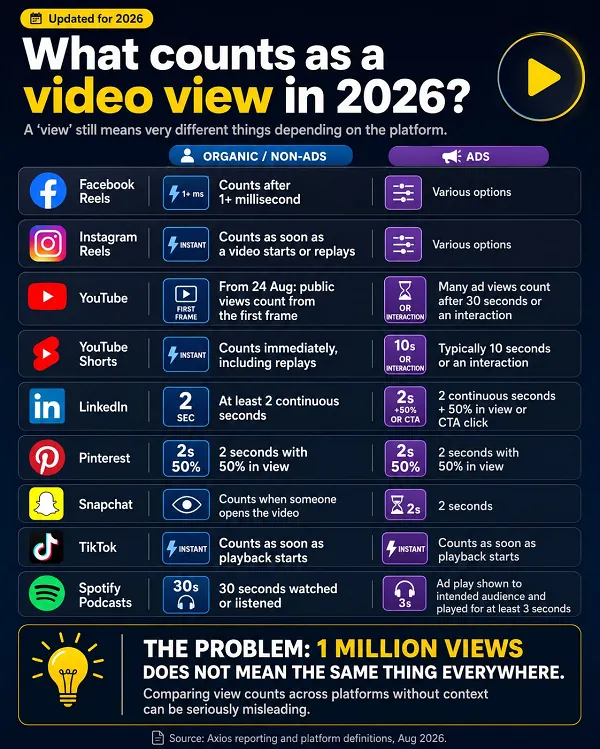
The disparity in view definitions is a critical challenge. What one platform counts as a view, another might disregard, leading to inflated or deflated performance perceptions. Insights from industry analysis, such as that provided by Axios reporters Sara Fischer and Kerry Flynn, and simplified graphics from social media commentators like Matt Navarra, reveal a patchwork of measurement approaches.
Here’s a general overview of how various prominent platforms typically define a video view, acknowledging that these definitions are subject to continuous updates and may have specific caveats for different content types (e.g., in-feed videos vs. Stories vs. Live streams):
- YouTube: Traditionally, YouTube counts a view when a video is watched for approximately 30 seconds. For shorter videos (under 30 seconds), watching the entire video typically counts as a view. The platform employs sophisticated algorithms to filter out spam, bots, and repeated views from the same user within a short timeframe, ensuring that views are legitimate. Recent updates aim to further enhance this accuracy, potentially impacting how views are tallied, especially for specific formats or regions. Live streams also have specific view counting methodologies, often tracking concurrent viewers and total unique viewers over time.
- Facebook/Instagram: For standard in-feed videos, Facebook and Instagram generally count a view after a video has been watched for at least 3 seconds. This low threshold is designed to capture fleeting attention in scroll-heavy feeds, where videos often autoplay silently. For longer-form content or videos watched with sound on, the platforms might differentiate between "3-second views" and "10-second views" or "ThruPlays" (watched to completion or for at least 15 seconds), offering more granular data. Story views are typically counted as soon as the story is opened.
- TikTok: As a platform built on short-form, highly engaging video, TikTok’s view count is often triggered almost immediately upon a video appearing in a user’s "For You" feed, even if only for a fraction of a second or a few frames. Given the rapid consumption nature of TikTok, this immediate count aims to reflect exposure rather than deep engagement. The sheer volume of views on TikTok can be impressive but requires careful interpretation regarding actual consumption duration or intent.
- X (formerly Twitter): X typically counts a video view when a video is 50% in-view on screen for at least 2 seconds. Similar to Facebook, videos often autoplay in users’ timelines. This metric aims to capture instances where a user has had at least a minimal opportunity to perceive the content.
- LinkedIn: For professional content, LinkedIn generally counts a video view when it has been watched for at least 3 seconds, similar to Facebook. This metric applies to native video uploads within the feed, reflecting engagement within a professional context.
These variations underscore the "gray areas" within view definitions. Factors such as whether a video autoplays, if sound is on by default, the percentage of the video in view, and the duration of playback all contribute to a complex matrix of metrics. Consequently, a high view count on one platform may not be directly comparable to a similar number on another, or even to a different format on the same platform, in terms of actual audience interest or engagement quality.
The Imperative for Metric Transparency and Accuracy
The digital advertising industry’s journey towards reliable measurement has been fraught with challenges. In the mid-2010s, for instance, Facebook faced significant scrutiny and a class-action lawsuit over inflated video metric reporting, admitting to miscalculating average watch times for video ads for years. This incident, among others, highlighted the urgent need for greater transparency and independent verification of digital metrics.
Industry bodies like the Media Rating Council (MRC) have played a crucial role in establishing guidelines for valid advertising impressions and viewability across digital platforms. The MRC’s standards often dictate that for an ad impression to be counted as viewable, at least 50% of its pixels must be visible on screen for a minimum of two consecutive seconds for video ads. While these standards primarily apply to paid advertising, they inform the broader discourse around what constitutes a meaningful "view" for organic content as well. The continuous evolution of platform algorithms and content formats, such as the explosion of short-form video, necessitates ongoing adaptation of these guidelines.
The push for accuracy is also fueled by the escalating costs of digital advertising and the growing reliance of businesses on data-driven decisions. As global digital ad spending continues its upward trajectory, projected to reach over $800 billion by 2026, the demand for precise performance indicators becomes paramount. Inaccurate view counts can lead to misallocated budgets, flawed campaign strategies, and an inability to accurately assess return on investment (ROI).
The Impact on Brands and Marketers
For brands and marketers, the inconsistencies in view counting present several critical challenges:
- Misleading Campaign Performance: Relying solely on raw view counts can lead to an inflated sense of campaign success. A high view count, especially from platforms with low thresholds, might not translate into actual audience interest, brand recall, or conversion. This can distort the perceived effectiveness of content and marketing initiatives.
- Ineffective Media Buying and Budget Allocation: When comparing performance across different platforms, marketers might inadvertently prioritize channels that report higher view counts but deliver lower quality engagement. This can result in misallocating advertising budgets to less impactful platforms or content formats.
- Complex Influencer Marketing Negotiations: In the burgeoning creator economy, influencer partnership deals are often predicated on metrics like view counts and subscriber numbers. YouTube’s revised methodology, or any platform’s metric update, can significantly alter a creator’s reported reach. Brands must now delve deeper than surface-level metrics, scrutinizing watch time, engagement rates (likes, comments, shares), audience demographics, and conversion data to assess an influencer’s true value. A sudden rise in a creator’s view count might simply be a counting update, not a surge in genuine audience growth.
- Challenges in Attribution: Understanding which touchpoints contribute to a customer journey is vital. If the foundational metric of a "view" is inconsistent, it complicates attribution models, making it harder for marketers to credit specific video content with driving desired outcomes.
- Shift from Vanity Metrics to Meaningful Engagement: The evolving landscape forces marketers to move beyond "vanity metrics" like raw view counts. Instead, the focus must shift towards more qualitative indicators such as average watch time, video completion rates, click-through rates, sentiment analysis of comments, and shares. These metrics provide a richer understanding of how deeply an audience is engaging with content.
Implications for Content Creators and the Creator Economy
Content creators, who often build their livelihoods on platform metrics, are directly affected by these changes. Their ability to attract brand partnerships, monetize content through advertising, and grow their audience hinges on reliable performance data.

- Perceived Value and Monetization: A creator’s perceived value by brands and advertising networks is heavily tied to their reach and engagement metrics. Changes in how views are counted can directly impact their reported performance, potentially affecting their earning potential and negotiation power.
- Content Strategy Adaptation: Creators may need to adapt their content strategies to align with how platforms prioritize and measure views. For instance, if a platform emphasizes longer watch times, creators might focus on producing more engaging, in-depth content. Conversely, if short, impactful exposure is valued, rapid-fire, attention-grabbing content might be favored.
- Transparency with Brands: Creators must be prepared to transparently explain their metrics to potential brand partners, detailing how views are counted on their primary platforms and providing a holistic view of their audience engagement beyond just the view count. This often means providing more sophisticated analytics on audience demographics, engagement rates, and even conversion data if applicable.
Industry Reactions and the Call for Standardization
The ongoing debate surrounding view metrics has elicited varied reactions across the industry. Platform representatives often emphasize that updates are made to enhance accuracy, combat fraudulent activity, and provide more meaningful data, aligning with industry best practices and advertiser demands. These changes are typically presented as efforts to protect the integrity of the ecosystem.
Advertising agencies and industry bodies, however, continue to advocate for greater standardization and transparency. There’s a persistent call for a more universal definition of a video view, or at least clearer, more consistent reporting standards that allow for easier comparison across platforms. The absence of such standardization forces agencies to invest significant resources in understanding and reconciling disparate data sets, adding layers of complexity to campaign management.
Furthermore, the issue extends to ethical considerations. The potential for platforms to subtly adjust metrics, even with good intentions, can create an environment where creators and advertisers feel a lack of control or transparency over the data that underpins their digital operations. This underscores the need for independent auditing and third-party verification services to validate platform-reported metrics.
Beyond the View Count: A Holistic Approach to Engagement
In light of these complexities, the most effective strategy for brands and marketers is to adopt a holistic approach to measuring video performance, moving beyond the singular focus on view counts. This involves:
- Focusing on Deeper Engagement Metrics: Prioritize metrics such as average watch time, video completion rates, repeat views, click-through rates to websites or landing pages, and engagement actions like likes, comments, shares, and saves. These indicators provide a more profound understanding of audience interest and content resonance.
- Contextualizing Data: Always consider the platform, content format, and campaign objectives when interpreting metrics. A short-form video on TikTok will naturally have different engagement patterns than a long-form tutorial on YouTube.
- Leveraging Audience Demographics and Psychographics: Understand who is watching the content. Are they the target audience? How do they interact with the content? Deeper audience insights can provide invaluable context to view numbers.
- Implementing A/B Testing and Attribution Models: Continuously test different video creatives, calls to action, and distribution strategies. Utilize robust attribution models to understand the true impact of video content on conversion paths and business objectives, rather than relying solely on top-of-funnel metrics.
- Embracing Third-Party Measurement Tools: Where available and credible, utilize third-party analytics and measurement tools that offer standardized reporting or cross-platform comparative analysis, providing an independent perspective on performance.
Conclusion: Navigating the Nuances of Digital Video Performance
The evolving definition of a video view is a testament to the dynamic nature of the digital media landscape. While platforms continue to refine their methodologies to offer more accurate and meaningful data, the onus is on brands, marketers, and content creators to understand these nuances. The era of simply chasing high view counts is waning; the future demands a sophisticated, data-driven approach that prioritizes genuine engagement, audience quality, and strategic alignment over superficial metrics. By embracing a holistic measurement framework and critically evaluating the context behind every number, stakeholders can navigate the complexities of digital video performance effectively, ensuring that their efforts truly resonate and drive tangible value. The conversation has shifted from "how many views?" to "what do those views truly represent, and how do they contribute to our broader goals?" This critical shift will define success in the increasingly sophisticated world of digital content and advertising.