Google is implementing a significant change to its Smart Bidding strategies within Google Ads, fundamentally altering how budget constraints interact with performance targets. Beginning August 17, 2026, the platform will permanently decouple budget limitations from efficiency metrics for key campaign types, a move poised to reshape the landscape of paid advertising and offer advertisers a more predictable path to scaling successful campaigns. This adjustment, detailed in Google’s official support documentation, addresses a long-standing challenge for Pay-Per-Click (PPC) managers: the destabilizing effect of budget increases on campaigns that were artificially achieving low costs per acquisition (CPA) or return on ad spend (ROAS) due to strict budget caps.
Historically, when a campaign operated under a daily budget cap and utilized target-based bidding strategies like Target CPA or Target ROAS, Smart Bidding would aggressively restrict its bidding behavior. This was to ensure it captured only the most cost-effective, highest-intent conversions that could be acquired within the imposed daily spend limit. While this often resulted in seemingly impressive low CPAs or high ROAS, it created a misleading baseline of performance. The campaign wasn’t necessarily outperforming its target; it was simply operating within a highly constrained environment, buying a small, select portion of available inventory. The moment this budget cap was raised, Smart Bidding would be forced to re-evaluate broader auction pools, leading to performance instability, significant CPA spikes, and extended learning periods. This made scaling successful campaigns a high-stakes, often anxiety-inducing process for PPC managers.
The upcoming August 17th change directly confronts this issue. According to Google’s official guidelines, Smart Bidding will now be instructed to optimize strictly towards the defined target CPA or ROAS, irrespective of whether the campaign is currently budget-constrained or operating at full capacity. This means that if a campaign has a $10 Target CPA but has been historically delivering at a $5 CPA due to budget limitations, the algorithm will now aim to deliver closer to the $10 target. While this might initially appear as a reduction in efficiency, industry analysts and Google’s own documentation frame it as a critical stabilization fix that will ultimately enable more predictable and sustainable growth.
The Historical Flaw: When Budget Caps Fueled Artificial Efficiency
To fully grasp the significance of the August 17th update, it’s crucial to understand the mechanics of how Smart Bidding operated under budget constraints. For years, a campaign flagged as "Limited by budget" was not merely a signal of spend limitations. It actively informed the Smart Bidding algorithm to narrow its focus, seeking out only the "lowest hanging fruit" – the most readily available and cost-effective conversions. This created an artificial efficiency ceiling.
Consider a campaign with a $50 Target CPA that consistently delivered conversions at $35. This impressive $15 saving per conversion might lead to client satisfaction and internal accolades. However, this efficiency was often a byproduct of the campaign’s inability to bid on a wider range of auctions due to its restrictive daily budget. When the budget was increased, the algorithm was compelled to explore a broader spectrum of auction opportunities. Since this expanded scope wasn’t part of the campaign’s initial learning phase under budget constraints, it often resulted in a sudden and sharp increase in CPA, pushing it well beyond the original $50 target. This necessitated a new, often lengthy, learning period for the algorithm to re-acclimate to the expanded inventory and re-establish efficiency. This cycle of scaling and subsequent instability was a recurring challenge for many PPC professionals.
The August 17th Shift: Decoupling Budget from Efficiency
The core of the impending change lies in Google’s decision to fundamentally disconnect the budget lever from the efficiency lever. After August 17, 2026, Smart Bidding algorithms will be engineered to prioritize achieving the set target CPA or ROAS above all else, even when faced with budget limitations. This means that if a campaign is set to a $10 Target CPA, and its historical performance under budget constraints was $5, the post-August 17th algorithm will adjust its bidding to bring the actual CPA closer to the $10 target.
This separation is achieved by re-architecting how the algorithm perceives and acts upon budget constraints. Instead of using budget limitations as a signal to aggressively reduce bids and capture only the cheapest conversions, the algorithm will now interpret budget as a directive for scale at the target efficiency. When the budget is increased, the algorithm will be able to capture more volume at the specified target CPA, rather than undergoing a chaotic recalibration of its bidding parameters in an attempt to guess the desired efficiency level. This transition from an efficiency-driven throttle to a scale-driven expansion is expected to create a more linear and predictable scaling experience.
Which Campaigns Will Be Impacted? A Clear Delineation
Google has provided a clear breakdown of which campaign types and bidding strategies will be affected by this significant update. This clarity is essential for advertisers to identify which of their campaigns require attention and strategic adjustments.

- Search, Shopping, Performance Max, Demand Gen, and Travel Campaigns: These campaign types utilizing Target CPA and Target ROAS bidding strategies, as well as Target CPC for Demand Gen, will experience the most profound change. They will be required to strictly adhere to their stated targets, eliminating the previous phenomenon of "budget-cap overperformance."
- Display and Hotel Campaigns: Campaigns in these categories using Target CPA and Target ROAS bidding strategies will see no change in their behavior. This is because they have historically operated under a stricter target-focused optimization model, already decoupling efficiency from budget limitations to a greater extent.
- App Campaigns, Video Reach, and Video View (VVC) Campaigns: These campaign types, employing Target CPA, Target ROAS, or Cost-Per-View bidding, will retain their historical bidding behavior. They are not included in the scope of this particular Smart Bidding overhaul.
- Manual Bidding and Maximize Strategies: Campaigns utilizing manual bidding strategies such as Manual CPC or Target Impression Share, as well as automated strategies like Maximize Conversions or Maximize Value, will remain unaffected by these target-based bidding changes. Their optimization logic is distinct from the target-driven CPA and ROAS strategies being modified.
This targeted approach by Google underscores the specific challenges associated with scaling budget-constrained target-based bidding strategies, while recognizing that other campaign types and bidding models already operate with different efficiency and scaling dynamics.
Preparing for the Shift: Unlocking the Strategic Upside
While the initial reaction within the PPC community has often centered on the potential loss of "cheap conversions," the long-term strategic upside of this update is substantial. The ability to scale campaigns predictably, without the fear of destabilizing performance, represents a significant opportunity for growth. However, this opportunity is not automatic. Google will not proactively adjust bid targets to align with historical "overperformance." Therefore, inaction on August 17th will effectively be an active choice to allow CPAs to trend upwards towards whatever legacy targets remain in campaign settings.
To leverage this change as a scaling opportunity, advertisers are advised to follow a structured transition framework, utilizing Google’s newly introduced Bid Target Adjustment Tool, which became available in accounts on July 6th. This tool is designed to streamline the preparation process for the August 17th deadline.
1. Accessing the Bid Target Adjustment Tool
The Bid Target Adjustment Tool can be accessed directly through notifications within a Google Ads account. Google has pre-populated this view with any campaign that experienced a "Limited by budget" constraint over the past 12 months. This eliminates the need for advertisers to manually sift through historical campaign status logs. For those who wish to conduct manual verification, filtering the campaign table by "Search Lost IS (budget) > 0%" over a 12-month date range will provide a similar overview. It is also recommended to cross-reference this data with the last 30 days of campaign performance to ensure the chosen target is realistic and sustainable.
2. Reviewing and Adjusting Current CPA Bids
The critical step involves strategically reviewing and potentially adjusting the current CPA bids within the affected campaigns. This is not simply a matter of leaving existing targets in place. Advertisers must assess whether the existing Target CPA or ROAS accurately reflects their current business objectives and market conditions. If a campaign has been consistently delivering at a significantly lower CPA than its target due to budget limitations, the advertiser must decide whether to:
- Maintain the current, artificially low CPA target: This would mean the algorithm will now aim to achieve this lower target while spending the increased budget, potentially limiting the volume of conversions acquired.
- Adjust the target CPA upwards to match actual performance: If the historical actual CPA was $35, and the target was $50, but the budget cap kept it at $35, the advertiser might choose to set the target closer to $35 to allow the campaign to scale at that efficiency.
- Set a new, realistic target CPA: This involves forecasting what a sustainable CPA would be at a higher budget level, considering market dynamics, competition, and business profitability goals.
3. Respecting the Conversion Cycle Window
A crucial aspect of successful Smart Bidding is understanding and respecting the conversion cycle window. The algorithm requires time to learn and stabilize after any significant bid adjustments. Google indicates that 1-2 conversion cycles are typically needed for re-stabilization. If a campaign operates with a longer sales cycle, for instance, a one-week cycle, advertisers must factor this into their bid adjustment timing. Making the bid change in advance of the August 17th deadline ensures that the campaign has sufficient time to stabilize its performance within the new parameters before the full impact of the update is felt. For example, if a campaign has a 14-day conversion lag, and a bid adjustment is made on August 10th, the performance observed immediately after August 17th might not reflect the true stabilization.
4. Incrementally Reality Checking and Re-evaluating Value
The shift also presents an opportunity for a more rigorous evaluation of campaign performance and incremental value. Campaigns that have been overperforming with significantly lower CPAs than their targets often capitalize on low-hanging fruit, such as branded search terms or highly qualified audiences that are easily converted. The upcoming change prompts a re-evaluation: does this campaign, at a higher spend level and potentially a slightly higher CPA, continue to generate incremental value for the business? This is the moment to reassess audience targeting, ad creative, and landing page optimization to ensure that the increased spend is not just acquiring more of the same, but genuinely expanding the reach and impact of the advertising efforts. This "reality check" ensures that scaling is not merely about volume, but about profitable, sustainable growth.
The Bottom Line: A New Era of Predictable Scaling
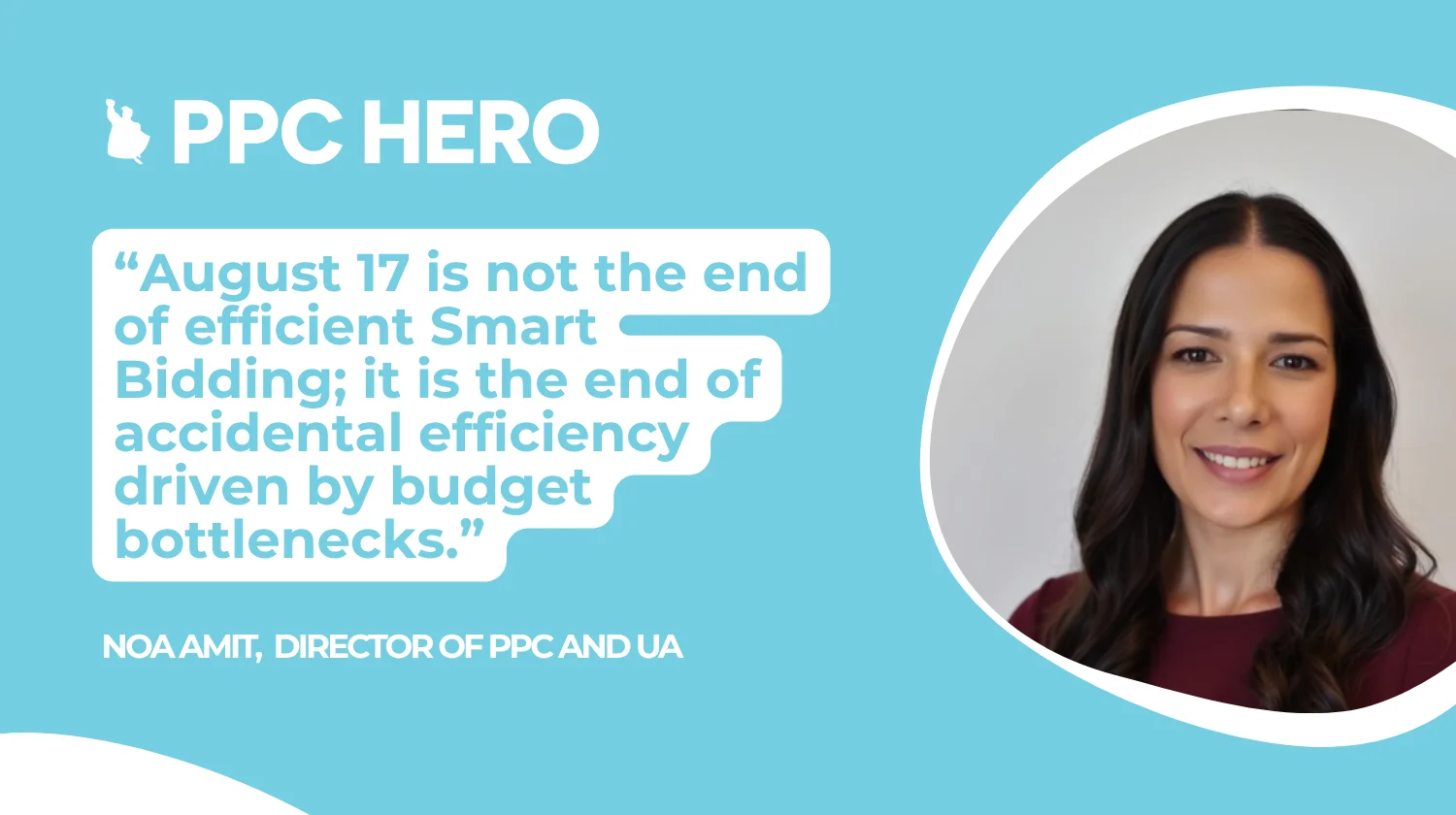
The August 17, 2026, update to Google Ads Smart Bidding is not an impediment to efficient advertising; rather, it marks the end of efficiency that was inadvertently manufactured by artificial budget bottlenecks. By requiring advertisers to align their bid targets with current actual performance, Google is eliminating the risk of unwanted CPA drift. More importantly, it is laying the groundwork for a future where increasing a campaign’s budget will reliably do what it was always intended to do: scale results predictably and effectively without breaking the winning formula. This strategic recalibration by Google Ads signifies a maturation of its automated bidding systems, offering advertisers a more robust and reliable platform for achieving their growth objectives in an increasingly competitive digital landscape. The move is expected to foster greater trust in Smart Bidding and empower advertisers to invest with more confidence in scaling their most successful campaigns.