Shopify and Tiendanube stand as two of the most prominent e-commerce platforms catering to Latin American merchants, yet their origins and intended functionalities diverge significantly. While Shopify has evolved into a global powerhouse serving millions of stores worldwide, Tiendanube, known as Nuvemshop in Brazil, was meticulously crafted with the Latin American market in mind. This regional focus has propelled Tiendanube to power an impressive network of approximately 190,000 live stores across the continent. This in-depth comparison scrutinizes both platforms across critical parameters—pricing, payment processing, sales features, design aesthetics, user-friendliness, and customer support—with all data rigorously verified against official company pricing pages at the time of publication.
The overarching conclusion is that Shopify emerges as the more robust and feature-rich platform overall. However, this assessment carries a significant caveat: for merchants whose sales operations are predominantly confined to Latin America, Tiendanube presents a compelling case as a more cost-effective and pragmatically suited alternative. This analysis will meticulously detail the strengths and weaknesses of each platform, unraveling hidden costs beyond the sticker price, and guiding merchants toward the optimal choice based on their unique selling strategies and operational needs.
Quick Comparison: Shopify vs. Tiendanube
| Category | Shopify | Tiendanube |
|---|---|---|
| Best for | Growing and scaling brands, international selling | Merchants selling primarily within Latin America |
| Entry Price | $5/month (Starter), $39/month (Basic) | Free plan in Argentina & Mexico; paid plans from ~$8 USD (MXN), ~$24 USD (ARS) |
| Top Standard Plan | Advanced, $399/month | Avanzado/Escala, ~$58 USD (MXN), ~$136 USD (ARS) per month |
| Enterprise Tier | Shopify Plus, from $2,300/month | Tiendanube Evolución (custom pricing) |
| Free Plan | No | Yes, in Argentina and Mexico |
| Free Trial | 3 days, then $1/month for 3 months | 7 days on paid plans |
| Native Payment Gateway | Shopify Payments (limited LatAm availability) | Pago Nube (waives per-sale platform fee) |
| Third-Party Gateway Fee | 2% (Basic), 1% (Grow), 0.6% (Advanced) | Varies by plan/country; waived with Pago Nube |
| App Store | 8,000+ apps | 100+ apps |
| Themes | 800+ themes, 13 free | 60+ free templates plus a premium design store |
| Markets Served | Global | Argentina, Brazil, Mexico, Colombia, Chile |
| Support | 24/7 chat/Help Center | Chat/email (all plans), WhatsApp (higher plans) |
Key Takeaways
- Pricing Dominance: Tiendanube offers significantly lower entry costs and free plan options in key markets, making it the clear winner for budget-conscious Latin American merchants.
- Payment Processing Advantage: Tiendanube’s native payment gateway, Pago Nube, incentivizes its use by waiving platform fees, a stark contrast to Shopify’s surcharges for third-party gateways in regions where Shopify Payments is unavailable.
- Feature Depth vs. Regional Focus: Shopify boasts a more extensive feature set, a vast app store, and superior international scaling capabilities. Tiendanube excels in providing localized payment solutions, WhatsApp-centric sales tools, and native language support tailored for the Latin American market.
- User Experience and Localization: Tiendanube offers a simpler, more intuitive interface and is fully localized in Spanish and Portuguese, a critical advantage for merchants and teams operating in those languages.
- Scalability and Internationalization: For businesses with ambitions beyond Latin America, Shopify’s infrastructure and feature set for global expansion are unmatched.
1. Best for Pricing: Tiendanube
The disparity in pricing between Shopify and Tiendanube is perhaps the most significant and straightforward advantage for the latter.
Shopify Pricing
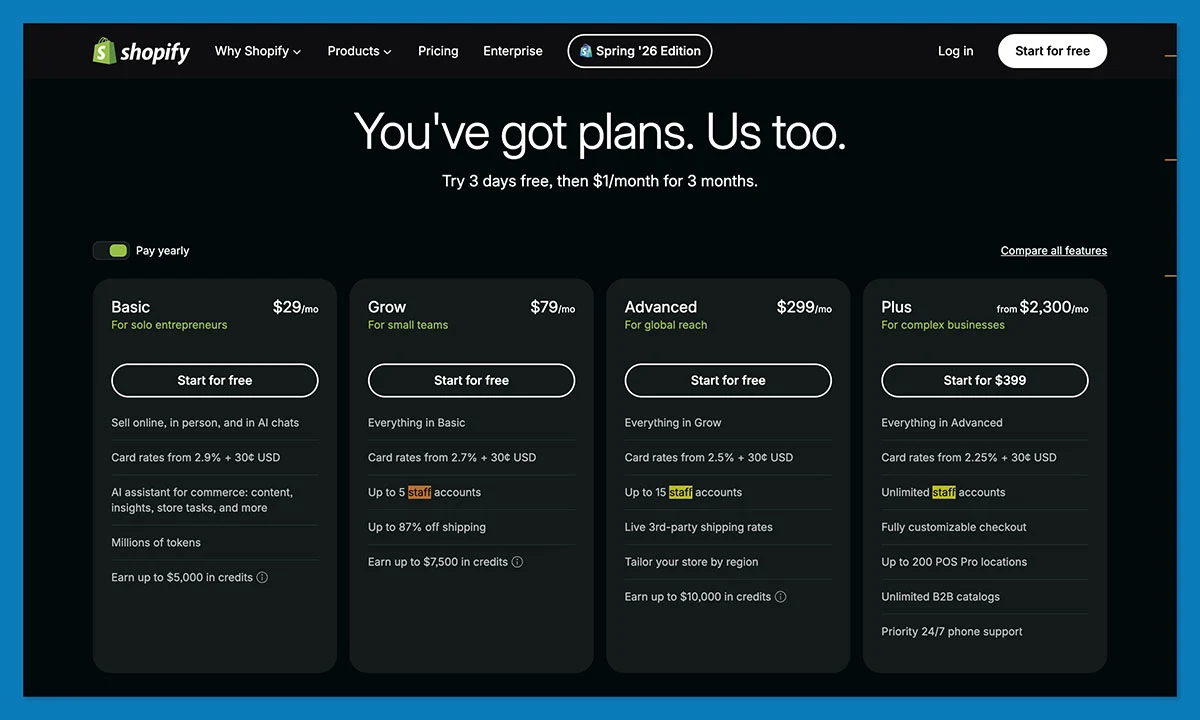
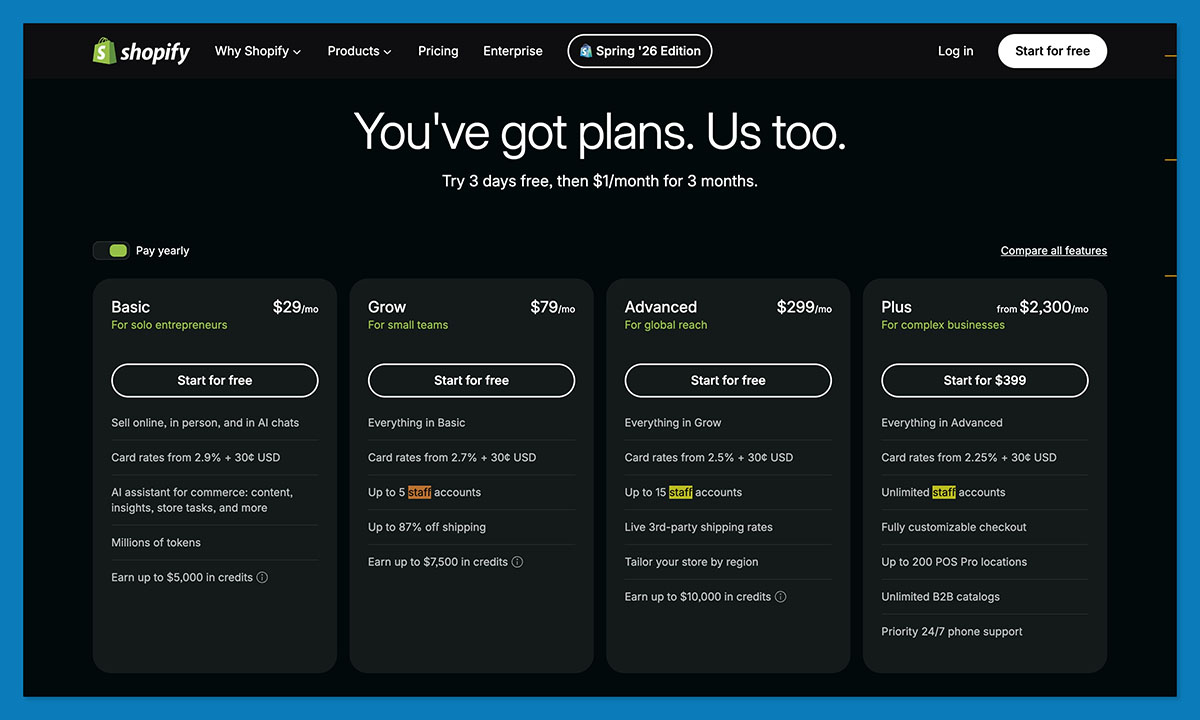
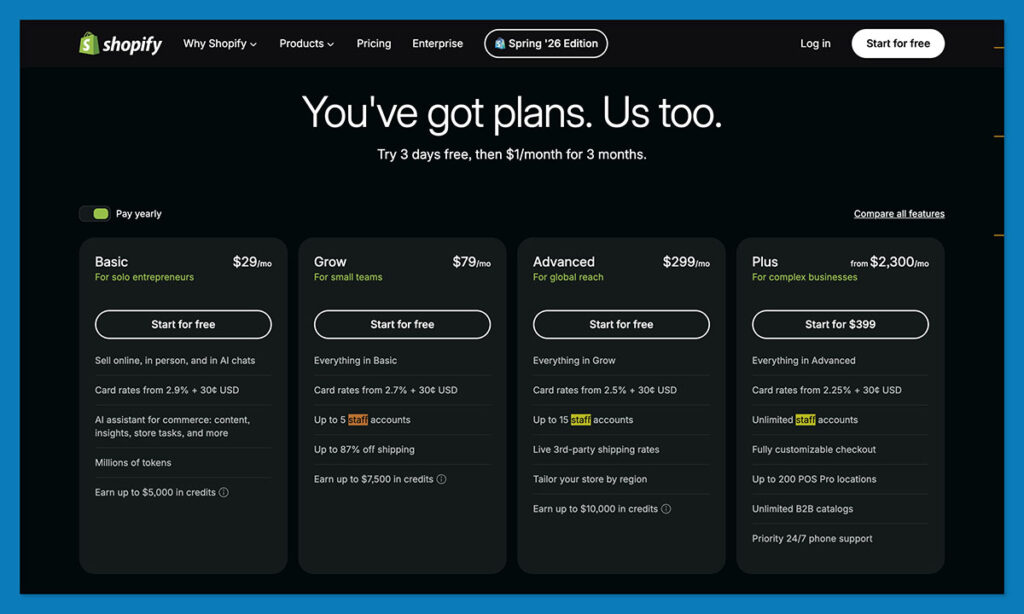
Shopify offers a tiered pricing structure, with plans denominated in US dollars and typically billed in USD. Annual billing provides a substantial discount of approximately 25%, and new users can benefit from a limited-time promotion of $1 per month for the initial three months following a brief 3-day free trial.
| Plan | Monthly Price | Billed Annually | Online Card Rate (Shopify Payments) | Third-Party Gateway Fee |
|---|---|---|---|---|
| Starter | $5 | $5 | Varies | 5% |
| Basic | $39 | $29 | 2.9% + $0.30 | 2% |
| Grow | $105 | $79 | 2.7% + $0.30 | 1% |
| Advanced | $399 | $299 | 2.5% + $0.30 | 0.6% |
| Plus | From $2,300 | Contract terms | Negotiated | 0.2% |
Note: The plan formerly known as "Shopify" has been rebranded as "Grow," maintaining its original pricing and features.
Tiendanube Pricing
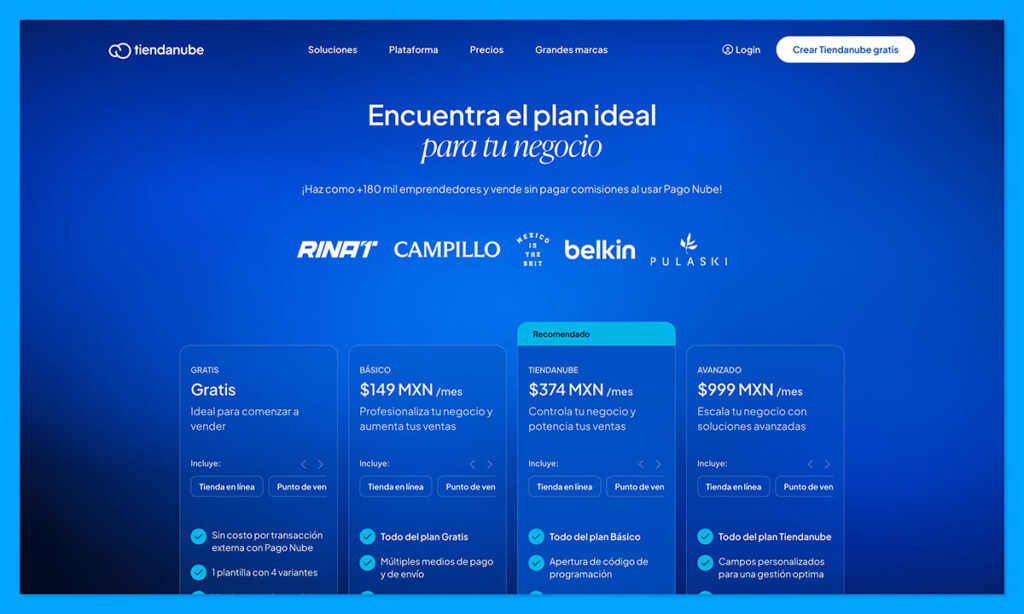
Tiendanube operates with a distinct pricing model, localizing its plans and billing in the currencies of the countries it serves. Crucially, both Argentina and Mexico offer a genuinely free-forever plan. Paid tiers, which include a 7-day free trial, are structured differently by country, with annual billing also offering a 25% discount.
| Country | Free Plan | Entry Paid Plan | Mid Plan | Top Standard Plan |
|---|---|---|---|---|
| Mexico | Gratis, $0 MXN | Básico, $149 MXN/month | Tiendanube, $374 MXN/month | Avanzado, $999 MXN/month |
| Argentina | Inicial, $0 ARS | Esencial, $26,999 ARS/month | Impulso, $78,999 ARS/month | Escala, $234,999 ARS/month |
| Colombia | Not available | Básico, $24,900 COP/month | Tiendanube, $49,900 COP/month | Avanzado, $149,900 COP/month |
| Chile | Not available | Básico, $5,999 CLP/month | Tiendanube, $14,999 CLP/month | Avanzado, $44,999 CLP/month |
Beyond the raw figures, two critical factors differentiate Tiendanube’s pricing:
- Local Currency Billing: This eliminates the risk and cost associated with currency exchange rate fluctuations, a significant advantage for businesses earning revenue in local currencies while facing platform fees in USD.
- Quarterly Price Adjustments: Tiendanube implements quarterly price adjustments tied to local inflation rates. While this ensures transparency and reflects economic realities, merchants must plan for potential increases in their subscription costs over time.
The Winner: Tiendanube is unequivocally the more cost-effective platform for initiating and operating an e-commerce business within Latin America. Its free plan availability in two of the region’s largest markets, coupled with entry-level paid plans that represent a fraction of Shopify’s Basic offering, provides a substantial financial advantage. Furthermore, avoiding US dollar exposure is a tangible benefit. While Shopify’s $1 promotional rate is attractive, its temporary nature means the higher, USD-denominated costs quickly come into play.
2. Best for Payments and Checkout: Tiendanube
The true cost of e-commerce payments is often obscured by platform fees, and this is where Tiendanube demonstrates a significant advantage for Latin American merchants.
The Shopify Payments Problem in Latin America
Shopify’s fee structure is intrinsically linked to the use of its proprietary payment gateway, Shopify Payments. When merchants utilize Shopify Payments, they are solely responsible for the card processing rate. However, if they opt for a third-party payment processor—a necessity in many Latin American markets where Shopify Payments has limited availability—Shopify imposes an additional surcharge: 2% on the Basic plan, 1% on Grow, and 0.6% on Advanced.
The critical issue for Latin American merchants is the restricted support for Shopify Payments in the region. While Mexico is covered, many other key markets are not. This forces merchants in these areas to route payments through local gateways like Mercado Pago or international providers like Stripe. Consequently, they incur Shopify’s surcharge on every transaction, on top of the processor’s fees and their monthly subscription. For a Basic plan merchant processing $10,000 per month, a 2% surcharge translates to an additional $200 monthly expense, a substantial figure that can significantly impact profitability. Merchants are strongly advised to verify Shopify’s current supported-countries list for their specific market before committing to the platform.
How Tiendanube Handles Payments
Tiendanube’s native payment gateway, Pago Nube (Nuvem Pago in Brazil), is designed to incentivize its use. By processing payments through Pago Nube, merchants completely bypass Tiendanube’s per-sale platform fee. Opting for alternative payment providers incurs a small per-sale cost, which progressively decreases with higher-tier plans.
More importantly, Tiendanube integrates seamlessly with the local payment methods that are crucial for conversion in Latin America. These methods are treated as first-class citizens rather than add-ons requiring third-party apps.
While Shopify also supports many of these local payment methods, they are typically accessed through third-party integrations, thereby triggering Shopify’s additional transaction fees. Tiendanube, conversely, treats them as the standard.
The Winner: Tiendanube offers superior payment economics for the Latin American market. Its native gateway rewards adoption by eliminating platform fees, local payment methods are integrated as standard, and there is no penalty structure tied to a payment product that may not even be available.
3. Best for Selling Online: Shopify
Shopify undeniably offers a more comprehensive and sophisticated suite of tools for online selling, particularly as businesses grow in complexity.
Sales Features
Both platforms provide essential e-commerce functionalities, including unlimited product listings, abandoned cart recovery, discount code generation, product variant management, inventory tracking, and integration with social selling channels like Instagram, Facebook, and WhatsApp. For businesses with straightforward requirements, Tiendanube is more than adequate.
Shopify distinguishes itself when operations become more intricate. Its core B2B capabilities, such as company profiles, tiered price lists, and net payment terms, are now included in all standard plans, eliminating the need for expensive enterprise-level contracts for wholesale operations. Furthermore, Shopify integrates native A/B testing, multi-location inventory management, advanced reporting tools, and Shopify Functions for custom checkout logic.
Shopify has also been at the forefront of integrating "agentic commerce," leveraging AI assistants to interact with product catalogs. While the immediate impact of this channel may vary, it represents a forward-looking capability that Tiendanube currently lacks.
App Ecosystems
Shopify’s app store boasts an expansive ecosystem of over 8,000 applications, providing solutions for virtually every conceivable business need. In contrast, Tiendanube’s app catalog is considerably smaller, with just over 100 integrations.
This disparity has implications for both platforms. Shopify’s reliance on apps for certain functionalities can lead to additional subscription costs, with a typical app stack potentially adding $50 to $150 per month. However, the sheer volume of apps ensures that specialized integrations, from niche ERP systems to complex loyalty programs, are readily available. Tiendanube’s more limited selection means less research and fewer potential points of failure, but it also means that specific, highly specialized functionalities might not be present.
AI Tools
Both platforms have embraced AI. Shopify offers "Shopify Magic" for automated product descriptions and image editing, alongside "Sidekick," an in-platform assistant that aids with analytics and operational tasks. Tiendanube includes AI-powered product description generation and photo enhancement across all its paid plans. Additionally, "Chat Nube" provides an AI assistant integrated within WhatsApp, a critical feature given the platform’s prevalence in Latin American commerce. While Tiendanube’s AI offerings are more targeted, they are strategically aligned with how merchants in the region conduct business.
The Winner: Shopify’s feature depth is unparalleled. Its inclusion of native B2B capabilities on standard plans, a vast app store, Shopify Functions, and early adoption of agentic commerce provide a technological ceiling that Tiendanube has yet to reach.
4. Best for Marketing and SEO: Shopify
While both platforms offer foundational SEO tools, Shopify provides more advanced capabilities that can benefit businesses prioritizing organic growth.
Both Shopify and Tiendanube equip merchants with essential SEO features, including customizable meta titles and descriptions, clean URL structures, automated sitemaps, image alt text functionality, and mobile-responsive themes. Neither platform is likely to hinder a merchant’s SEO efforts.
Shopify extends its capabilities in three key areas:
- Semrush Integration: Through the "Ecommerce Booster" app, Shopify integrates with Semrush, transforming site audits into actionable optimization checklists.
- Content Management: Shopify’s blogging and content creation tools are more robust, which is advantageous for businesses relying heavily on organic search for customer acquisition.
- Native Email Marketing: "Shopify Email" allows merchants to build and send email campaigns directly from their admin interface, negating the need for third-party email service providers.
Tiendanube’s "Marketing Nube" offers automated emails, abandoned cart recovery, lead capture, and native Meta Ads creation from its dashboard. While competent and sufficient for many small businesses, it lacks the depth of Shopify’s offerings.
However, Tiendanube holds a distinct advantage in its profound social commerce integration with WhatsApp. In Latin America, WhatsApp is often not merely a marketing channel but the primary sales conduit. Tiendanube’s specialized WhatsApp tools, including a cloud keyboard for direct product sharing within chats, are meticulously designed for the region’s unique commerce landscape.
The Winner: Shopify possesses a more comprehensive marketing and SEO toolkit, featuring superior SEO tools, native email marketing capabilities, and a significantly larger ecosystem of marketing applications. While Tiendanube’s WhatsApp-centric approach is strategically astute for regional sellers, its overall toolkit is more specialized.
5. Easiest to Use: Tiendanube
Tiendanube generally offers a more accessible and less intimidating user experience, particularly for merchants who are new to e-commerce or operate in Spanish or Portuguese.
Shopify’s administrative interface is polished, well-organized, and user-friendly. However, its extensive feature set can also lead to a steeper learning curve. The platform presents numerous menus and settings, requiring more decisions before a product can be published. Its onboarding process is comprehensive, often presenting a checklist with over a dozen steps tailored to the merchant’s business stage and channels.
Tiendanube’s admin interface is intentionally lighter and less overwhelming. It features fewer navigation points, a streamlined setup process, and, crucially for its target market, a fully native interface, documentation, and support in Spanish and Portuguese. This linguistic advantage eliminates the daily friction that can arise from operating in a translated environment.
Both platforms employ a section-based content editor, allowing users to stack content blocks like image carousels, product grids, and contact forms. While this method is easy to learn, it can be restrictive for those seeking highly unconventional layouts. Shopify’s editor offers greater flexibility, whereas Tiendanube’s is quicker to master. Higher-tier Tiendanube plans also provide full design customization via HTML, CSS, and JavaScript for users with coding expertise.
The Winner: Tiendanube is simpler to learn and natively localized. While Shopify’s editor is more powerful, Tiendanube facilitates a faster and less friction-filled path to launching a live store, especially for first-time merchants in the region.
6. Best Online Store Templates: Shopify
Shopify surpasses Tiendanube in the sheer volume and quality of its online store templates.
The Shopify Theme Store hosts over 800 free and paid themes, with 13 high-quality free options developed and maintained by Shopify’s design team, ensuring ongoing compatibility with platform updates. Premium themes, typically ranging from $180 to $400, represent a mature ecosystem with sophisticated, conversion-tested designs and dedicated developer support.
Tiendanube offers more than 60 free templates, which are clean, mobile-responsive, and professional. While the quantity of free options is commendable, the premium theme market is less developed compared to Shopify’s.
The Winner: Shopify offers a superior design ecosystem. While Tiendanube provides more free options, Shopify delivers a greater quantity and higher overall quality of themes, complemented by a premium market that Tiendanube cannot currently match.
7. Best for Business Support: Tiendanube
Tiendanube’s approach to customer support prioritizes human interaction and localized understanding, making it a more valuable resource for many Latin American merchants.

Shopify provides 24/7 support primarily through an AI-driven live chat within its Help Center, which can escalate to human support advisors for complex issues. Its Help Center is comprehensive, featuring extensive documentation, video tutorials, an active community forum, and free business courses. However, Shopify has discontinued email support, and access to human assistance can sometimes require persistence. Priority support is reserved for Shopify Plus clients.
Tiendanube, conversely, emphasizes direct human support. All paid plans include chat and email support. Higher tiers offer dedicated WhatsApp support with guaranteed response times, as rapid as four hours on certain Argentine plans. Support is provided in the merchant’s native language and time zone, with support staff possessing an understanding of local tax, shipping, and payment nuances without requiring extensive explanation.
The Winner: Tiendanube offers more human-centric and locally relevant support. While Shopify provides extensive documentation and round-the-clock availability, Tiendanube connects merchants with real individuals who understand their specific market context.
8. Best for Scaling and Selling Internationally: Shopify
For merchants with aspirations that extend beyond Latin America, Shopify is the clear choice for global expansion.
Shopify natively supports multi-currency transactions, storefront translations across more than 30 languages, automatic geolocation redirects, and the calculation of duties and import taxes for up to 50 markets on its Advanced plan. Its robust infrastructure is designed to handle significant traffic spikes, such as those experienced during flash sales or peak seasons, at a scale that Tiendanube has not historically been required to serve. The platform offers a well-defined upgrade path from Basic to Grow, Advanced, and ultimately to Shopify Plus, which unlocks advanced features like checkout customization and international expansion stores.
Tiendanube supports multiple languages and currencies, and its "Evolución" tier caters to larger regional brands. However, its operational footprint is limited to five countries. Expanding sales into markets like the United States, Europe, or Asia requires capabilities that Tiendanube was not fundamentally designed to provide.
Furthermore, the potential cost of migrating from Tiendanube to Shopify later in a business’s lifecycle is a significant consideration. Migrating product data, customer records, order history, URL structures, and SEO equity is a complex undertaking. Businesses confident in their trajectory towards international markets within a few years may find it more efficient to start on Shopify, thereby avoiding a substantial migration project down the line.
The Winner: Shopify is architected for global scalability. Tiendanube is optimized for growth within Latin America. For businesses with an international roadmap, Shopify is the inevitable platform, making an early adoption often strategically advantageous.
How We Compare E-commerce Platforms
Our evaluation of e-commerce platforms is based on seven weighted criteria, selected for their direct impact on a merchant’s ability to sell effectively and achieve growth. All pricing data presented in this comparison was verified against the official pricing pages of each platform at the time of writing, acknowledging that such figures are subject to frequent updates.
| Criteria | Weight | What We Assess |
|---|---|---|
| Sales Features | 30% | Core e-commerce capabilities: catalog, checkout, inventory, multichannel, B2B. |
| Payments & True Cost | 20% | Subscription price, transaction fees, gateway surcharges, local payment support. |
| Website & SEO Features | 15% | Content tools, technical SEO controls, marketing integrations. |
| Help & Support | 12% | Channels, response times, documentation, language coverage. |
| Design Functionality | 10% | Template quality and quantity, editor flexibility, code access. |
| User Experience | 8% | Onboarding, admin clarity, learning curve. |
| Scalability | 5% | Multi-currency, multi-market, enterprise upgrade path. |
Shopify vs. Tiendanube: Our Verdict
Shopify stands as the superior e-commerce platform in terms of raw capability, while Tiendanube often represents the more judicious decision for Latin American merchants. These two statements are not mutually exclusive; understanding their interplay is central to this comparison.

Shopify excels in feature depth, boasting over 8,000 apps, native B2B functionalities on standard plans, the most robust design ecosystem available, and an international infrastructure that Tiendanube cannot rival. For brands intending to expand globally or projecting significant sales volume within two years, initiating operations on Shopify can preempt a costly and disruptive migration later on.
Conversely, for businesses whose customer base is primarily located within Latin America—in cities like São Paulo, Mexico City, Buenos Aires, Bogotá, or Santiago—Tiendanube is frequently the more sensible and considerably more economical choice. It offers free plans in two of the region’s largest markets, billing in local currencies to mitigate exchange rate risks, payment processing that favors conversion rather than surcharging, sales tools optimized for WhatsApp, and support from individuals who understand the local language, tax regulations, and market dynamics. Shopify’s headline pricing often fails to account for the 2% third-party gateway fee that many Latin American merchants cannot avoid, a cost that escalates with every transaction.
The most effective way for a merchant to make a decision is to utilize both platforms. Tiendanube’s free plan and Shopify’s $1-per-month promotional offer allow for the creation of functional stores on each platform, enabling a hands-on evaluation before a financial commitment is made.
Frequently Asked Questions
Is Tiendanube cheaper than Shopify?
Yes, substantially so for merchants operating within Latin America. Tiendanube provides a free, perpetual plan in Argentina and Mexico, and its entry-level paid plans (starting around $8 USD equivalent) are a fraction of Shopify’s $39 per month Basic plan. Tiendanube also bills in local currencies, eliminating exchange rate volatility. The primary caveat is Tiendanube’s quarterly price adjustments tied to local inflation.
Can I use Shopify in Latin America?
Yes, Shopify is a global platform accessible from anywhere in Latin America. However, the practical application can be complicated by the limited availability of Shopify Payments in the region. While Mexico is supported, many other key markets are not. Merchants in unsupported countries must rely on third-party gateways like Mercado Pago, which incurs Shopify’s additional transaction fees (up to 2% on the Basic plan). It is crucial to check Shopify’s supported-countries list for your specific market.
Is Tiendanube the same as Nuvemshop?
Yes, they are the same company and platform. The company operates as Nuvemshop in Brazil and as Tiendanube in Spanish-speaking Latin American countries. Founded in 2011 and headquartered in São Paulo, it currently powers approximately 190,000 stores across Argentina, Brazil, Mexico, Colombia, and Chile.
Does Tiendanube charge transaction fees?
Tiendanube waives its per-sale platform fee when payments are processed through its native gateway, Pago Nube. If a different payment provider is used, a small per-sale fee applies, which decreases with higher plan tiers. This fee is separate from the payment processor’s own transaction fees, which typically range from 3% to 5%.
Which platform is better for selling on WhatsApp and Instagram?
For WhatsApp, Tiendanube offers superior integration. Both platforms connect with Instagram and Facebook Shops, but Tiendanube is designed with WhatsApp as a primary sales channel. Its features include Chat Nube (an AI assistant via WhatsApp) and a cloud keyboard for seamless product sharing within chats. Given WhatsApp’s role as a primary sales channel in much of Latin America, Tiendanube’s approach is more aligned with regional commerce practices.
Can I migrate from Tiendanube to Shopify later?
Yes, but consider it a significant project. Migrating product data, customer records, order history, and preserving SEO equity requires careful planning and execution, often involving migration apps or specialized agencies. If international expansion is a near-term goal, starting on Shopify can eliminate the need for this migration.
Which platform should a brand-new store choose?
For a new store selling exclusively within Latin America and testing a business concept, Tiendanube’s free plan offers the quickest and most cost-effective entry. If the business already has traction, plans to sell internationally, or requires advanced B2B features, sophisticated reporting, or specific app integrations, starting with Shopify Basic and leveraging the $1-per-month promotion is advisable.