
In an unprecedented move that has sent shockwaves through the digital marketing industry, PayPal Honey, one of the world’s most recognizable browser extensions and affiliate publishers, has been removed from two of North America’s premier affiliate networks. This development comes six years after PayPal’s high-profile $4 billion acquisition of the coupon-aggregating tool, an event that originally signaled the mainstreaming of affiliate technology. However, following a series of technical investigations and whistleblowing reports, the industry’s major gatekeepers—Rakuten Advertising and Impact.com—have taken decisive action against the platform, citing serious breaches of network policy and "attribution manipulation."
The removal of such a significant player highlights a growing tension within the partnership economy. While browser extensions like Honey provide consumers with convenience and savings, their technical methods for claiming commissions have long been a subject of scrutiny. The recent enforcement actions suggest that the industry’s tolerance for "last-click" manipulation and non-compliance with "stand-down" rules has reached a breaking point, prioritizing network integrity over the massive volume of transactions a publisher like Honey generates.
A Chronology of the Fallout
The sequence of events leading to Honey’s removal was both swift and strategically timed, coinciding with the largest gathering of industry professionals in the United States.
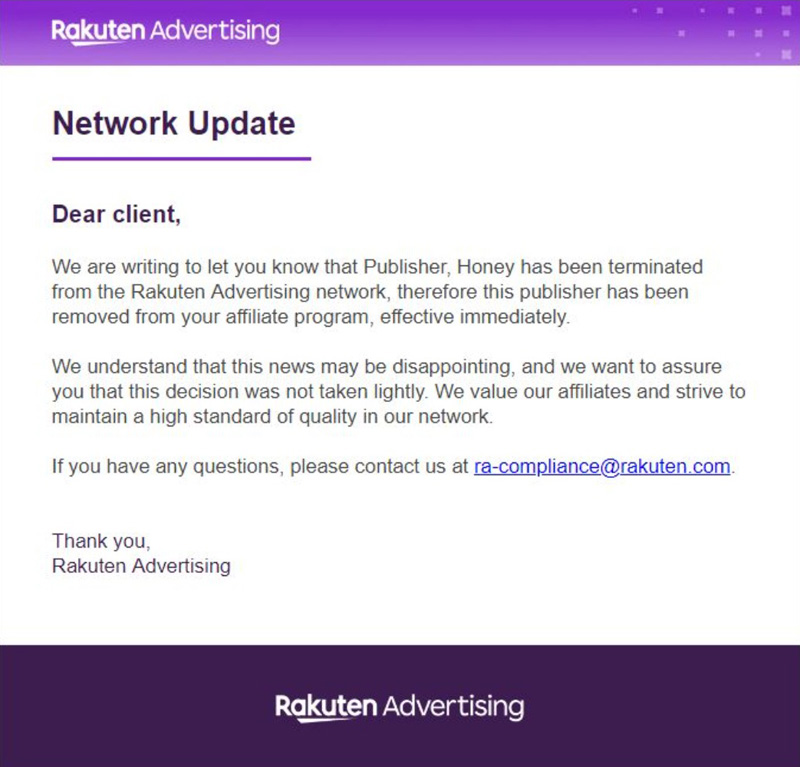
On Monday, January 12, the first day of the Affiliate Summit West conference, Rakuten Advertising issued a formal announcement stating that Honey had been "terminated from the network." The timing of the announcement, delivered as thousands of affiliate managers and publishers gathered in Las Vegas, was viewed by many as a powerful public relations move. Rakuten characterized the termination as a necessary step to "maintain a high standard of quality," signaling that even the largest publishers are not immune to the network’s quality control protocols.
By Friday, January 16, the situation worsened for PayPal Honey as Impact.com, another titan in the affiliate space, moved to suspend the publisher. Impact.com reported that Honey was "out of compliance" with platform policies and subsequently removed the extension from its "Discovery Marketplace." While Impact’s move was framed as a suspension rather than a permanent termination, the rhetoric from leadership was sharp. Impact.com’s CEO explicitly identified "attribution manipulation" as the core issue, an accusation that strikes at the heart of the trust required for affiliate partnerships to function.
The Catalyst: Investigations and Whistleblowing
The networks’ decisions were not made in a vacuum. They followed a series of public investigations that exposed the technical maneuvers Honey allegedly used to claim commissions unfairly. Two primary sources served as the catalyst for the networks’ investigations: a detailed video report by the tech investigator known as MegaLag and a technical analysis by Ben Edelman, a well-known expert in web privacy and affiliate fraud.

The investigation by MegaLag utilized controlled environments to demonstrate how the Honey browser extension behaved during the checkout process. The findings suggested that the extension was firing affiliate tracking links even when a user had not engaged with it, thereby overwriting the cookies of previous affiliates who had actually influenced the customer’s journey.
Ben Edelman’s investigation went further, uncovering code that appeared designed to detect when the extension was being tested by auditors. According to Edelman, Honey employed "detecting testers" logic—a sophisticated method of concealment that allowed the extension to behave according to the rules when it sensed it was being monitored, while reverting to non-compliant behavior for standard users. This "intentional and concealed" violation of stand-down rules made it nearly impossible for individual merchants to detect the manipulation without advanced technical resources.
Understanding the Technical Violation: Stand-Down Rules
To understand the severity of the allegations, one must understand the "stand-down" rule, a cornerstone of ethical affiliate marketing. In a standard "last-click" attribution model, the affiliate who provides the final touchpoint before a sale receives the full commission. However, browser extensions occupy a unique and controversial space because they often appear at the very end of the funnel, after the consumer has already decided to purchase.
Stand-down rules mandate that a browser extension must not fire its affiliate link if another affiliate’s cookie is already present in the user’s browser. This prevents the extension from "hijacking" the commission from content creators, influencers, or review sites that did the heavy lifting of educating the consumer. By allegedly violating these rules, Honey was accused of "cookie stuffing" or "attribution theft," effectively siphoning revenue away from other partners in the ecosystem and increasing costs for merchants without providing incremental value.
The $4 Billion Context and PayPal’s Reputation
The fallout is particularly notable given Honey’s parentage. When PayPal acquired Honey Science Corp in 2020 for $4 billion, it was the largest acquisition in PayPal’s history. At the time, Honey boasted 17 million monthly active users and was seen as a way for PayPal to move "upstream" in the commerce journey, influencing the consumer before they reached the payment stage.
However, the integration of a massive affiliate publisher into a global payments giant created inherent complexities. The recent suspensions suggest that PayPal’s oversight of Honey’s technical compliance may have been insufficient, or that the pressure to maintain growth led to aggressive attribution tactics. For PayPal, a company built on trust and financial security, the association with "attribution manipulation" is a significant reputational risk.
Broader Implications for the Affiliate Industry
The removal of PayPal Honey serves as a landmark case study for the entire performance marketing industry. It highlights five critical lessons for affiliate managers and brand owners who must navigate an increasingly complex digital landscape.
1. The Proliferation of "Bad Apples"
In the affiliate world, a single non-compliant publisher can degrade the value of an entire program. Savvy, high-quality affiliates—such as content creators and niche influencers—frequently audit the programs they join. If they see that a merchant allows "cookie-dropping" extensions to operate without oversight, they are likely to leave the program or refuse to join. They recognize that their efforts to drive traffic will likely be "overwritten" at the checkout by a non-compliant extension, meaning they will never see a return on their investment.
2. The Limits of Network Policing
While Rakuten and Impact.com eventually took action, the Honey case demonstrates that merchants cannot rely solely on affiliate networks to protect their interests. Networks often face a conflict of interest; they earn fees on the volume generated by large publishers, which can lead to a "look the other way" mentality. It is incumbent upon brand owners to conduct their own policing, using third-party tools and manual audits to ensure that their Terms and Conditions are being followed.
3. The Necessity of Technical Literacy
The Honey investigation shows that affiliate fraud has moved beyond simple spam. It now involves sophisticated scripts and concealment logic. Affiliate managers must take the time to understand the nuances of "soft clicks," "stand-down" protocols, and the technical behavior of Downloadable Software Publishers (DSPs). Without this knowledge, managers cannot engage in the "intelligent policing" required to protect their budgets.
4. Avoiding Generalization
While the Honey case casts a shadow over browser extensions, industry experts warn against banning entire classes of affiliates. Not all extensions are non-compliant. Many provide legitimate value through loyalty programs, card-linked offers, or closed-user-group (CUG) rewards. The goal for a healthy program is to evaluate each partner on an individual basis, rewarding those who drive incremental growth while removing those who merely manipulate attribution.
5. The Urgency of Diversification
Perhaps the most significant takeaway is the danger of over-reliance on a few "super-affiliates." Many programs discover that 80% of their revenue comes from just one or two partners, often in the coupon or extension category. If those partners are suspended or change their algorithms, the merchant’s revenue can vanish overnight.
To build a resilient program, brands must diversify across multiple affiliate types. A truly robust ecosystem includes:
- Content Producers: Bloggers and media houses that build brand awareness.
- Affinity Groups and Charities: Organizations that leverage community trust.
- Paid Search and CTV: Partners who manage complex ad placements.
- Sub-affiliate Networks: Providing access to thousands of smaller micro-influencers.
- Podcasters and Video Marketers: Engaging audiences through long-form storytelling.
- Post-checkout and Cart Abandonment Solutions: Assisting in conversion recovery.
Conclusion: A New Era of Accountability
The suspension of PayPal Honey from major networks marks a turning point in the "partnership economy." It signals that the industry is moving toward a more transparent and accountable model where technical compliance is not optional, regardless of a company’s size or valuation. For merchants, the event serves as a wake-up call to audit their existing partnerships and reinvest in a diverse, ethical affiliate base. As the industry looks toward 2026, the focus will undoubtedly remain on ensuring that every "click" represents genuine consumer intent and that every commission is truly earned.