

Shopify and Tiendanube stand as titans in the Latin American e-commerce landscape, each catering to a distinct segment of the market. While both empower merchants to establish an online presence, their origins, functionalities, and pricing structures reveal a fundamental divergence in their strategic approach. Shopify, a global powerhouse, has long been the default choice for businesses aiming for international reach and scalable growth. In contrast, Tiendanube, also known as Nuvemshop in Brazil, was meticulously crafted within Latin America, for Latin America, and has rapidly become the preferred platform for a vast network of regional businesses, currently powering an impressive 190,000 live stores across the continent. This in-depth comparison scrutinizes their offerings across critical areas: pricing, payment processing, sales features, design capabilities, user experience, and customer support, providing a definitive guide for merchants navigating this competitive digital marketplace.
The core question for many Latin American entrepreneurs is not simply which platform is "better" in an absolute sense, but which platform is the most strategic fit for their specific business model, target market, and growth aspirations. This analysis verifies every financial figure against the companies’ official pricing pages, ensuring an accurate and up-to-date assessment. While Shopify emerges as the stronger, more feature-rich platform overall, its global design comes with a significant caveat: for businesses operating almost exclusively within Latin America, Tiendanube often presents a more cost-effective and practical solution.
Shopify vs. Tiendanube: A Snapshot
At a glance, the distinction is clear. Shopify is engineered for global expansion, catering to growing and scaling brands with international ambitions. Its comprehensive feature set and extensive app ecosystem support complex operations and ambitious growth trajectories. Tiendanube, on the other hand, is intrinsically designed for the nuances of the Latin American market. Its strength lies in its deep integration with local payment methods, pricing in local currencies, and a support structure attuned to regional business realities, making it an exceptionally attractive option for merchants primarily serving customers within Argentina, Brazil, Mexico, Colombia, and Chile.
| Category | Shopify | Tiendanube |
|---|---|---|
| Best For | Growing & scaling brands, international selling | Merchants selling primarily within Latin America |
| Entry Price | $5/month (Starter), $39/month (Basic) | Free plan (Argentina, Mexico); Paid from $149 MXN/month |
| Top Standard Plan | Advanced ($399/month) | Avanzado/Escala ($999 MXN / $234,999 ARS/month) |
| Enterprise Tier | Shopify Plus (from $2,300/month) | Tiendanube Evolución (custom pricing) |
| Free Plan | No | Yes (Argentina, Mexico) |
| Free Trial | 3 days, then $1/month for 3 months | 7 days on paid plans |
| Native Payment | Shopify Payments (limited LatAm support) | Pago Nube (waives platform fee) |
| 3rd Party Fee | 0.6% – 2% | Varies, waived with Pago Nube |
| App Store | 8,000+ apps | 100+ apps |
| Themes | 800+ themes, 13 free | 60+ free templates + premium store |
| Markets Served | Global | Argentina, Brazil, Mexico, Colombia, Chile |
| Support | 24/7 chat, Help Center | Chat, email (all plans); WhatsApp (higher plans) |
1. The Economic Advantage: Tiendanube’s Localized Pricing
The most striking differentiator between Shopify and Tiendanube lies in their pricing structures, a critical factor for any business, particularly those in emerging markets. This is where Tiendanube demonstrates a clear and significant advantage for Latin American merchants.
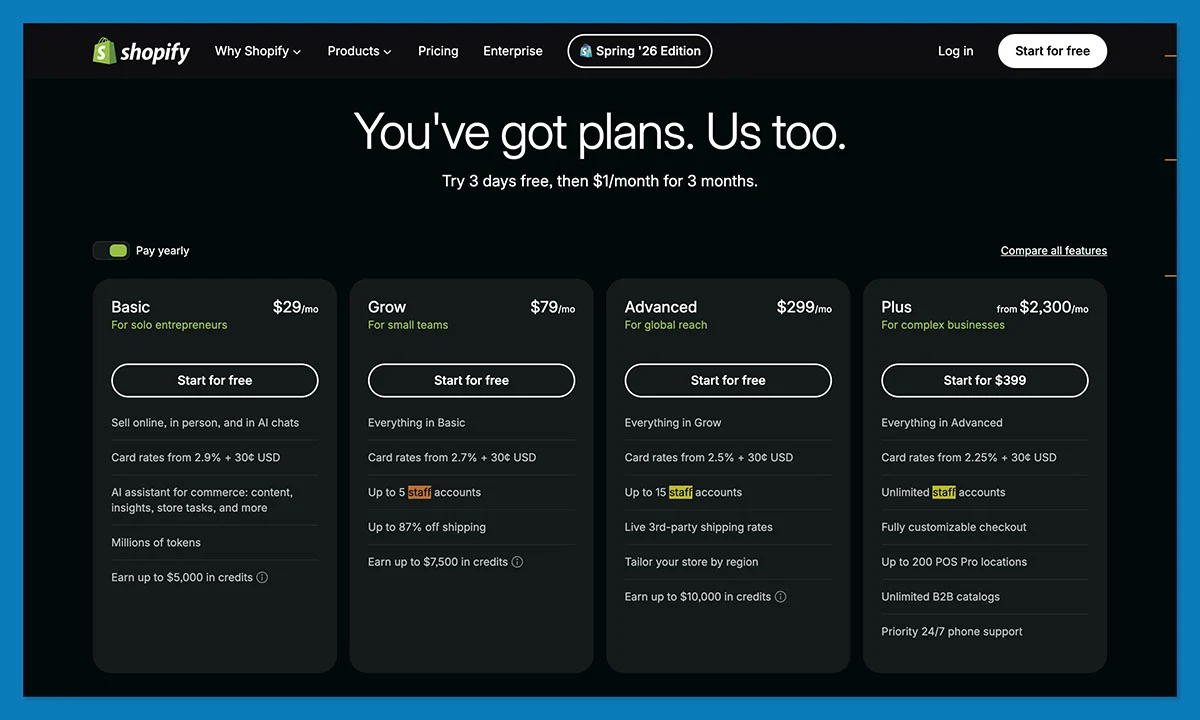
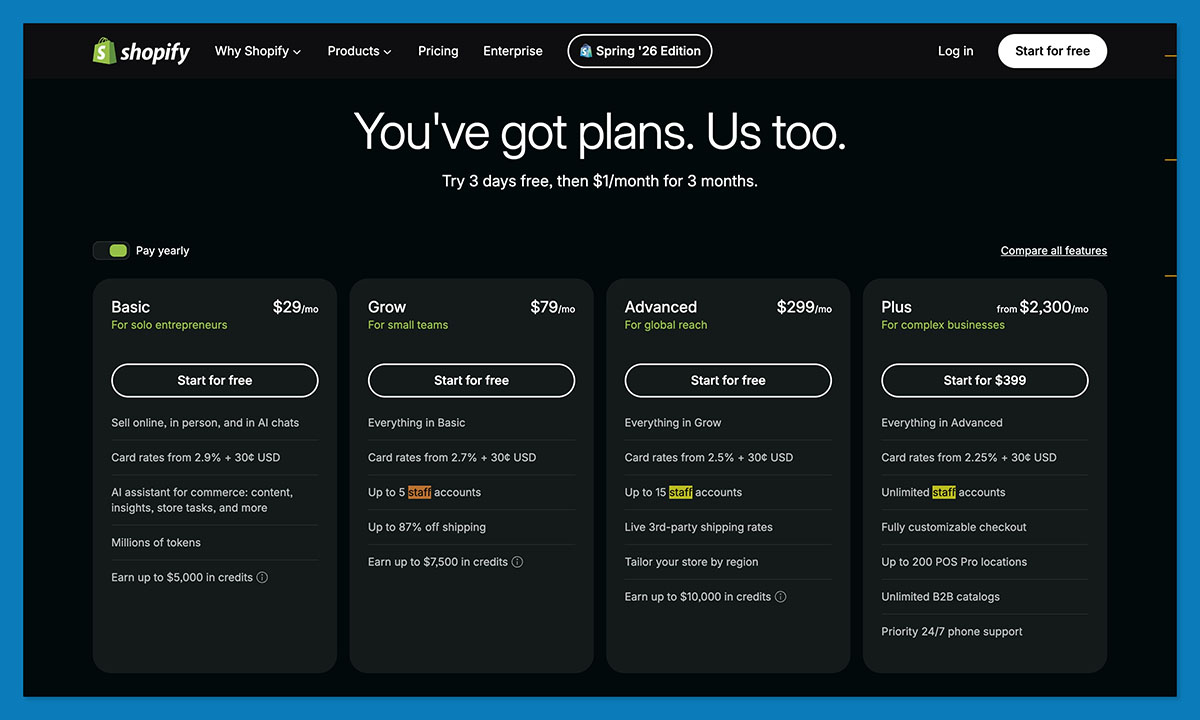
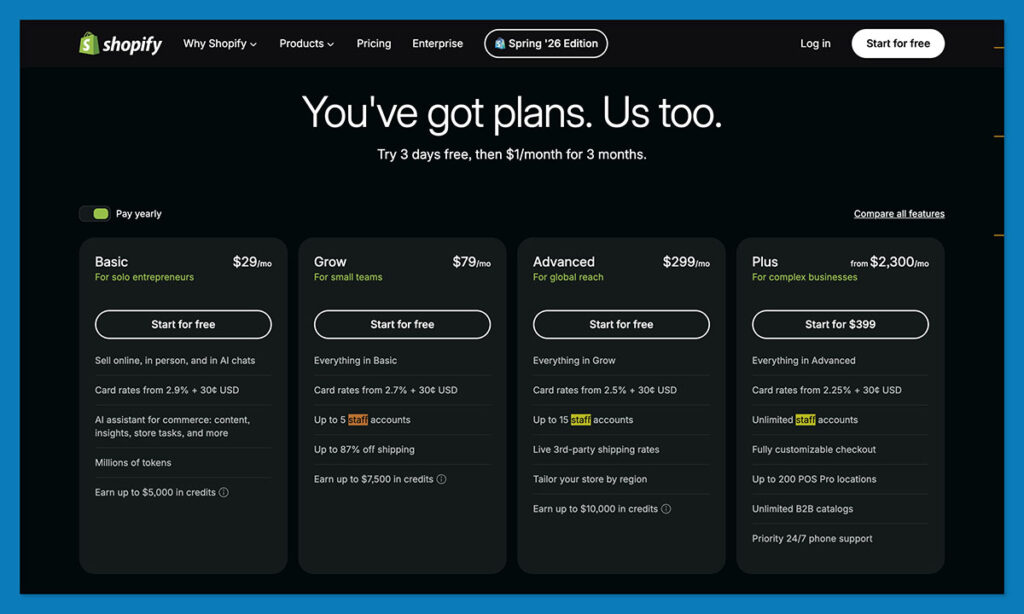
Shopify’s Pricing Strategy: Shopify operates on a global scale, with its pricing denominated in US dollars and typically billed in USD across most markets. The platform offers several tiers, starting with the Starter plan at $5 per month for basic social selling, moving up to the Basic plan at $39 per month, Grow at $105 per month, and Advanced at $399 per month. Annual billing provides a substantial 25% discount, and new users can leverage a 3-day free trial followed by a promotional rate of $1 per month for the initial three months.
| Plan | Monthly | Billed Annually | Online Card Rate (Shopify Payments) | Third-Party Gateway Fee |
|---|---|---|---|---|
| Starter | $5 | $5 | Varies | 5% |
| Basic | $39 | $29 | 2.9% + $0.30 | 2% |
| Grow | $105 | $79 | 2.7% + $0.30 | 1% |
| Advanced | $399 | $299 | 2.5% + $0.30 | 0.6% |
| Plus | From $2,300 | Contract terms | Negotiated | 0.2% |
The "Shopify" plan was recently rebranded as "Grow," maintaining its original pricing and feature set. While the $1 per month promotional offer is attractive, it’s a temporary measure, and the ongoing cost in USD can become a burden, especially with currency fluctuations.
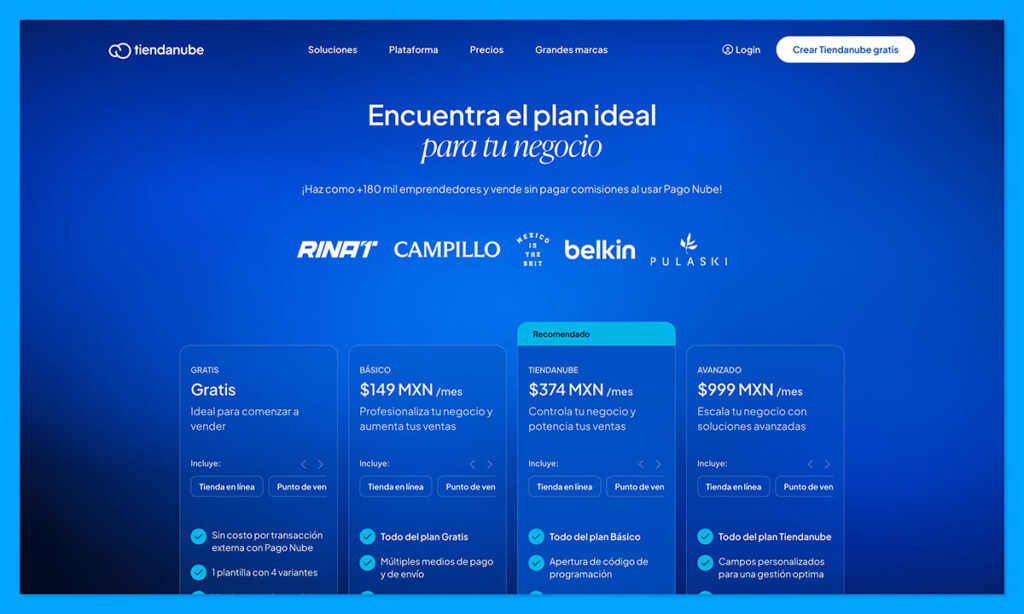
Tiendanube’s Localized Approach: Tiendanube’s pricing is a testament to its regional focus. It bills in local currencies and offers distinct plans tailored to each country it serves. Crucially, both Argentina and Mexico benefit from a genuinely free-forever plan, providing an accessible entry point for aspiring entrepreneurs. Paid plans are structured competitively, starting at approximately $149 MXN (Mexico), $26,999 ARS (Argentina), $24,900 COP (Colombia), or $5,999 CLP (Chile) per month.
| Country | Free Plan | Entry Paid Plan | Mid Plan | Top Standard Plan |
|---|---|---|---|---|
| Mexico | Gratis ($0 MXN) | Básico ($149 MXN) | Tiendanube ($374 MXN) | Avanzado ($999 MXN) |
| Argentina | Inicial ($0 ARS) | Esencial ($26,999 ARS) | Impulso ($78,999 ARS) | Escala ($234,999 ARS) |
| Colombia | Not available | Básico ($24,900 COP) | Tiendanube ($49,900 COP) | Avanzado ($149,900 COP) |
| Chile | Not available | Básico ($5,999 CLP) | Tiendanube ($14,999 CLP) | Avanzado ($44,999 CLP) |
Two pivotal advantages of Tiendanube’s model are the elimination of exchange rate risk – a significant operational cost when revenue is in local currency and platform fees are in USD – and the absence of a mandatory third-party gateway surcharge. Furthermore, while Tiendanube does implement quarterly price adjustments tied to local inflation, this transparency is often preferred over the unpredictable impact of global currency fluctuations on USD-denominated fees.
The Winner: Tiendanube unequivocally wins on pricing for Latin American merchants. Its free plans, local currency billing, and absence of hidden third-party gateway fees make it substantially more affordable to launch and operate an e-commerce business within the region.
2. Seamless Transactions: Tiendanube’s Payment Ecosystem
The payment gateway and associated fees are often the most underestimated cost of running an online store. This is an area where Tiendanube’s strategic alignment with the Latin American market shines.
Shopify Payments and the LatAm Challenge: Shopify’s fee structure is predicated on the use of its native payment gateway, Shopify Payments. When merchants utilize this service, they incur only the card processing rates. However, the challenge for Latin American businesses is that Shopify Payments has limited availability across the region. While Mexico is supported, many other key markets are not. This forces merchants in these unsupported countries to route payments through third-party gateways like Mercado Pago or Stripe, which incurs an additional surcharge from Shopify itself – 2% on the Basic plan, 1% on Grow, and 0.6% on Advanced. For a business processing $10,000 per month on the Basic plan, this 2% surcharge amounts to an extra $200, on top of processor fees and the monthly subscription. Merchants must meticulously verify Shopify’s current supported-countries list for their specific location before committing.
Tiendanube’s Pago Nube Advantage: Tiendanube’s native gateway, Pago Nube (Nuvem Pago in Brazil), is designed to incentivize its use. By processing payments through Pago Nube, merchants entirely waive Tiendanube’s per-sale platform fee. While using alternative payment providers is an option, it incurs a small per-sale cost that diminishes with higher-tier plans. This structure ensures that merchants are rewarded for leveraging the platform’s integrated payment solution.
Moreover, Tiendanube prioritizes local payment methods that are critical for conversion in Latin America. These include popular options like Mercado Pago, bank transfers, and local credit/debit card processing, which are treated as native integrations rather than requiring additional third-party apps and their associated fees. While Shopify does integrate with many of these methods, they often trigger the third-party gateway surcharge, making them less cost-effective.
The Winner: Tiendanube offers a superior payment and checkout experience for Latin American merchants. Its native gateway provides direct financial benefits, its local payment integrations are seamless and cost-effective, and its structure avoids the penalty system associated with using third-party gateways on platforms with limited native support.
3. Feature Depth and Scalability: Shopify’s Global Ambitions
When it comes to the breadth and depth of sales features, app integrations, and the ability to scale complex operations, Shopify takes a commanding lead.
Shopify’s Robust Sales Toolkit: Both platforms competently handle essential e-commerce functions such as unlimited product listings, abandoned cart recovery, discount codes, product variants, inventory management, and multichannel selling across social media platforms like Instagram, Facebook, and WhatsApp. However, Shopify differentiates itself significantly as a business grows and its operational needs become more complex.
A key advancement is the integration of core B2B capabilities directly into standard plans, not just the enterprise-level Shopify Plus. This includes features like company profiles, custom price lists, and net payment terms, allowing wholesale operations to thrive on plans like the Advanced tier without the necessity of a costly enterprise contract. Shopify also natively offers advanced features such as A/B testing for product pages, multi-location inventory management, sophisticated report builders, and Shopify Functions, which enable custom logic for checkout processes.
Furthermore, Shopify has been at the forefront of embracing emerging technologies, particularly in the realm of agentic commerce. Its integration with AI assistants like ChatGPT and Perplexity allows customers to discover and transact with products directly through conversational interfaces. While the immediate applicability of this channel varies, it signifies Shopify’s commitment to future-proofing its platform.
The App Ecosystem and Its Implications: Shopify boasts an expansive app store with over 8,000 applications, offering solutions for virtually any business need, from advanced marketing automation to specialized inventory management. This vast ecosystem provides unparalleled flexibility and customization. However, this extensive offering comes with a trade-off: the reliance on third-party apps can add significant monthly costs, often ranging from $50 to $150 for a functional app stack. Moreover, managing a large number of apps can introduce complexity and potential points of failure.
Tiendanube’s app store, while significantly smaller with just over 100 integrations, offers a more curated experience. This smaller catalog means less time spent researching and managing subscriptions, and fewer opportunities for integration conflicts. However, for highly specialized needs, a required integration might simply not exist within Tiendanube’s ecosystem.
AI Integration: Both platforms are actively incorporating AI features. Shopify offers "Shopify Magic" for generating product descriptions and image editing, alongside "Sidekick," an in-platform AI assistant for analytics and operational tasks. Tiendanube provides AI-driven product description generation and photo enhancement across all its paid plans. Additionally, "Chat Nube," a WhatsApp-native AI assistant, is a notable feature, directly addressing the region’s heavy reliance on this communication channel for sales.
The Winner: Shopify’s feature depth is unparalleled. Its native B2B capabilities on standard plans, an extensive app marketplace, advanced customization options through Shopify Functions, and early adoption of agentic commerce provide a ceiling for growth and complexity that Tiendanube currently cannot match.
4. Marketing and SEO Capabilities: Shopify’s Comprehensive Stack
When it comes to optimizing online stores for search engines and implementing robust marketing strategies, Shopify offers a more comprehensive suite of tools.
SEO Fundamentals and Beyond: Both platforms provide essential SEO features, including editable meta titles and descriptions, clean URL structures, automatic sitemaps, image alt text, and mobile-responsive themes, ensuring that no store is fundamentally disadvantaged from an SEO perspective.
Shopify, however, extends its capabilities further. Through the "Ecommerce Booster" app, it integrates with Semrush, transforming site audits into actionable optimization checklists. Its blogging and content management tools are more sophisticated, which is a significant advantage for businesses that rely heavily on organic search traffic as an acquisition channel. Furthermore, "Shopify Email" allows merchants to create and send email marketing campaigns directly from their admin dashboard, eliminating the need for separate email service providers for basic campaigns.
Tiendanube’s Marketing Tools: Tiendanube offers "Marketing Nube," a competent suite that includes automated emails, abandoned cart recovery, lead capture, and native Meta Ads creation from the dashboard. While sufficient for many small businesses, it lacks the depth and integration found in Shopify’s offerings.
The WhatsApp Advantage: Where Tiendanube truly excels is in its deep integration with WhatsApp, a dominant sales channel across Latin America. Its tooling is specifically designed for this environment, including features like "Chat Nube" and a cloud keyboard for seamless product sharing directly into customer conversations. This "WhatsApp-first" approach reflects a keen understanding of regional consumer behavior.
The Winner: Shopify possesses a stronger overall marketing and SEO stack, characterized by superior SEO tooling, native email marketing capabilities, and a vast ecosystem of marketing applications. While Tiendanube’s WhatsApp-centric approach is highly effective for regional sellers, Shopify offers a broader and more deeply integrated set of tools for comprehensive online marketing.
5. User Experience and Localization: Tiendanube’s Simplicity
Ease of use is a critical factor, especially for new entrepreneurs venturing into e-commerce. Tiendanube shines in this regard due to its intuitive interface and native language support.
Shopify’s Feature-Rich Interface: Shopify’s administrative dashboard is undeniably polished, well-organized, and generally pleasant to navigate. However, its extensive feature set means it can be more intimidating for newcomers. The onboarding process involves a detailed questionnaire about business stage and channels, followed by a checklist that can extend to over a dozen steps, requiring a greater learning curve.
Tiendanube’s Streamlined Approach: Tiendanube’s admin interface is intentionally lighter and less overwhelming. With fewer menus and a more straightforward setup path, it significantly reduces the friction for new users. Critically, the entire interface, documentation, and support are natively available in Spanish and Portuguese, not merely translated. This native localization is a profound advantage for businesses whose teams are not fully proficient in English, impacting daily operations and learning efficiency.
Website Design Editors: Both platforms utilize a section-based editor, allowing users to stack content blocks like image carousels, product grids, and contact forms. While easy to learn, this method can be restrictive for highly custom design requests. Shopify’s editor offers greater power and flexibility, whereas Tiendanube’s is quicker to master. Higher-tier Tiendanube plans provide full design customization access via HTML, CSS, and JavaScript for users with coding expertise.
The Winner: Tiendanube is the simpler and more accessible platform for new users, particularly those operating in Spanish or Portuguese. Its native localization and less complex interface reduce the initial learning curve, allowing merchants to launch their stores more quickly and with less friction.
6. Design Aesthetics and Template Options: Shopify’s Premium Ecosystem
While both platforms offer professional-looking templates, Shopify leads in the sheer volume and quality of its design options, particularly within its premium theme market.
Shopify’s Extensive Theme Store: Shopify’s Theme Store hosts over 800 free and paid themes, with 13 high-quality free options designed and maintained by Shopify itself. These free themes, such as Dawn, Sense, Craft, and Crave, are consistently updated to ensure compatibility with platform changes. Premium themes, typically priced between $180 and $400, represent a mature ecosystem with sophisticated designs, conversion-optimized layouts, and ongoing developer support from dedicated studios.

Tiendanube’s Free Templates: Tiendanube provides more than 60 free templates, which are clean, mobile-responsive, and professionally designed. For businesses with zero budget for design, this generous offering is a significant advantage over Shopify’s 13 free themes. However, the premium theme market on Tiendanube is less developed and specialized compared to Shopify’s extensive network of third-party theme developers.
The Winner: Shopify boasts the superior design ecosystem. While Tiendanube offers more free templates, Shopify provides a greater quantity and higher overall quality of options, particularly in its premium theme market, giving businesses more sophisticated and diverse choices for their online storefront.
7. Business Support: Tiendanube’s Human Touch
Customer support is a crucial element of any platform, and here, Tiendanube’s localized and human-centric approach offers a distinct advantage for Latin American businesses.
Shopify’s Support Model: Shopify provides 24/7 support primarily through an AI-driven live chat system within its Help Center, which can escalate to human agents for complex issues. Its Help Center is comprehensive, featuring extensive documentation, video tutorials, an active community forum, and free business courses. However, email support has been discontinued, and accessing human assistance can sometimes require persistence. Priority support is reserved for Shopify Plus merchants.
Tiendanube’s Personalized Assistance: Tiendanube emphasizes human support as a core component of its service. All paid plans include chat and email support. Higher-tier plans offer dedicated WhatsApp support with guaranteed response times, which can be as quick as four hours for top plans in Argentina. Crucially, support is provided in the user’s native language and within their local time zone. The support team possesses an intrinsic understanding of local tax, shipping, and payment regulations, eliminating the need for merchants to extensively explain regional nuances.
| Feature | Shopify Support | Tiendanube Support |
|---|---|---|
| Availability | 24/7 | Business hours, with potential for extended/weekend for higher tiers |
| Channels | AI Chat, Help Center, Community Forum | Chat, Email (all plans); WhatsApp (higher plans) |
| Response Time | Varies; AI-first, escalates to human | Guaranteed response times on higher plans (e.g., 4 hours) |
| Language | Primarily English | Spanish, Portuguese (native) |
| Documentation | Extensive Help Center, video tutorials, courses | Comprehensive Help Center |
| Human Support | Available after AI escalation | Core offering, integrated into plans |
| Localization | Global focus, less regional nuance | Deep understanding of local market realities |
The Winner: Tiendanube offers superior business support for Latin American merchants due to its human-centric approach, native language offerings, and localized understanding of regional business complexities. While Shopify provides extensive documentation and round-the-clock availability, Tiendanube’s direct access to knowledgeable support staff via channels like WhatsApp provides a more immediate and relevant form of assistance.
8. Global Expansion: Shopify’s Designed-for-Scale Infrastructure
For businesses with ambitions that extend beyond Latin America, Shopify’s robust infrastructure and comprehensive international selling features make it the clear choice for scaling globally.
Shopify’s International Capabilities: Shopify is engineered for global commerce. It supports multi-currency sales, offers storefront translations in over 30 languages, provides automatic geolocation redirects, and calculates duties and import taxes. The Advanced plan allows merchants to manage up to 50 markets. Shopify’s infrastructure is built to handle massive traffic volumes, including flash sales and seasonal peaks, at a scale that Tiendanube has not yet been required to serve. The platform offers a well-defined upgrade path from Basic to Grow, Advanced, and finally to Shopify Plus, which provides extensive customization options, expansion stores, and full B2B capabilities.
Tiendanube’s Regional Focus: Tiendanube does support multiple languages and currencies, and its "Evolución" tier is designed for larger regional brands. However, its operational footprint is currently limited to five Latin American countries. If a business aims to expand into markets like the United States, Europe, or Asia, Tiendanube is not architected for such a transition.

Migration Considerations: A significant factor for businesses considering their long-term trajectory is the potential cost and complexity of migrating from Tiendanube to Shopify later. This process involves transferring product data, customer records, order history, and preserving SEO equity through proper redirects. While migration tools and agencies exist, starting on Shopify if international expansion is a foreseeable goal within a few years can circumvent this disruptive and costly project entirely.
The Winner: Shopify is unequivocally the platform for scaling and selling internationally. Its infrastructure, feature set, and upgrade path are designed for global ambitions, whereas Tiendanube’s strengths lie in its deep penetration and optimization within Latin America.
Conclusion: The Right Platform for the Right Market
Shopify is, by objective metrics, the more capable and feature-rich e-commerce platform. Its vast app ecosystem, advanced functionalities, and global infrastructure make it the premier choice for businesses aiming for international expansion and requiring the utmost in scalability and customization. However, for the vast majority of Latin American entrepreneurs whose customer base is primarily regional, Tiendanube represents not just a viable alternative, but often the more strategic and economically sensible decision.
Tiendanube’s free plans in key markets, its local currency billing, its seamless integration with popular regional payment methods, its WhatsApp-centric sales tools, and its human, localized support system provide an unparalleled advantage for businesses operating within the continent. The hidden costs associated with Shopify, particularly the third-party gateway fees that many Latin American merchants cannot avoid, can significantly inflate the actual expense of using the platform.
Ultimately, the choice hinges on ambition and market focus. For those with clear international growth plans, starting with Shopify can save a significant migration effort down the line. For businesses rooted in Latin America, seeking to optimize their operations, minimize costs, and connect authentically with their local customer base, Tiendanube offers a powerful, practical, and remarkably cost-effective solution. The availability of Tiendanube’s free plan and Shopify’s low-cost introductory offer allow merchants to experiment with both platforms, build a real store on each, and make an informed decision based on their unique business needs before committing financially.








