The digital marketing paradigm is undergoing a profound transformation, with artificial intelligence fundamentally reshaping how consumers discover and engage with brands. No longer are buyers solely relying on traditional search engine results; a growing segment is turning to AI-powered platforms like ChatGPT, Perplexity, and Gemini for direct vendor recommendations and synthesized information. This pivotal shift underscores the burgeoning importance of Answer Engine Optimization (AEO), a specialized discipline focused on ensuring brand visibility and favorable characterization within these conversational AI environments. As marketers grapple with this new frontier, the critical challenge isn’t merely recognizing AI’s impact on search but strategically selecting the right tools to navigate and leverage it effectively.
The emergence of dedicated AEO platforms signals a maturation of the field, offering marketers the means to track, measure, and enhance their brand’s presence in AI-driven interactions. Among the most prominent solutions vying for market attention are HubSpot AEO and Peec AI. While both address the overarching need for AI visibility, their underlying philosophies, feature sets, and integration capabilities serve distinctly different functions, necessitating a careful evaluation to align with an organization’s specific stage of AEO maturity, existing technology stack, and available resources.
The Rise of Answer Engine Optimization: A Paradigm Shift in Digital Discovery
The evolution of search from keyword-matching algorithms to complex AI models marks a significant inflection point for digital marketers. Historically, Search Engine Optimization (SEO) revolved around optimizing content for organic rankings on platforms like Google, focusing on keywords, backlinks, and technical site health. However, the advent of sophisticated large language models (LLMs) has introduced a new dimension: conversational AI that synthesizes information to provide direct answers, often without requiring users to click through to external websites. This move towards "answer engines" fundamentally alters the buyer’s journey, making a brand’s representation within AI-generated responses as critical, if not more so, than its traditional organic search ranking.
Industry observers note that this transition is driven by consumer demand for instant, concise, and personalized information. According to a hypothetical 2024 report by "Digital Insights Group," over 40% of B2B buyers now consult AI tools during their initial vendor research phase, a figure projected to exceed 65% by 2026. This trend has catalyzed the rapid adoption of AEO as a strategic imperative, compelling businesses to evaluate how AI platforms characterize their brand, products, and competitive standing. The stakes are high: a positive AI characterization can significantly influence buyer perception and lead generation, while negative or absent mentions can relegate a brand to digital obscurity.
HubSpot AEO vs. Peec AI: Two Distinct Approaches to AI Visibility
At its core, the choice between HubSpot AEO and Peec AI hinges on an organization’s operational model. HubSpot AEO is designed as an integrated solution, seamlessly connecting AI visibility insights with a CRM-driven content execution workflow. This means marketers can identify gaps in AI representation and immediately act on them within the same ecosystem where their content is created and managed. Peec AI, conversely, positions itself as a robust visibility monitoring and reporting infrastructure, engineered to feed comprehensive data into external tools and agency dashboards, making it ideal for organizations prioritizing deep analytics and flexible data integration.

HubSpot AEO: The Integrated Workflow Champion
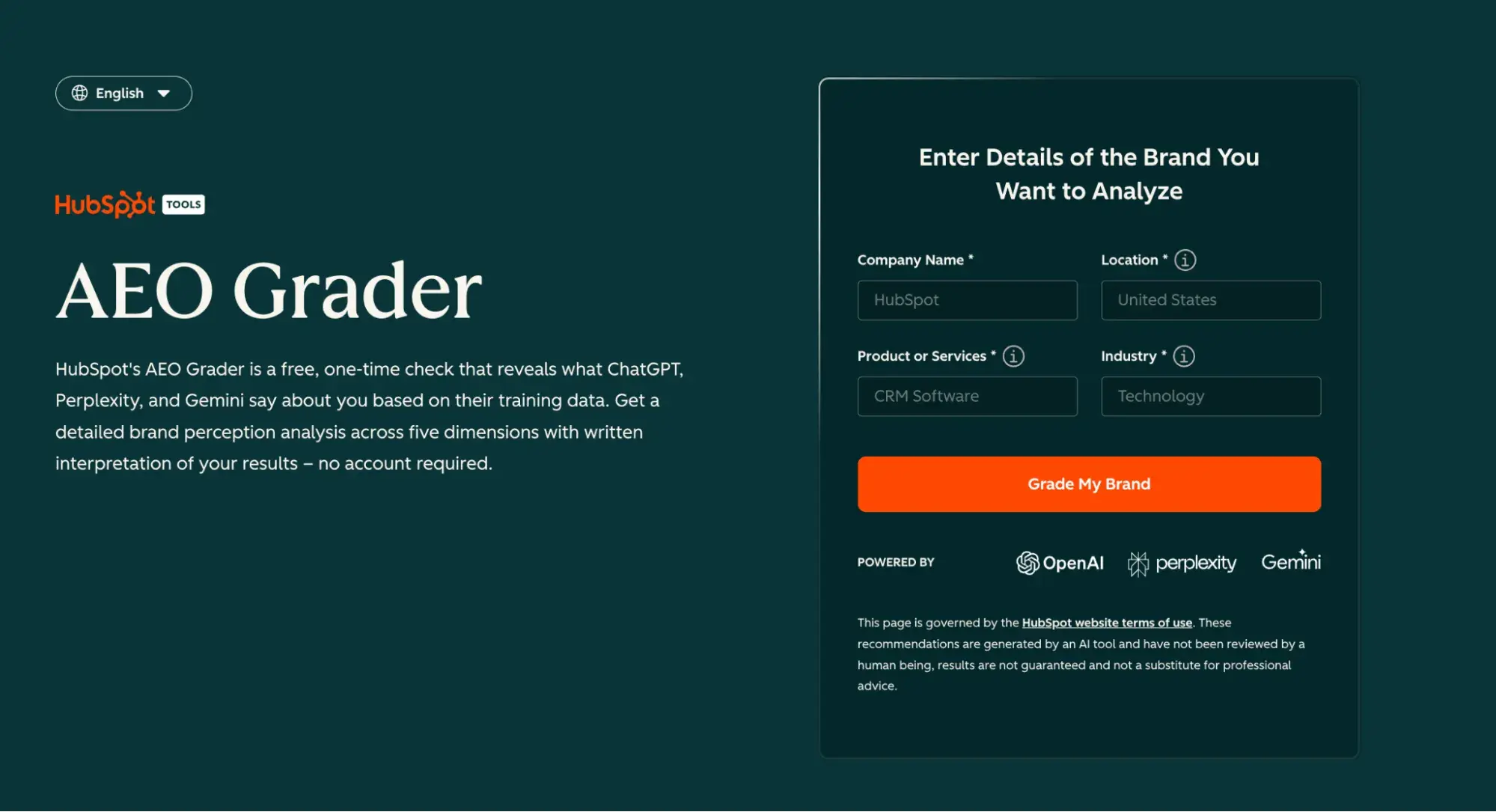
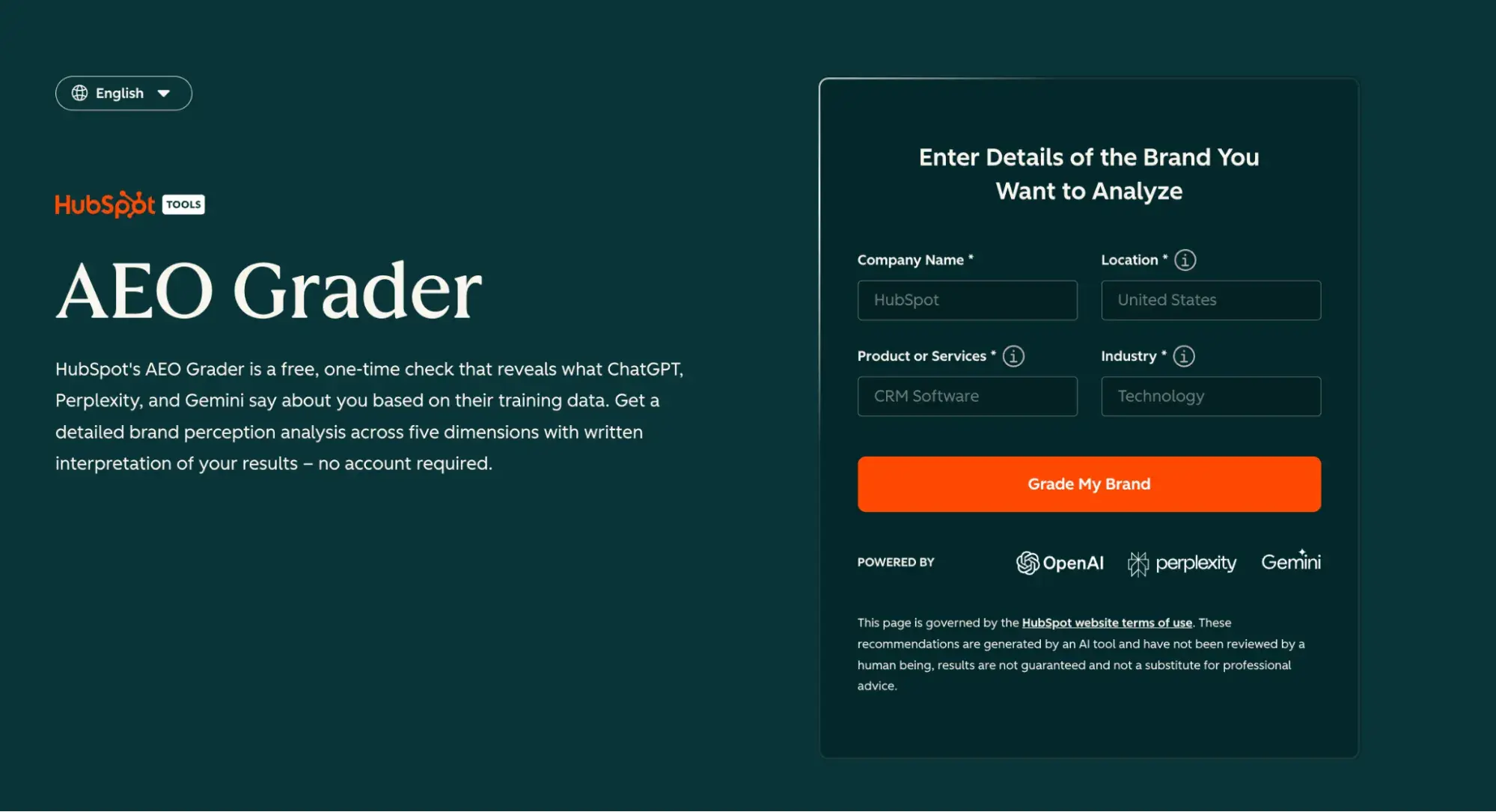
HubSpot AEO serves as a comprehensive tool embedded within the broader HubSpot ecosystem. Its free entry point, the AEO Grader, offers a one-time brand visibility assessment across ChatGPT, Perplexity, and Gemini, evaluating how these AIs characterize a brand based on their training data. This initial report provides a composite score out of 100, broken down into five critical dimensions:
- Sentiment Analysis (40 pts): Measures the overall tone and credibility of sources AI uses to describe the brand. A low score here indicates potential reputational risks or mischaracterizations.
- Presence Quality (20 pts): Assesses the accuracy and depth of AI descriptions regarding offerings, capabilities, and differentiators. Gaps here suggest the AI lacks sufficient high-quality information about the brand.
- Brand Recognition (20 pts): Determines how reliably AI engines identify and categorize the brand in relevant queries. A low score implies the brand is not consistently linked to its core offerings.
- Share of Voice (10 pts): Quantifies the brand’s appearance frequency in AI responses relative to competitors. A diminished share points to competitors dominating AI conversations.
- Market Competition (10 pts): Evaluates the brand’s perceived competitive positioning within AI-generated answers. A low score might signal that AI perceives competitors as stronger or more relevant.
Beyond the initial grader, the full HubSpot AEO platform offers continuous monitoring and actionable recommendations. Its key advantage lies in its native integration with HubSpot’s Smart CRM and Marketing Hub. This allows the platform to auto-generate prompt suggestions tailored to a business’s specific products, ideal customer profiles (ICPs), and competitor names, directly leveraging existing CRM data. When AEO identifies a visibility gap or a decline in sentiment, it surfaces prioritized recommendations that can be directly executed within Marketing Hub, whether through creating new blog posts, updating landing pages, or scheduling social media content. This "Track → Identify → Create → Publish → Monitor" workflow within a single platform significantly reduces operational friction and ensures that insights quickly translate into strategic action.
Peec AI: The Monitoring and Reporting Powerhouse
Peec AI, in contrast, focuses on delivering sophisticated AI visibility monitoring and reporting at scale. The platform utilizes UI scraping technology to simulate genuine user interactions, providing a high-fidelity view of what actual users see in AI-generated responses. This approach can reveal subtle formatting and citation nuances that API-based tools might miss. Peec AI tracks visibility across ChatGPT, Perplexity, and Google AI Overviews as standard, with options for additional engines like Claude, Gemini, DeepSeek, and Grok as paid add-ons.
Peec AI’s strengths lie in its deep analytical capabilities and flexible data export options. It offers detailed source insights, categorizing cited URLs by type (e.g., product pages, review sites, news articles) and providing a "Gap Analysis" that highlights sources frequently citing competitors but not the user’s brand. This is invaluable for digital PR and authority-building outreach strategies. For agencies and larger organizations, Peec AI provides multi-project accounts, agency credit systems, and white-label dashboards, making it well-suited for managing numerous client brands or diverse product lines. Its robust export capabilities, including CSV, Looker Studio connectivity (on advanced plans), and API access (Enterprise-only), enable seamless integration with external business intelligence tools and custom reporting pipelines.
Feature Set Analysis: Beyond the Basics
- Engines Tracked: HubSpot AEO provides ChatGPT, Gemini, and Perplexity across all plans without additional fees, with broader AI referral tracking from Copilot, Claude, and Meta AI within its web analytics. Peec AI offers a wider selection of seven engines, but self-serve plans are limited to three, with additional engines incurring extra costs. This is a critical distinction for businesses prioritizing specific engines like Claude or Grok, or those with diverse global audiences.
- Prompt Tracking and Caps: HubSpot AEO leverages CRM data to generate highly relevant prompts, offering 25 prompts on its standalone plan, scaling to 50 on Marketing Hub Enterprise, and 100+ via expansion packs. Peec AI offers higher raw prompt volumes at each tier (50 on Starter, 150 on Pro, 350 on Advanced), catering to organizations prioritizing breadth of query coverage. The trade-off is between HubSpot’s CRM-contextualized prompts and Peec AI’s sheer volume.
- Citation and Source Insights: Both platforms identify cited domains and pages. HubSpot AEO connects these insights directly to content creation within Marketing Hub, allowing immediate action. Peec AI provides detailed categorization of cited URLs and a Gap Analysis, serving as a powerful input for digital PR and link-building strategies, assuming an external content execution process is in place.
- Update Frequency: Both tools provide daily data refreshes, ensuring marketers are working with current AI visibility information.
- Exports, Reporting, and Integrations: HubSpot AEO keeps reporting native to the HubSpot ecosystem, integrating AEO data with CRM, web analytics, and marketing campaign performance. Peec AI offers a more open architecture with CSV exports, Looker Studio integration, and API access (Enterprise), alongside an MCP integration for automated alerts and workflows, catering to teams with existing BI tools and custom reporting needs.
- Alerting: HubSpot AEO uses its recommendation engine within Marketing Hub as a functional alert system, prompting specific actions when visibility changes. Peec AI offers more configurable alerts via its MCP integration, allowing teams to set sentiment thresholds for real-time Slack or email notifications, complete with the exact AI responses that triggered the alert.
Pricing Models and Accessibility: Budgeting for AEO

The financial commitment for AEO tools varies significantly between HubSpot AEO and Peec AI, reflecting their differing product philosophies and target users.
HubSpot AEO offers two free entry points: the AEO Grader for a one-time baseline score and a 28-day free trial of the standalone product (10 prompts, ChatGPT only). The standalone plan is priced at $50/month ($45/month annually), including 25 daily prompts across ChatGPT, Gemini, and Perplexity, with up to 2,500 answers per month. A significant advantage is its inclusion with Marketing Hub Professional ($890/month, 25 prompts) and Enterprise ($3,600/month, 50 prompts) at no additional cost, making it highly accessible for existing HubSpot users.
Peec AI does not offer a free tier or a free diagnostic. It provides a 7-day free trial across its paid plans, which start at $95/month for the Starter tier (50 prompts, 3 of 7 engines). The Pro tier is $245/month (150 prompts, 3 of 7 engines), and the Advanced tier is $495/month (350 prompts, 3 of 7 engines). Peec AI’s prompt volume scales more aggressively at comparable price points, making it attractive for organizations with extensive prompt tracking requirements. However, the limitation of three engines per plan and additional costs for more engines or specific geographies (e.g., Claude on Enterprise only) are important considerations.
Strategic Considerations for Diverse Organizations
The optimal choice often depends on the organization’s size, existing tech stack, and strategic objectives:
- SMB Teams (1-10 Marketers): HubSpot AEO’s free grader, free trial, and affordable standalone plan ($50/month) offer a low-friction entry into AEO, especially if they value integrated content execution. Peec AI’s Starter plan ($95/month) provides higher prompt volume but requires a separate content execution workflow.
- Mid-market Teams (10-50 Marketers, Existing HubSpot Stack): HubSpot AEO, included with Marketing Hub Professional/Enterprise, is a natural fit, providing seamless integration with CRM and content tools. For mid-market teams with non-HubSpot content stacks (e.g., WordPress, Webflow), Peec AI’s standalone monitoring offers flexibility without platform migration.
- Agency Teams (Multiple Client Brands): Peec AI is purpose-built for agencies, offering multi-project accounts, credit pooling, unlimited seats, and white-label dashboards, streamlining multi-client management and reporting. HubSpot AEO would require separate purchases per client account, adding operational friction.
- Enterprise Teams (50+ Marketers, RevOps Integration): HubSpot AEO’s native integration with Marketing Hub Enterprise and Smart CRM supports robust governance, attribution, and pipeline reporting. Peec AI’s Enterprise tier offers extensive prompt volume, API access, and seven-engine coverage, but integrating this data into existing CRM/RevOps systems would require significant manual configuration.
International and Multi-brand Considerations
For global and multi-brand organizations, the architectural differences become even more pronounced. Both platforms support multi-language and multi-region prompt tracking. However, Peec AI’s country coverage is tier-gated (Starter: 1 country, Pro: 3, Advanced: multi-country), while HubSpot AEO includes multi-region tracking on all plans without per-country restrictions.
For multi-brand management, Peec AI’s project structure natively supports tracking different brands, industries, and regions within a single account, with agency plans pooling credits across projects. HubSpot AEO currently operates as a single-brand, single-account tool. While HubSpot Enterprise’s "Brands" add-on can manage multiple brands within a shared CRM, AEO itself would need to be activated per brand, potentially leading to more fragmented views for organizations with fully independent brand operations.
The Foundational Step: HubSpot’s AEO Grader
Before committing to any paid solution, understanding a brand’s current AI visibility is paramount. HubSpot’s free AEO Grader offers an accessible entry point. By simply entering company details, the tool runs dozens of test queries across ChatGPT, Perplexity, and Gemini, delivering a composite score and a detailed interpretation of results within minutes. This initial diagnostic provides a concrete, data-driven baseline for discussions with leadership and cross-functional teams, allowing marketers to quantify the current state of their AI presence and build a compelling business case for AEO investment. A low score in any of the five dimensions—Sentiment Analysis, Presence Quality, Brand Recognition, Share of Voice, or Market Competition—serves as a clear signal for immediate action and continuous monitoring.
Conclusion: Matching the Tool to the Workflow
Ultimately, the decision between HubSpot AEO and Peec AI is not about identifying an objectively superior tool, but rather selecting the one that best aligns with an organization’s existing workflows, strategic priorities, and resource allocation.
If the primary goal is to integrate AI visibility insights directly into content creation, campaign management, and sales pipeline reporting within a unified CRM platform, HubSpot AEO stands out. Its native integration with Marketing Hub allows for a seamless "insight-to-execution" loop, minimizing the need for manual data transfer and separate logins. This approach is particularly advantageous for teams that already operate within the HubSpot ecosystem or are looking to consolidate their marketing technology stack.
Conversely, if the focus is on comprehensive AI visibility monitoring, deep analytical reporting, and flexible data export capabilities for integration into external BI tools or multi-client agency dashboards, Peec AI presents a compelling solution. Its open architecture and robust reporting features cater to organizations with established content production processes outside of an integrated platform, or agencies managing a diverse portfolio of clients with varied tech stacks.
The era of Answer Engine Optimization is here, and its importance will only continue to grow. The ability to measure, understand, and strategically influence how AI platforms characterize a brand is no longer a luxury but a necessity for competitive advantage. The success of any AEO initiative will ultimately hinge on whether the chosen tool not only provides actionable data but also fits organically into the team’s operational rhythm, fostering consistent use and continuous improvement.
Ready to gain a competitive edge in the AI-driven search landscape? Get started with HubSpot AEO today or explore Peec AI’s advanced monitoring capabilities to empower your brand’s future visibility.