

The landscape of email marketing is experiencing a profound transformation, with Gmail at the forefront of these industry-wide shifts. Recent reports from email senders indicate a dramatic decline in Gmail open rates over the past few months, with some Validity customers observing quarter-over-quarter drops exceeding 30 percent. This trend is not isolated, as Validity’s proprietary engagement data corroborates these observations, showing a substantial reduction of approximately one-third in Gmail image loading activity—including the crucial tracking pixels—since late November 2025. This development signals a critical juncture for email marketers, necessitating a re-evaluation of established metrics and strategies.
The Underlying Mechanics: Reduced Image Prefetching
Industry experts largely attribute this significant decline to a speculated change in Gmail’s image prefetching protocols. Since 2013, Gmail has routed images through its proxy servers, a practice that often involved prefetching images, including open tracking pixels, even before a user explicitly opened an email. This prefetching mechanism inadvertently contributed to inflated open rates, as the loading of a tracking pixel was recorded as an "open" regardless of actual user engagement. The conjectured reduction in the frequency of this prefetching activity directly translates to fewer recorded opens, creating a discrepancy between reported metrics and actual email readership. While this technical adjustment is a primary driver, a deeper analysis reveals that this phenomenon is merely one facet of a broader strategic evolution within Gmail’s ecosystem, aiming to enhance user experience and foster genuine engagement.

A History of Evolving Email Engagement Metrics
This current shift at Gmail is not an unprecedented event in the email marketing world. Indeed, it echoes similar challenges and adaptations observed at other major mailbox providers in recent years. Validity previously investigated comparable engagement declines at Apple and Yahoo, offering valuable context for the present situation. At Apple, the introduction of features such as inbox categories, digest views, groupings, and AI summaries significantly altered how users interacted with their emails, leading to shifts in engagement metrics. Concurrently, Yahoo’s stricter enforcement of bulk sender requirements also impacted deliverability and, consequently, engagement.
The concept of "false opens" is particularly relevant here, having been significantly amplified by Apple Mail Privacy Protection (MPP) in 2021. MPP’s design pre-loads emails via proxy servers, triggering tracking pixels irrespective of whether the user actually views the email. Given that a substantial number of Gmail users access their accounts through Apple Mail applications, MPP introduced an artificial inflation of open rates across a considerable segment of the email audience. Many of these false opens were generated by inactive subscribers, distorting the true picture of audience engagement. Gmail’s recent actions, therefore, can be seen as a continuation of this industry trend towards dismantling such artificial metric inflations, pushing senders to focus on cultivating genuinely active and engaged subscriber bases.
A Strategic Pivot: From Vanity Metrics to True Engagement

While the immediate reaction to declining open rates might be alarm, a closer examination reveals a silver lining for the email marketing community. Gmail’s renewed emphasis on targeting engaged subscribers inherently means fewer false opens. This is largely positive news, as evidenced by the fact that many senders are not reporting corresponding declines in crucial metrics like clicks and revenue. This suggests that the actual impact on business outcomes may be less severe than the open rate numbers alone might suggest.
Nonetheless, open rates continue to serve as a valuable directional health signal. A sudden or sustained drop, even if partially attributable to technical changes, can still indicate underlying issues that warrant investigation. Marketers should, therefore, refrain from prematurely suppressing Gmail addresses based solely on reported open inactivity. Instead, the focus must shift towards understanding the true nature of engagement and adapting strategies to Gmail’s evolving user experience framework.
Key Developments and Their Strategic Implications
Gmail has implemented a series of significant changes over the past two years, each contributing to the observed shifts in open rates and demanding a strategic response from email marketers.
1. Increased Enforcement of Bulk Sending Requirements
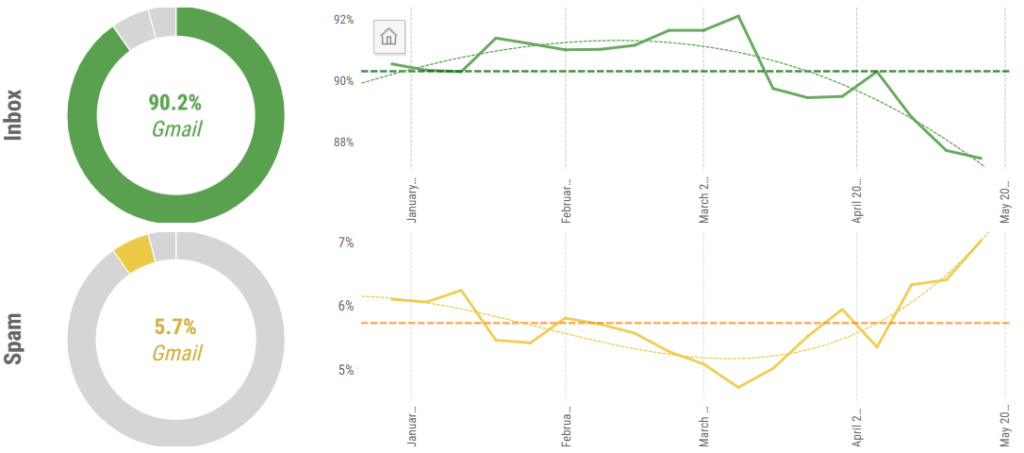
In late 2025, Gmail transitioned from a policy of soft enforcement for non-compliant bulk email traffic to active rejection. This resulted in a notable increase in hard SMTP-level rejection codes, directly impacting inbox placement rates. According to the Validity Intelligence Network, Gmail inbox placement rates have seen an approximate three percent drop over recent months. The consequence for open rates is straightforward: rejected emails generate no opens.
- Analysis: This shift highlights Gmail’s commitment to maintaining a clean and relevant inbox environment for its users. Senders who do not adhere to best practices will face direct deliverability challenges, underscoring the importance of compliance.
- Response: Email senders must thoroughly review their adherence to Gmail’s bulk sender guidelines, moving beyond basic requirements like DMARC, List-Unsubscribe, and complaint rates. Utilizing Google Postmaster Tools V2 to monitor critical compliance status indicators and scrutinizing bounce logs for specific Gmail error codes pointing to non-compliance are essential proactive measures.
2. Relevance-Sorted Promotions Tab
Gmail has moved to sort the Promotions tab by engagement rather than recency. This means emails from lower engagement senders are now positioned further down the tab, significantly reducing their visibility and, consequently, their likelihood of being opened.
- Analysis: This change creates a reinforcing cycle: messages that aren’t opened generate fewer positive engagement signals, further diminishing the sender’s relevance score and placement. It fundamentally redefines the role of personalization and content relevance, making them direct drivers of deliverability within this tab. Generic broadcast campaigns will struggle to gain visibility.
- Response: The strategic imperative is to suppress low-engagement Gmail segments to avoid damaging overall relevance scores. Marketers should segment Gmail recipients based on engagement recency and establish more aggressive suppression thresholds to ensure mailings are directed towards genuinely interested subscribers.
3. Auto-Annotations for Promotional Previews
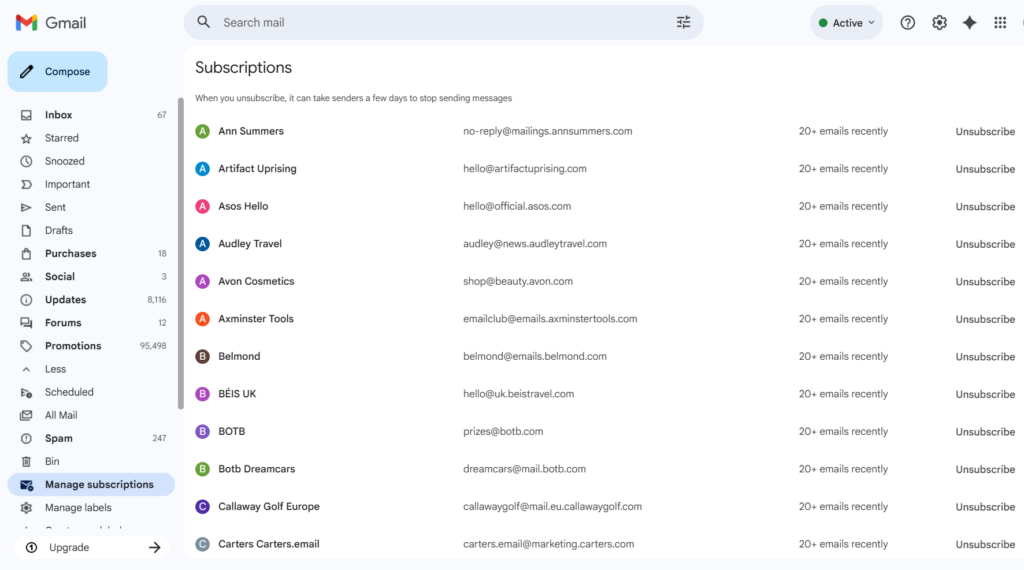
Gmail now automatically extracts deal details, images, and discount codes from promotional emails to display as rich previews in the Promotions tab, even if senders haven’t explicitly implemented the Annotations markup schemas.
- Analysis: While enhancing the user experience, this feature allows subscribers to consume headline offers, product images, and promotional codes without opening the email itself. If an offer’s value proposition is clearly communicated in the preview, the incentive to open the email is diminished, exerting downward pressure on open rates.
- Response: Marketers are advised to implement Annotations markup themselves to gain full control over the content surfaced in these previews. Experimenting with offers that require an actual click-through, rather than merely presenting a simple discount code in the preview, can help drive deeper engagement.
4. Subscriptions Manager
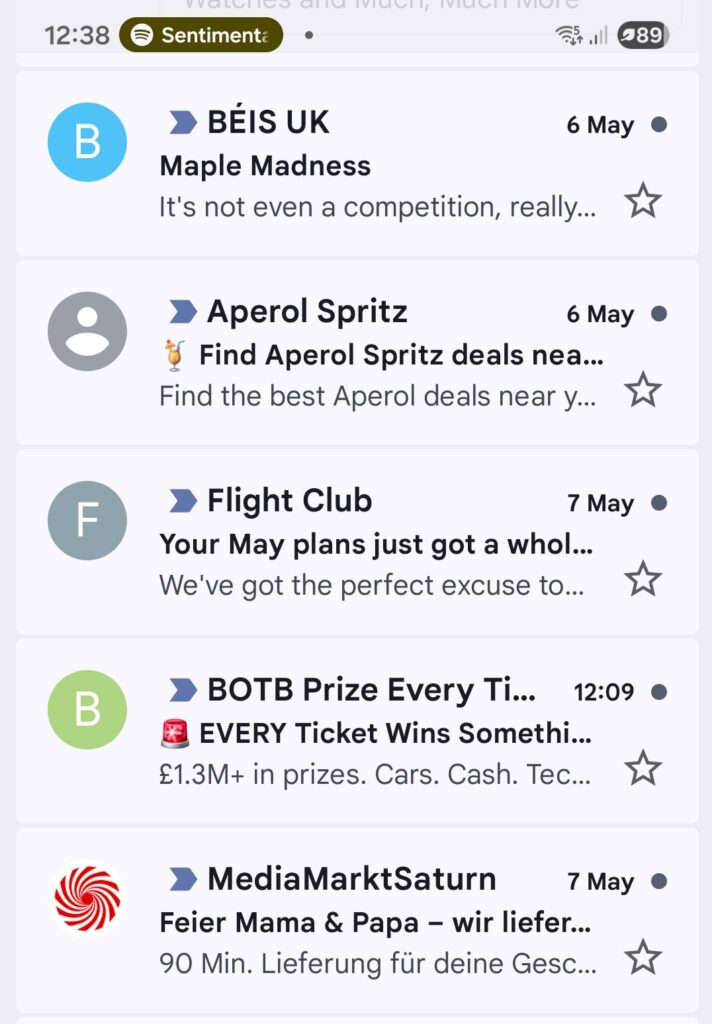
Rolled out fully to personal Gmail accounts by mid-2025, the Subscriptions Manager presents a consolidated dashboard listing all marketing senders, ranked by sending frequency. Users can unsubscribe from any sender’s mail stream with a single click, without opening an email.
- Analysis: This feature primarily impacts open rates through list shrinkage. While this might seem negative, it ultimately results in a smaller but more engaged subscriber list, improving overall list health and potentially leading to higher per-email engagement rates for the remaining audience.
- Response: Brands with high sending frequencies should evaluate whether reducing their cadence would impact revenue, potentially making them less prominent in the Subscriptions Manager. For brands utilizing multiple "From" addresses for different content streams, ensuring each address has a unique List-Unsubscribe header is crucial. This allows subscribers to opt down from specific content streams rather than initiating a blanket removal, preserving relationships for other relevant content.
5. AI-Generated Email Summaries
Beginning in January 2026, Gmail started rolling out AI-generated summaries that display automatically when users open emails. These snippets capture the key message in 1-2 sentences.
- Analysis: This feature introduces a dual concern for open rates. First, there’s ongoing debate regarding whether AI summaries inflate open rates by auto-opening emails for summarization purposes. Second, and more directly, if subscribers can glean sufficient information from the summary, their motivation to open the full email diminishes.
- Response: Senders must prioritize placing their most important content and a clear call to action in the opening lines of the email body, as summaries are typically drawn from the earliest readable text. Front-loading value and clearly articulating the next desired step can transform a summary into a catalyst for a click, rather than a substitute for an open.
6. Integration of Gemini for Inbox Search and Management
Also introduced in January 2026, the Gemini integration enables conversational, natural-language search across the Gmail inbox. Subscribers can query their email history without needing to open individual messages. For instance, a user might ask, "What discount codes do I have for sportswear?" and receive compiled answers from multiple emails without opening any of them.
- Analysis: This represents another significant shift in inbox behavior, as users can extract specific information from emails without generating an "open." This feature is expected to disproportionately affect low-engagement senders, further reducing human interaction with their messages and potentially creating a cycle of disengagement.
- Response: Senders whose emails contain time-sensitive or actionable content should structure it to be highly legible for AI extraction. This includes using specific deadlines, named actions, structured data markup, and clean HTML. Monitoring changes in the ratio of opens between highly engaged and lapsed segments can provide insights into the feature’s impact.
7. Message Clipping
While not a new development, message clipping remains a crucial factor influencing open rates. Gmail typically clips messages with HTML file sizes exceeding 1,024 bytes. Content beyond this threshold is not displayed unless the reader explicitly requests it.
- Analysis: Many senders place their open tracking pixel at the very end of the email’s HTML code. If the message is clipped, this pixel may not trigger, leading to an unrecorded open. Beyond open rates, clipping can hide essential elements like unsubscribe links, which are often in email footers, potentially leading to increased spam complaints if users cannot easily opt out.
- Response: Senders must incorporate a review of email message sizes into their pre-send quality assurance processes to ensure they do not exceed Gmail’s 1KB clipping threshold. Additionally, it is advisable to include the link to the open tracking pixel as early as possible within the HTML file to maximize its chances of being triggered.
8. Gmail Email Address Change Feature
Gmail’s address change capability allows users to modify their primary email address. When a user changes their address, marketing emails sent to the previous address will no longer be delivered to an active, human-readable inbox.

- Analysis: This feature directly reduces opens from affected addresses, as emails simply stop reaching the intended recipient. Furthermore, marketers should not assume that the new address will automatically generate replacement opens, as the subscriber may have changed their address specifically to discontinue receiving marketing communications.
- Response: Marketers should diligently monitor hard bounces and sustained non-engagement from previously active Gmail addresses, as these can indicate an address change. Engagement-based suppression thresholds will naturally catch these newly inactive addresses. Developing relationship-building strategies that extend beyond the email address, such as loyalty programs, first-party identity resolution, and progressive profiling, becomes increasingly important.
9. Purchases Tab
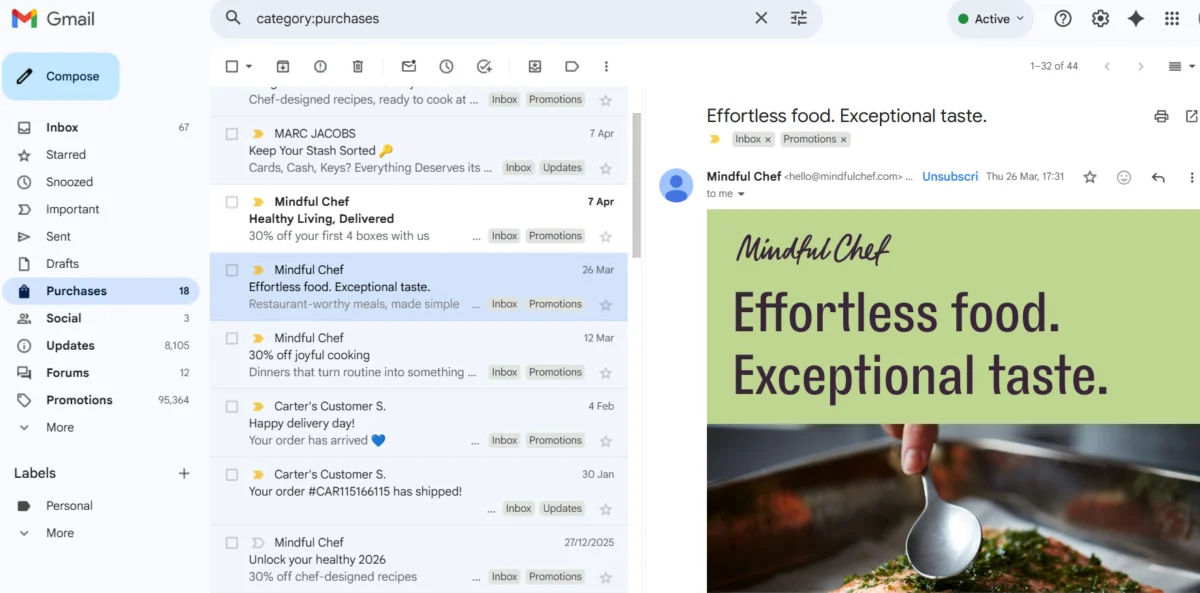
Introduced in late 2025, Gmail’s dedicated Purchases view consolidates order confirmations, shipping updates, and delivery notifications into a separate tab.
- Analysis: A concerning observation is that some marketing emails are inadvertently landing in this tab, often when they contain content related to delivery policies or product fulfillment. This miscategorization can depress open rates, as subscribers are not accustomed to finding promotional messages in a transactional tab. It can also erode trust if recipients haven’t recently purchased anything from the brand, leading to confusion and frustration.
- Response: Senders should conduct audits to determine if any of their promotional emails are being misclassified and routed to the Purchases tab. Maintaining a clear separation between transactional and promotional email streams is crucial. This can be achieved by using distinct "From" addresses, sub-domains, subject line conventions, and content structures. Avoiding promotional content within transactional emails is key to ensuring correct routing and preserving subscriber trust and legal compliance.
10. Inactive Accounts Policy
Google reserves the right to delete accounts that have been inactive for two years or more. Activity is broadly defined and includes reading or sending emails, using Google Drive, watching YouTube videos, sharing photos, downloading apps, using Google search, and using Google to sign in to third-party apps or services.
- Analysis: While seemingly straightforward, this policy underscores the critical importance of list hygiene. Addresses associated with truly inactive accounts will, by definition, not be opening emails, contributing to a pool of unengaged subscribers that can negatively impact sender reputation and overall deliverability metrics.
- Response: Best practices dictate that email marketers should suppress addresses long before they reach 24 months of inactivity. Proactive list cleaning and re-engagement strategies are essential to maintain a healthy and responsive subscriber base.
The Broader Implications for Email Marketing Strategy
The cumulative effect of these changes underscores a fundamental paradigm shift in how email marketing effectiveness should be measured and approached. Gmail is not "broken"; it is strategically evolving to prioritize genuine user engagement and privacy. For email marketers, this necessitates a move away from solely optimizing for vanity metrics like open rates and towards a more holistic understanding of customer interaction.
The emphasis must now be on engagement quality over mere volume. Marketers need to delve deeper into analytics, tracking metrics such as click-through rates, conversion rates, time spent interacting with emails, and lifetime customer value. This requires more sophisticated data-driven decision-making and potentially investments in advanced analytics tools.
Content relevance and personalization become paramount. In an environment where inboxes are sorted by engagement and AI summarizes content, generic, one-size-fits-all campaigns will struggle. Crafting highly targeted, valuable content that resonates with individual subscriber interests will be crucial for standing out and driving meaningful interactions.
Strict compliance with sender guidelines is no longer just about avoiding the spam folder; it’s about earning the right to be seen and engaged with. Adhering to technical specifications, maintaining low complaint rates, and managing list hygiene are foundational to successful email programs.
Finally, the focus must broaden to customer relationship management beyond the email address. As email platforms introduce features like Subscriptions Manager and address change capabilities, marketers need to build deeper connections with their audience, leveraging first-party data, loyalty programs, and multi-channel engagement strategies to foster lasting relationships.

In conclusion, the current developments at Gmail represent a call to action for email marketers to sharpen their strategies and adapt to a more sophisticated email ecosystem. Those who embrace these changes as an opportunity to refine their approach, prioritize genuine engagement, and ensure robust compliance will undoubtedly emerge stronger and more effective in this evolving digital landscape. To gain further insights into these developments and their practical implications, including hands-on guidance for AI summaries, design tweaks, and testing tools, marketers are encouraged to consult expert resources, such as the latest "State of Email Tactics" webinars.








