In the fiercely competitive digital landscape, where attention spans are fleeting and content proliferation is rampant, the humble headline remains the gatekeeper to audience engagement. Far more than a mere title, a headline serves as a subject line, a tweet, an SEO tag, and a video title—a concise invitation designed to compel a click amidst an overwhelming stream of information. BuzzSumo, a leading content marketing analytics platform, has once again delved into its vast index, analyzing a staggering 100 million headlines to uncover the latest trends and best practices for capturing audience interest on social media platforms like Facebook and Twitter. This comprehensive study, building upon a similar analysis conducted in 2017, provides critical insights into how headline effectiveness has evolved, offering a roadmap for publishers and content creators navigating today’s dynamic digital ecosystem.
The Crucial Role of Headlines in the Digital Age
The sheer volume of content available online has surged dramatically, with reports indicating a 64% increase in published articles since 2016. This "content overload" necessitates highly effective headlines that cut through the noise, providing clarity and immediate value to potential readers. Algorithms now play a significant role in content distribution, acting as gatekeepers that decide which headlines reach which audiences. Coupled with increasingly discerning audiences, the art and science of headline writing have become more challenging than ever. Understanding what constitutes a "good" headline is no longer a matter of intuition but a data-driven imperative.
Key Findings from the 2019-2020 Analysis
BuzzSumo’s latest research, covering headlines from 2019 to 2020, reveals several distinct characteristics of highly engaging content:
Optimal Headline Length: Specificity Over Brevity
Contrary to some outdated advice advocating for extremely short headlines, the study found that the ideal headline length for top-performing content on Facebook and Twitter is 11 words and 65 characters. This length allows for sufficient detail and specificity to draw readers in, providing a clearer preview of the content without being overly verbose. While headlines have generally become snappier compared to 2017, the emphasis remains on informative conciseness rather than extreme brevity.
The Magic of Numbers: 10 Reigns Supreme
Numbers continue to be a powerful element in headlines, particularly for listicles. The number 10 emerged as the single most effective number to use, driving the highest engagement on social media. Beyond 10, single-digit numbers (3 through 9) also performed exceptionally well, dominating the top seven positions for most shared headlines. Interestingly, the study found no strong preference for odd or even numbers within the top-performing categories. This suggests that readers appreciate the promise of structured, easily digestible information that numbers often convey.
Dominant Headline Phrases on Facebook: Instructional and Hyperbolic Drive Engagement
The analysis of three-word phrases, or "trigrams," on Facebook revealed distinct patterns:
- Ranking: Phrases like "of the year" (e.g., "Person of the Year 2020") topped the charts, leveraging public votes, awards, and controversial decisions to spark discussion.
- Newness: Trigrams such as "in X years" (often part of "for the first time in X years") generated high interest by highlighting rare or unique events.
- Hyperbole: Exaggerated statements using superlatives (e.g., "one of the most," "of the best") proved highly effective, tapping into readers’ desire for exceptional content.
- Instructional: This category was a standout, with phrases like "you need to" and "need to know" driving significant engagement. These headlines imply urgency, responsibility, and a fear of missing out (FOMO), promising readers essential, concise information. As marketing expert Amanda Milligan notes, this trend reflects a growing desire to learn from experts and inherent authority.
- Curiosity and Guidance: Phrases that hint at revelations, explanations, or offer "how-to" advice also performed strongly, catering to an audience keen to learn and understand.
Headline Composition on Facebook: Starting and Ending Strong
On Facebook, headlines frequently began with numbers (listicles), instructional phrases, or curiosity-provoking statements. "How to" guides, falling under the guidance category, were particularly popular at the start of headlines, indicating a strong appetite for actionable advice. When it came to ending phrases, time-centric statements, especially those referencing "2020" or "2021," dominated, driven by the immediate relevance of the pandemic. Numbers were also used at the end to evoke surprise or emphasize speed to insight.
Twitter Engagement: A Focus on Future, Research, and Immediacy
Twitter audiences displayed different preferences:
- "Future Of": The phrase "future of" was the most popular trigram on Twitter, appearing both in the middle and at the beginning of headlines, indicating a strong interest in forward-looking analysis and predictions.
- Research-Driven Content: Words like "study" and "report" at the start of headlines performed well, suggesting Twitter is a prime platform for sharing research and data-backed insights.
- Immediacy and Current Affairs: Headlines ending with specific years (e.g., "2020") or phrases emphasizing present developments showed high engagement, reflecting Twitter’s role as a real-time news and discussion platform.
Evolving Landscape: A Shift from 2017 to 2019-2020
A significant aspect of the BuzzSumo study is the comparison with its 2017 findings, revealing a profound transformation in headline effectiveness.
The Demise of Overtly Emotional and Sensational Headlines
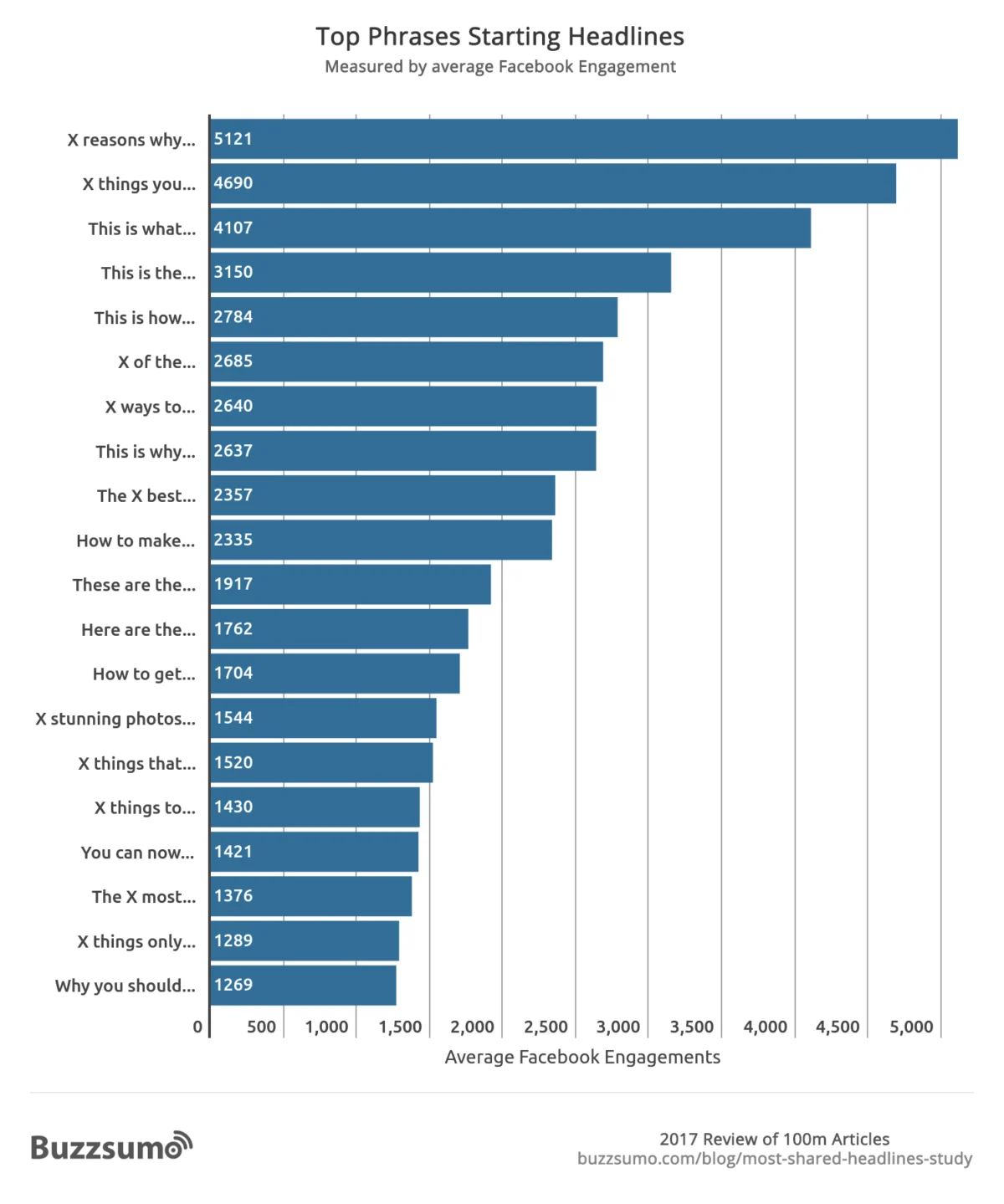
In 2017, emotional phrases like "will make you" (e.g., "This Is Why These 10 Stunning Photos Will Make You Cry Tears Of Joy!") and "melt your heart" were dominant on Facebook, promising a strong emotional reaction. The latest study shows a dramatic decline in the effectiveness of such explicitly emotional or sensational language. This shift can be attributed to Facebook’s algorithmic changes, which began in May 2017 to demote "clickbait" headlines that exaggerate or withhold information. As a result, the top phrase from 2017, "will make you," saw its average shares plummet from 1.7 million to just 143,000 in the updated analysis.
Farewell to Quizzes and Tribal Content
Headlines featuring quizzes (e.g., "Can We Guess Your Real Age?") and tribal identity phrases (e.g., "X Things Only Teachers Will Understand") were highly popular in 2017. These types of headlines appealed to a sense of belonging and self-discovery. However, the 2019-2020 data shows these formats have largely fallen out of favor, appearing rarely in top-performing content. This further underscores the algorithmic demotion of content perceived as low-quality engagement bait.
Increased Homogeneity Across Platforms
While Facebook and Twitter showed distinct preferences in 2017 (only one shared top 20 phrase), the latest study reveals a growing convergence. Eight of the top 20 headline phrases now overlap between the two platforms, indicating a 2.5% to 20% similarity. This suggests that certain content strategies, particularly instructional headlines, can be effectively duplicated across networks, though platform-specific testing remains crucial.
Shifting Engagement Dynamics: Facebook Up, Twitter Down
Interestingly, the study found a significant divergence in average shares. The most engaging Facebook trigram in 2019-2020 garnered three times more average shares than its 2017 counterpart. Conversely, Twitter shares for top phrases decreased by nearly fourfold. This occurs despite Twitter’s monthly active users remaining relatively stable, suggesting a potential dilution of engagement across a wider variety of headlines or changing user behavior on the platform.
The Rise of Authoritative Publishers on Facebook
A notable change in the publisher landscape was observed on Facebook. In 2017, a mix of news, entertainment, and lifestyle sites dominated. By 2019-2020, major news organizations like cnn.com, dailymail.co.uk, nbcnews.com, washingtonpost.com, cbsnews.com, and time.com became prominent. This directly reflects Facebook’s deliberate algorithmic adjustments, announced in January 2018 and refined in June 2020, to prioritize "trustworthy sources" and "original and authoritative news reporting." This shift has undoubtedly influenced the types of headlines that now perform best on the platform, favoring more factual and informative approaches.
Snappier Headlines for Speed to Insight
The optimal headline length decreased from 15 words and 95 characters in 2017 to 11 words and 65 characters in the current study. This reduction of approximately four words and 30 characters reflects a broader trend of audiences demanding information quickly and efficiently, a response to the ever-increasing volume of online content.
Strategic Implications for Content Creators
The findings of this comprehensive analysis offer crucial guidance for anyone crafting content in the digital age. As industry experts like Rand Fishkin of SparkToro emphasize, this research is invaluable not just for writing headlines but for understanding the fundamental shifts in what resonates with audiences.
- Prioritize Instructional Value on Facebook: For Facebook, focus on headlines that tell readers what they "need to know" or "should do." Frame content as essential guidance, leveraging the implicit FOMO and desire for actionable insights.
- Embrace Hyperbole (Carefully): While overtly emotional headlines are out, a measured use of superlatives (e.g., "one of the most beautiful") can still signal exceptional content without veering into clickbait.
- Numbers are Your Friend: Continue to use numbers, especially "10," in listicles. Single-digit lists are also highly effective, promising digestible information.
- Target Twitter for Research and Future-Oriented Content: Twitter audiences show a strong appetite for studies, reports, and discussions about "the future of" various topics. Frame your headlines to reflect this forward-looking, analytical interest.
- Adapt to Algorithmic Shifts: Recognize that social media algorithms are constantly evolving. Facebook’s preference for authoritative news and its demotion of clickbait mean strategies must align with platform goals for quality and trust.
- Test and Iterate: While data provides strong guidelines, specific audiences and niches may respond differently. Utilize analytics tools like BuzzSumo to continuously test headline variations and refine your approach. As Ann Handley of MarketingProfs advises, understanding the broader messages—what engages, what solves problems, what sparks curiosity—is more important than simply copying popular phrases.
- Maximize Perceived Benefit: Andy Crestodina of Orbit Media Studios highlights that every click is a cost-benefit calculation for the reader. Headlines must clearly communicate the value and benefit of engaging with the content, making the "cost" of two seconds of attention worthwhile.
Methodology: A Rigorous Approach
BuzzSumo’s 2019-2020 study analyzed 100 million article headlines to identify three-word phrases (trigrams) that garnered the highest average shares on Facebook and Twitter. To ensure data accuracy and prevent popular sites from skewing results, only one headline trigram example per domain was included in the analysis. Furthermore, the three most shared examples of each trigram were removed to eliminate potential outliers. The research measures engagement by average median shares, providing a robust indicator of content resonance. This rigorous approach, spearheaded by BuzzSumo co-founder Steve Rayson in the original 2017 study and updated by Content Manager Louise Linehan and CTO Henley Wing Chiu, underscores the credibility of the findings.
Conclusion: A Data-Driven Path to Engagement
The landscape of digital content is in constant flux, shaped by evolving algorithms and audience preferences. BuzzSumo’s analysis of 100 million headlines provides invaluable, data-backed insights into what currently drives engagement on Facebook and Twitter. The shift away from emotional clickbait towards instructional, informative, and authoritative content signals a maturing digital ecosystem where value and clarity are paramount. For publishers and content creators, the message is clear: understanding these evolving dynamics and adapting headline strategies accordingly is not just beneficial, but essential for connecting with audiences and ensuring content visibility in an increasingly crowded online world.