A comprehensive new analysis of UK search trends reveals a significant structural shift underway, with traditional "head terms" experiencing a decline in search volume across most categories, while "longtail" queries are on the rise. This evolution, driven in part by the increasing prevalence of AI Overviews (AIOs) in search engine results pages (SERPs), presents a narrowing window of opportunity for brands reliant on organic search visibility. The study, conducted by digital marketing agency Brainlabs, examined 1.35 million keywords across nine distinct UK search categories, offering a granular view of how user search behavior and Google’s responses are reshaping the digital landscape.
The findings are unambiguous: head terms, typically short and high-volume search queries, are in structural decline in seven out of nine categories analyzed. Conversely, longtail queries, which are longer, more specific, and often conversational, are showing consistent growth. Crucially, AI Overviews are appearing most frequently and prominently precisely where this search volume is heading – on longtail queries. This trend suggests a fundamental change in how users interact with search engines and how information is presented, necessitating a strategic pivot for brands aiming to maintain or enhance their organic search presence.

The Genesis of the Study: Unpacking the Semrush Findings
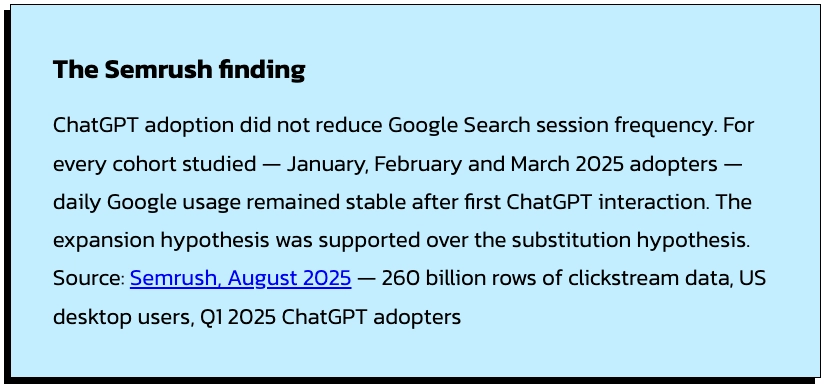
The Brainlabs research was prompted by a landmark study published by Semrush in August 2025. This earlier analysis, which examined 260 billion rows of clickstream data, investigated how user search habits on Google changed following their initial engagement with ChatGPT. Semrush’s conclusion was that ChatGPT was not replacing Google but rather expanding the overall search ecosystem. Users who adopted ChatGPT showed no statistically significant decrease in their daily Google sessions; in fact, their overall search activity saw a slight uptick.
While this finding might initially seem reassuring for traditional search platforms, Brainlabs argues it misses a critical nuance. The Semrush study focused on the frequency of Google usage, not the nature of the searches conducted or the results displayed. This distinction is paramount for brands seeking to understand their organic visibility and refine their paid search strategies over the next two years. As Google itself has acknowledged, average query length is increasing, with users posing longer, more conversational questions – a trend that predates AI Overviews but has been significantly accelerated by them. Brainlabs’ clients have directly observed this shift, with head term traffic softening, longtail queries growing, and AI Overviews appearing beyond the purely informational searches where they were initially anticipated.

To address these evolving questions, Brainlabs undertook its own detailed analysis, drawing on 1.35 million keywords from Ahrefs across nine UK categories. The research was driven by two core hypotheses:
-
AI Adoption is Reshaping Query Composition within Google: The study posited that while overall search volume on Google might remain stable, the types of queries users are making are changing. AI tools, it was hypothesized, are training users to formulate longer, more specific questions. This would lead to a decline in head terms, which historically drove significant value, and a corresponding growth in longtail and potentially branded queries. This aspect was not directly addressed by the Semrush study.
- Verdict: Largely confirmed in 7 out of 9 categories.
-
AI Overviews are Appearing on Commercial Queries, Not Just Informational Ones: The conventional wisdom suggested that Google would primarily deploy AI Overviews on informational queries (e.g., "how-to," "what-is") to protect its lucrative advertising revenue from commercial SERPs. Brainlabs hypothesized that this was only partially true, and that AIOs were already appearing across a broader spectrum of keywords, including mid-funnel commercial queries. If true, this would significantly increase the risk of "click suppression" – where users find answers within the AI Overview and do not click through to websites.
- Verdict: Confirmed – the AIO rate on longtail queries is demonstrably higher than on head terms across all categories, often by a factor of 2-3x.
It is important to note that Brainlabs’ methodology, which analyzes search volume trends at the keyword level using Ahrefs data, is complementary to Semrush’s session-frequency approach. While Semrush answers whether people are still using Google, Brainlabs’ study delves into what they are searching for and what they are seeing when they do, offering more direct implications for organic and paid search strategy.
AI Overview Coverage Varies by Sector: Intent Classification is Key
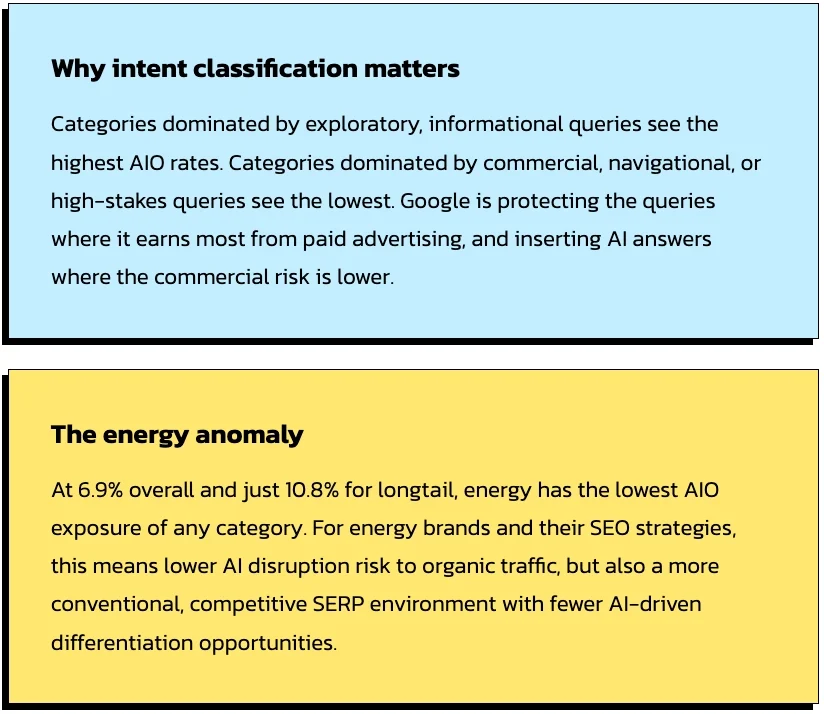
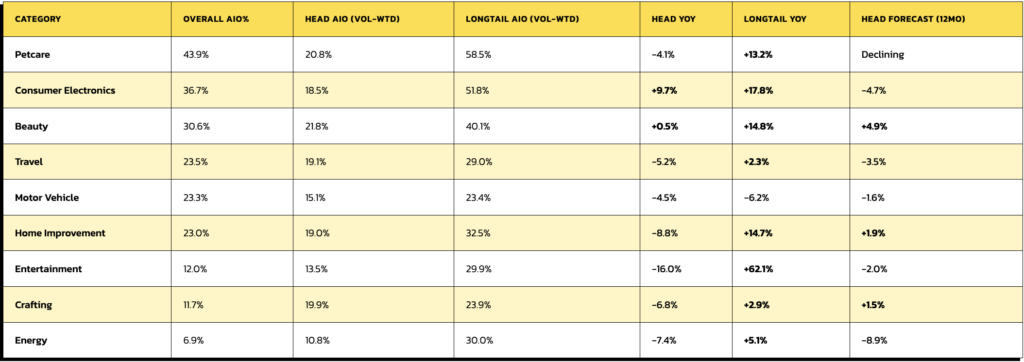
Google’s deployment of AI Overviews is not uniform across all sectors; coverage ranges from 6.9% to 43.9%. This variation is attributed to deliberate intent classification rather than algorithmic inconsistency.
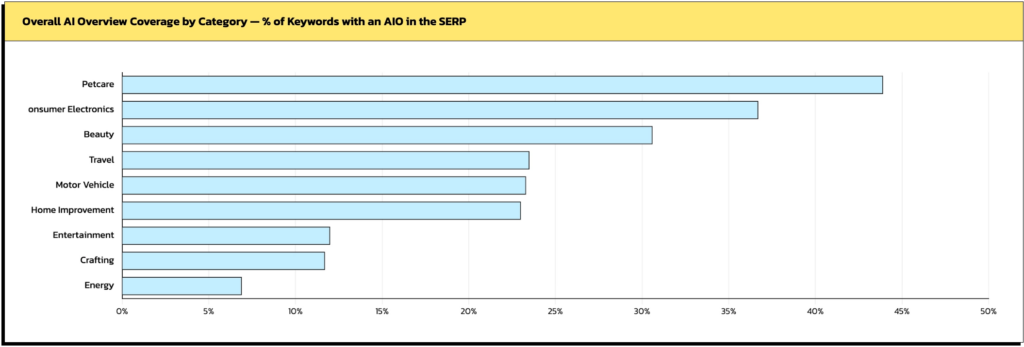
- Petcare emerges at the top, largely due to a saturation of informational queries. Questions like "What can dogs eat?" or "Is chocolate toxic to cats?" are areas where Google is confident its AI can provide accurate and helpful answers. This category, therefore, rewards an AI-first content strategy.
- Energy sits at the bottom of the AIO coverage spectrum. The majority of energy-related queries are navigational ("British Gas contact number") or highly commercially specific ("cheapest electricity provider"). Google appears to be exercising caution in generating AI answers for queries where factual inaccuracies could lead to significant financial consequences for users, opting instead to prioritize traditional search results.
- Consumer electronics (36.7%) and beauty (30.6%) fall into the middle-upper range, indicating a strong presence of research and comparison-based searches where AI can provide synthesized information.
- Travel (23.5%) and motor vehicles (23.3%) show similar AIO coverage rates, suggesting a shared dynamic where commercial intent suppresses AI Overview deployment.
- Entertainment (12.0%) and crafting (11.7%) exhibit low AIO rates despite being generally informational categories. This anomaly warrants further investigation, as it suggests factors beyond simple informational intent are influencing AIO placement.
Longtail Queries Attract AI Overviews at Nearly Twice the Rate of Head Terms
A consistent and striking finding across all nine categories is that longtail queries attract AI Overviews at a significantly higher rate than head terms. The volume-weighted AIO rate for longtail queries (defined as 4+ words) consistently outpaces that of head and mid-length terms (1-3 words). In several categories, this gap is dramatic.
- Petcare exhibits the widest disparity, with a 58.5% AIO rate for longtail queries compared to 20.8% for head terms.
- Consumer electronics follows closely, with 51.8% for longtail versus 18.5% for head terms.
This pattern strongly indicates that Google perceives longtail queries as the prime territory for AI-generated answers, where they can offer the most value to users. Conversely, Google approaches head terms with more caution, more frequently deferring to traditional ranked results.
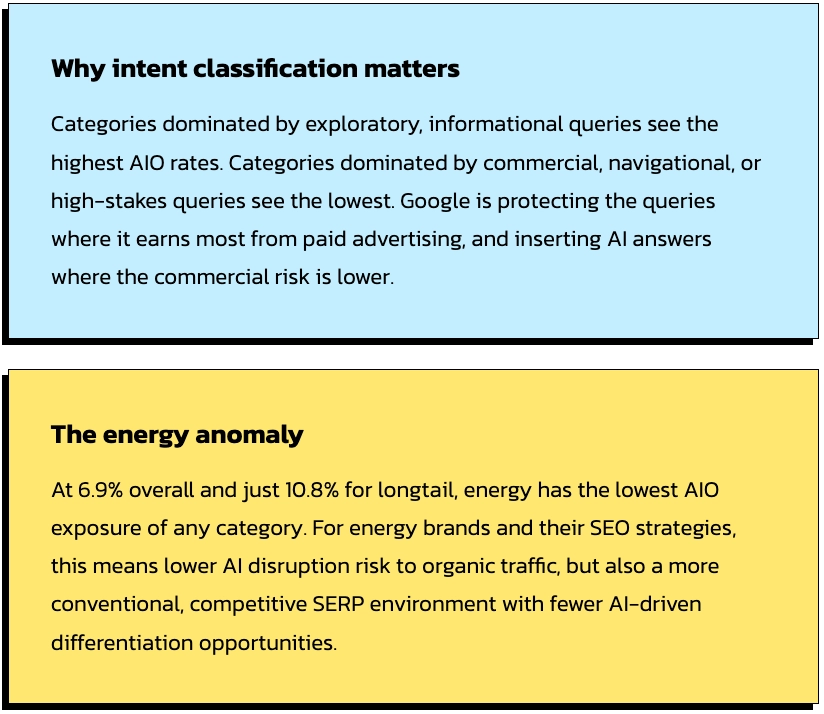
An exception to this trend is motor vehicles. Here, the gap between head and longtail AIO rates is the narrowest (15.1% vs. 23.4%), with a minimal longtail premium. This is likely because car buying is a high-commercial-intent journey across almost all query types, and Google treats nearly all of it as too consequential for AI-generated shortcuts.
For brands operating in sectors like petcare and consumer electronics, this trend elevates longtail optimization beyond a mere traffic-generation tactic. Being cited within an AI Overview for high-intent longtail queries is now a distinct and meaningful visibility objective, complementing traditional SEO efforts.
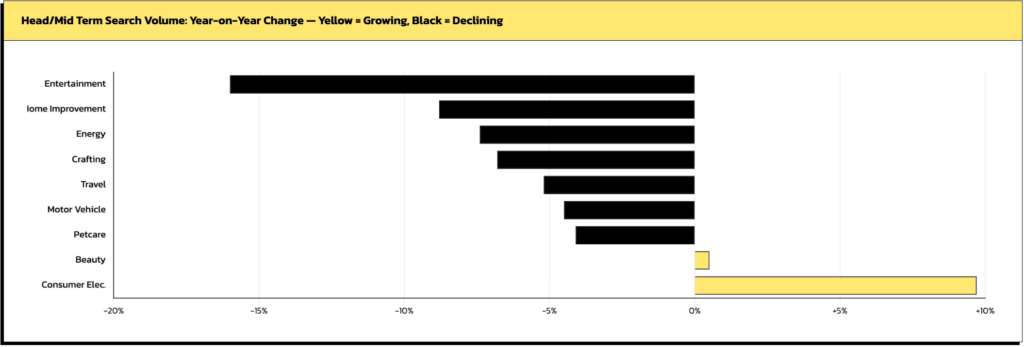
Head Terms Are Losing Search Volume in Seven of Nine Categories
The year-on-year (YoY) trend for head and mid-length terms (1-3 words) paints a consistent picture of structural decline across most analyzed categories.
- Entertainment leads this decline with a sharp -16% YoY drop. This category is particularly susceptible to AI disruption, as tools like ChatGPT can credibly substitute for Google searches for entertainment recommendations. This suggests queries might be leaving the Google platform altogether, rather than migrating within it.
- Home improvement (-8.8%), energy (-7.4%), and crafting (-6.8%) also show meaningful declines.
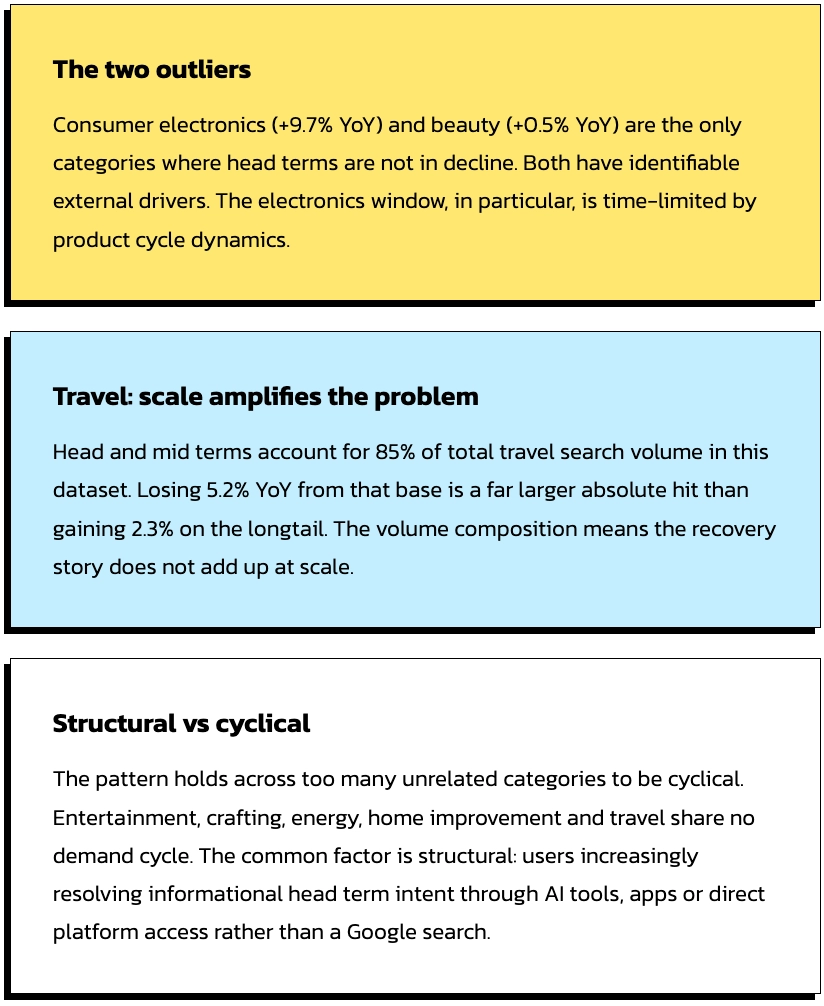
- Travel (-5.2%) is concerning in absolute terms. With 165 million head term searches in the dataset, a 5.2% decline represents tens of millions of lost impressions annually, and a significant 69.6% of individual keywords within this category are already declining.
The outliers in this trend are consumer electronics (+9.7%) and beauty (+0.5%). Consumer electronics growth is attributed to the "AI device supercycle," with new product launches and comparison queries driving head term volume. Beauty’s growth reflects the ongoing influence of social media discovery and trend-led search terms. However, neither growth trend is guaranteed to be permanent; consumer electronics already shows signs of deceleration.
Longtail is Mostly Compensating for Head Term Declines, But Not Always
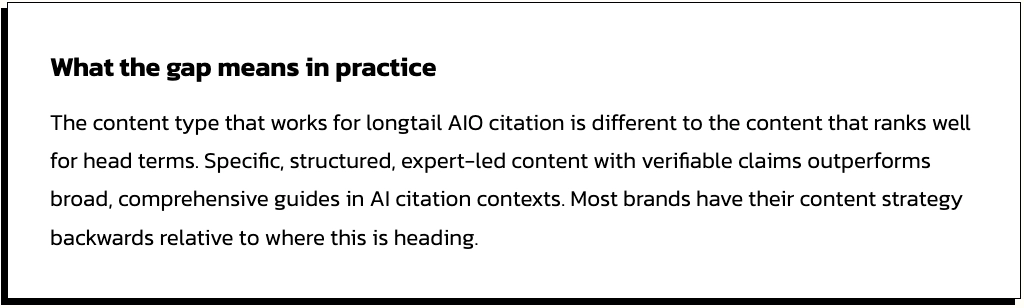
When comparing head and longtail YoY trends side-by-side, the scale of divergence becomes apparent. In most categories, the gap is significant. Only two categories, beauty and consumer electronics, show positive volume movement in both longtail and head term tiers. Motor vehicles is the sole category where both are declining, suggesting a migration away from Google towards more specialized automotive search tools.
- Entertainment displays the most dramatic divergence: head terms falling at -16% while longtail surges by +62.1% YoY. This reflects a fundamental shift in how entertainment-related queries are being formed, with users moving from broad terms to highly specific, conversational questions that Google is increasingly answering with AI.
- Home improvement (+14.7% longtail, -8.8% head) and petcare (+13.2% longtail, -4.1% head) exhibit a similar dynamic, albeit at a smaller scale. While head term decline is evident, longtail growth offers partial compensation in total volume, and the higher AIO exposure on longtail queries alters the visibility calculus.
The motor vehicles category presents a unique challenge. Both head and longtail volumes are declining, indicating users may be migrating away from Google altogether, potentially towards OEM apps, dealer configurators, or platform-specific automotive search tools. There is no longtail recovery to offset the decline, making it the most structurally challenged category in the dataset.
Implications for Brands: Beyond Ranking to AIO Citation and Zero-Click Presence
The shift towards longtail queries and the increasing prevalence of AI Overviews necessitate a strategic evolution for brands. Optimizing solely for traditional rankings is no longer sufficient. Three primary objectives now exist where one (ranking) once dominated:
- Ranking for Visibility: This remains crucial, but the landscape is changing.
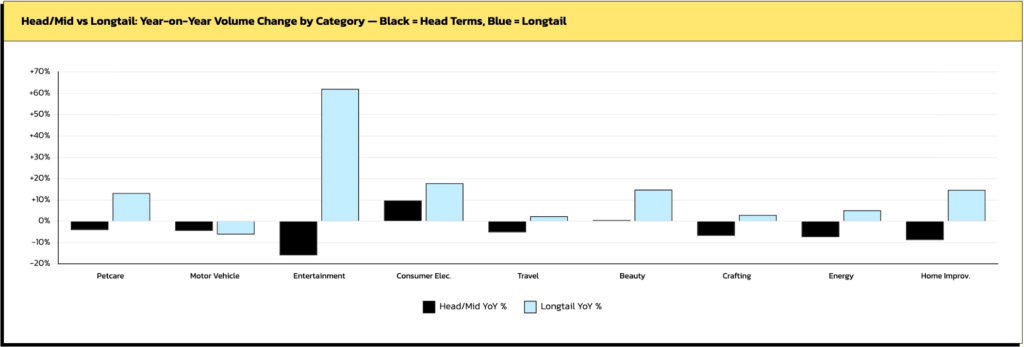
- Optimizing for AI Overview Citation: With longtail AIO rates ranging from 23.4% to 58.5% across categories, being the top-ranked result for a longtail query may not guarantee traffic if an AI Overview provides the answer directly. Brands must now create authoritative, well-structured content with clear, verifiable claims to be cited by Google. This requires a departure from broad, generalized "comprehensive guides" towards content that demonstrates specificity, demonstrable expertise, and factual precision.
- Achieving Zero-Click Brand Presence: In high-AIO categories, being cited as a source within an AI Overview can build credibility and brand awareness even without a click-through. Measuring this exposure requires new frameworks beyond traditional organic traffic reporting, as most current analytics setups do not capture it.
The sheer volume of head terms means their decline has a significant impact. Head and mid-length terms still account for 65-85% of total search volume across most sectors. For instance, the travel sector’s 165 million head term searches versus 28 million longtail searches highlights this imbalance. A 5-17% decline in head term volume represents a larger absolute loss than a substantial percentage gain on a smaller longtail base, except in categories like entertainment where longtail growth is exceptionally strong.
The two growing categories, consumer electronics and beauty, currently warrant more aggressive content investment. However, even these may not remain stable. The consumer electronics forecast shows deceleration, and beauty’s head term growth is modest enough to be vulnerable to market shifts.
Impact on Google’s Advertising Revenue Model
Google’s advertising business is heavily reliant on high-volume head term auctions, where the Cost Per Click (CPC) is significantly higher than for longtail queries. A decline in head term volume, as seen in multiple major categories, directly impacts auction depth and CPC inflation, which are core drivers of Google’s revenue.
Categories like entertainment (-16% YoY), energy (-7.4% with a further -8.9% forecast), home improvement (-8.8%), and crafting (-6.8%) are most vulnerable. The travel sector, with its vast head term volume and widespread keyword decline, is also a significant concern.
While longtail growth offers some compensation through increased ad impressions, the revenue per click is materially lower, and inventory is more fragmented. Google would require substantially higher longtail volume growth to offset head term revenue decline at scale, a trend not currently evident across the board.
A more significant long-term risk for Google is the potential for users to bypass the SERP entirely by using AI tools for informational queries. If users no longer reach a Google SERP for these searches, that query volume is lost, not just migrated within Google. Entertainment and crafting are prime candidates for this "silent attrition" due to the strong substitutive capabilities of conversational AI.
For paid search advertisers, this shift implies potential short-term increases in head term CPCs due to constrained supply. The long-term dynamics will depend on whether advertisers follow volume migration into longtail or maintain head term budgets for brand visibility. While large advertisers will likely pursue both strategies, the overall adjustment is underway, with significant implications for budget allocation and campaign performance.

Methodology: A Deep Dive into the Data
The Brainlabs analysis was meticulously conducted using data from Ahrefs, a leading SEO data platform. The dataset comprised 1.35 million keywords across nine UK consumer categories: petcare, motor vehicle, entertainment, consumer electronics, travel, beauty, crafting, energy, and home improvement. Each category dataset contained up to 150,000 keywords, all pertaining to UK (gb) search queries captured in May 2026.
AI Overview presence was identified by tracking the "AI Overview" feature within Ahrefs’ SERP data. Volume-weighted AIO rates were calculated by weighting each keyword’s AIO flag against its monthly search volume. This method provides a more accurate representation of user exposure to AIOs than a simple keyword count, as it accounts for the actual search volume of queries. For example, a high-volume keyword with an AIO is more impactful than thousands of low-volume keywords with an AIO. The study defined head/mid terms as 1-3 words and longtail terms as 4 or more words.
Search volume trends were analyzed using a 24-month historical series (May 2024 to April 2026) and a 13-month forecast series (May 2026 to May 2027), both generated by Ahrefs. Year-on-year trends were calculated by comparing average monthly search volumes across two consecutive 12-month periods.
It is important to acknowledge the limitations of the study. AI Overview presence is dynamic and subject to Google’s frequent updates. Ahrefs’ SERP crawls provide a robust sample but not a real-time census of every query. Forecast data is modeled and should be treated as directional.
The current search landscape is undergoing a profound transformation, driven by technological advancements and evolving user behaviors. Brands that fail to adapt to the rise of longtail queries and the pervasive influence of AI Overviews risk becoming invisible in an increasingly fragmented and complex digital ecosystem. The window to strategize and implement necessary changes is narrowing, demanding immediate attention and a forward-thinking approach.