The digital marketing landscape is undergoing an unprecedented transformation as traditional search engine result pages (SERPs) evolve from lists of blue links into dynamic, AI-generated answers. This profound shift, driven by the emergence of Google’s AI Overviews, OpenAI’s ChatGPT, and Perplexity, mandates a radical rethinking of content strategy, forcing marketers to prioritize Answer Engine Optimization (AEO) over conventional SEO. The imperative to adapt is no longer theoretical; according to HubSpot’s 2026 State of AEO Report, a significant 58% of marketers are already actively optimizing their content for these burgeoning answer engines, signaling AEO’s rapid ascent from an experimental niche to a mainstream strategic pillar.
The Evolution of Search: From Keywords to Conversational AI
For decades, search relied primarily on keyword matching and backlink profiles to rank web pages, presenting users with a curated list of links to explore. The advent of semantic search began to introduce a deeper understanding of user intent and content meaning. However, the true inflection point arrived with the widespread adoption of large language models (LLMs) and generative AI. These sophisticated algorithms are not merely indexing pages; they are reading and synthesizing information to provide direct, concise answers to user queries, often without the need to click through to an external website.
This transition began subtly with featured snippets and "People Also Ask" sections, which offered quick answers directly on the SERP. The full realization of this shift, however, came with Google’s integration of AI Overviews into its main search interface, providing users with a summary generated by AI at the top of results. Concurrently, standalone platforms like ChatGPT and Perplexity have demonstrated the power of conversational AI to answer complex questions, creating a new expectation among users for immediate, authoritative responses. This chronological development underscores the urgency for content creators to move beyond optimizing for clicks and instead focus on optimizing for direct citation.
The Core Principle of AEO: Structure as the Key to Citation
In this new paradigm, visibility is redefined. It’s less about appearing on the first page of ten links and more about whether an answer engine can extract a clean, self-contained passage from your content and confidently attribute it to your brand. This extraction mechanism is heavily reliant on content structure. AI models are trained to parse information efficiently, and well-structured content offers the clarity and organization necessary for effective understanding and citation.
Leading digital marketing experts emphasize that the content most frequently cited by answer engines shares a handful of recognizable traits, all primarily hinging on a meticulous approach to structure. "The days of keyword stuffing and vague prose are long gone," states a leading SEO strategist. "AI demands precision, clarity, and explicit organization. If an AI can’t easily understand your answer, it won’t cite it."
Pillars of Effective Answer Engine Optimization
To thrive in the AI search era, marketers must implement a multi-faceted AEO strategy built upon five critical structural themes:
1. Question-Led Headings and Direct-Answer Summaries
This is perhaps the most immediate and impactful structural change marketers can make. Answer engines are designed to answer questions, and content that explicitly poses and immediately answers those questions performs exceptionally well.

- Question-Led Headings: Instead of generic headings like "Introduction to Marketing," opt for "What is Answer Engine Optimization (AEO)?" or "How Does AEO Differ from SEO?" These headings mirror natural language queries, making it easy for AI to map a user’s question directly to your content. AirOps’ 2026 State of AI Search Report highlights that sequential heading structures can increase citation odds by an impressive 2.8 times.
- Direct-Answer Summaries (TL;DR): Following a question-led heading, a concise, one-to-two-sentence summary that directly answers the question is crucial. This "Too Long; Didn’t Read" (TL;DR) format provides the AI with a ready-to-lift snippet, even before the more detailed context.
- Q&A Blocks: Formatting explicit question-and-answer pairs within the content further enhances citable potential. These blocks should be self-contained, with the answer immediately following the question, ideally in a distinct format (e.g., bolded question, clear paragraph answer).
2. Semantic Schema and Entity Modeling
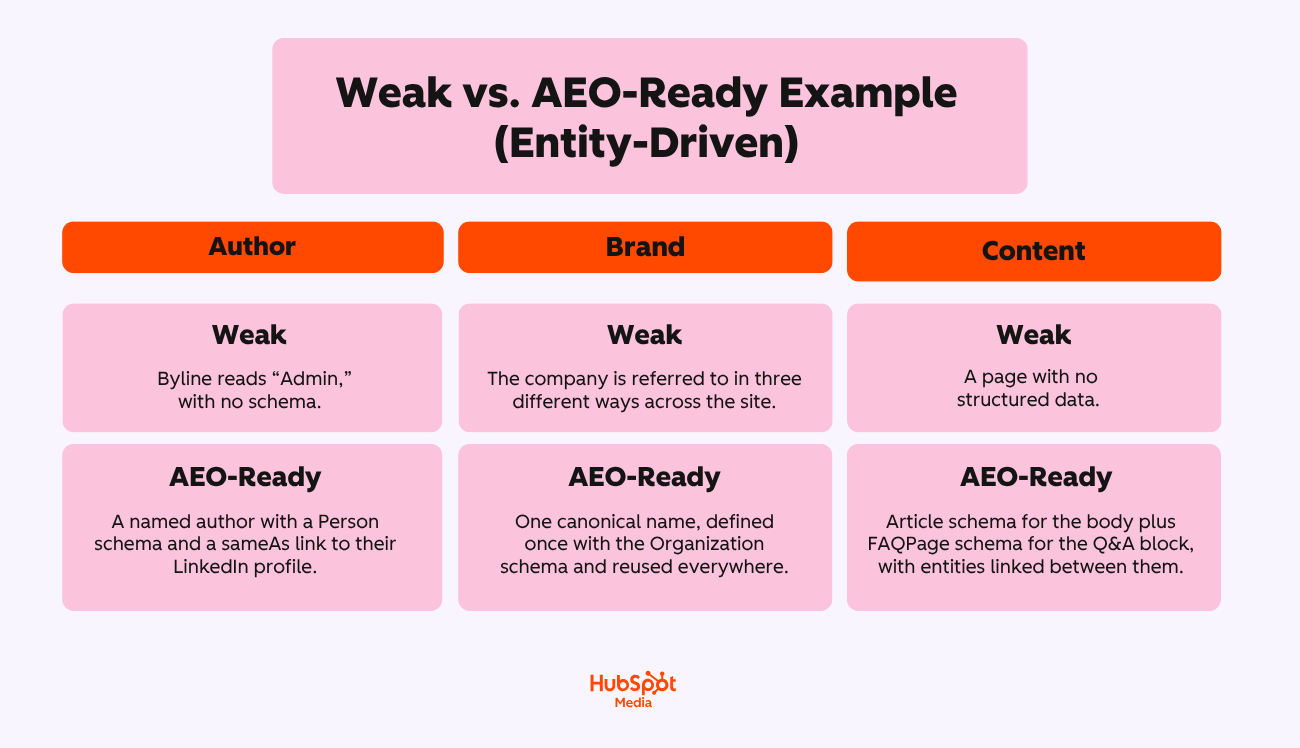
While human readers understand context, AI needs explicit signals. Semantic schema and robust entity modeling provide this machine-readable layer, telling engines precisely what a page is about, who authored it, and which brand stands behind it.
- Structured Data (Schema.org): Implementing relevant schema types (e.g., Article, FAQPage, HowTo, Organization, Person, Product) labels parts of a page so engines don’t have to infer their meaning. This is vital for establishing credibility and clarity.
- Entity Consistency: This involves defining people, brands, and products on your site as consistent, connected entities rather than isolated words. Using consistent naming conventions, linking to author bios, and establishing clear brand mentions helps engines build confidence in your source. A deliberate entity model strengthens brand, product, and author relationships, which is crucial for AI models to trust and attribute information.
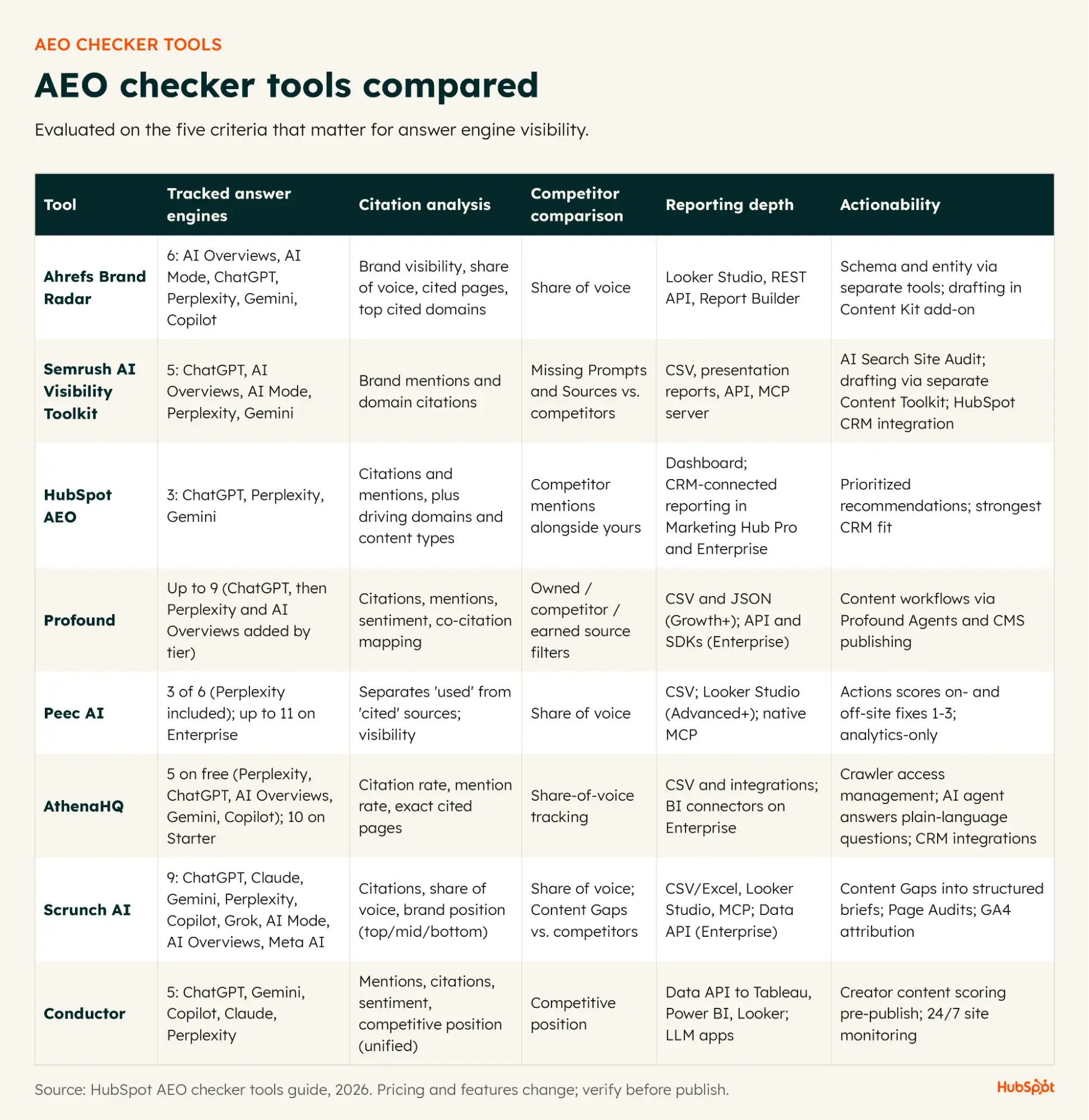
- Measuring Schema and Entities: Tracking metrics like "Entity Mentions," "Schema Coverage," and "Citation Count from Entity" allows marketers to gauge the effectiveness of their efforts and identify gaps in their machine-readable layer. Tools like HubSpot’s AEO Grader can benchmark how answer engines perceive a brand’s entities.
3. Authoritative Signals and Trust Markers
Trustworthiness is paramount for AI citation. Answer engines prioritize sources they can verify, meaning two equally well-answered questions might see the more authoritative source cited. These signals build the confidence an AI needs to attribute information.
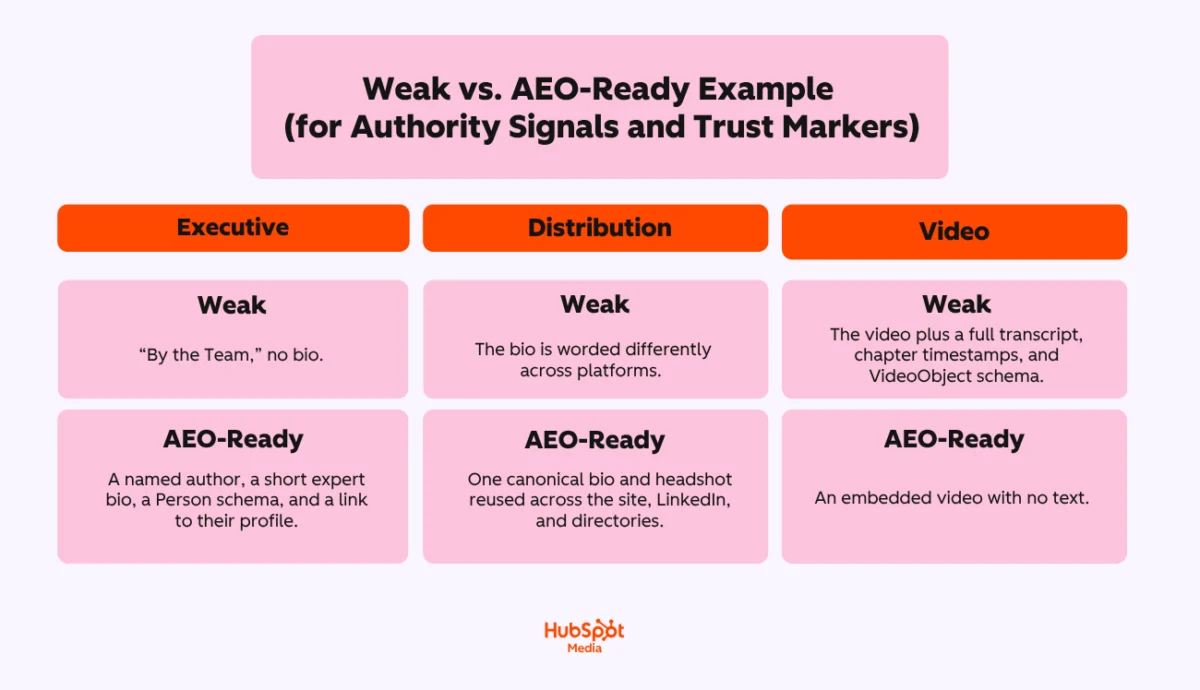
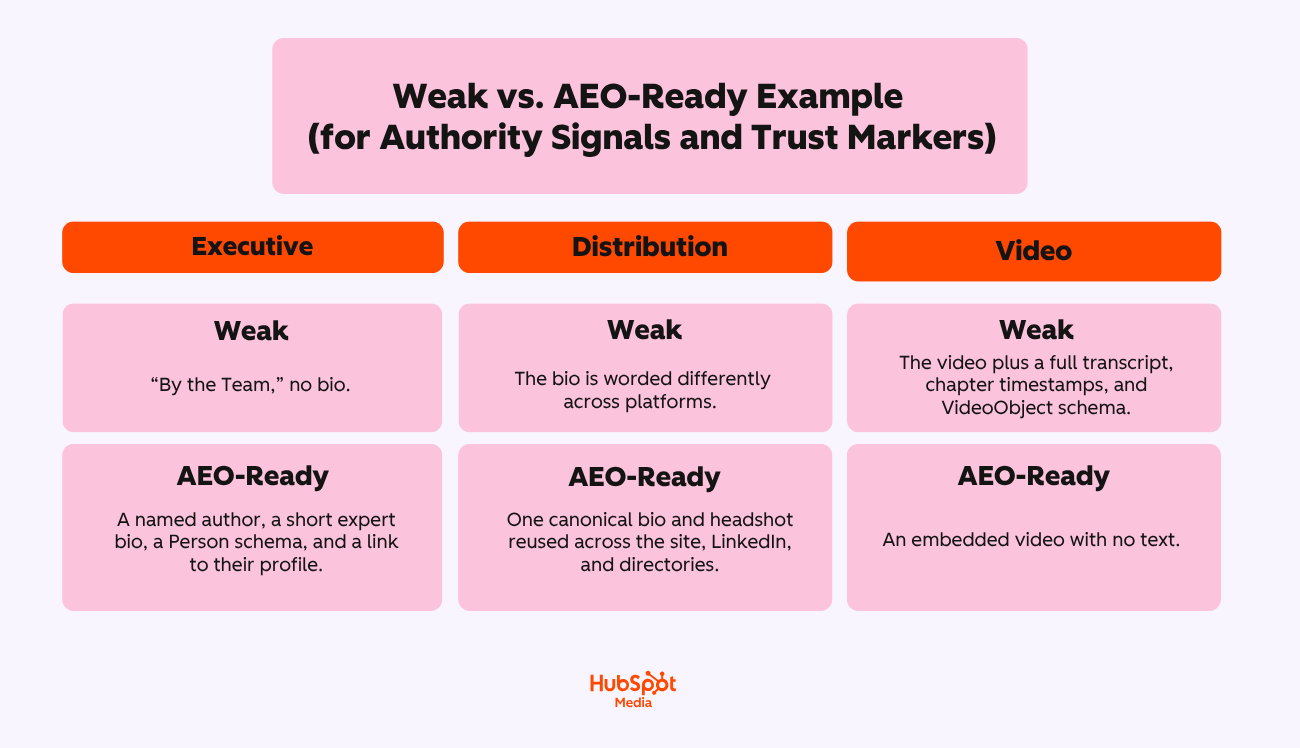
- Authoritative Profiles: Robust, well-described profiles for authors, brands, and executives are essential. These profiles should clearly state expertise, credentials, and affiliations, providing verifiable entities rather than vague mentions.
- Distribution Across Trusted Ecosystems: Content and entity mentions appearing across reputable external sources (e.g., industry publications, academic journals, news sites) act as powerful corroboration signals for answer engines.
- Video Optimization: As video content gains prominence, making it machine-readable is critical. This includes providing accurate transcripts, adding timestamps to key sections, and using
VideoObjectschema to describe the video’s content, allowing AI to parse and cite specific segments.
4. Strategic Internal Linking Architecture
Internal linking is the structural blueprint of your website, guiding both users and AI crawlers. A well-designed internal linking strategy helps engines understand the relationships between content, group related topics, and establish topical authority.
- Hub-and-Spoke Model/Topic Clusters: Organizing content around authoritative "hub" pages that link to detailed "spoke" (supporting) pages creates a clear hierarchy and demonstrates comprehensive coverage of a subject. This "topic cluster" approach signals expertise to AI.
- Clear Anchor Text: The text used for internal links should be descriptive and relevant to the linked page’s content. Ambiguous anchor text can confuse AI about the linked page’s topic.
- Early Link Placement: Placing relevant internal links early in a page’s content signals their importance to AI crawlers and helps them quickly grasp the page’s context within the broader site structure.
5. Passage-Level Optimization for Extraction
The most granular level of AEO involves optimizing individual passages so they can be lifted and cited independently. The goal is to make each paragraph, list, or table row make complete sense even out of its surrounding context.
- Stand-Alone Paragraphs: Each paragraph should ideally answer a single question or convey one distinct idea, starting with the answer and then providing supporting details. Avoiding pronouns that refer to previous text (e.g., "this," "that approach") ensures the passage remains coherent if extracted.
- Structured Formats: Lists, tables, and definition boxes are inherently snippet-friendly. They present information concisely and in a format that AI can easily parse and present as direct answers.
- Concise, Extractable Sentences: Short, clear sentences improve readability for both humans and AI. Complex sentence structures can hinder clean extraction, making it harder for AI to quote specific points accurately.
Aligning AEO with Google’s Quality Guidelines: The Human-First Imperative
While structural optimization is key, it is ineffective without high-quality content. Google’s overarching goal remains to reward "people-first content." AEO tactics must never be used to game the system with weak or manipulative content; they should serve to amplify genuinely helpful information.
- Accuracy, Quality, Relevance, and User Context: These are the foundational prerequisites for any AEO work. Content must be factually accurate, well-researched, highly relevant to the user’s query, and considerate of their specific context. "Would this answer satisfy the searcher even if no AI summarized it?" is the critical question to ask before optimizing structure.
- Disclosure When Automation Assists: Google permits AI-assisted content when it is helpful and not primarily designed to manipulate rankings. Transparency about AI involvement (e.g., "Reviewed and fact-checked by [Name], [Title]") builds trust with both readers and AI.
- Do/Do-Not Guardrails: Establishing clear internal guidelines helps content teams maintain quality. "Do provide original insights, cite sources, and answer questions directly. Do not produce content primarily for search engines, mislead users, or republish without added value." These guardrails ensure AEO efforts reinforce, rather than undermine, content quality.
Measuring and Operationalizing AEO Impact
Proving the efficacy of AEO is crucial for its sustained implementation. This requires a robust measurement framework and operationalizing successful strategies.
- Key Performance Indicators (KPIs):
- Citation Count: The number of times your content is explicitly referenced by answer engines.
- Passage Lift Rate: How often specific passages from your content are extracted and used in AI-generated answers.
- Attribution Volume: The frequency with which your brand, author, or product is named as the source of information.
- The Measurement Loop: A continuous cycle of diagnosing current performance, testing structural changes, measuring the impact on KPIs, and iterating based on data is essential for refinement.
- Operationalizing Success: Implementing AEO consistently across content teams involves:
- Role-Based Checklists: Assigning specific AEO tasks (e.g., schema implementation, heading optimization, internal linking review) to clear owners.
- Reusable Templates: Building content templates (potentially within platforms like HubSpot’s Content Hub) that embed AEO best practices by default, including fields for Q&A blocks, TL;DR summaries, and schema requirements. AI tools can even generate first-pass drafts for these elements, which human editors then refine to meet quality standards.
The Future of Content: A Durable Advantage
The transition to AEO may seem daunting, but it boils down to mastering the discipline of structure. AI models prioritize content that is clear, direct, and easily digestible. Marketers don’t need to reinvent their entire content strategy; rather, they must make their most valuable answers easy for AI to find, extract, and attribute.
This systematic approach offers a durable advantage. By consistently applying structural best practices, refining entity relationships, and continuously measuring impact, businesses can secure their visibility in an evolving search landscape. The era of AI search is not just about technology; it’s about clarity, authority, and trust, all amplified by intelligent content structure. Brands that embrace this shift proactively will not only maintain their presence but establish themselves as authoritative voices in the conversational future of search.