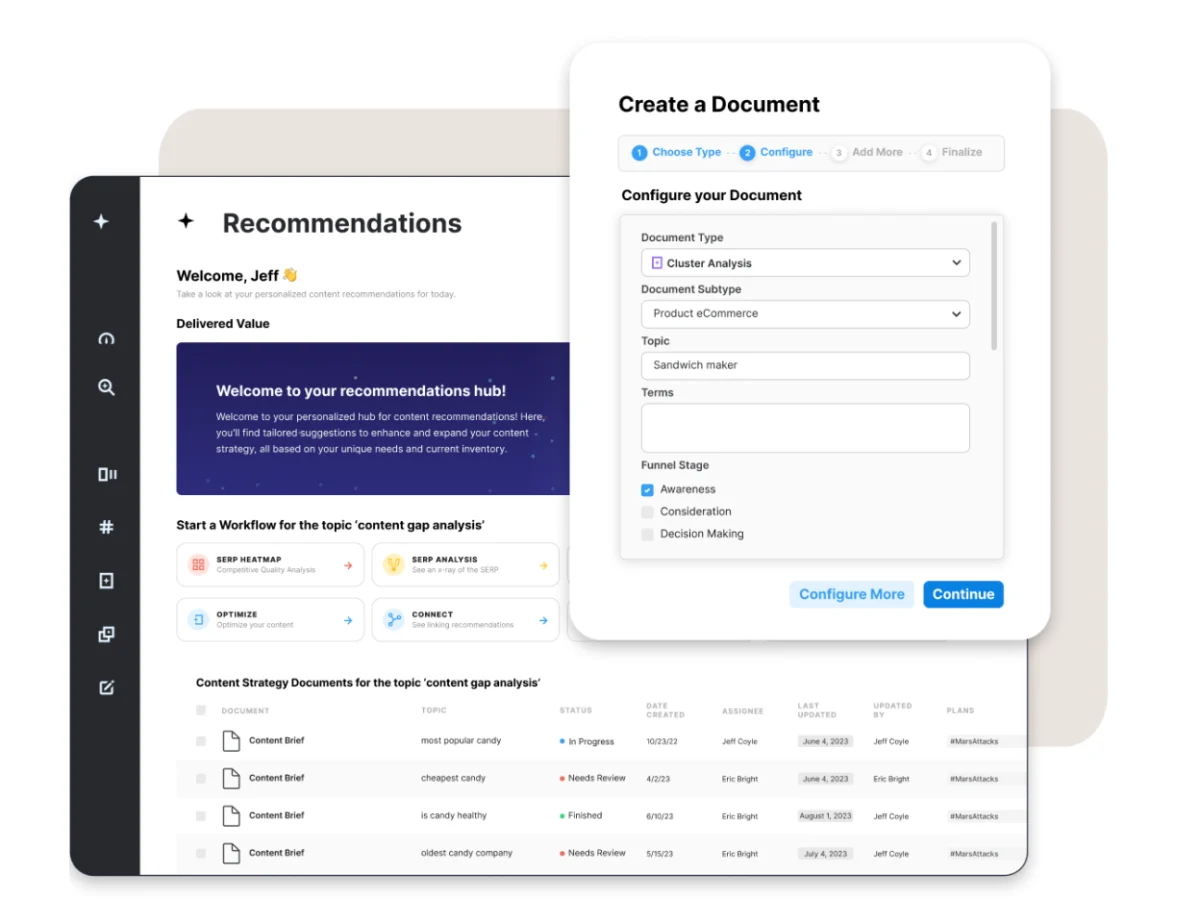
Organic search remains a cornerstone of digital marketing, consistently delivering robust returns on investment. However, the landscape of content optimization has undergone a profound transformation by 2026, necessitating a new generation of tools and strategies. The traditional pursuit of high Google rankings is no longer sufficient; the advent of sophisticated AI search engines, such as Google AI Overviews, Perplexity, and ChatGPT, has fundamentally altered the buyer research process. These AI platforms do not interpret and select sources in the same manner as conventional search engines, presenting a significant challenge for marketing teams that fail to adapt. Brands optimized solely for Google’s legacy algorithms often find their content invisible within AI-generated answers, effectively disappearing from the buyer’s radar. This guide provides a comprehensive overview of the leading content optimization tools available in 2026, categorized by their specific use cases, and designed to help marketing teams build a resilient content stack or enhance existing workflows for both traditional SEO and the burgeoning field of Answer Engine Optimization (AEO).
The Evolving Search Landscape: From SEO to AEO
The digital ecosystem has witnessed a seismic shift in how users access information. For decades, Search Engine Optimization (SEO) focused on optimizing content for keyword density, backlinks, and technical factors to rank highly on search engine results pages (SERPs). This approach successfully drove billions of queries and clicks. However, the rapid advancement of generative AI has ushered in a new era. In the early 2020s, platforms like OpenAI’s ChatGPT began demonstrating the ability to synthesize information and provide direct answers, challenging the traditional model of displaying a list of links. By 2024, Google introduced AI Overviews directly into its search results, followed by the widespread adoption of AI-powered conversational assistants like Gemini and Perplexity.
This evolution signifies more than just a new interface; it represents a fundamental change in how information is consumed and attributed. Instead of clicking through to websites, users increasingly receive summarized answers directly from AI, often with citations. This shift has given rise to Answer Engine Optimization (AEO), a discipline focused on ensuring content is structured, authoritative, and contextually relevant enough to be cited by AI search engines. A recent industry report by Digital Insights Global indicates that 70% of online buyers now interact with AI search engines at least once during their research journey, a sharp increase from 30% in 2024, underscoring the urgency for marketers to embrace AEO.
Understanding Content Optimization Tools in 2026

Content optimization tools are designed to enhance content quality, improve search visibility (both traditional SEO and AEO), and boost conversion performance. The market is saturated with various content and SEO analysis tools, many offering overlapping functionalities. Before delving into specific recommendations, it is crucial to understand the major categories that comprise a robust content optimization stack for 2026:
- On-Page Optimization and Content Scoring: These tools analyze content against top-ranking competitors, providing data-driven recommendations. They leverage advanced Natural Language Processing (NLP) and semantic analysis to understand content depth and relevance, moving beyond simple keyword matching.
- Research, Briefs, and Content Writing Accelerators: Focusing on the pre-writing phase, these tools assist in strategic planning, competitive analysis, and accelerating first-draft creation, ensuring content is grounded in current keyword trends and user intent, and is primed for AI interpretation.
- Internal Linking and Site Structure Support: Critical for both human navigation and search engine crawlers, these tools help visualize and optimize website architecture, ensuring proper topical authority and equitable distribution of link value.
- Experimentation and Content QA: Post-publication, these tools provide insights into user behavior and technical performance, enabling continuous improvement and auditing of existing content.
- Performance Reporting and Strategy Tools: These platforms are essential for measuring content ROI, tracking both traditional search rankings and, crucially, AI citation visibility, allowing marketers to demonstrate the impact of their efforts on leads and revenue.
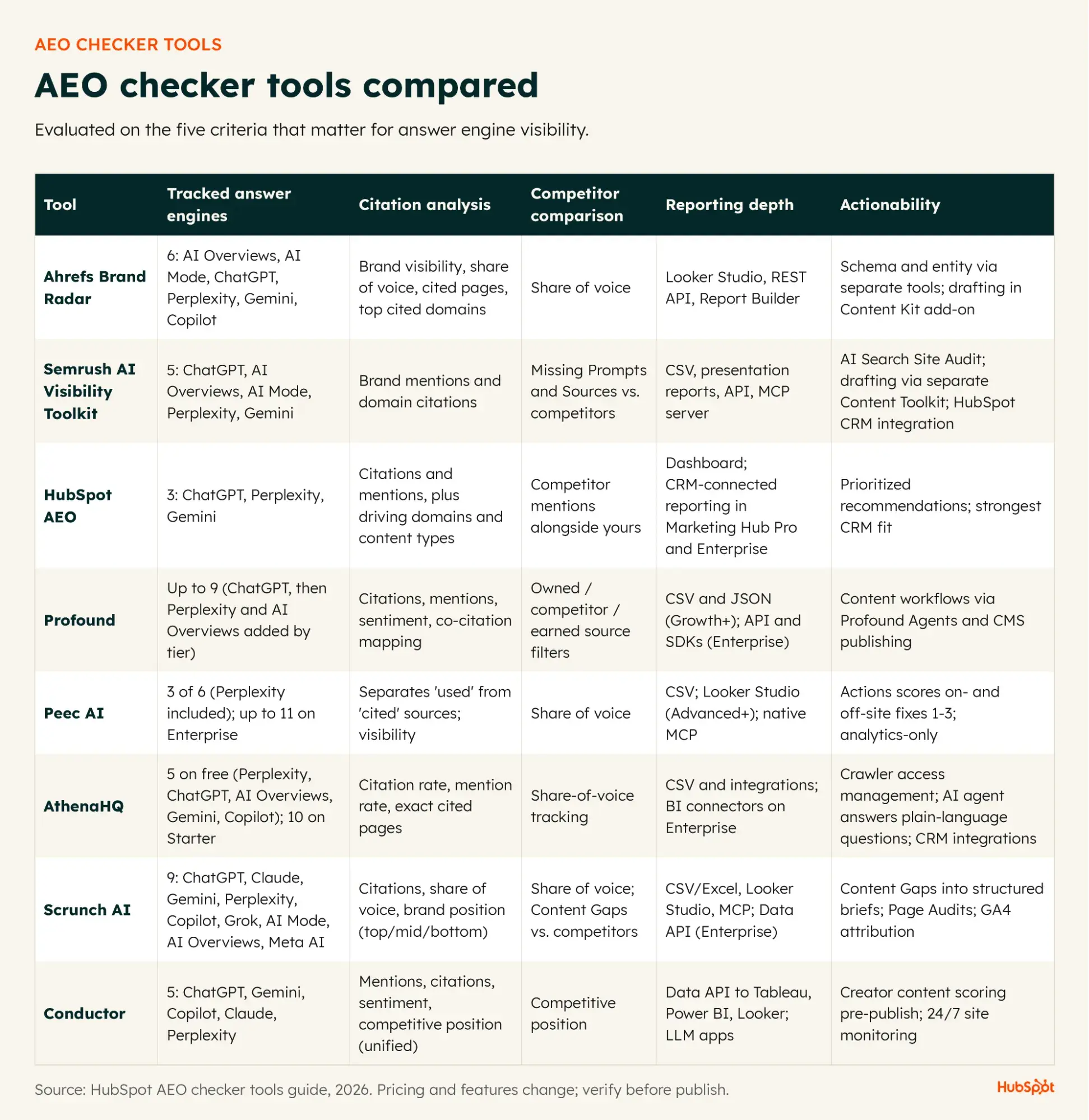
As AI visibility becomes a standard reporting requirement, tools that specifically track and analyze AEO performance are gaining paramount importance. For instance, HubSpot AEO provides insights into a brand’s appearance in AI-generated answers across major platforms like ChatGPT, Perplexity, and Gemini, connecting this critical data directly to CRM systems to track leads and pipeline impact. This integration is vital for demonstrating tangible business value from content investments.
The Best Content Optimization Tools by Use Case
An effective content strategy in 2026 requires a blended approach, combining traditional SEO optimization software with specialized tools for research, AI visibility, and integrated reporting. The following breakdown highlights key tools in each category, detailing their functionalities, ideal users, and how they contribute to a modern content stack.
On-Page Optimization and Content Scoring
These tools are indispensable for crafting content that resonates with both human readers and sophisticated algorithms. They move beyond basic keyword checks, utilizing NLP and semantic analysis to identify gaps and opportunities by comparing content against leading competitors.
HubSpot SEO Marketing Software
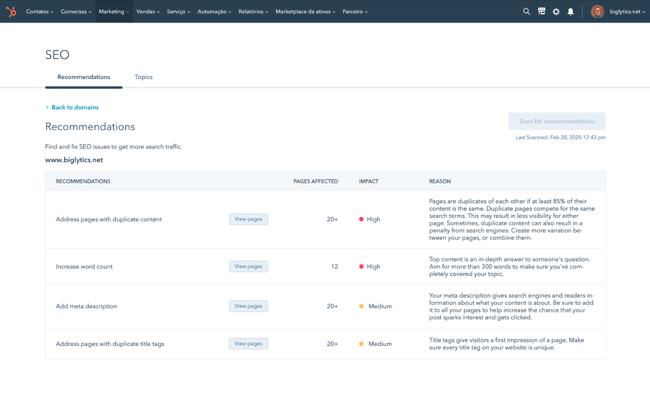
Integrated within Marketing Hub, HubSpot’s SEO Marketing Software offers a centralized platform for managing SEO performance, delivering specific on-page recommendations, and structuring content using topic clusters. Its unique advantage lies in its direct connection to the HubSpot CRM. This integration allows teams to identify content requiring optimization, implement changes directly within the platform, and track the subsequent impact on traffic and leads without cumbersome data transfers or tool switching.
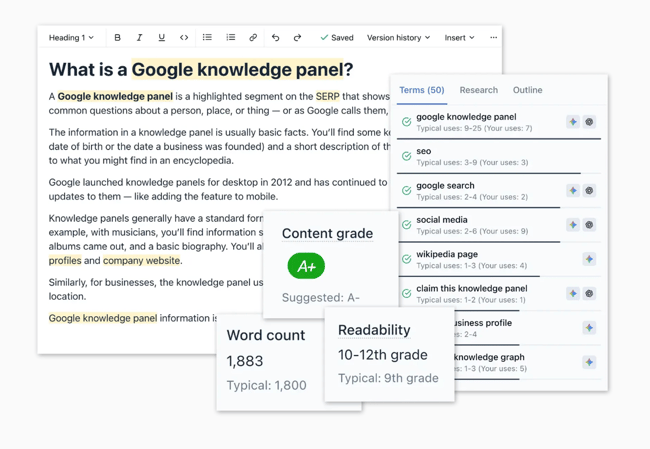
- Key Features: Integrated SEO recommendations within the content editor, topic cluster planning and visualization, on-page SEO audits, performance tracking linked to CRM data, competitive analysis.
- What I like: The seamless integration with CRM data is a game-changer. Content teams can directly attribute improvements in page performance to measurable increases in Marketing Qualified Leads (MQLs) or pipeline, significantly simplifying executive buy-in for SEO investments.
- Best for: Marketing teams already leveraging HubSpot for their CRM and marketing automation. It is particularly well-suited for mid-market and enterprise organizations that require comprehensive ROI reporting across the entire sales funnel.
- Pro Tip: Teams on Marketing Hub Professional or Enterprise can enhance their capabilities by adding AEO through the HubSpot for Marketers bundle, consolidating both traditional SEO and AI search visibility within a single, unified platform.
- Expert Insight: Rob Freedman, VP of Marketing at SureCam, emphasizes, "HubSpot’s content editor, SEO recommendations, and content calendar are integral to how I plan, publish, and optimize web and blog content. The ability to tie each asset directly to campaigns and report on pipeline and revenue impact in our CRM is invaluable."
Clearscope
Clearscope stands as a content discoverability platform that spans the entire content workflow. It supports topic research, AI-assisted drafting, on-page optimization, continuous content monitoring, internal linking strategies, and crucial AI search visibility tracking across platforms like ChatGPT and Gemini.
- Key Features: Content grading and optimization scores based on top-ranking content, AI-driven keyword and topic suggestions, competitive analysis for content gaps, query fan-out analysis for AI search intent, content monitoring and decay detection.
- Pricing: Starts at $129/month.
- What I like: Clearscope’s user-friendly interface facilitates widespread adoption across writing teams. The "query fan-out" feature is particularly insightful for AEO strategies, helping teams understand the broader search ecosystem that AI platforms explore to generate answers, providing concrete direction for content investment.
- Best for: Enterprise content teams and agency partners seeking a unified platform for on-page optimization and AI search visibility, benefiting from unlimited user seats without per-seat pricing constraints.
- Expert Insight: Cassy Aite, co-founder of Postbeam.ai and Hoppier.com, notes, "Clearscope has been instrumental in scaling content with new writers. It significantly reduces the manual on-page SEO research, streamlines the editing process, and provides confidence that content is truly optimized before publishing."
Surfer
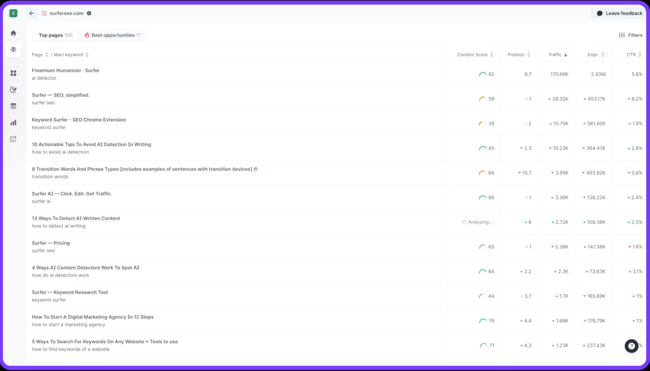
Surfer is a comprehensive AI visibility platform that integrates on-page content optimization with advanced AI search tracking, topical authority planning, and competitive intelligence. It monitors performance across Google and major AI engines including ChatGPT, Perplexity, Gemini, and Google AI Overviews.
- Key Features: Content Editor with real-time scoring and keyword suggestions, AI-powered content generation, content audit dashboards showing performance metrics (Content Score, search position, traffic), SERP analyzer, Mention Gap analysis for AI citation opportunities.
- Pricing: Starts at $119/month (monthly) or $99/month (annually).
- What I like: The "Mention Gap" feature is a powerful asset for developing a targeted AI search strategy. It pinpoints which AI engines are citing competitors for specific topics, offering clear actionable insights to close visibility gaps, rather than merely optimizing reactively.
- Best for: Content teams and SEO specialists requiring a holistic platform for on-page optimization and AI visibility tracking, especially those with high-volume publishing needs or managing multiple brands.
- Expert Insight: Chris Coussons, founder at Visionary Marketing, shares a compelling case study: "We tested Surfer SEO by optimizing 50% of a client’s aged blogs, leaving the other 50% as a control. The optimized blogs saw an average increase of 4 ranking positions (zero for the control) and a 43% increase in clicks within three months. We’ve adopted it for all our clients’ blogs since."
Research, Briefs, and Content Writing Accelerators
Effective content optimization begins long before a single word is written. Tools in this category empower teams to plan more strategically, produce comprehensive content briefs, and accelerate the creation of high-quality first drafts, all while ensuring content is deeply rooted in genuine keyword and user intent data.
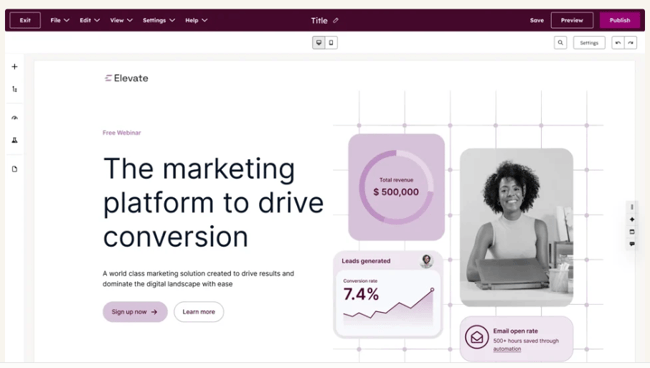
HubSpot Content Hub
HubSpot Content Hub is a robust CMS platform featuring built-in AI content creation, intuitive drag-and-drop editing, and advanced content optimization capabilities. It is designed for teams seeking a unified environment to build, publish, and optimize their content. Content Hub not only accelerates publishing but, more importantly, facilitates the creation of structurally sound, extractable content that is easily parsed and cited by both human readers and AI search engines. This inherent structure aligns perfectly with how generative AI engines evaluate and pull information from sources.
- Key Features: AI-powered content generation for outlines, drafts, and summaries; drag-and-drop page editor; SEO and AEO recommendations integrated into the writing workflow; content performance analytics; robust CMS functionality.
- Best for: Teams prioritizing a unified platform for content creation, publishing, optimization, and measurement, eliminating the need to stitch together disparate CMS, SEO, and AI tools.
- Pro Tip: Content Hub and Marketing Hub, though distinct, are designed to work synergistically. For a truly integrated traditional SEO and AEO strategy, the HubSpot for Marketers bundle combines both hubs, including AEO capabilities, all connected to the central CRM data.
- Expert Insight: Kshitij Chaudhary, founder of Dintellects, attests, "HubSpot Content Tools help me organize my content workflow and track blog post performance, linking directly to lead generation and search rankings. Keeping all content and marketing efforts in one place is extremely helpful."
Frase
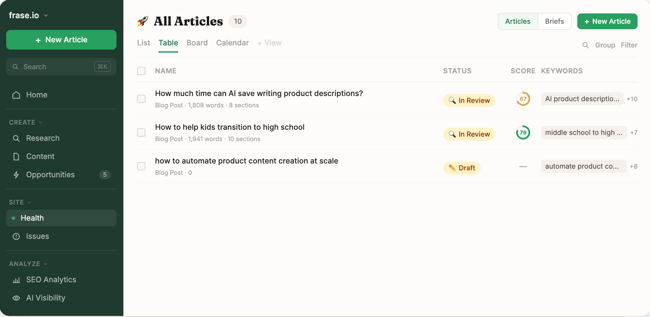
Frase is an agentic SEO and GEO (Generative Engine Optimization) platform that consolidates research, writing, optimization, AI-driven visibility tracking, and content maintenance into a single, cohesive environment. Frase supports the entire content strategy lifecycle, from SERP research and brief creation to AI-powered drafting, combined SEO + GEO scoring, and automated content decay detection.
- Key Features: AI-powered content briefs and outlines, content editor with real-time optimization scores (SEO + GEO), AI content generation, SERP analysis, competitive content gap analysis, automated content decay detection.
- Pricing: Starts at $49/month (monthly) or $39/month (annually).
- What I like: Frase’s ability to provide a single, unified score that accounts for both traditional Google optimization and AI visibility is a significant advantage. This directly addresses the critical question marketers are asking: "Are we optimizing for the right things now that AI search is so prominent?"
- Best for: Content teams looking to streamline a fragmented tool stack into one platform that comprehensively covers research, writing, SEO, GEO, and AI visibility tracking.
- Expert Insight: Chaudhary also utilizes Frase for its efficiency: "I use this tool for rapid content research. It helps me develop article outlines and uncover user search intent, including common questions and desired information. It greatly assists my article writing process."
MarketMuse
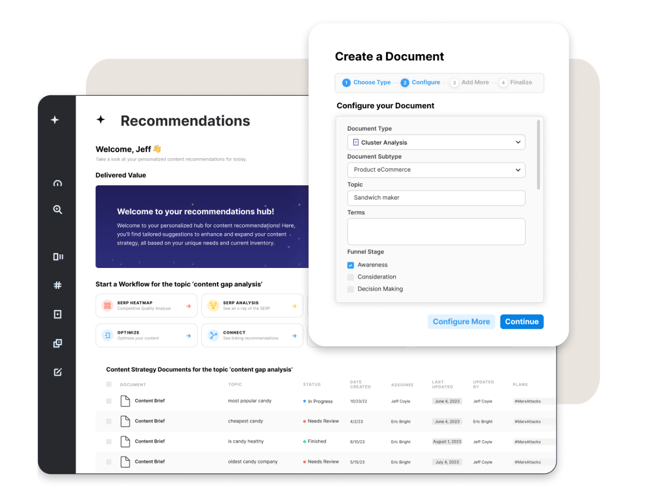
MarketMuse operates as a content intelligence platform, leveraging AI to identify content gaps, prioritize topics based on potential impact, and score content quality across an entire website. It provides a strategic, holistic view of a brand’s content landscape.
- Key Features: AI-driven content audits to identify gaps and opportunities, topic clustering and content pillar recommendations, content briefs for writers, content scoring and optimization suggestions, competitive content analysis.
- Pricing: Free plan available; paid plans are quote-based.
- What I like: MarketMuse empowers marketers to efficiently build an extensive content library that effectively addresses target topics and high-priority gaps. For large content teams, it helps prevent content duplication and ensures efforts are concentrated on areas with the greatest strategic impact.
- Best for: Enterprise and mid-market teams managing extensive content libraries (100+ pages) who require a strategic, site-wide perspective on their content gaps and opportunities.
Internal Linking and Site Structure Support
Robust internal linking is foundational to strong SEO and AEO. It helps search engines comprehend topical authority, enhances crawlability, and distributes "link equity" among related pages, yielding compounded benefits over time. These tools are crucial for optimizing site structure.
HubSpot SEO Topic Clusters (via Marketing Hub)
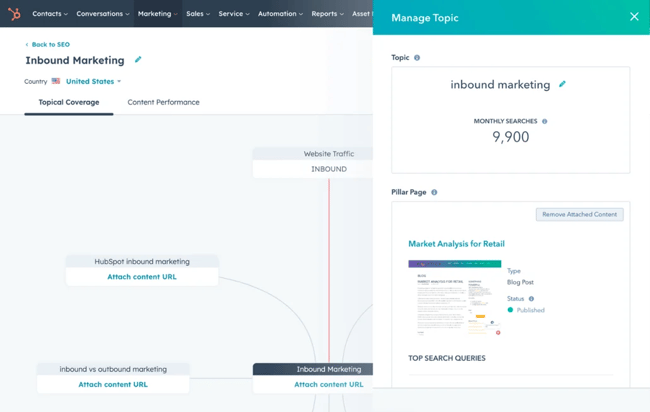
HubSpot’s topic cluster tool offers a visual representation of how pillar pages and supporting cluster content interlink across a website. It effectively identifies missing links, flags orphaned content, and simplifies the creation of a semantic architecture that is highly favored by both traditional and AI search engines.
- Key Features: Visual topic cluster map, identification of orphaned content and linking opportunities, performance tracking of clusters, integration with content calendar and editor.
- What I like: The intuitive visual map makes it easy to communicate complex site structure concepts to non-SEO stakeholders. Demonstrating the direct connection between strategic topics and actual content in a single view accelerates alignment on content priorities and strengthens the case for investing in gap content.
- Best for: Marketing teams already using HubSpot who need a strategic overview of their content architecture without relying on a separate site auditing tool. It is particularly beneficial for teams developing or expanding topic clusters as part of an AEO strategy.
Link Whisper
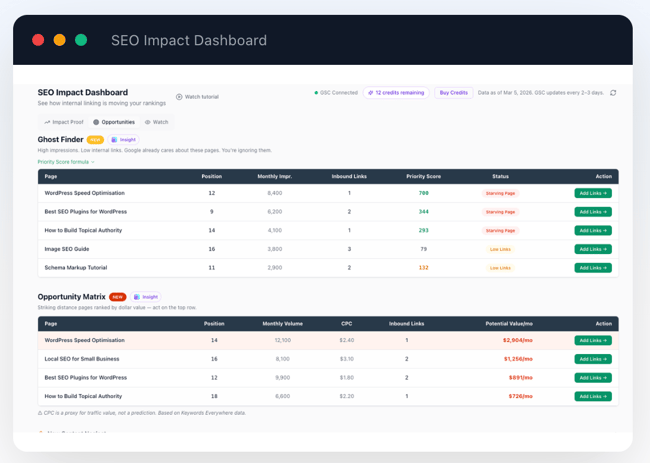
Link Whisper is a WordPress plugin that leverages AI to suggest and automatically insert internal links as content is being written. It also provides site-level reporting for orphaned pages, broken links, and overall link structure, simplifying what can often be a manual and time-consuming process.
- Key Features: AI-powered internal link suggestions, automatic link insertion, comprehensive internal link reporting, identification of orphaned content, integration with Google Search Console for keyword data.
- Pricing: Starts at $97/year.
- What I like: Link Whisper significantly reduces the manual effort involved in internal linking without requiring a complete strategic overhaul. Its integration with Google Search Console is a valuable addition, surfacing terms that Google already associates with a brand’s pages as optimal linking targets.
- Best for: WordPress-based content teams managing large archives who aim to improve internal linking at scale without an arduous manual audit process. It is not suitable for non-WordPress sites.
- Expert Insight: Keran Smith, Co-Founder and Chief Marketing Officer at LYFE Marketing, states, "Link Whisper saves me hours by allowing me to implement anchor text across multiple keywords with a single click. With thousands of pages on our site, it’s essential for scaling our anchor text efforts."
Screaming Frog
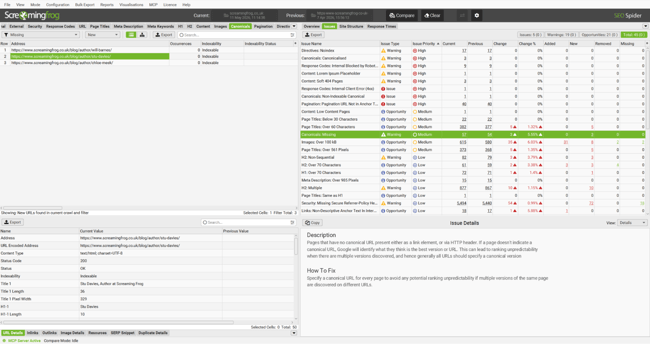
Screaming Frog SEO Spider is a powerful desktop-based technical SEO crawler compatible with Windows, macOS, and Linux. It meticulously audits site structure, identifies over 300 potential SEO issues, and uncovers internal linking deficiencies.
- Key Features: Comprehensive site crawling and auditing, identification of broken links, redirect chains, duplicate content, and meta issues, XML sitemap generation, custom extraction for specific data points, AI integration for content quality checks.
- Pricing: $279/year. A free version is also available with limited functionality.
- What I like: No other tool provides such a depth of crawl data at its price point. Screaming Frog’s recent AI integration allows SEO teams to conduct content quality checks or run custom extraction prompts at scale during a crawl, streamlining complex workflows.
- Best for: SEO specialists and technical teams who require deep, granular site crawls, especially before or after major content initiatives, site migrations, or CMS changes.
- Expert Insight: Robertas Voroneckis, Head of SEO and Growth at Demo Agency, considers Screaming Frog indispensable: "It’s my go-to for technical SEO audits, providing incredibly detailed insights into crawl issues, metadata, internal linking, indexation signals, and overall site structure."
Experimentation and Content QA
Content optimization is an ongoing process that extends beyond initial publication. This category encompasses tools that help teams test what resonates with users and meticulously audit existing content for republishing or updates.
Hotjar
Now part of Contentsquare, Hotjar is a behavior analytics platform that provides invaluable insights into how real users interact with content pages. It achieves this through visual heatmaps, session recordings, conversion funnels, and on-page surveys.
- Key Features: Heatmaps (click, scroll, move), session recordings, conversion funnels, on-page surveys and feedback widgets, user interviews.
- Pricing: Free plan available. Paid plans start at $49/month (monthly) or $39/month (annually).
- What I like: Hotjar addresses a critical question that most traditional content optimization tools cannot: Do visitors actually read, engage with, and understand the content once they land on a page? Integrating heatmap data with post-publish performance metrics helps close the loop between content quality and user behavior, providing a richer context for optimization decisions.
- Best for: Content and demand generation teams who need behavioral data to inform content quality assurance and page-level optimization. It is particularly useful for high-traffic landing pages, pillar content, and any page being tested for conversion improvements.
- Expert Insight: Keran Smith also relies on Hotjar: "It plays a vital role in helping us understand and improve our website UI and UX. The ability to view actual recordings of how visitors navigate our site is extremely insightful for making data-driven improvements."
Google Search Console
Google Search Console (GSC) is Google’s free and essential tool for monitoring a website’s search performance. It provides crucial data on clicks, impressions, Click-Through Rate (CTR), and average search position for various queries and pages.
- Key Features: Performance reports (clicks, impressions, CTR, average position), index coverage reports, sitemap submission, core web vitals and mobile usability reports, security issues.
- Pricing: Free.
- What I like: GSC serves as the fundamental baseline for any content optimization effort. Its query data is particularly useful for identifying content that is on the verge of ranking but might be underperforming, offering clear opportunities for targeted optimization.
- Best for: All marketing and SEO teams, regardless of size or industry. It is a non-negotiable tool for understanding organic performance directly from Google.
- Expert Insight: Robertas Voroneckis considers GSC his starting point: "Google Search Console is usually where I begin, as it reveals how a business is already being discovered, which pages have traction, and where the most straightforward optimization opportunities lie."
Performance Reporting and Strategy Tools
Quantifying the return on investment (ROI) of content is one of the most challenging aspects of marketing. Tools in this category bridge the gap between content publication and performance reporting, providing the data needed to prove impact.
HubSpot AEO (Answer Engine Optimization)
HubSpot’s AEO tool is specifically designed to help marketing teams understand precisely where and how their brand’s content appears in AI-generated answers across platforms like ChatGPT, Perplexity, and Gemini. It also pinpoints the content and entity signals that either drive or limit this crucial visibility. In 2026, achieving high rankings in traditional search and being cited in AI answers are distinct outcomes, often requiring different optimization signals. A page might rank on Google’s first page but remain unmentioned in AI responses for the same query. HubSpot AEO addresses this by surfacing AI citation data, identifying influencing factors, and providing a structured framework for tracking AEO progress over time.
- Key Features: AI citation tracking across ChatGPT, Perplexity, and Gemini, analysis of content and entity signals influencing AI visibility, share of AI answers by topic, integrated reporting with CRM data, historical performance tracking.
- Pricing: Starts at $50/month (or $45/month annually), with a free 28-day trial. Deeper CRM integration and built-in content tools are available with Marketing Hub Professional or Enterprise.
- What I like: The seamless connection of AI visibility data to the same platform used for SEO, content, CRM, and pipeline tracking is its strongest feature. This integration transforms data from merely "interesting" to "actionable," enabling teams to identify not just where the brand appears in AI answers, but what content and entity-building activities are directly driving that visibility and, ultimately, business outcomes.
- Pro Tip: Combining HubSpot SEO tools with AEO provides a unified view of both traditional and AI search performance, which is essential for accurately measuring the full impact of content investments in the current digital landscape.
Semrush
Semrush is an all-encompassing digital marketing platform that covers a vast array of functionalities, including SEO, AI-driven visibility tracking, competitive intelligence, content optimization, advertising, and public relations.
- Key Features: Extensive keyword research, competitive analysis, site auditing, backlink analysis, content marketing platform with writing assistant, AI Visibility Toolkit for tracking AI citations, local SEO, PPC campaign management.
- Pricing: Starts at $139.95/month (monthly) or $117.33/month (annually).
- What I like: The integration of the AI Visibility Toolkit and Semrush One bundle means that teams no longer need to manage separate tools to track both traditional search rankings and AI citation visibility, offering a truly holistic view.
- Best for: Mid-market and enterprise SEO and content teams requiring a full-suite platform for organic strategy, competitive intelligence, and comprehensive AI visibility tracking.
- Expert Insight: Chaudhary is a strong proponent of Semrush: "I use this tool for keyword discovery and competitive intelligence. Semrush helps me strategically plan my content and monitor my website’s performance over time, providing a clear roadmap for my online presence."
Ahrefs
Ahrefs is a powerful AI marketing platform that combines deep SEO intelligence, exhaustive backlink analysis, robust content research, and AI-driven search visibility tracking.
- Key Features: Site Explorer for competitive analysis and backlink profiles, Keyword Explorer for detailed keyword research, Content Explorer for identifying top-performing content, Site Audit for technical SEO issues, Rank Tracker for monitoring search positions, AI-driven search visibility tracking.
- Pricing: Starts at $129/month (monthly) or $108/month (annually).
- What I like: Ahrefs’ Content Explorer is particularly valuable for strategic content planning. Marketers can use it to pinpoint the highest-traffic content on any given topic, filtered by date, domain rating, and linking domains, uncovering competitive gaps that traditional keyword research alone might miss.
- Best for: SEO strategists and content teams who demand deep competitive intelligence alongside comprehensive keyword and backlink data, and who desire integrated AI visibility tracking within the same platform.
Implications for Marketing Teams and the Future of Content
The shift from traditional SEO to a dual SEO + AEO imperative carries significant implications for marketing teams. It demands not only an understanding of new algorithms but also a fundamental rethinking of content creation and distribution strategies. Marketers must now:
- Prioritize Clarity and Conciseness: AI models favor clear, factual, and well-structured content that can be easily extracted and summarized.
- Focus on Entity-Based SEO: Building strong topical authority around specific entities (people, places, things, concepts) becomes crucial, as AI seeks to understand the relationships between these entities.
- Embrace Multi-Platform Optimization: Content must be optimized for diverse AI platforms, each with its unique sourcing and presentation nuances.
- Integrate Data Across the Funnel: The ability to connect content performance (including AI citations) directly to business outcomes like leads and revenue will differentiate successful teams.
The market for AI-powered content optimization tools is projected to grow by 45% annually through 2028, reflecting the escalating importance of these capabilities. Organizations that invest in robust, integrated tool stacks and develop expertise in AEO will be best positioned to capture buyer attention and drive measurable business growth in the evolving digital landscape.
Building a Content Optimization Stack that Performs in 2026
Content optimization is not a singular step but a holistic discipline encompassing strategy, creation, structure, and continuous measurement. Teams that achieve superior results treat content optimization as a core strategic function, underpinned by the right tools and a clear operational system. For many, a full-stack content optimization solution centered around an integrated platform like HubSpot proves most effective, as it connects traditionally siloed elements: SEO recommendations, AI writing capabilities, AEO visibility, and CRM-attributed performance reporting.
For content teams embarking on this journey or seeking to refine their approach, foundational resources such as Content Marketing Planning Templates are an excellent starting point. These templates facilitate the development of a structured, measurable content program, ensuring that optimization efforts translate into tangible business impact in 2026 and beyond.