The landscape of digital experimentation is currently undergoing a fundamental shift, moving away from a rigid adherence to academic statistical standards toward a more pragmatic, decision-based framework. Andrea Bronzini, the founder of Confident Story and a prominent figure in the conversion rate optimization (CRO) sector, argues that the traditional obsession with "statistical significance" may actually be hindering corporate growth. By focusing on the interplay between signal and noise, Bronzini suggests that the industry must re-evaluate how it defines success and how it utilizes emerging artificial intelligence technologies to streamline the testing lifecycle.
The Evolution of the Optimization Framework
For decades, the discipline of optimization has been viewed through the lens of frequentist statistics, a methodology inherited from clinical trials and academic research. In these fields, the primary objective is to avoid "Type I" errors—false positives—at all costs. However, in the high-velocity world of e-commerce and digital products, this narrow focus often overlooks the economic costs of missed opportunities and inflated expectations.
Bronzini’s entry into the field was driven by a desire for objective decision-making. Yet, his career has led him to a realization that the metrics often deemed "objective" are, in fact, shaped by subjective judgment calls made before a single visitor enters a test. Factors such as chosen significance thresholds, minimum sample sizes, and the timing of test conclusions are all human-driven variables that dictate the eventual data output. This realization has shifted the focus of modern optimization from merely measuring "lift" to deeply understanding and modeling stochastic noise.

The Three Failure Modes of Modern Experimentation
A core component of the current discourse in experimentation involves identifying where traditional A/B testing fails to provide business value. According to Bronzini’s analysis, there are three distinct "failure modes" that practitioners must navigate. These modes are structurally intertwined, meaning that attempting to solve one often exacerbates the others.
Mode 1: The False Positive
The first mode is the most commonly understood: calling a winner that is actually a loser. This occurs when random variance, or "noise," pushes a measurement in a positive direction, leading a team to implement a change that does not actually improve the user experience or revenue. Statistical significance (typically set at 95%) is designed specifically to guard against this error. While effective at filtering out "junk" results, it does not provide a complete picture of experimental health.
Mode 2: The Missed Winner
The second failure mode is arguably more damaging to long-term growth: the failure to identify a genuine improvement. This happens when a change produces a real, positive impact, but the observed lift fails to cross the 95% significance threshold. In many corporate environments, these results are labeled "inconclusive" and discarded.
While the standard solution is to perform a power analysis to determine a proper sample size, many companies face traffic constraints that make reaching those sizes impossible. Consequently, a vast amount of "true" winners are left in the inconclusive pile. The industry rarely calculates the "cost of inaction," yet the cumulative loss of these missed winners can represent a significant portion of potential revenue.

Mode 3: The Inflated Winner
The third mode, and perhaps the most insidious, is the "inflated winner." This occurs when an experiment correctly identifies a positive direction but vastly overestimates the magnitude of the lift. For example, a test might show a 12% conversion increase, while the "true" lift is only 4%.
This discrepancy occurs because, under strict significance thresholds, only the experiments that "run hot"—meaning they benefit from positive noise during the testing window—manage to cross the finish line. When these winners are implemented, their performance appears to "regress" over the following months. In reality, the performance didn’t drop; the initial measurement was simply a noise-amplified version of the truth.
The Meta-Experiment: Simulating Reality
To prove the impact of these failure modes, Bronzini conducted a series of large-scale simulations that functioned as "experiments about experiments." Using a simulator to replay the same test 5,000 times with a known "true lift" of 3.2% and a fixed conversion rate, the study yielded startling results regarding the reliability of standard significance testing.
In a scenario involving 500 total conversions over a four-week period, using a standard 95% two-tailed confidence interval, only 12 out of 100 runs were flagged as significant. The remaining 88 runs were labeled inconclusive, despite the fact that a 3.2% improvement was actually present in every single one.
More tellingly, the 12 "winners" that did cross the threshold showed an average measured lift between 9% and 14%. Because the true lift was only 3.2%, every single "significant" result was a massive overestimation. This meta-experiment serves as a foundational proof that strict thresholds do not necessarily produce accurate estimates; they simply isolate the most extreme outliers.
AI and the Removal of Implementation Friction
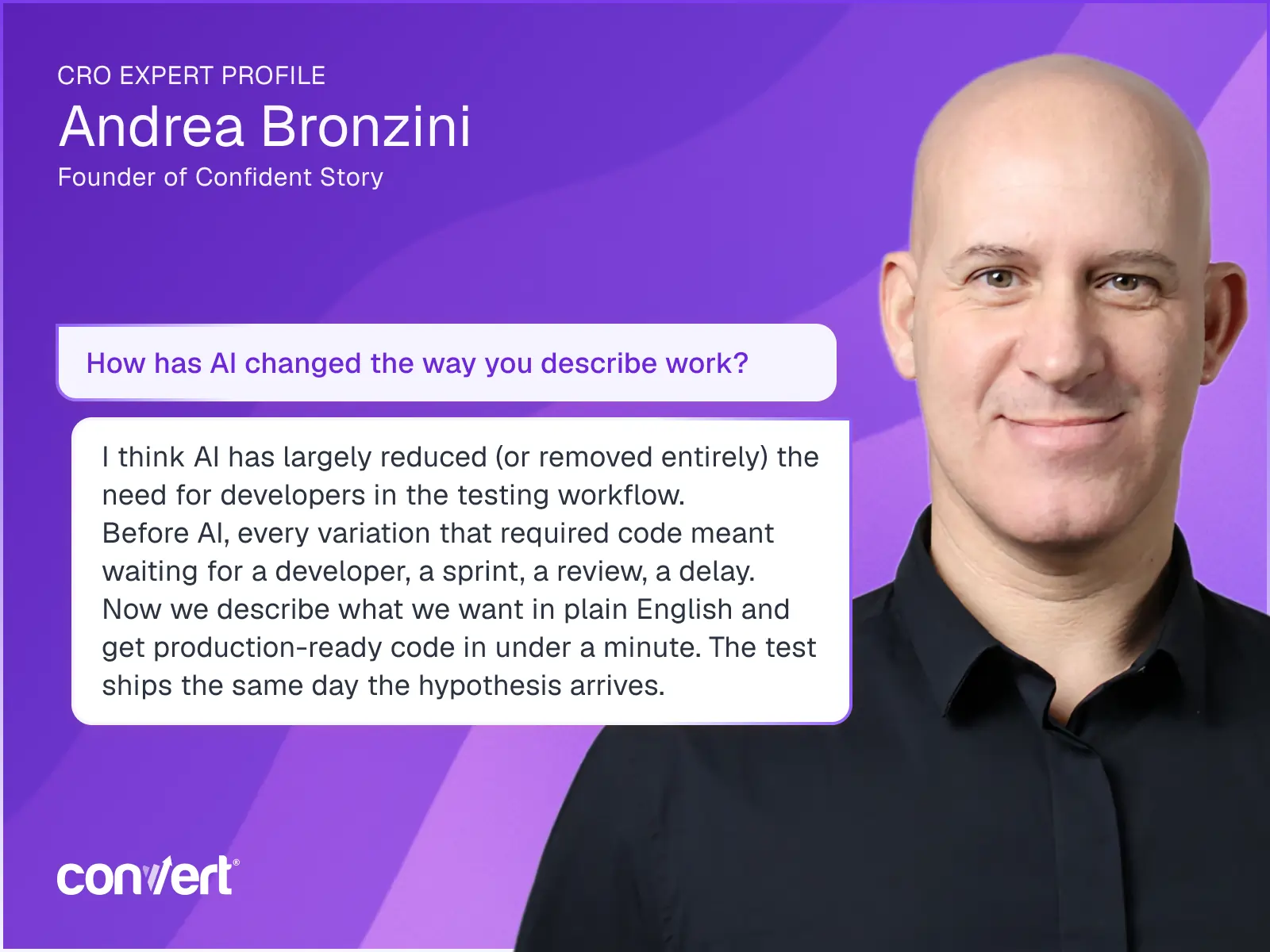
As the statistical side of optimization undergoes a theoretical revolution, the operational side is being transformed by Artificial Intelligence. The most immediate impact of AI in the CRO workflow is the near-total elimination of the developer bottleneck.
Historically, every variation in an A/B test required a developer to write JavaScript code, followed by a sprint cycle, code review, and QA process. This created a high level of implementation friction, which naturally led teams to favor "safe," easy-to-build tests—such as changing button colors or headline copy.
With the advent of Large Language Models (LLMs), practitioners can now describe complex structural changes in plain English and receive production-ready code in seconds. This shift has two major implications:
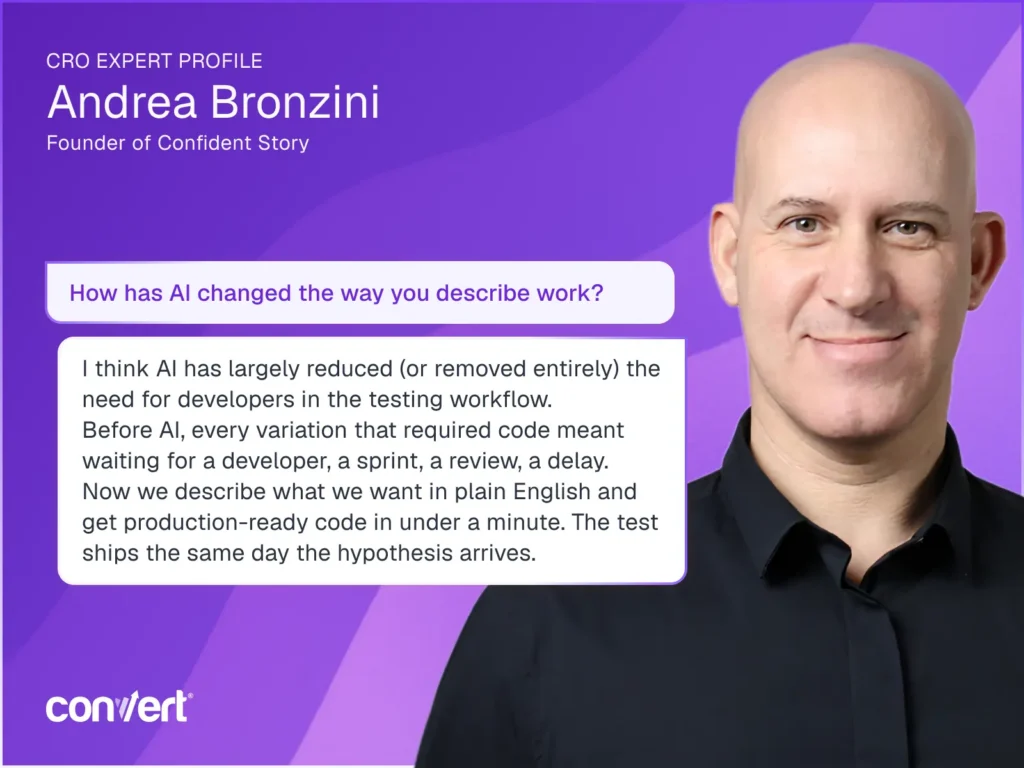
- Velocity: Tests can be launched the same day a hypothesis is formed, allowing for a much higher volume of experiments.
- Boldness: When the cost of implementation drops to near zero, teams are more willing to test radical, structural hypotheses that were previously deemed too "expensive" or time-consuming to build for a mere experiment.
AI is also being integrated into the analytical phase of the workflow. Current systems are being developed where AI examines a webpage, generates insights based on user behavior data, prioritizes hypotheses, creates the test variations, and autonomously deploys the winner. This level of automation allows human optimizers to shift their focus from execution to strategy—asking better questions and forming sharper hypotheses based on deep psychological insights.
Strategic Implications: Decision-Policy Thinking
The convergence of noise modeling and AI execution is leading the industry toward what Bronzini calls "decision-policy thinking." In this model, the question is no longer "Is this result significant?" but rather, "Given our specific traffic, our typical effect sizes, and our tolerance for different types of error, what is the most profitable decision rule to follow?"
Practitioners are encouraged to stop treating 95% confidence as a fixed requirement. Instead, it should be viewed as a variable with associated costs. For some high-risk changes, a 99% confidence level might be appropriate. For low-risk, high-reward structural changes, a 70% or 80% confidence level might be more economically sound than letting a potential winner sit in the "inconclusive" pile for months.
Recommendations for Optimization Teams
To adjust to this new paradigm, experimentation teams should consider the following strategic shifts:

- Track "Winner Capture": Move beyond measuring the number of tests run. Start tracking how many real improvements are being found versus how many are likely being missed due to overly strict thresholds.
- Tune Monitoring Cadence: Rather than using default settings on testing platforms, adjust minimum runtimes and maximum durations based on the company’s specific traffic patterns and business goals.
- Embrace AI-Driven Execution: Integrate AI into the coding and QA phases of testing to increase the "boldness" of hypotheses.
- Model the Noise: Use simulations or Bayesian models to understand the likelihood of "winner’s curse" inflation before forecasting the long-term impact of a successful test.
Conclusion: The Balancing Act of Errors
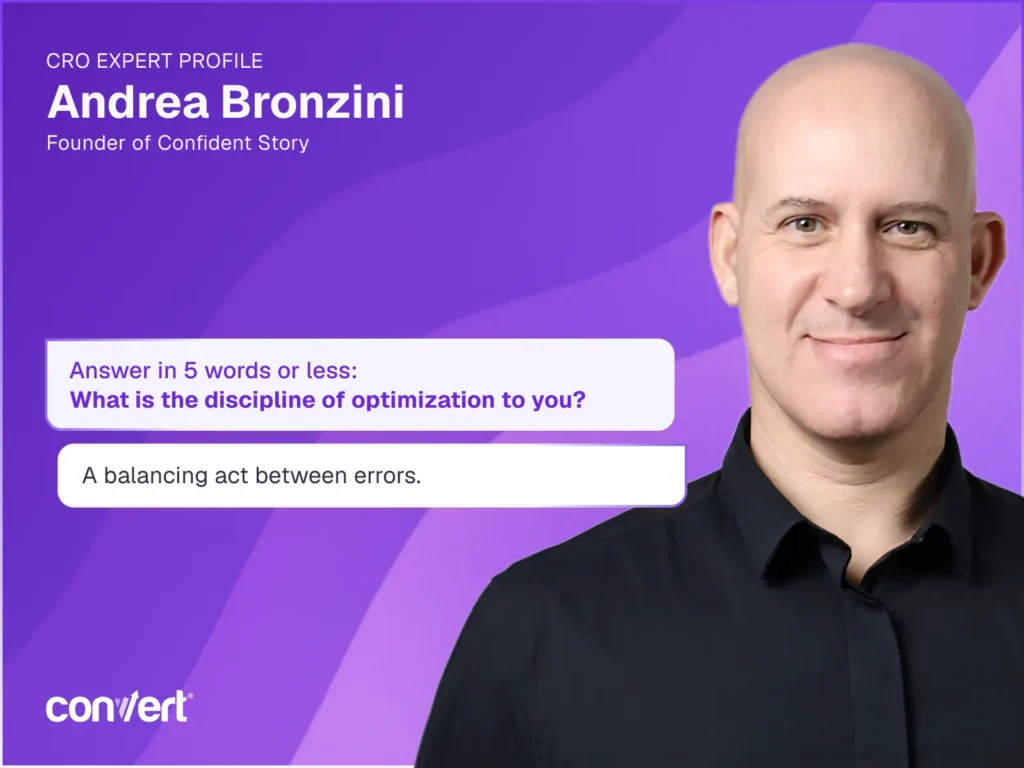
The discipline of optimization is ultimately a balancing act between different types of errors. There is no mathematical configuration that can simultaneously eliminate false positives, missed winners, and inflated estimates. Every choice in test design is a choice about how to distribute those errors.
As AI takes over the repetitive tasks of coding and deployment, the value of the human optimizer will increasingly lie in their ability to navigate these statistical trade-offs. The future of the industry belongs to those who can move beyond the "significance" binary and adopt a more nuanced, policy-driven approach to data-informed growth. By understanding that noise is the real protagonist of every experiment, businesses can finally build experimentation systems that scale effectively and results that truly hold over time.