The modern wholesale business operates within a highly dynamic and intricate ecosystem, demanding far more than a conventional customer relationship management (CRM) system. Generic CRMs, often designed for simpler B2C or service-based models, fall short in addressing the unique complexities inherent to wholesale distribution. A truly effective CRM for wholesalers must be engineered to handle account-specific pricing, manage extensive product catalogs with myriad SKUs, facilitate high volumes of repeat orders, and seamlessly integrate sales workflows with critical inventory and fulfillment systems. The absence of such interconnectedness inevitably leads to significant operational friction, manifesting as protracted quoting cycles, a proliferation of errors, and ultimately, missed revenue opportunities that undermine competitive advantage.
The industry consensus for 2026 firmly points towards a future where the most successful wholesale distributors leverage CRM solutions that intimately connect customer data with sophisticated pricing logic, streamlined order workflows, and real-time inventory visibility. This integrated infrastructure empowers sales teams to transition effortlessly from generating a quote to processing an order, all within a single, unified system, thereby eliminating the inefficiencies of toggling between disparate platforms. Concurrently, operations leaders gain invaluable, accurate insights into their sales pipeline, enabling more precise forecasting and resource allocation. Furthermore, field representatives, who are often the frontline of customer engagement, can operate with unprecedented effectiveness from mobile devices, accessing crucial information and executing tasks regardless of their physical location. This guide delves into the leading CRM software options for wholesale distributors in 2026, evaluating each platform against core wholesale-specific requirements such as robust enterprise resource planning (ERP) and inventory integration, advanced mobile field sales capabilities, unparalleled pricing flexibility, and a transparent total cost of ownership.
The Imperative for Tailored CRM in Wholesale
A CRM specifically designed for wholesalers is a strategic asset, meticulously crafted to support the distinct B2B distribution workflows that characterize the sector. This includes the nuanced application of account-specific pricing, the efficient processing of bulk orders, and sales processes that are inherently integrated with inventory and fulfillment systems. Its primary objective is to empower wholesale teams to meticulously manage accounts, generate precise quotes, and advance orders through the sales cycle without the inefficiencies and inaccuracies that arise from relying on disconnected tools.
This specialized software is adept at handling customer-specific pricing models and tiered price lists, allowing distributors to accurately apply complex contract pricing, volume discounts, and individually negotiated terms at the account level. Crucially, it links sales workflows directly to real-time inventory and order status data, typically achieved through robust integrations with ERP systems. In practice, while the CRM system excels at managing accounts, contacts, deals, and sales activities, the ERP system focuses on inventory, purchasing, and fulfillment. This clear division of labor ensures that wholesale teams maintain precise operational data, while sales teams are equipped with the comprehensive context necessary to quote and sell with optimal efficiency. Many of these requirements closely parallel those found in manufacturing environments, where CRM systems similarly bridge sales activity with production and fulfillment processes.
Defining the Wholesale CRM Advantage: Beyond Standard Functionality
Wholesale distribution introduces a set of unique operational demands that standard, general-purpose CRMs simply cannot fully support without extensive, often costly, additional configuration or complex integrations. These fundamental differences profoundly impact how wholesale teams approach pricing, selling, and ultimately fulfilling orders.
Key Differentiators from Standard CRMs
While a standard CRM might manage contacts and basic sales pipelines, a wholesale CRM excels in:
- Complex Pricing Models: Ability to handle multi-tiered pricing, volume discounts, contract pricing, and customer-specific negotiated rates, often linked to product variants and order quantities.
- Large Product Catalogs: Efficiently manages thousands of SKUs, product variations, bundles, and custom configurations, with detailed product information readily accessible to sales.
- High-Volume, Repeat Orders: Designed to track recurring purchases, facilitate quick reordering, and analyze historical buying patterns to proactively identify future sales opportunities.
- ERP and Inventory Integration: Native or robust third-party integrations with ERP systems provide real-time visibility into stock levels, order status, and fulfillment timelines, preventing overselling or delays.
- B2B Customer Lifecycle: Focuses on long-term account relationships, complex organizational hierarchies within client companies, and multi-touchpoint interactions across different departments.
- Field Sales Enablement: Offers advanced mobile capabilities, offline access, route planning, and on-site order taking, crucial for reps operating away from the office.
The Interplay with ERP and Inventory Systems
The seamless integration between a wholesale CRM and ERP (Enterprise Resource Planning) systems, along with dedicated inventory management solutions, is paramount. This integration transforms a CRM from a mere sales tool into a central nervous system for the entire distribution operation. Without it, sales reps might quote products that are out of stock, offer incorrect pricing, or be unable to provide accurate delivery estimates, leading to customer dissatisfaction and operational bottlenecks. A unified system ensures:
- Accurate Quoting: Sales teams can access real-time inventory data, preventing commitments that cannot be met.
- Streamlined Order Processing: Quotes can convert directly into orders in the ERP, eliminating manual data entry and reducing errors.
- Enhanced Customer Service: Service teams have full visibility into order history, shipping status, and inventory, allowing them to provide informed support.
- Improved Forecasting: Consolidated sales data, combined with inventory insights, leads to more accurate demand forecasting and procurement planning.
Market Landscape 2026: Leading CRM Platforms for Wholesale
The competitive landscape for wholesale CRMs in 2026 is robust, with several platforms offering specialized functionalities. While some requirements might overlap with adjacent industries like retail, the fundamental differences in pricing models, order volume, and account structures necessitate a focused evaluation. The following six CRM platforms represent leading choices, each addressing distinct wholesale needs from field sales and stock-aware quoting to enterprise forecasting and deep ERP connectivity.
HubSpot Smart CRM: The Integrated Ecosystem Approach
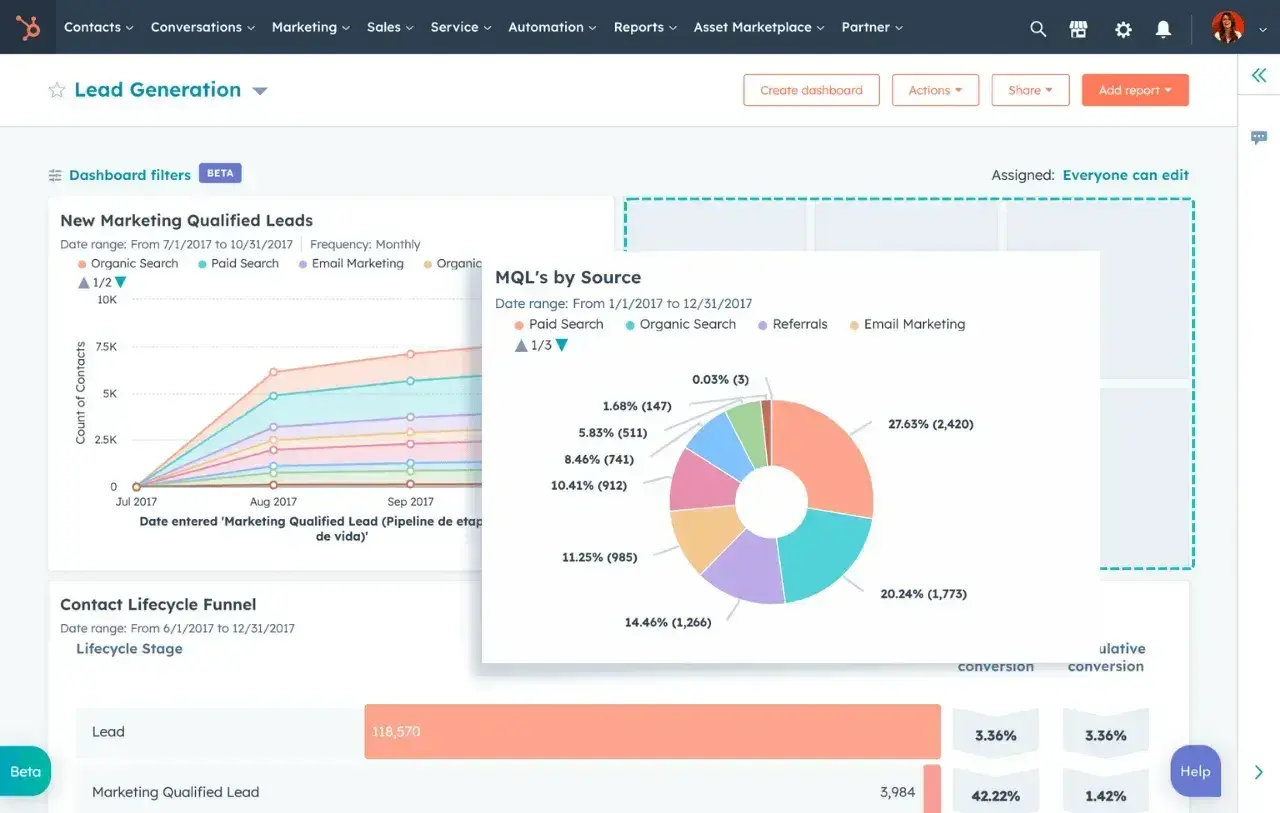
HubSpot Smart CRM stands out as an AI-powered system of record that unifies account, contact, deal, and activity data. For wholesale distributors, its strength lies in supporting comprehensive quote-to-order workflows through intuitive product libraries, customizable quotes, automated workflows, robust reporting, and flexible integrations with a wide array of ERP, inventory, and order management systems. HubSpot’s strategic advantage is further amplified by its integration with Commerce Hub and Breeze, its suite of AI tools. This combination allows wholesale teams to manage customer data, quoting, billing, payments, automation, and reporting from a single, shared customer record, minimizing operational overhead.
- Key Features: Unified customer database, sales automation, AI-driven insights, customizable reporting, robust integration marketplace, product libraries, quote generation, and payment processing via Commerce Hub.
- Best for: Wholesalers seeking a consolidated platform for sales, service, and marketing, with powerful AI capabilities and flexible ERP/inventory system connectivity.
- What we like: The platform’s ability to combine a unified customer database with automation, AI, and flexible integrations simplifies the management of complex B2B relationships without adding significant operational burden. Pricing scales from free tools to enterprise-level solutions, offering adaptability for various business sizes.
Pepperi: Empowering Field Sales and B2B Commerce
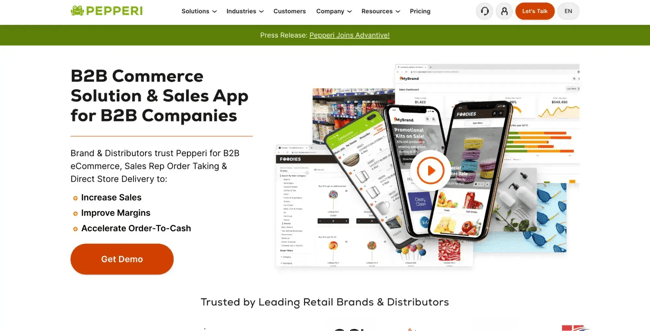
Pepperi offers a specialized blend of CRM, B2B commerce, mobile order taking, and field sales tools tailored specifically for wholesale distributors and brands. It empowers sales representatives and B2B buyers alike to access customer-specific catalogs, personalized price lists, targeted promotions, and streamlined order workflows through both web and dedicated mobile experiences.
- Key Features: Mobile sales app (online/offline), B2B e-commerce portal, field sales automation, dynamic pricing and promotions, comprehensive product catalog management, route planning.
- Best for: Wholesale distributors prioritizing strong field sales execution, requiring robust offline mobile access, route-based selling capabilities, and highly customized customer buying experiences.
- What we like: Its purpose-built design for wholesale operations, offering comprehensive support for mobile sales reps, efficient order taking, and individualized customer catalogs, is a significant advantage. Pricing is available upon request, indicating a customized approach based on specific business needs.
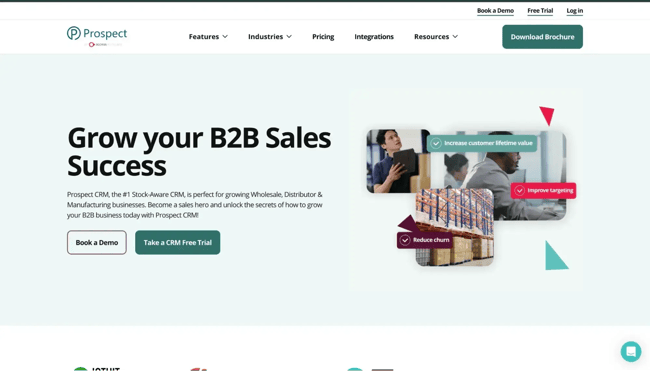
Prospect CRM: Real-time Inventory-Aware Sales
Prospect CRM positions itself as a "stock-aware" CRM, uniquely built for product-selling B2B businesses. It intelligently connects customer, product, sales, and inventory data, enabling wholesale teams to quote, manage accounts, and prioritize sales activities with enhanced visibility into real-time stock levels and customer buying patterns. This platform is particularly effective for distributors whose CRM records need to accurately reflect product movement, facilitate repeat orders, manage backorders, and identify cross-sell opportunities based on inventory availability.

- Key Features: Real-time inventory visibility, sales opportunity management, customer purchase history, automated reorder suggestions, integrated product catalog.
- Best for: Wholesalers for whom real-time inventory visibility, directly embedded within the CRM, is a critical operational requirement.
- What we like: Its core strength lies in being a "stock-aware CRM," directly linking sales activities with inventory data, thereby empowering reps to sell based on actual product availability. Pricing starts at approximately $243 for four users, making it accessible for growing businesses.
Zoho CRM: Agile and Affordable Customization
Zoho CRM provides a highly customizable solution, ideal for small to mid-sized wholesale teams seeking powerful sales automation, pipeline management, territory management, and robust integrations without the premium price tag of enterprise-level platforms. Wholesale teams can seamlessly connect Zoho CRM with Zoho Inventory and other applications within the Zoho ecosystem, allowing for integrated management of sales activities alongside inventory and order workflows.
- Key Features: Sales automation, lead and deal management, customizable workflows, AI assistant (Zia), territory management, extensive app integrations (especially within Zoho ecosystem).
- Best for: Cost-conscious small to mid-sized wholesalers who value flexible customization and integration capabilities, particularly those already utilizing or planning to adopt other Zoho products.
- What we like: It strikes an excellent balance between affordability and functionality, offering strong process automation and optional, deep inventory integration through the comprehensive Zoho ecosystem. Pricing begins at an attractive $20 per user per month.
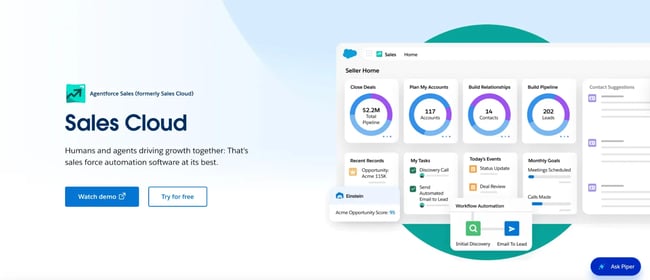
Salesforce Agentforce Sales (formerly Sales Cloud): Enterprise-Grade Flexibility
Salesforce Agentforce Sales, previously known as Sales Cloud, is a powerful CRM solution geared towards sales teams requiring extensive customization, advanced AI capabilities, sophisticated forecasting, detailed territory management, comprehensive product and price book functionalities, and a vast ecosystem of app integrations. Wholesale distributors can configure Salesforce to manage highly complex account structures, intricate pricing models, multi-stage approval workflows, and multi-team coverage scenarios.
- Key Features: Advanced sales forecasting, robust territory management, customizable product and price books, Einstein AI for sales insights, extensive AppExchange for integrations.
- Best for: Enterprise-level wholesalers with complex territory structures, highly specific pricing models, and significant customization needs, backed by the budget and internal resources for implementation and ongoing administration.
- What we like: Its unparalleled configurability and powerful tools for territory forecasting, intricate product pricing structures, and a vast ecosystem of integrations make it a top choice for large, complex operations. Pricing starts at higher per-user tiers reflective of its enterprise focus.
Microsoft Dynamics 365 Sales: Seamless Microsoft Ecosystem Integration
Microsoft Dynamics 365 Sales serves as Microsoft’s CRM offering for sales teams already deeply embedded within the Microsoft ecosystem. Wholesale distributors can integrate Dynamics 365 Sales with Microsoft 365, Power BI, Teams, and other Dynamics ERP tools to create a cohesive environment that links sales activity with product, pricing, quote, order, and fulfillment contexts.
- Key Features: Integration with Microsoft 365 and Power BI, sales automation, lead and opportunity management, customizable dashboards, native integration with Dynamics ERP solutions.
- Best for: Wholesalers who are existing Microsoft users or those who require tight, native integration between their CRM and ERP workflows, prioritizing a unified Microsoft experience.
- What we like: Its strong alignment and integration across CRM, ERP, and productivity tools, coupled with built-in support for complex pricing models and sales territories, make it a compelling option for Microsoft-centric organizations. Pricing starts at higher per-user tiers, similar to other enterprise solutions.
Tangible Benefits: Driving Efficiency, Growth, and Retention
The adoption of specialized CRM software fundamentally transforms how wholesale teams manage quoting, selling, and account relationships. By intelligently connecting customer data with pricing, inventory, and order workflows, these systems provide a significant operational uplift. For distributors contending with high order volumes, frequent repeat purchases, and intricate pricing structures, a robust CRM is instrumental in reducing manual effort while dramatically improving visibility across the entire sales cycle. Industry reports consistently indicate that specialized CRM adoption can boost sales efficiency by up to 25% and reduce quoting errors by 40% for wholesale businesses, showcasing its profound impact.
Streamlining the Quote-to-Cash Cycle
Traditional wholesale operations often grapple with disparate systems for quote generation, pricing verification, inventory checks, and order processing. This fragmentation creates bottlenecks, fosters redundant data entry, and leads to inconsistent customer information. CRM software acts as a unifier, streamlining this entire process:
- Automated Quote Generation: Enables rapid creation of accurate quotes, pre-populated with customer-specific pricing and product details.
- Real-time Inventory Checks: Integrations with ERP systems provide immediate visibility into stock levels, preventing overselling and managing customer expectations.
- Accelerated Approvals: Workflow automation facilitates quicker internal approvals for discounts or special terms, reducing delays.
- Seamless Order Conversion: Quotes can be converted into orders with a single click, automatically transferring data to fulfillment systems and reducing manual errors.
- Integrated Payment Processing: Platforms like HubSpot’s Commerce Hub allow for integrated billing and payments, further compressing the quote-to-cash timeline.
Cultivating Enduring Customer Relationships
Wholesale growth is intrinsically linked to repeat orders and the cultivation of strong, long-term account relationships. Without a CRM, vital account history, communication logs, and purchasing patterns are often siloed across different systems or dependent on individual sales representatives. This makes maintaining continuity challenging when account ownership shifts and hinders the proactive identification of growth opportunities. A CRM provides a centralized, 360-degree view of every account, encompassing order history, communication logs across all channels, and engagement metrics. This equips wholesale distribution teams with:
- Personalized Interactions: Access to comprehensive customer data enables more relevant and personalized sales conversations.
- Proactive Engagement: Automated reminders for reorders or follow-ups based on buying cycles strengthen customer loyalty.
- Cross-sell and Upsell Opportunities: Analysis of past purchases and product preferences helps identify potential new sales.
- Consistent Customer Experience: A unified record ensures that every team member, from sales to service, has the full context of the customer relationship.
- Reduced Churn: Better understanding of customer needs and potential issues allows for proactive intervention to prevent churn.
For organizations managing high volumes of customer communication, CRM functionality often overlaps significantly with call center operations, emphasizing the need for robust logging and tracking capabilities.
Quantifying the Return on Investment (ROI)
CRM adoption directly translates into revenue impact by accelerating the sales cycle, boosting sales representative productivity, and providing unparalleled visibility into pipeline and account performance. For wholesalers, the most substantial gains typically stem from minimizing manual administrative work, maximizing the capture of repeat orders, and adeptly identifying lucrative upsell and cross-sell opportunities. A CRM also significantly enhances forecast accuracy by keeping pipeline data current and directly linking sales activities to revenue outcomes. This empowers leadership teams to make more informed decisions regarding inventory management, staffing levels, and strategic growth planning.
Common revenue drivers from CRM adoption include:
- Increased Sales Win Rates: Better lead qualification and personalized engagement improve conversion.
- Higher Average Order Value: Proactive upsell/cross-sell suggestions lead to larger purchases.
- Improved Sales Cycle Speed: Streamlined processes reduce the time from lead to closed deal.
- Enhanced Customer Lifetime Value (CLTV): Better retention and repeat business contribute to long-term profitability.
- Reduced Operational Costs: Automation minimizes manual data entry and administrative overhead.
To accurately estimate a CRM system’s ROI, wholesale teams typically examine metrics such as:
- Sales Productivity Gains: Time saved on administrative tasks, allowing reps to focus on selling.
- Lead Conversion Rate Improvement: The percentage increase in turning leads into customers.
- Customer Retention Rate: The impact on retaining existing customers and reducing churn.
- Forecast Accuracy: The reduction in variance between projected and actual sales.
- Cost of Sales Reduction: Efficiencies in the sales process leading to lower per-sale costs.
Even marginal improvements across these critical areas can compound into substantial, meaningful revenue gains over time. Platforms like HubSpot, with their integrated pipeline tracking, comprehensive reporting, and automation capabilities, help teams maintain cleaner data and improve forecasting accuracy. AI tools, such as HubSpot’s Breeze, further assist with prioritization and task execution, significantly reducing the time spent on manual, repetitive work.
Essential Features: What to Look for in a Wholesale CRM
For wholesale CRM software to be truly effective, it must go beyond generic functionalities and address the specific demands of complex pricing, high-volume ordering, and seamless integration with inventory and fulfillment systems. The following features are indispensable for distributors aiming to manage accounts efficiently and scale operations effectively.
1. Precision in Pricing and Quoting
A wholesale CRM must support account-specific pricing, encompassing contract pricing, volume discounts, and individually negotiated terms. This ensures that every quote accurately reflects agreed-upon pricing without requiring laborious manual adjustments.
- Dynamic Price Lists: Ability to create and manage multiple price lists based on customer segments, product categories, or contract terms.
- Automated Discounting: Support for tiered pricing, volume discounts, and promotional pricing that applies automatically based on order criteria.
- Quote Generation Tools: Integrated tools to quickly generate professional, accurate quotes directly from the CRM, with e-signature capabilities.
- HubSpot Advantage: HubSpot offers robust product libraries and direct quote creation from deals, with advanced tiered pricing capabilities accessible through Commerce Hub.
2. Seamless ERP and Inventory Synchronization
A critical feature is the ability to connect sales workflows directly to real-time inventory and order data. This empowers sales reps to quote based on available stock and track fulfillment status without ever having to switch systems.
- Real-time Stock Levels: Instant access to current inventory quantities across multiple warehouses.
- Order Status Tracking: Visibility into the complete order lifecycle, from processing to shipping.
- Bi-directional Data Flow: Ensuring updates in one system (e.g., a new order in CRM) are reflected in the other (e.g., inventory deduction in ERP).
- HubSpot Advantage: HubSpot’s extensive Marketplace offers numerous integrations with leading ERP and inventory tools, facilitating shared visibility and data synchronization. For organizations managing complex logistics, the CRM’s integration capabilities often extend to sophisticated supply chain and warehousing systems.
3. Comprehensive Product and SKU Management
Wholesale teams typically manage vast product catalogs, often with thousands of SKUs, multiple variations (e.g., size, color, material), and complex pricing structures. The CRM must facilitate easy organization and access to this extensive data during sales workflows.
- Centralized Product Catalog: A single source of truth for all product information, including descriptions, images, specifications, and pricing.
- SKU and Variant Management: Ability to handle numerous product variations and their associated unique SKUs efficiently.
- Product Bundling: Support for creating and quoting product bundles or kits.
- HubSpot Advantage: HubSpot’s product libraries are designed to help sales teams organize products effectively and add the correct items to quotes without needing to rebuild catalog information from scratch.
4. Optimizing Repeat Orders and Reorder Workflows
The backbone of wholesale operations is repeat purchases. CRM software should proactively help teams track buying patterns, predict demand, and trigger timely follow-ups based on anticipated reorder cycles, thereby preventing missed opportunities and enhancing account retention.
- Order History Tracking: Detailed records of all past purchases, including quantities, dates, and prices.
- Automated Reorder Reminders: Workflows that alert sales reps or even customers when it’s time to reorder specific products based on historical purchasing frequency.
- Subscription or Recurring Order Management: Tools to manage ongoing contracts or scheduled deliveries.
- HubSpot Advantage: HubSpot’s robust workflow automation can be configured to trigger automated follow-ups and reminders based on specific customer behavior or deal activity, making reorder management highly efficient.
5. Strategic Territory and Account Governance
Wholesale sales teams are frequently structured by geographical region, specific account coverage, or distinct product lines. The CRM must facilitate clear account ownership, efficient lead routing, and precise territory-based reporting.
- Territory Assignment: Tools to define sales territories and automatically assign accounts or leads to the appropriate reps.
- Account Hierarchy Management: Ability to map complex organizational structures within client companies (e.g., parent company, subsidiaries).
- Performance Reporting by Territory: Dashboards and reports that provide insights into sales performance at a regional or territory level.
- HubSpot Advantage: HubSpot supports assigning and tracking account ownership through company records, customizable properties, lists, and reporting views that can be tailored to reflect various territory or coverage models.
6. Empowering the Mobile Field Sales Force
Field sales representatives are critical to many wholesale businesses, requiring unfettered access to CRM data while on the go—visiting customers, taking orders, or managing accounts remotely.
- Robust Mobile App: A fully functional mobile application for iOS and Android, offering core CRM capabilities.
- Offline Access: Ability to view and edit data, and take orders, even without an internet connection, with automatic synchronization once online.
- Route Optimization: Tools for planning and optimizing sales routes for maximum efficiency.
- HubSpot Advantage: HubSpot’s mobile app provides comprehensive functionality, allowing reps to manage deals, tasks, contacts, and even generate quotes from anywhere, ensuring productivity in the field.
7. Advanced Reporting and Revenue Forecasting
Wholesale CRM software must directly link sales activity to revenue outcomes, providing teams with the tools to accurately track performance, analyze trends, and forecast demand.
- Customizable Dashboards: Tailored dashboards to visualize key performance indicators (KPIs) related to sales, accounts, and products.
- Pipeline Management: Detailed views of the sales pipeline, allowing for tracking of deal progress and identification of bottlenecks.
- Sales Forecasting: Tools to predict future sales based on current pipeline, historical data, and other factors.
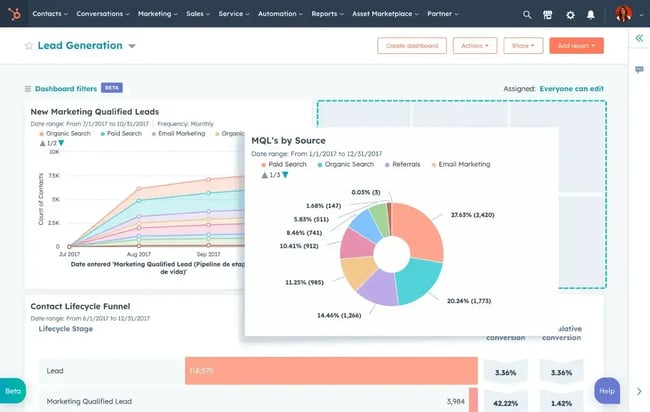
- HubSpot Advantage: HubSpot offers highly customizable dashboards and powerful reporting tools that allow teams to track pipeline, sales performance, and other critical metrics with precision.
8. Automation for Operational Excellence
Automation is key to reducing manual work and ensuring consistency across both sales and operational processes. This is particularly vital for wholesalers managing high order volumes and multi-step approval processes.
- Workflow Automation: Capabilities to automate repetitive tasks, such as sending follow-up emails, updating deal stages, or creating tasks.
- Lead Routing: Automated assignment of new leads to the appropriate sales rep or team.
- Approval Workflows: Streamlining internal approval processes for discounts, custom orders, or credit requests.
- HubSpot Advantage: HubSpot’s robust workflow automation engine empowers teams to automate a wide array of repetitive tasks and streamline handoffs between sales, operations, and even marketing.
Strategic Selection: A Step-by-Step Guide for Wholesalers
Choosing the right CRM is a strategic decision that can significantly impact a wholesale business’s future. A structured approach is essential to ensure the chosen solution aligns perfectly with organizational needs and goals.
Step 1: Map Your Current Processes and Identify Pain Points.
Begin by meticulously documenting all existing sales, customer service, and operational workflows. Identify areas where manual efforts, disconnected systems, or lack of visibility create inefficiencies, delays, or errors. Consider your current order processing methods, how customer communication is managed, and the specifics of your reporting needs. This granular understanding will form the basis for your CRM requirements.
Step 2: Define Integration Requirements with Existing Systems.
Create a comprehensive list of all existing systems that your CRM will need to seamlessly connect with, including your ERP system, inventory management software, accounting platforms, and any B2B e-commerce portals. Thoroughly investigate each prospective CRM platform’s integration options, noting whether native integrations are available or if middleware solutions will be necessary. Compatibility is non-negotiable for a unified operation.
Step 3: Calculate the Total Cost of Ownership (TCO).
Beyond the sticker price, consider all financial implications. This includes subscription fees (per user, per month/year), initial implementation costs (setup, data migration, customization), ongoing training expenses for your team, and the cost of continuous support. A lower monthly fee might conceal higher implementation or integration costs.

Step 4: Involve Key Stakeholders Across Departments.
CRM adoption impacts various departments. Include representatives from sales, customer service, operations, and even finance in the decision-making process. Their insights are crucial to ensuring the selected CRM meets the diverse needs and expectations of all departmental users, fostering greater buy-in and successful adoption.
Step 5: Test with Real-World Scenarios.
Leverage free trials or request detailed demos from sales representatives. Crucially, test the CRM using actual business scenarios: create sample quotes with specific pricing, manage test orders through the pipeline, simulate a field sales visit, and evaluate the ease of use and intuitiveness of the interface for your team. This hands-on experience is invaluable.
Step 6: Plan for Future Scalability and Growth.
Select a CRM that possesses the inherent flexibility and scalability to evolve alongside your business. A solution that can adapt to increasing user counts, expanding product catalogs, and new market demands will prevent the need for another costly migration down the line. Platforms like HubSpot, for instance, offer scalable solutions, allowing businesses to start with free tools and progressively add advanced features as their operations grow.
Frequently Asked Questions
What is the best CRM for wholesalers?
The optimal CRM for wholesalers is highly dependent on specific business parameters such as size, the complexity of sales processes, and the extent to which it needs to integrate with existing inventory, pricing, and order management systems. HubSpot emerges as a strong contender for businesses seeking a unified platform for sales, service, and marketing, complete with advanced automation, AI tools, and robust integrations that connect CRM data with ERP and inventory systems. This makes it exceptionally well-suited for wholesalers focused on streamlining quote-to-order workflows and enhancing visibility across the entire customer lifecycle.
What features should I look for in a wholesale CRM?
A wholesale CRM must prioritize features that accommodate pricing complexity, enable inventory-connected sales workflows, and facilitate efficient repeat ordering. Key features include customer-specific pricing and quoting, deep ERP and inventory integration, comprehensive product catalog management, and automated reorder workflows. Additional capabilities such as strategic territory management, mobile access for field sales teams, revenue-linked reporting, and workflow automation are crucial for wholesalers aiming to scale operations and maintain accurate pipeline visibility. Platforms like HubSpot provide these functionalities through extensive product libraries, powerful automation, and a rich ecosystem of integrations with inventory and ERP systems.
Is HubSpot suitable for wholesale businesses?
Yes, HubSpot is highly suitable for wholesale businesses, particularly those looking to centralize their sales, service, and marketing operations on a single, integrated platform. HubSpot supports complex wholesale workflows through its customizable properties, robust automation capabilities, and extensive integrations with ERP and inventory systems. Features such as product libraries, direct quote creation, and the Commerce Hub empower teams to manage pricing and expedite deals from quote to payment. Furthermore, Breeze, HubSpot’s suite of AI tools, assists teams in automating tasks, prioritizing opportunities, and maintaining cleaner pipeline data—all critical for managing high-volume, repeat-order sales environments effectively.
How much does a wholesale CRM typically cost?
The cost of a wholesale CRM varies significantly based on the breadth of features, the number of users, and the level of customization required. For example, Pepperi’s Pro plan starts at $500/month, while Prospect CRM begins at approximately $243 for four users. Zoho CRM offers more budget-friendly per-user pricing, starting at $20/user/month, making it a popular choice for smaller teams. Enterprise-grade platforms such as Salesforce and Microsoft Dynamics 365 typically command higher per-user price points, reflecting their advanced capabilities and extensive configurability. HubSpot offers a range of pricing, from free CRM tools (including contact management, deals, and reporting) to paid tiers. HubSpot’s Smart CRM Starter plan is priced at $20/month/seat, Professional at $50/month/seat, and Enterprise at $75/month/seat (with promotional annual pricing often available for Professional at $45/month/seat). This tiered structure allows businesses to choose a plan that aligns with their current needs and budget, with options to scale as they grow.
Meet HubSpot, a Top CRM Choice for Wholesale Distributors.
HubSpot consistently stands out as a flexible and powerful CRM solution for wholesale distributors aiming to modernize their operations, streamline the critical quote-to-order workflows, and cultivate stronger, more profitable customer relationships. Its comprehensive suite of tools and integrated approach offer distinct advantages:
- Unified Platform: Consolidates sales, service, and marketing functionalities onto a single platform, eliminating data silos and providing a holistic view of the customer journey.
- Automation and AI: Leverages powerful workflow automation and AI-driven insights (via Breeze) to reduce manual tasks, enhance efficiency, and help sales reps prioritize the most promising opportunities.
- Flexible Integrations: Offers an extensive marketplace for seamless integration with existing ERP, inventory, and accounting systems, ensuring data flows effortlessly across critical business functions.
- Scalability: Designed to grow with your business, from free basic tools to advanced enterprise-level features, allowing distributors to invest confidently in a long-term solution.
- Specialized Features: Provides wholesale-specific capabilities like robust product libraries, customizable quote generation, and the Commerce Hub for integrated billing and payments.
Ready to transform your wholesale operations? Begin with HubSpot’s free CRM tools to experience core functionalities, then progressively add advanced sales, marketing, service, automation, and commerce features as