

In the rapidly evolving digital ecosystem, a profound transformation is reshaping how information is discovered and consumed, marking a significant departure from traditional search engine optimization (SEO) toward a new paradigm known as Answer Engine Optimization (AEO). This shift underscores a critical need for marketers and brand strategists to recalibrate their understanding of success, moving beyond mere top rankings on Search Engine Results Pages (SERPs) to comprehensively tracking their brand’s presence within AI-powered search environments. The emergence of sophisticated AI models and large language models (LLMs) has introduced a novel set of metrics, including brand mentions, citations, and share of voice, as indispensable indicators of visibility and influence.
The Dawn of AI Search and AEO: A Paradigm Shift
The advent of generative artificial intelligence has fundamentally altered the landscape of information retrieval. Where traditional search engines provided a ranked list of blue links, modern AI search engines—such as ChatGPT, Google’s Gemini, and Perplexity—synthesize information from various sources to deliver a single, comprehensive answer directly to the user. This evolutionary leap from “search engine” to “answer engine” necessitates a corresponding evolution in optimization strategies.
Historically, SEO focused on optimizing web pages to rank highly for specific keywords, driving traffic through clicks on those ranked links. The satisfaction of achieving a number-one ranking was often the ultimate metric of success. However, the rise of AI Overviews, featured snippets, and conversational AI interfaces has diluted the immediate impact of a top organic ranking. A groundbreaking Semrush analysis of over 200,000 Google AI Overviews revealed that the top organic result was cited in the AI-generated answer only 34% of the time on mobile devices and 46% on desktop. This stark statistic highlights that a high ranking no longer guarantees inclusion in the synthesized answer, forcing brands to rethink their visibility strategies.
Answer Engine Optimization (AEO) is the discipline dedicated to ensuring a brand’s presence, accuracy, and favorable representation within these AI-generated answers. It encompasses understanding how AI models retrieve, interpret, and present information, and then optimizing digital assets to align with these mechanisms. This transition is not about replacing SEO but augmenting it, adding a crucial layer of strategy atop the foundational principles of traditional search optimization. Strong organic rankings, robust crawlability, and established topical authority remain vital, as they feed the underlying models that power these answer engines.
Navigating the New Search Landscape: AI Visibility Defined
AI search visibility measures the frequency and manner in which answer engines acknowledge or reference a brand within their generated responses. Unlike traditional SEO, which quantifies success by page position on a ranked list, AI search shifts the unit of measurement to a synthesized answer. The brand either appears within that answer or it does not, making the threshold for success both higher and more nuanced.
The core drivers behind this shift include the proliferation of advanced LLMs, which power conversational AI interfaces, and the increasing user expectation for direct answers rather than lists of resources. Users are increasingly turning to platforms that offer concise, curated information, leading to a greater reliance on the AI’s ability to summarize and present authoritative content. This makes direct brand mentions and citations within these answers invaluable for brand recognition, credibility, and ultimately, traffic and conversions.
Evolving Metrics for a New Era: Quantifying AI Presence
To effectively gauge success in this new environment, marketers must adopt a refined set of metrics tailored to AI search visibility. These metrics provide a more granular view of how a brand is perceived and presented by answer engines:
-
Mentions and Citations:
- Mentions: This refers to instances where a brand’s name is explicitly stated within an AI-generated answer, even without a direct hyperlink back to the brand’s website. These mentions contribute to brand awareness and recall.
- Citations: A citation occurs when an answer engine directly references a source, providing a link back to the originating content.
- Owned Citations: These are citations where the linked source is a page owned and controlled by the brand. This is the most desirable outcome, as it directly drives traffic and reinforces authority.
- Unowned Citations: These occur when an AI cites a third-party page that mentions or discusses the brand. While not directly driving traffic to the brand’s site, unowned citations still contribute to overall brand visibility and external validation.
-
AI-Referred Traffic: This metric tracks visits to a brand’s website that originate from clicks within AI-generated answers. A significant challenge here is that many AI platforms do not consistently pass referrer data, leading to AI-driven traffic often being miscategorized as “direct” traffic. However, advanced analytics platforms, such as HubSpot, are increasingly capable of tagging clicks from specific AI sources (e.g., ChatGPT, Claude, Perplexity, Gemini) as distinct “AI Referrals,” offering a clearer picture of this traffic segment.
-
Conversions and Pipeline Attribution: The ultimate measure of marketing effectiveness, this metric traces leads, opportunities, and ultimately, closed deals back to initial AI discovery. By integrating CRM data with AI referral tracking and incorporating “How did you hear about us?” form fields with AI-specific options, organizations can connect AI visibility directly to revenue generation.
-
Consistency Over Time: AI answers are dynamic, varying by platform, specific prompt phrasing, user session context, and even model updates. Therefore, a single check provides only a snapshot. Consistent monitoring of brand presence across repeated runs of fixed prompt sets on a regular cadence (e.g., monthly or weekly) is crucial to identify stable trends versus transient appearances.
-
Accuracy and Hallucination Detection: A critical concern in AI search is the phenomenon of “hallucinations,” where AI models generate factually incorrect information. This metric tracks how often answer engines present inaccurate pricing, outdated features, or false claims about a brand. Detecting and logging these inaccuracies by engine and prompt is essential for developing corrective strategies.
-
Sentiment and Tone Analysis: Beyond mere presence, how favorably an AI describes a brand profoundly impacts perception. This metric evaluates the emotional tone and sentiment of AI-generated descriptions, ranging from highly positive to highly negative. Tools that score sentiment (e.g., from -100% to +100%) can help differentiate between a visibility problem and a brand perception issue within AI answers.
-
Retrieved and Cited Pages: This metric identifies the specific URLs from a brand’s website that answer engines retrieve and cite as sources. Understanding which content pieces are earning visibility allows marketers to replicate successful content strategies and optimize existing assets for better AI integration.
Strategic Framework for Tracking AI Presence: A Step-by-Step Approach
Implementing a robust AI search visibility tracking workflow can be managed manually or through dedicated AEO tools. The core steps remain consistent:
-
Add Domains and Define Prompts to Monitor:
- Begin by registering your primary domain and any associated subdomains.
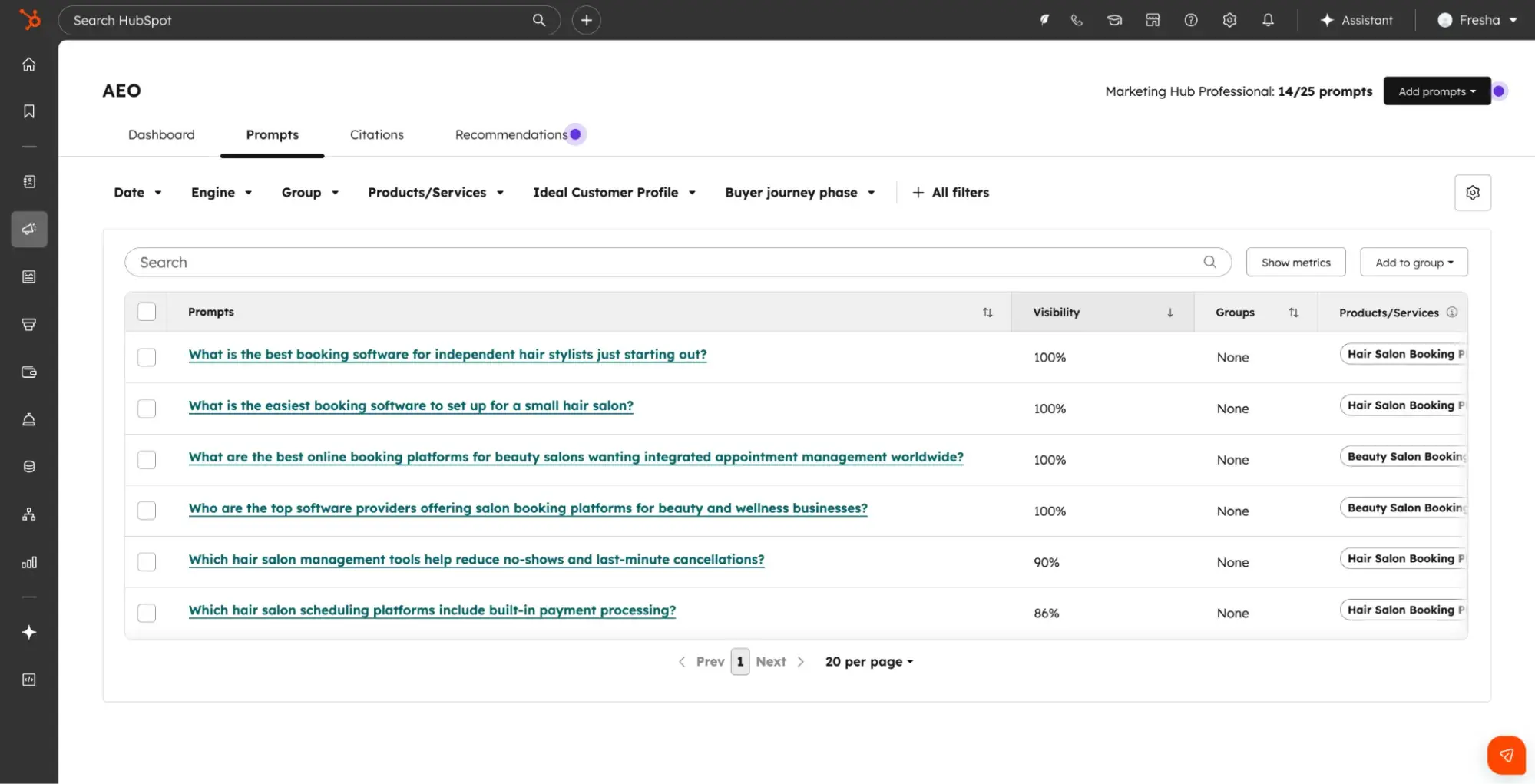
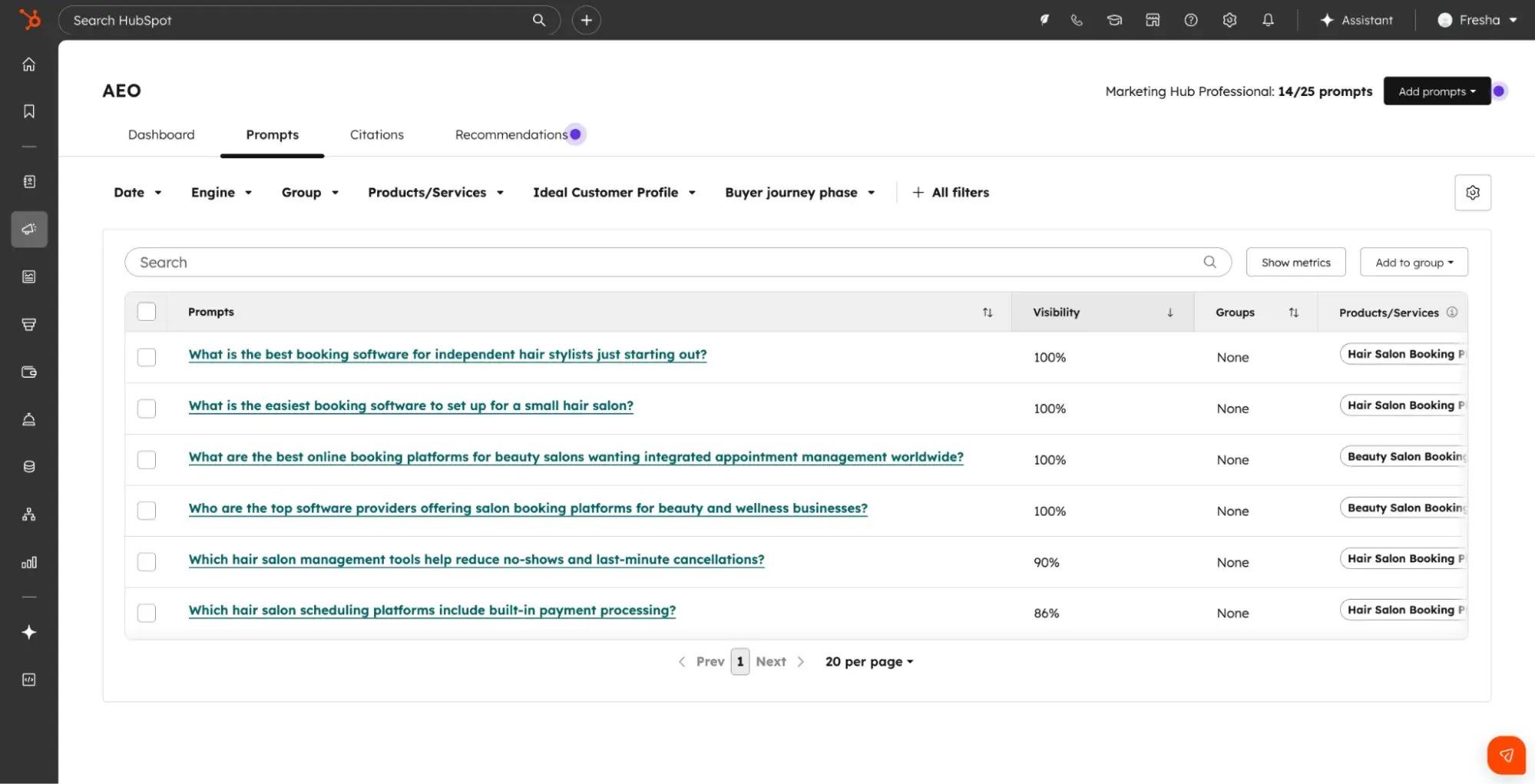
- Shift from keyword tracking to prompt monitoring. Construct an initial set of prompts, prioritizing unbranded, solution-seeking queries that align with potential customer needs. Branded prompts are useful for competitive analysis but less impactful for generating new visibility.
- Pro Tip: Leverage existing CRM data or customer inquiries to inform prompt selection, ensuring relevance to actual business context. Platforms like HubSpot AEO can automatically suggest prompts based on this data.
-
Configure AI Search Tracking Per Engine:
- Each answer engine (ChatGPT, Gemini, Perplexity, etc.) operates with distinct models and retrieval mechanisms, leading to varied responses for the same prompt.
- Systematically run each defined prompt through every relevant engine. It is crucial to use logged-out or temporary sessions to prevent personalization from skewing results.
- For each response, meticulously record: whether your brand was named, which specific pages were cited, and which competitors were mentioned.
- Automation: Manual tracking can be arduous. Dedicated AEO tools automate this process, consistently running prompts, tracking citations, and identifying competitors across multiple engines.
-
Map KPIs and Build a Simple Dashboard:
- Select a concise list of the most critical KPIs (as outlined above) to monitor over time.
- For small-scale audits, a spreadsheet might suffice, particularly for monthly checks of a limited prompt set.
- However, the dynamic nature of AI answers (variability by engine, session, model updates, and retrieval sources) makes manual, ongoing monitoring quickly unsustainable. For continuous tracking and trend analysis, a dedicated AEO tool capable of consistent prompt reruns, citation tracking, competitive comparisons, and historical trend visualization is essential.
-
Analyze Competitor Share of AI Voice:
- For each monitored prompt, document every competitor explicitly named by the answer engine.
- Calculate your brand’s “share of voice” relative to these competitors. This involves determining the percentage of times your brand is mentioned or cited compared to rivals for a given set of prompts.
- Conducting this analysis monthly can reveal which competitors dominate specific question clusters, providing strategic insights into content gaps and priority areas for optimization. Integrated AEO tools often automate this competitor presence reporting, making it easier to identify these strategic opportunities.
Optimizing for Answer Engines: A Strategic Imperative

Improving AI search visibility requires a multi-faceted approach that builds upon strong SEO fundamentals while adapting to the unique demands of answer engines.
-
Strengthen External Brand Signals:
- What authoritative third-party sites say about a brand significantly influences how answer engines perceive and represent it. An SE Ranking study of 129,000 domains found a strong correlation between the number of referring domains and ChatGPT citations. The study also highlighted the importance of mentions on community platforms like Reddit and Quora.
- Strategies include robust digital PR campaigns, expert commentary placements, and active, authentic participation in relevant online communities where target audiences seek information. These efforts build the external validation that LLMs often use to assess trustworthiness and authority.
-
Rank in Traditional Search to Feed LLMs:
- Despite the shift, traditional organic rankings remain foundational. Answer engines frequently draw upon the same underlying web indexes as traditional search. ChatGPT, for instance, can leverage Bing results in certain contexts, and Google AI Overviews heavily pull from pages that already rank well.
- While a top organic ranking doesn’t guarantee an AI citation, pages that rank poorly are unlikely to appear at all. Therefore, maintaining excellent crawlability, developing deep topical authority, and implementing effective internal linking structures are crucial prerequisites. Integrating AI into SEO workflows can further enhance these foundational efforts.
-
Add Structured Data and Schema Markup:
- Schema markup provides engines with structured information about the entities on a page and their relationships, facilitating easier parsing and understanding. While its direct impact on citations is debated, research from HubSpot’s “State of AEO 2026” indicated that pages combining Q&A sections with FAQ schema markup achieved higher citation rates on platforms like Gemini, Google AI Mode, and Perplexity. This suggests that clearly structured, machine-readable content is favored by answer engines.
-
Write with Semantic Clarity:
- Answer engines prioritize declarative, self-contained statements over ambiguous or pronoun-heavy prose. Content should be crafted to present facts as clear subject-verb-object relationships, explicitly naming entities rather than relying on pronouns.
- Resolving questions directly and concisely before adding supplementary context is also beneficial. Consistency in brand naming, category descriptions, and key facts across all digital properties (website, LinkedIn, review sites like G2) helps engines accurately recognize and represent the brand as a consistent entity.
-
Create Compact, Prompt-Shaped Content Units:
- Answer engines typically retrieve and process specific passages rather than entire web pages. Therefore, each section or “chunk” of content should be designed to stand alone and directly answer a potential query.
- Leading sections with the direct answer, followed by supporting details, is an effective strategy. Utilizing tables, bulleted lists, and other structured formats for comparable facts, rather than embedding them in dense prose, enhances machine readability and extractability. Advanced AEO tools can often identify these content structure gaps and provide prioritized recommendations for optimization.
Tools and Technologies for AI Visibility: Choosing the Right Solution
The selection of an AI visibility tool hinges on specific organizational objectives. Key considerations include:
- The primary goal: proving ROI, tracking competitive landscape, or identifying content optimization opportunities?
- The required frequency of monitoring: occasional checks or continuous, real-time tracking?
- The need for integration with existing marketing and CRM platforms.
- The budget and technical capabilities of the team.
The market offers both standalone monitoring solutions and integrated platforms. Standalone monitors provide visibility scores and competitor share, while integrated platforms, such as HubSpot AEO, pair tracking with prioritized recommendations and connect visibility data directly to CRM records.
For initial assessment, free tools like HubSpot’s AEO Grader offer a baseline snapshot of brand representation across major answer engines, including a competitive share-of-voice analysis. This can help determine if a more comprehensive, continuous tracking solution is warranted. If weekly tracking, granular competitor monitoring, or pipeline attribution are critical, investing in a dedicated AEO tool becomes essential.
Connecting AI Search Tracking to Leads and Revenue: Proving ROI
The ultimate objective for any marketing initiative is to demonstrate business impact. For AI search visibility, this means tracing the path from an AI-referred visit to a qualified lead, an opportunity, and ultimately, closed revenue.
-
Source Dimension Tracking: Platforms like HubSpot automatically tag visitors arriving from major AI engines (ChatGPT, Claude, Perplexity, Gemini) with a distinct “AI Referrals” original source. This ensures that contacts created from these sessions inherit the correct attribution, allowing for segmented reporting of leads, deals, and revenue by AI Referrals, similar to how organic search or email are tracked.
-
Self-Reported Attribution: Given that many AI engines do not pass referrer data, some AI-driven visits might still fall into the “direct traffic” category. To address this, implementing a “How did you hear about us?” field on conversion forms, with explicit options for platforms like ChatGPT, Gemini, and Perplexity, allows users to self-identify their source. These responses can then be written to the contact record, supplementing referrer data.
By combining these methods, a comprehensive CRM dashboard can connect AI visibility metrics (mentions, citations) with tangible business outcomes (pipeline by source). This integrated view allows organizations to follow each contact from their initial AI touchpoint through to a closed deal, providing robust evidence of whether rising AI visibility translates into increased revenue. This monthly review is critical for validating strategies and demonstrating the return on investment for AEO efforts.
Reporting Results and Governing AI Brand Accuracy: A Continuous Loop
Effective AI search visibility management culminates in a structured reporting and governance process. A monthly report should consolidate key metrics into a clear, concise narrative for leadership. This includes:
- Reach: Mentions and citations to demonstrate overall brand exposure.
- Perception: Sentiment analysis to convey how favorably the brand is described.
- Integrity: Accuracy and hallucination detection to highlight any factual errors.
- Content Effectiveness: Retrieved pages to identify which content assets are successfully earning visibility.
- Business Impact: Pipeline attribution to demonstrate the direct contribution to leads and revenue.
Beyond reporting, establishing a governance framework is crucial for addressing inaccuracies. Since AI answers cannot be directly edited, corrections must focus on modifying the source material the engines draw from. This involves:
- Updating Owned Content: Ensuring all brand-owned pages (website, knowledge base, product listings) contain accurate, up-to-date information regarding pricing, features, and claims.
- Strengthening Third-Party Signals: Actively working to secure accurate mentions and authoritative citations from reputable external sources, which reinforces the correct information to LLMs.
- Logging and Monitoring: Maintaining a detailed log of all identified inaccuracies by engine and prompt, allowing for systematic tracking of corrective actions and verification in subsequent monitoring cycles.
This report-and-govern loop creates a continuous feedback mechanism: the report identifies problems, governance assigns solutions, and the next month’s report verifies the effectiveness of those fixes.
Challenges and Future Outlook
While AEO presents significant opportunities, it also introduces challenges. The inherent volatility of AI models, the ongoing issue of missing referrer data, and the rapid pace of platform updates demand continuous adaptation. Furthermore, ethical considerations surrounding data privacy, algorithmic bias, and the potential for deepfakes will continue to shape the regulatory and technical landscape of AI search.
Despite these complexities, AI search visibility is no longer a niche concern but a core component of modern digital strategy. As answer engines become increasingly sophisticated and ubiquitous, mastering AEO will be paramount for brands seeking to maintain relevance, build authority, and drive growth in the evolving digital frontier. The future of search is conversational and synthesized, and brands that proactively optimize for this new reality will be best positioned to thrive.








