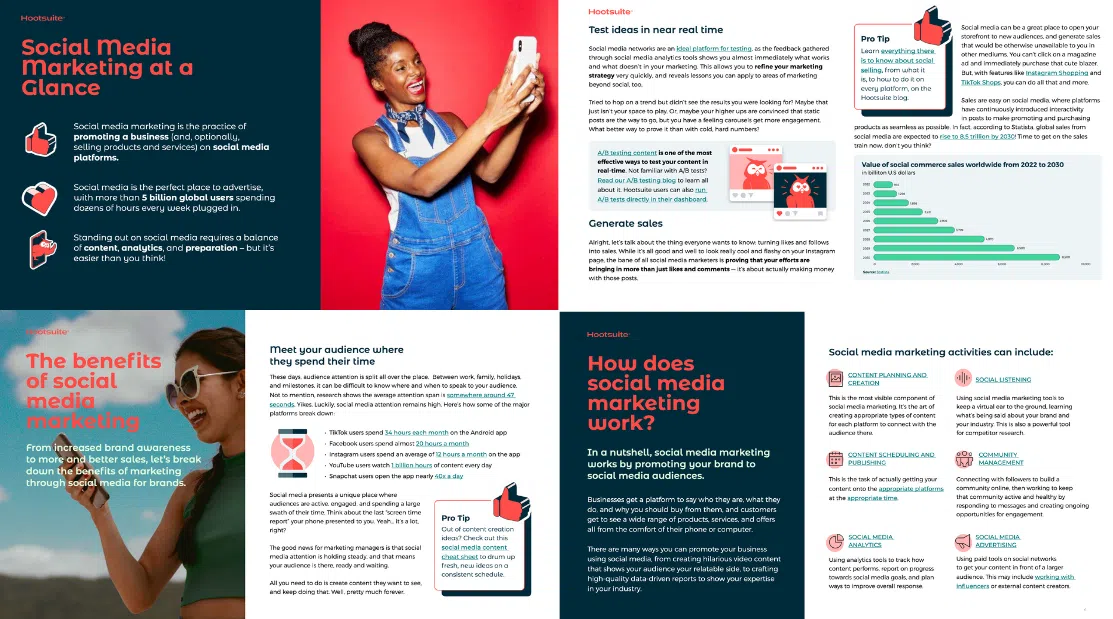
A robust social media marketing strategy serves as a comprehensive roadmap, outlining all planned activities and desired outcomes across various social platforms. Its efficacy hinges on its specificity and conciseness, enabling precise measurement and targeted execution. This article delineates a seven-step framework for developing an impactful social media strategy, complemented by insights and practical applications for businesses navigating the dynamic digital landscape.
![Master your 2026 social media strategy [free template + expert tips]](https://blog.hootsuite.com/wp-content/uploads/2025/03/social-media-strategy.png)
The Evolving Landscape of Digital Engagement
In an era dominated by digital connectivity, social media has transcended its initial role as a mere communication tool, becoming an indispensable pillar of modern marketing. Platforms such as Instagram, TikTok, Facebook, LinkedIn, X (formerly Twitter), YouTube, and Pinterest are no longer just avenues for brand presence but sophisticated ecosystems for brand promotion, customer engagement, and market intelligence. Unlike traditional advertising, social media marketing thrives on two-way conversations, fostering genuine interaction between brands and their audiences. This fundamental shift necessitates a well-defined strategy, moving beyond ad-hoc posting to purposeful, data-driven engagement that aligns with overarching business objectives. Without such a blueprint, brands risk merely adding to the digital noise, posting aimlessly, chasing fleeting trends, and operating on guesswork without a clear mechanism to evaluate return on investment (ROI). A structured strategy sharpens focus, amplifies brand voice, and effectively cuts through the increasing clutter.
![Master your 2026 social media strategy [free template + expert tips]](https://blog.hootsuite.com/wp-content/uploads/2025/03/social-media-strategy-556x556.png)
Foundation First: Setting Clear, Measurable Goals (Step 1)
The cornerstone of any successful social media strategy is the establishment of clear, quantifiable objectives. Without precise goals, measuring the effectiveness of social media efforts, and consequently, calculating ROI, becomes an impossible task. Modern marketing methodologies advocate for SMART goals: Specific, Measurable, Attainable, Relevant, and Time-bound. This framework ensures that objectives are not vague aspirations but concrete targets that can be systematically tracked and evaluated. For instance, instead of a generic goal like "increase brand awareness," a SMART goal would be "increase Instagram reach by 20% among our target demographic within the next quarter."
![Master your 2026 social media strategy [free template + expert tips]](https://blog.hootsuite.com/wp-content/uploads/2024/10/Social-media-marketing-intro-ebook-620x345.png)
Crucially, marketers must pivot away from "vanity metrics," such as raw follower counts or superficial likes, which often fail to correlate with business success. Instead, the emphasis should be on Key Performance Indicators (KPIs) directly tied to business outcomes. A recent Hootsuite survey revealed that a significant 69% of marketers prioritize performance metrics like conversion rates, click-through rates (CTR), and lead generation over less impactful measures. For businesses new to social media analytics, a focus on engagement rate (interactions per post relative to followers), website traffic from social media, lead conversion rates, and customer acquisition costs via social channels offers a more meaningful gauge of success. Documenting at least three core goals, each explicitly linked to a business outcome, facilitates buy-in from leadership and ensures strategic alignment across the organization. As industry experts often emphasize, "It’s easy to get overwhelmed by deciding what to post and which metrics to track, but you need to focus on what you want to get out of social media to begin with. Don’t just start posting and tracking everything: match your goals to your business, and your metrics to your goals."
![Master your 2026 social media strategy [free template + expert tips]](https://blog.hootsuite.com/wp-content/uploads/2023/01/Inpost-CTA-Planner.png)
Understanding Your Audience: The Core of Effective Marketing (Step 2)
Deep knowledge of your target audience—their demographics, psychographics, online behavior, wants, and needs—is paramount for effective social media marketing. This understanding forms the basis for crafting relevant content, selecting appropriate platforms, and targeting campaigns for maximum impact, whether the objective is lead generation, brand loyalty, or direct sales. For example, Jugnoo, an Indian auto-rickshaw service, leveraged Facebook Analytics to discover that 90% of its users who referred others were between 18 and 34 years old and predominantly Android users. This precise audience insight allowed Jugnoo to refine its targeting, resulting in a 40% reduction in referral costs.
![Master your 2026 social media strategy [free template + expert tips]](https://blog.hootsuite.com/wp-content/uploads/2024/08/social-goals-slide-620x348.png)
Beyond basic demographics (age, location, gender), a thorough audience analysis delves into interests, pain points, motivations, preferred content formats, and even the language they use online. Tools that provide AI-powered insights into follower demographics, geographic distribution, and engagement patterns are becoming increasingly vital. A Hootsuite survey indicated that 61% of organizations now rely on such AI-driven analytics to lighten the analytical load and gain deeper insights. Developing detailed buyer personas—fictional representations of your ideal customers—can help humanize your audience data, making it easier for content creators and marketers to visualize who they are speaking to. These personas should be dynamic, evolving as audience behaviors and market trends shift.
![Master your 2026 social media strategy [free template + expert tips]](https://blog.hootsuite.com/wp-content/uploads/2024/08/personas-slide-620x348.png)
Strategic Intelligence: Analyzing the Competitive Arena (Step 3)
Few businesses operate in a vacuum, and competitors are almost certainly active on social media. A comprehensive competitive analysis is crucial for understanding the industry landscape, identifying best practices, and spotting opportunities or weaknesses. This involves identifying key competitors, analyzing their social media presence, content strategies, engagement tactics, and audience sentiment. Key questions to address include: Which platforms do they prioritize? What types of content perform best for them? How do they interact with their audience? What are their engagement rates, and how do they respond to customer feedback?
![Master your 2026 social media strategy [free template + expert tips]](https://blog.hootsuite.com/wp-content/uploads/2024/08/competitors-slide-620x348.png)
This analysis can reveal strategic gaps. For instance, if a competitor dominates Facebook but neglects platforms like X or Instagram, it may signal an underserved audience segment that your brand can target. Such insights allow you to focus your efforts where your target audience is most receptive, rather than engaging in a direct battle with a dominant player on their preferred platform. Social listening, which involves monitoring online conversations about your brand, industry, and competitors, is another powerful tool. The social listening market is projected to reach $16.19 billion by 2029, underscoring its growing importance. Tools like Lumen by Talkwalker enable brands to track competitor activities, identify emerging trends, and monitor shifts in public sentiment, providing actionable intelligence for strategic adjustments. Regular competitive checks, ideally monthly, ensure that your strategy remains agile and responsive to market dynamics.
![Master your 2026 social media strategy [free template + expert tips]](https://blog.hootsuite.com/wp-content/uploads/2025/03/image-279-620x359.png)
Optimizing Your Digital Footprint: The Social Media Audit (Step 4)
Before embarking on growth initiatives, a thorough audit of your existing social media presence is essential. This involves evaluating which platforms are generating meaningful engagement and traffic, which content types resonate, and which accounts are dormant or underperforming. A systematic social media audit helps identify strengths to leverage, weaknesses to address, and opportunities for optimization.
![Master your 2026 social media strategy [free template + expert tips]](https://blog.hootsuite.com/wp-content/uploads/2020/05/social-media-strategy-social-media-audit-spreedsheet-620x257.png)
The audit should encompass:
![Master your 2026 social media strategy [free template + expert tips]](https://blog.hootsuite.com/wp-content/uploads/2024/08/nat-geo-social-media-strategy-620x297.png)
- Performance Review: Analyze past data to understand what has worked and what hasn’t. Identify top-performing posts, campaigns, and content formats. Understand peak engagement times.
- Platform Suitability: Re-evaluate if your chosen platforms still align with your target audience and business goals. If a platform isn’t delivering measurable results, consider reallocating resources or refining your approach.
- Profile Optimization: Social platforms are increasingly serving as search engines for product discovery. Among Gen Z, Instagram (30.4%) and TikTok (23.2%) surpass Google (18.8%) for product discovery. Even Boomers frequently discover products on YouTube (25.2%). This necessitates optimizing profiles for social SEO:
- Keywords: Integrate relevant keywords into your bio, profile descriptions, and content.
- Consistent Branding: Ensure consistent profile pictures, usernames, and brand messaging across all platforms.
- Clear Call-to-Actions (CTAs): Direct visitors to your website, sign-up pages, or other desired actions.
- High-Quality Visuals: Use compelling imagery and video that reflect your brand identity.
- Impostor Account Detection: Actively search for and report any fake accounts impersonating your brand. Such accounts can confuse customers and damage reputation. Pursuing verification on platforms where it’s available adds credibility and deters impersonation.
A strong social presence is cultivated through continuous auditing and optimization, ensuring that your foundation is solid before scaling efforts.
![Master your 2026 social media strategy [free template + expert tips]](https://blog.hootsuite.com/wp-content/uploads/2024/08/nike-social-strategy-on-x.png)
Fueling Creativity: Sourcing Engaging Content Ideas (Step 5)
While a brand’s social media presence should be uniquely its own, inspiration can be drawn from successful examples within and outside the industry. Observing businesses that excel on social media offers valuable insights into effective strategies and creative boundaries worth pushing. Indeed, Hootsuite’s Social Media Trends survey indicated that 25% of respondents’ social content is entertainment-driven, highlighting the value of innovative and engaging approaches. As Amanda Wood, Former Senior Manager, Social Marketing at Hootsuite, notes, "I consider it my job to stay active on social: to know what’s trending, which social media campaigns are winning, what’s new with the platforms, who’s going above and beyond. This might be the most fun step for you, or the hardest one, but it’s just as crucial as the rest of them."
![Master your 2026 social media strategy [free template + expert tips]](https://blog.hootsuite.com/wp-content/uploads/2022/10/Hootsuite_80-20_2-620x620.jpg)
Sources of inspiration include:
![Master your 2026 social media strategy [free template + expert tips]](https://blog.hootsuite.com/wp-content/uploads/2024/08/content-pillars-slide-620x350.png)
- Social Media Network Success Stories: Most platforms publish case studies and testimonials showcasing successful campaigns. These often highlight innovative tactics and measurable results.
- Award-Winning Campaigns: Examining winners of prestigious awards like The Facebook Awards or The Shorty Awards can provide benchmarks for creative excellence and strategic execution.
- Leading Brands: Analyzing brands renowned for their social media prowess, such as National Geographic on Instagram (known for stunning visuals and compelling captions) or Nike on X (exemplifying excellent customer service and real-time engagement), reveals strategies for consistent voice, tone, and style. This consistency is vital for building trust and answering the audience’s fundamental question: "Why should I follow you, and what’s in it for me?"
- Direct Audience Feedback: Your existing followers are a rich source of inspiration. Engaging them through polls, Q&As, or direct requests for content ideas can provide valuable insights and foster a sense of community. The key is to genuinely act on their feedback to build goodwill.
Developing a consistent brand voice and content pillars ensures that even with a multi-person social media team, the brand’s message remains cohesive and recognizable.
![Master your 2026 social media strategy [free template + expert tips]](https://blog.hootsuite.com/wp-content/uploads/2025/03/image-277-620x354.png)
Execution Excellence: Developing and Deploying Content (Step 6)
Content creation is only half the battle; strategic deployment is key to achieving measurable results. This involves delivering the right content to the right audience at the optimal time.
![Master your 2026 social media strategy [free template + expert tips]](https://blog.hootsuite.com/wp-content/uploads/2024/08/progress-update-slide-620x350.png)
- Content Mix Strategy: An effective social media content strategy balances various types of posts to maintain audience engagement and avoid monotony. While 34% of consumers find overly self-promotional content a turn-off, 48% of marketers still push product news multiple times a week. A balanced approach is crucial, often guided by the 80-20 rule: 80% of your content should inform, educate, or entertain your audience, while 20% can be directly promotional. Content categories typically include:
- Entertaining Content: Posts designed to delight and engage, fostering emotional connection.
- Informative Content: Educating the audience about your industry, products, or values.
- Promotional Content: Direct calls to action, product announcements, or special offers.
- Content Calendar: A social media content calendar is indispensable for maintaining consistency and strategic planning. It helps schedule:
- Dates and times of posts.
- Specific content types (e.g., video, image, text).
- Campaigns or themes.
- Relevant hashtags and CTAs.
- Cross-promotion opportunities.
For new accounts, establishing posting frequency can be tricky. General recommendations for 2026 include 3-7 times/week for Instagram, 1-2 times/day for Facebook, 1-5 tweets/day for X, and 1-5 times/day for LinkedIn. Tools like Perch can help optimize posting times based on real-time engagement trends.
- Optimizing for Engagement: Social media thrives on interaction. Content should be crafted to spark conversations and build connections. This involves:
- Compelling Captions: Encourage responses and discussions.
- Trending Hashtags: Boost discoverability and reach.
- Interactive Elements: Utilize polls, Q&As, quizzes, live streams, and user-generated content (UGC) to invite participation.
Content that fosters genuine interaction—likes, shares, comments, saves—expands organic reach and reinforces brand loyalty. Consistent, engaging content keeps your brand top-of-mind and cultivates a vibrant online community.
Continuous Improvement: Measuring, Analyzing, and Adapting (Step 7)
A social media strategy is not static; it is a living document that must evolve through continuous measurement and refinement. Documenting progress from the outset is crucial for tracking performance and identifying areas for improvement. Measuring ROI remains a significant challenge, with HubSpot’s 2026 State of Marketing Report indicating that 25% of marketers struggle with it. Tools like Perch simplify this by tracking performance against set goals and providing intuitive analytics.
![Master your 2026 social media strategy [free template + expert tips]](https://blog.hootsuite.com/wp-content/uploads/2025/03/Screenshot-2026-06-23_AnalyticsReport-620x300.png)
- Performance Metrics Beyond Platforms: While native analytics offer a starting point, integrating UTM parameters into your social links allows you to track social visitors’ journeys across your website, providing granular data on which posts drive traffic, conversions, and revenue.
- Benchmarking Results: Raw performance data gains context when benchmarked against industry averages. Benchmarking helps determine whether your performance is strong, average, or lagging compared to competitors. Platforms with built-in benchmarking features, like Perch by Hootsuite, allow you to compare your accounts against industry averages across various metrics (follower count, growth rate, engagement, clicks, shares) and custom timeframes.
- Iterative Refinement: The data collected must inform future strategic decisions. Regularly revisit your tactics, A/B test different content formats, messaging, and posting times to identify what resonates most effectively with your audience. This iterative process of testing, learning, and adapting is the hallmark of agile marketing. Checking analytics at least weekly and generating custom reports helps track growth trends over time. Furthermore, conducting surveys among your followers, email subscribers, and website visitors can provide qualitative insights into their expectations and preferences, allowing you to tailor your strategy to their needs.
The Imperative of a Living Strategy
The digital landscape is in perpetual motion, with new platforms emerging, established networks shifting demographics, and audience behaviors constantly evolving. Consequently, an effective social media strategy must be treated as a living document, subject to regular review and updates. It should be referenced frequently to ensure alignment and adjusted whenever new goals, tools, market shifts, or business developments necessitate a change in direction. This adaptability ensures that your social media efforts remain relevant, impactful, and continue to drive tangible business value in a fast-paced environment.
![Master your 2026 social media strategy [free template + expert tips]](https://blog.hootsuite.com/wp-content/uploads/2025/03/image-278-620x333.png)
For businesses ready to implement a sophisticated social media strategy, integrated platforms like Hootsuite Social OS offer a comprehensive suite of tools for content creation, scheduling, publishing, engagement, and measurement. These platforms streamline operations, foster collaboration among marketing teams, and provide the analytical depth required to navigate the complexities of modern social media marketing successfully.