Large Language Models (LLMs) have fundamentally altered the landscape of human-computer interaction, but their utility remains tethered to the quality of user input. As organizations increasingly integrate generative artificial intelligence into their core operations, the limitations of standard, "one-shot" prompting have become a significant hurdle. Vague instructions often yield inconsistent results, leading to what industry experts call "prompt drift," where the AI’s output quality fluctuates across different sessions. To solve this, a sophisticated technique known as meta-prompting has emerged. This method involves tasking the AI itself with the design of reusable prompts, templates, and structured workflows, effectively turning the model into a prompt architect rather than a mere task executor.
The Technical Foundation of Meta-Prompting
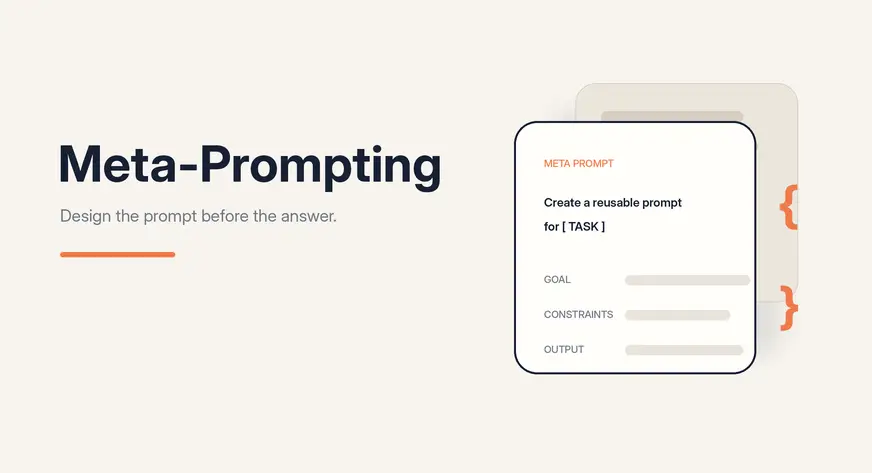
At its core, meta-prompting is the process of using one prompt to create, improve, or control another. In traditional prompting, a user provides a direct instruction, such as "Write a marketing email for a new software tool." While functional, this approach relies entirely on the model’s internal—and often unpredictable—weights to determine tone, structure, and depth.
Meta-prompting introduces a secondary layer of abstraction. Instead of asking for the email, the user asks: "Design a comprehensive, reusable prompt that guides an AI to write high-quality marketing emails for SaaS products, ensuring they follow a specific psychological framework like AIDA (Attention, Interest, Desire, Action)." The result is not the email itself, but a robust set of system instructions and templates that can be deployed repeatedly to achieve uniform results. This shift from "doing" to "designing" allows teams to scale AI operations without manually refining every individual query.
The Chronological Evolution of AI Interaction
The emergence of meta-prompting is the latest milestone in a rapidly evolving timeline of AI prompt engineering that began with the public release of GPT-3 in 2020.
- The Direct Era (2020–2021): Early users engaged in simple, zero-shot prompting. The focus was on discovering what the models could do with basic commands.
- The Example Era (2021–2022): Few-shot prompting became the standard. Users realized that providing three to five examples of a desired output significantly improved performance and stylistic mimicry.
- The Reasoning Era (Late 2022–2023): With the release of GPT-4 and Claude, Chain-of-Thought (CoT) prompting gained prominence. Users began asking models to "think step-by-step," which improved logic and mathematical accuracy.
- The Meta Era (2024–Present): As enterprise-level AI adoption surged, the need for "prompt systems" rather than "single prompts" became clear. Meta-prompting emerged as the solution for creating standardized, auditable, and scalable AI workflows.
Supporting Data: Why Consistency Matters in Enterprise AI
Market analysis from firms like McKinsey and Gartner indicates that while 65% of organizations are regularly using generative AI, a major pain point remains the "reliability gap." In a 2023 survey of AI developers, nearly 40% cited inconsistent output as the primary reason for delayed deployment of AI agents in customer-facing roles.
Meta-prompting directly addresses this reliability gap. By generating a "System Instruction" set that includes a validation checklist, the model essentially performs its own quality assurance. Data suggests that workflows utilizing meta-prompted templates see a 30% reduction in "hallucination" rates and a 50% increase in formatting compliance compared to standard direct prompting. This is particularly critical in industries like finance and healthcare, where a deviation from the established format can lead to regulatory or operational failures.
The Meta-Prompting Workflow: A Four-Step Architecture
To implement meta-prompting effectively, practitioners follow a systematic four-step workflow designed to move from a vague goal to a high-performance asset.
Step 1: Goal and Constraint Definition
The user identifies the high-level objective and the necessary constraints. This involves defining the target audience, the desired tone (e.g., technical, empathetic, or authoritative), and the structural requirements (e.g., "must include a comparison table" or "avoid jargon").
Step 2: The Meta-Generation Phase
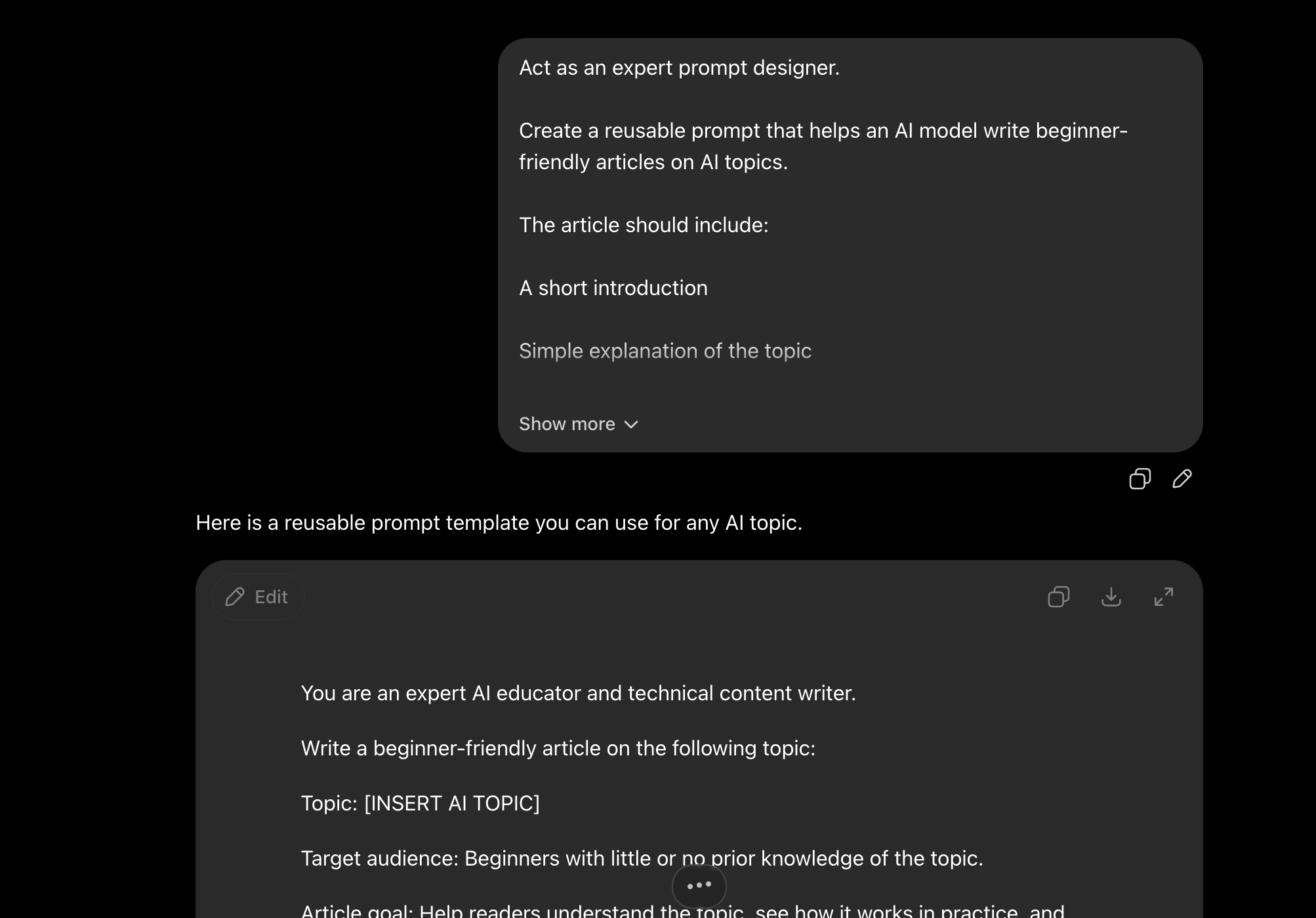
The user inputs a meta-prompt. An example of a professional-grade meta-prompt is: "Act as an expert prompt engineer. Create a system-level prompt for a junior content creator that ensures every blog post produced is SEO-optimized, follows a 1,500-word structure, and includes a meta-description and five internal link suggestions. Provide a placeholder-based template for the user."
Step 3: Deployment and Placeholder Integration
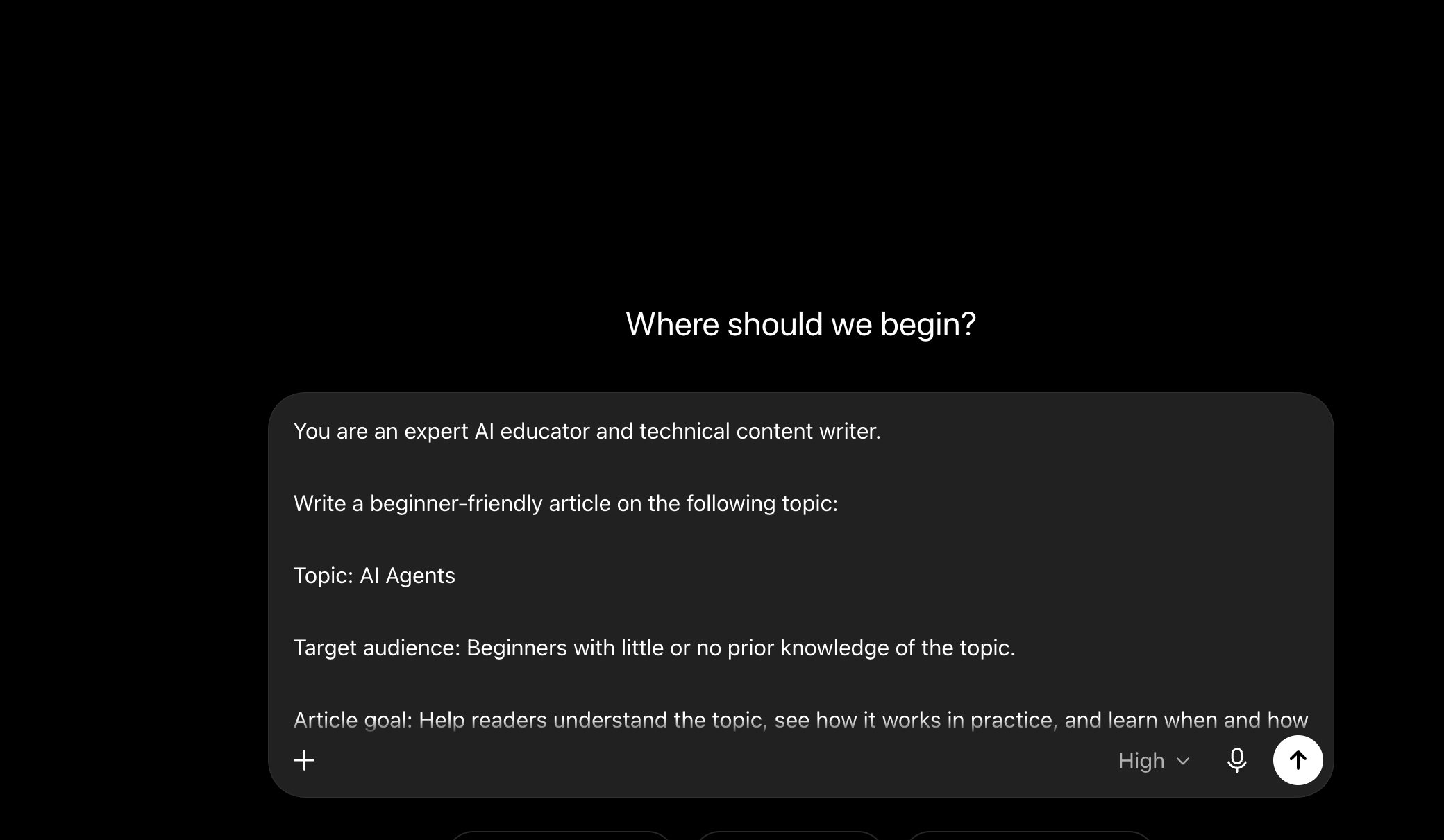
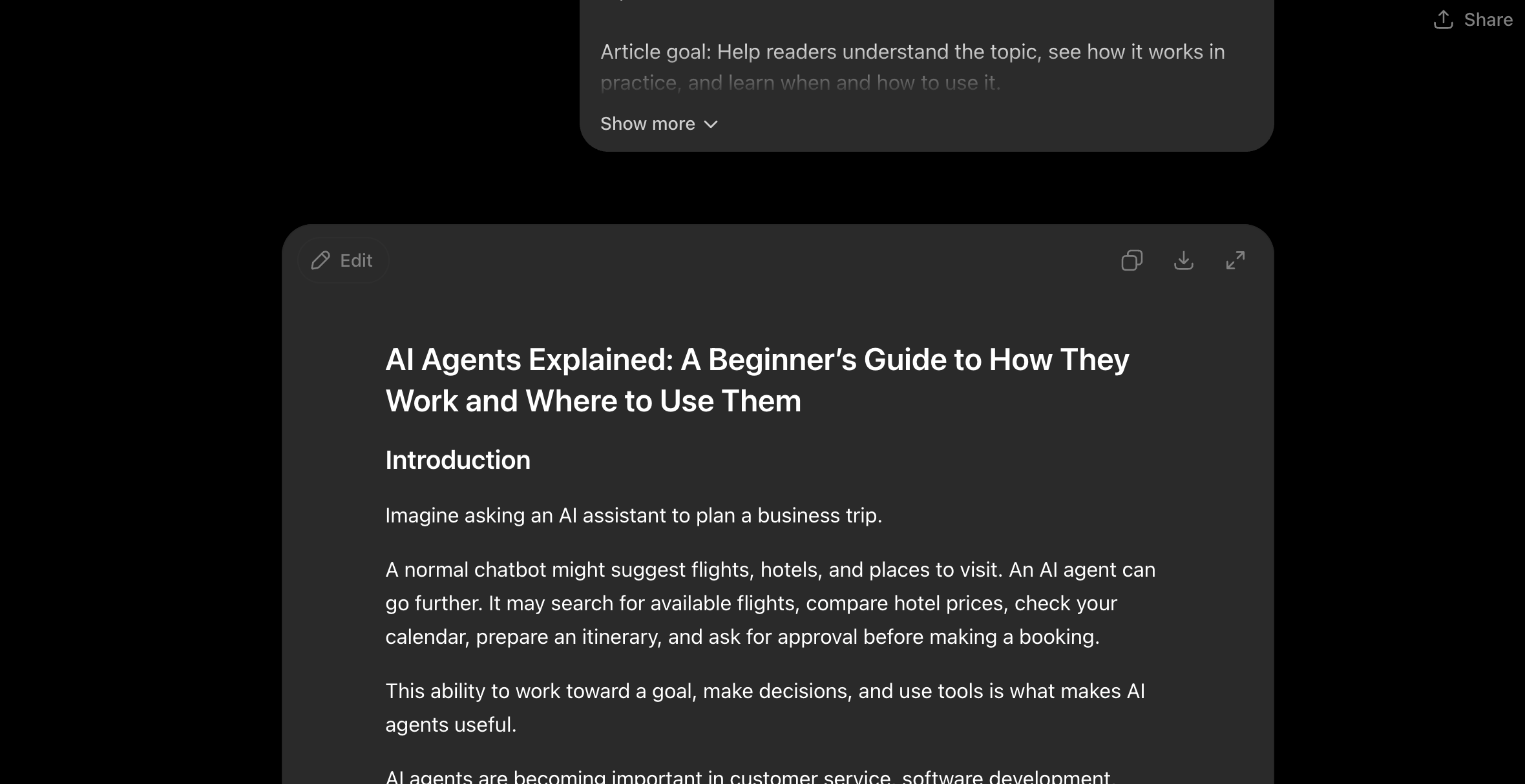
The model generates a sophisticated prompt. The user then takes this generated prompt and fills in specific variables—such as the "Topic" or "Keywords"—to produce the final content.
Step 4: Iterative Refinement and Testing
The final output is measured against a rubric. If the meta-generated prompt fails to produce the desired nuance, the user provides feedback to the model to refine the meta-prompt itself. This creates a "Self-Critique Loop," a pattern where the AI evaluates its own instructions for clarity and effectiveness.
Comparative Analysis: Benchmarking Prompting Techniques
Meta-prompting does not replace other techniques; rather, it orchestrates them. To understand its value, it is necessary to compare it with established methodologies.
- Normal Prompting: Best for one-off, low-stakes questions. It is fast but lacks control.
- Few-Shot Prompting: Best for teaching a specific style. It requires the user to have high-quality examples ready to share with the model.
- Chain-of-Thought (CoT): Best for complex reasoning and multi-step math or logic. It focuses on the process of reaching an answer.
- Meta-Prompting: Best for building a "factory" for content or data. It creates the infrastructure that can then incorporate few-shot examples or CoT reasoning.
Strategic Patterns in Meta-Prompting
Professional prompt engineers have identified several "patterns" of meta-prompting that serve different organizational needs:
- The Prompt Refiner: This pattern is used when a user has a weak prompt that isn’t working. The meta-prompt asks the AI to diagnose the weaknesses of the original prompt and rewrite it for maximum clarity.
- Agent Scaffolding: This is used in the development of autonomous AI agents. The meta-prompt defines the "cognitive architecture" of the agent—how it should search for information, how it should verify its sources, and how it should handle errors.
- The Template Builder: This focuses on generating prompts with strict JSON or Markdown placeholders, making it easier to integrate AI outputs into existing software applications or databases.
Professional Reactions and Industry Implications
The rise of meta-prompting has sparked a significant shift in the labor market for AI talent. Initial skepticism regarding "Prompt Engineering" as a long-term career has been met with the reality of "Prompt Architecture." Senior AI consultants argue that the ability to design meta-prompts is what separates a casual user from a professional who can build reliable AI systems.
"We are moving away from the era where we ‘chat’ with AI," says one lead data scientist at a major tech firm. "We are now in the era where we program AI using natural language. Meta-prompting is essentially the ‘compiler’ for this new way of programming. It takes a high-level intent and turns it into a rigorous set of execution instructions."
Furthermore, the legal and compliance sectors are beginning to take interest. Meta-prompting allows for "Instruction Auditing," where a company can prove that their AI was explicitly instructed to avoid biased language or to protect user privacy, as the instructions are saved as a reusable, static template rather than a series of ephemeral chat messages.
Broader Impact and Future Outlook
The implications of meta-prompting extend beyond simple efficiency. As LLMs become more capable, the bottleneck is no longer the AI’s intelligence, but the human’s ability to communicate complex requirements. Meta-prompting bridges this gap by allowing the AI to help the human communicate more effectively.
In the near future, we can expect the integration of "Automated Prompt Optimization" (APO) within major AI platforms. Features like OpenAI’s "System Message" and "Instruction Tuning" are early precursors to a world where meta-prompting happens behind the scenes. However, for the foreseeable future, the ability to manually steer this process remains a critical competitive advantage for businesses.
By moving from direct tasks to meta-design, organizations can ensure that their AI implementation is not just a series of lucky guesses, but a standardized, high-quality professional workflow. Meta-prompting transforms the LLM from a talented but erratic freelancer into a reliable, disciplined, and scalable department.